2018 NISSAN VERSA CD player
[x] Cancel search: CD playerPage 179 of 354

iPod®* PLAYER OPERATION (if so
equipped)
Connecting iPod®
WARNING
Do not connect, disconnect or operate
the USB device while driving. Doing so
can be a distraction. If distracted you
could lose control of your vehicle and
cause an accident or serious injury.
CAUTION
∙ Do not force the USB device into the
USB port. Inserting the USB device
tilted or up-side-down into the port
may damage the port. Make sure that
the USB device is connected correctly
into the USB port.
∙ Do not grab the USB port cover (if so
equipped) when pulling the USB de-
vice out of the port. This could dam-
age the port and the cover.
∙ Do not leave the USB cable in a place
where it can be pulled unintentionally.
Pulling the cable may damage the
port.
For additional information, refer to your de-
vice manufacturer’s owner information re-
garding the proper use and care of the
device.
To connect an iPod® to the vehicle so that
the iPod® can be controlled with the audio
system controls and display screen, use
the USB Connection port located beneath
the heater and air conditioner controls.
Connect the iPod®-specific end of the
cable to the iPod® and the USB end of the
cable to the USB Connection port on the
vehicle. If your iPod® supports charging viaa USB connection, its battery will be
charged while connected to the vehicle
with the ignition switch in the ACC or ON
position. The port is illuminated for better
visibility when the headlight switch is in the
ON position.
While connected to the vehicle, the iPod®
can only be operated by the vehicle audio
controls.
To disconnect the iPod® from the vehicle,
remove the USB end of the cable from the
USB Connection port on the vehicle, then
remove the cable from the iPod®.
* iPod® is a trademark of Apple Inc., regis-
tered in the U.S. and other countries.
Compatibility
The following models are compatible:
∙ iPod® 5th Generation (firmware version
1.3 or later)
∙ iPod® Classic (80GB) (firmware version
1.1.2PC or later)
∙ iPod® Classic (120GB) (firmware version
2.0.1PC or later)
∙ iPod® nano - 1st generation (firmware
version 1.3.1 or later)
LHA4458
4-44Display screen, heater, air conditioner, audio and phone systems
Page 181 of 354
(RDM) RANDOM
When the RDM button is pressed while a
track is being played, the play pattern can
be changed as follows:
Shuffle Off→Track Shuffle→Album Shuffle
→Shuffle Off
Track Shuffle: the tracks in the current list
will be played randomly.
Album Shuffle: the albums in the current list
will be played randomly.
Shuffle Off: no random play pattern is ap-
plied.
BACK button
When the
BACK button is pressed, it
returns to the previous menu.
BLUETOOTH® STREAMING AUDIO
(if so equipped)
If you have a compatible Bluetooth® audio
device that is capable of playing audio files,
the device can be connected to the vehi-
cle’s audio system so that the audio files on
the device play through the vehicle’s
speakers. For additional information, refer
to “FM/AM/SAT radio with compact disc
(CD) player” in this section.NOTE:
For additional information, refer to the
cellular phone Owner’s Manual.
Connecting Bluetooth® audio
To connect your Bluetooth® audio device
to the vehicle, follow the procedure below:
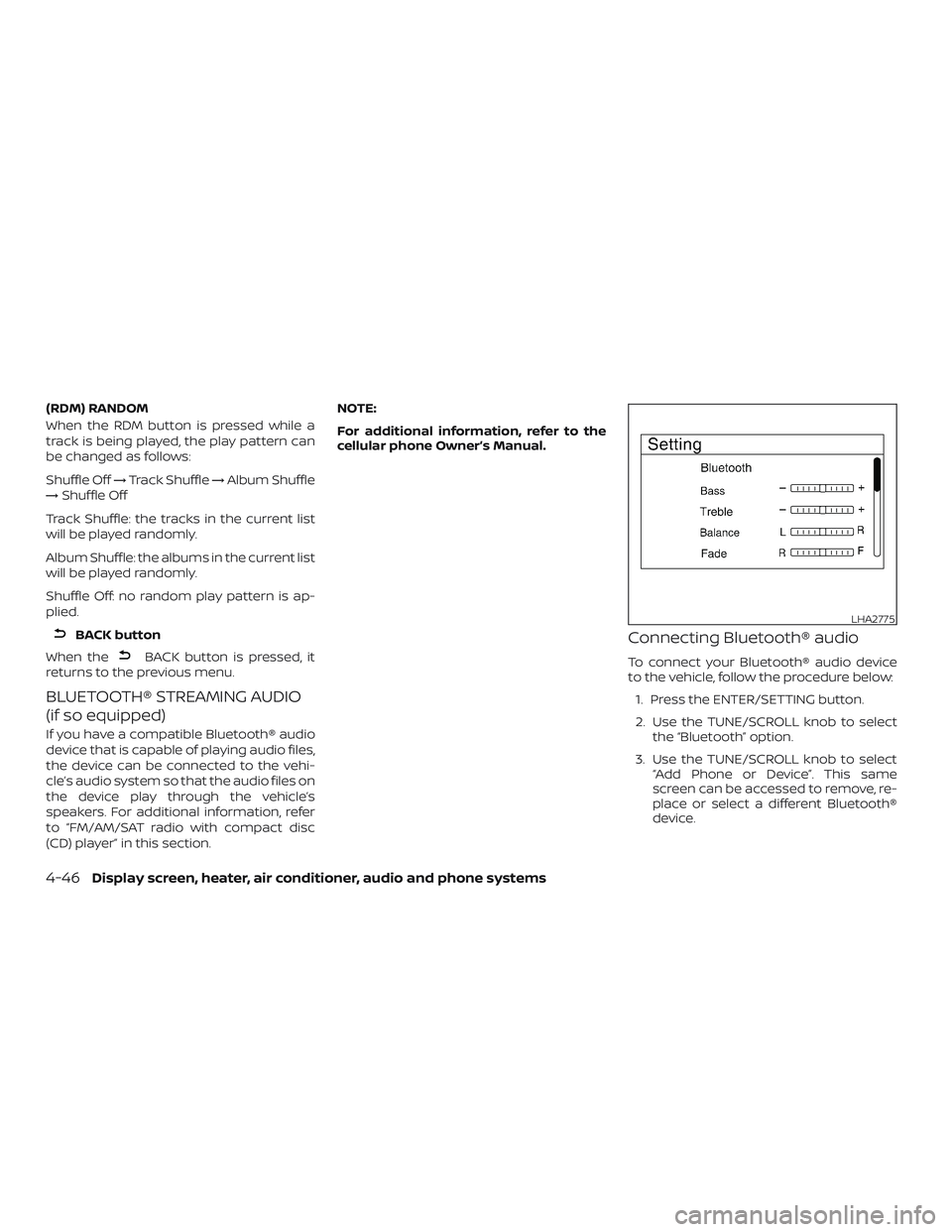
1. Press the ENTER/SETTING button.
2. Use the TUNE/SCROLL knob to select
the “Bluetooth” option.
3. Use the TUNE/SCROLL knob to select
“Add Phone or Device”. This same
screen can be accessed to remove, re-
place or select a different Bluetooth®
device.
LHA2775
4-46Display screen, heater, air conditioner, audio and phone systems
Page 222 of 354
CAUTION
Do not operate the starter for more
than 15 seconds at a time. If the engine
does not start, turn the key off and wait
10 seconds before cranking again, oth-
erwise the starter could be damaged.
4. Allow the engine to idle for at least
30 seconds af ter starting. Do not race
the engine while warming it up. Drive at
a moderate speed for a short distance
first, especially in cold weather.
NOTE:
Care should be taken to avoid situations
that can lead to potential battery dis-
charge and potential no-start conditions
such as:
1.Installation or extended use of elec-
tronic accessories that consume bat-
tery power when the engine is not
running (phone chargers, GPS, DVD
players, etc.).
2.The vehicle is not driven regularly
and/or only driven short distances.
In these cases, the battery may need
to be charged to maintain battery
health.
CONTINUOUSLY VARIABLE
TRANSMISSION (CVT) (if so
equipped)
WARNING
∙ Do not depress the accelerator pedal
while shif ting from P (Park) or N (Neu-
tral) to R (Reverse), D (Drive) or L (Low).
Always depress the brake pedal until
shif ting is completed. Failure to do so
could cause you to lose control and
have an accident.
∙ Cold engine idle speed is high, so use
caution when shif ting into a forward
or reverse gear before the engine has
warmed up.
∙ Never shif t to either the P (Park) or R
(Reverse) position while the vehicle is
moving forward and P (Park) or D
(Drive) position while the vehicle is re-
versing. This could cause an accident
or damage the transmission.
∙ Do not downshif t abruptly on slippery
roads. This may cause a loss of
control.
CAUTION
∙ To avoid possible damage to your ve-
hicle, when stopping the vehicle on an
uphill grade, do not hold the vehicle by
depressing the accelerator pedal. The
foot brake should be used for this
purpose.
∙ Except in an emergency, do not shif t
to the N (Neutral) position while driv-
ing. Coasting with the transmission in
the N (Neutral) position may cause se-
rious damage to the transmission.
The CVT in your vehicle is electronically
controlled to produce maximum power
and smooth operation.
The recommended operating procedures
for this transmission are shown on the fol-
lowing pages. Follow these procedures for
maximum vehicle performance and driv-
ing enjoyment.
NOTE:
Engine power may be automatically re-
duced to protect the CVT if the engine
speed increases quickly when driving on
slippery roads or while being tested on
some dynamometers.
DRIVING THE VEHICLE
Starting and driving5-11
Page 278 of 354
CAUTION
∙ Do not substitute engine antifreeze
coolant for windshield-washer solu-
tion. This may result in damage to the
paint.
∙ Do not fill the windshield-washer fluid
reservoir with washer fluid concen-
trates at full strength. Some methyl
alcohol based washer fluid concen-
trates may permanently stain the
grille if spilled while filling the
windshield-washer fluid reservoir.
∙ Pre-mix windshield-washer fluid con-
centrates with water to the manufac-
turer’s recommended levels before
pouring the fluid into the windshield-
washer fluid reservoir. Do not use the
windshield-washer fluid reservoir to
mix the washer fluid concentrate and
water.∙ Keep the battery surface clean and dry.
Clean the battery with a solution of bak-
ing soda and water.
∙ Make certain the terminal connections
are clean and securely tightened.
∙ If the vehicle is not to be used for
30 days or longer, disconnect the nega-
tive (-) battery terminal cable to prevent
discharge.
NOTE:
Care should be taken to avoid situations
that can lead to potential battery dis-
charge and potential no-start conditions
such as:
1.Installation or extended use of elec-
tronic accessories that consume bat-
tery power when the engine is not
running (Phone chargers, GPS, DVD
players, etc.).
2.Vehicle is not driven regularly and/or
only driven short distances.
In these cases, the battery may need to
be charged to maintain battery health.
WARNING
∙ Do not expose the battery to flames,
an electrical spark or a cigarette. Hy-
drogen gas generated by the battery
is explosive. Explosive gases can
cause blindness or injury. Do not allow
battery fluid to contact your skin,
eyes, fabrics or painted surfaces. Sul-
furic acid can cause blindness or in-
jury. Af ter touching a battery or bat-
tery cap, do not touch or rub your
eyes. Thoroughly wash your hands. If
the acid contacts your eyes, skin or
clothing, immediately flush with wa-
ter for at least 15 minutes and seek
medical attention.
∙ Do not operate the vehicle if the fluid
in the battery is low. Low battery fluid
can cause a higher load on the battery
which can generate heat, reduce bat-
tery life, and in some cases lead to an
explosion.
∙ When working on or near a battery,
always wear suitable eye protection
and remove all jewelry.
BATTERY
Do-it-yourself8-11
Page 311 of 354
brake needs adjustment, it is recom-
mended that you visit a NISSAN dealer for
this service.
Seats:Check seat position controls such
as seat adjusters, seatback recliner, etc., to
ensure they operate smoothly and all
latches lock securely in every position.
Check that the head restraints/headrests
move up and down smoothly and the locks
(if so equipped) hold securely in all latched
positions.
Seat belts:Check that all parts of the seat
belt system (for example, buckles, anchors,
adjusters and retractors) operate properly
and smoothly, and are installed securely.
Check the belt webbing for cuts, fraying,
wear or damage.
Steering wheel:Check for changes in the
steering system, such as excessive free
play, hard steering or strange noises.
Warning lights and chimes:Make sure all
warning lights and chimes are operating
properly.
Windshield defroster:Check that the air
comes out of the defroster outlets properly
and in sufficient quantity when operating
the heater or air conditioner.Windshield wiper and washer*:Check
that the wipers and washer operate prop-
erly and that the wipers do not streak.
Under the hood and vehicle
The maintenance items listed here should
be checked periodically (for example, each
time you check the engine oil or refuel).
Battery*:Check the fluid level in each cell.
The fluid should be at the bottom of the
filler opening. Vehicles operated in high
temperatures or under severe conditions
require frequent checks of the battery fluid
level.
NOTE:
Care should be taken to avoid situations
that can lead to potential battery dis-
charge and potential no-start conditions
such as:
1.Installation or extended use of elec-
tronic accessories that consume bat-
tery power when the engine is not
running (Phone chargers, GPS, DVD
players, etc.).
2.Vehicle is not driven regularly and/or
only driven short distances.In these cases, the battery may need to
be charged to maintain battery health.
Brake and clutch (if so equipped) fluid
level*:Make sure that the brake and clutch
fluid levels are between the MIN and MAX
lines on the reservoir.
Engine coolant level*:Check the coolant
level when the engine is cold.
Engine drive belts*:Make sure the drive
belts are not frayed, worn, cracked or oily.
Engine oil level*:Check the level af ter
parking the vehicle on a level surface with
the engine off. Wait more than 15 minutes
for the oil to drain back into the oil pan.
Exhaust system:Make sure there are no
loose supports, cracks or holes. If the
sound of the exhaust seems unusual or
there is a smell of exhaust fumes, immedi-
ately have the exhaust system inspected. It
is recommended that you visit a NISSAN
dealer for this service. For additional infor-
mation, refer to “Exhaust gas (carbon mon-
oxide)” in the “Starting and driving” section
of this manual.
9-4Maintenance and schedules
Page 346 of 354
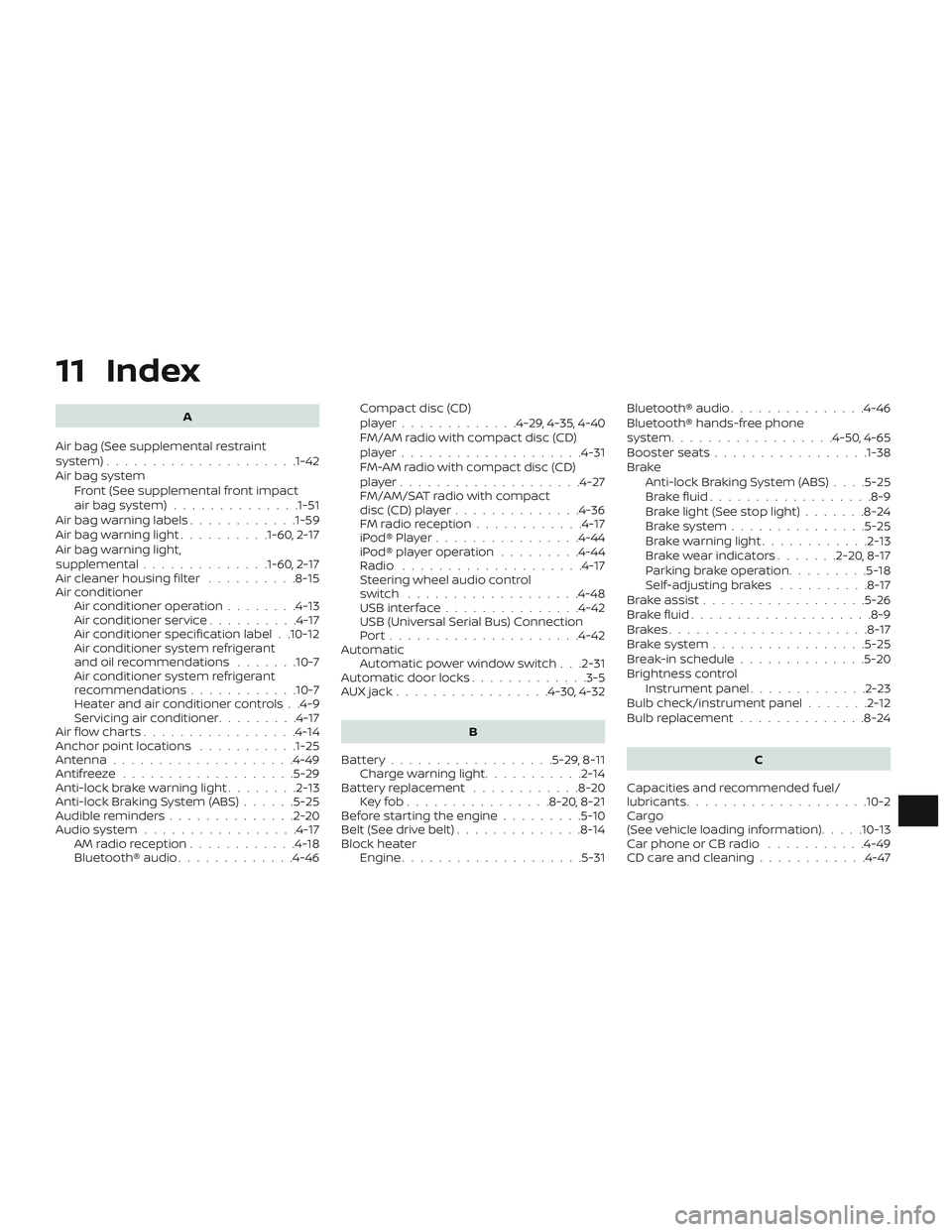
11 Index
A
Air bag (See supplemental restraint
system).....................1-42
Air bag system
Front (See supplemental front impact
airbagsystem)..............1-51
Air bag warning labels............1-59
Airbagwarninglight..........1-60, 2-17
Air bag warning light,
supplemental..............1-60, 2-17
Air cleaner housing filter..........8-15
Air conditioner
Air conditioner operation........4-13
Air conditioner service..........4-17
Air conditioner specification label . .10-12
Air conditioner system refrigerant
and oil recommendations.......10-7
Air conditioner system refrigerant
recommendations............10-7
Heater and air conditioner controls . .4-9
Servicing air conditioner.........4-17
Air flow charts.................4-14
Anchor point locations...........1-25
Antenna....................4-49
Antifreeze...................5-29
Anti-lock brake warning light........2-13
Anti-lock Braking System (ABS)......5-25
Audible reminders..............2-20
Audio system.................4-17
AMradioreception............4-18
Bluetooth® audio.............4-46Compact disc (CD)
player.............4-29,4-35,4-40
FM/AM radio with compact disc (CD)
player....................4-31
FM-AM radio with compact disc (CD)
player....................4-27
FM/AM/SAT radio with compact
disc(CD)player..............4-36
FMradioreception............4-17
iPod®Player................4-44
iPod® player operation.........4-44
Radio....................4-17
Steering wheel audio control
switch ...................4-48
USBinterface...............4-42
USB (Universal Serial Bus) Connection
Port.....................4-42
Automatic
Automatic power window switch . . .2-31
Automatic door locks.............3-5
AUXjack.................4-30,4-32
B
Battery..................5-29,8-11
Charge warning light...........2-14
Battery replacement............8-20
Keyfob................8-20,8-21
Before starting the engine.........5-10
Belt(Seedrivebelt)..............8-14
Block heater
Engine....................5-31Bluetooth® audio...............4-46
Bluetooth® hands-free phone
system..................4-50,4-65
Booster seats.................1-38
Brake
Anti-lock Braking System (ABS)....5-25
Brakefluid..................8-9
Brakelight(Seestoplight).......8-24
Brakesystem...............5-25
Brakewarninglight............2-13
Brakewearindicators.......2-20,8-17
Parking brake operation.........5-18
Self-adjustingbrakes ..........8-17
Brakeassist..................5-26
Brakefluid....................8-9
Brakes......................8-17
Brakesystem.................5-25
Break-in schedule..............5-20
Brightness control
Instrument panel.............2-23
Bulb check/instrument panel.......2-12
Bulb replacement..............8-24
C
Capacities and recommended fuel/
lubricants....................10-2
Cargo
(See vehicle loading information).....10-13
Car phone or CB radio...........4-49
CDcareandcleaning............4-47
Page 347 of 354

CD player
(See audio system).......4-29,4-35,4-40
Childrestraints........1-18, 1-19, 1-20, 1-23
LATCH (Lower Anchors and Tethers for
CHildren)System..............1-23
Precautions on child
restraints .........1-20, 1-27, 1-33, 1-38
Top tether strap anchor point
locations...................1-25
Child safety rear door lock..........3-5
Chimes, audible reminders.........2-20
Cleaningexteriorandinterior......7-2,7-4
Clock set/adjustment . .4-28, 4-33, 4-34, 4-37
Clock setting (models without Navigation
System)..................4-28,4-39
Clutch
Clutchfluid.................8-10
Coldweatherdriving.............5-29
Compact disc (CD) player . . .4-29, 4-35, 4-40
Continuously Variable Transmission
(CVT).....................5-8,5-11
Continuously Variable Transmission
(CVT) fluid...................8-9
Driving with Continuously Variable
Transmission (CVT)..........5-8,5-11
Controls
Audio controls (steering wheel)....4-48
Heater and air conditioner controls . . .4-9
Coolant
Capacities and recommended
fuel/lubricants...............10-2
Changing engine coolant.........8-5
Checking engine coolant level......8-5
Engine coolant temperature gauge . .2-8
Corrosionprotection..............7-7
Cruisecontrol..................5-19Cupholders...................2-29
Curtain side-impact and rollover air
bag........................1-57
D
Defroster switch
Rearwindowdefrosterswitch.....2-22
Dimensions and weights...........10-9
Dimmer switch for instrument panel . . .2-23
Door locks..................3-3,3-4
Door open warning light...........2-14
Drivebelt ....................8-14
Driving
Cold weather driving...........5-29
Driving with Continuously Variable
Transmission (CVT)..........5-8,5-11
Driving with manual
transmission..............5-9,5-16
Precautions when starting and
driving.....................5-2
Drivingthevehicle...............5-11
E
Economy - fuel.................5-22
Emission control information label. . . .10-11
Emission control system warranty . . . .10-19
Engine
Before starting the engine........5-10
Blockheater ................5-31
Capacities and recommended
fuel/lubricants...............10-2
Changing engine coolant.........8-5Changing engine oil............8-7
Changing engine oil filter.........8-8
Checking engine coolant level......8-5
Checking engine oil level.........8-6
Engine compartment check
locations...................8-3
Engine coolant temperature gauge . .2-8
Engine cooling system..........8-4
Engine oil...................8-6
Engine oil and oil filter
recommendation.............10-6
Engine oil pressure warning light....2-14
Engine oil viscosity.............10-7
Engine serial number...........10-11
Engine specifications...........10-8
Starting the engine............5-10
Engine coolant temperature gauge....2-8
EventDatarecorders ............10-21
Exhaust gas (Carbon monoxide).......5-2
Explanation of maintenance items.....9-2
Explanation of scheduled maintenance
items .......................9-5
Extended storage switch..........8-20
F
Flashers
(Seehazardwarningflasherswitch)....6-2
Flattire....................6-2,6-3
Floormatpositioningaid...........7-6
Fluid
Brakefluid..................8-9
Capacities and recommended
fuel/lubricants...............10-2
Clutchfluid.................8-10
11-2
Page 348 of 354

Continuously Variable Transmission
(CVT) fluid...................8-9
Engine coolant...............8-4
Engine oil...................8-6
F.M.V.S.S. certification label..........10-11
Foglightswitch................2-25
Front air bag system (See supplemental
restraint system)................1-51
Frontseats....................1-2
Fuel
Capacities and recommended
fuel/lubricants...............10-2
Fuel economy...............5-22
Fuel-filler cap................3-13
Fuel-filler door lock opener lever....3-13
Fuel-filler lid.................3-13
Fuel gauge..................2-9
Fueloctanerating.............10-5
Fuel recommendation..........10-4
Loose fuel cap warning..........2-6
Fuelefficientdrivingtips...........5-21
Fuel-filler door.................3-13
Fuel gauge....................2-9
Fuses.......................8-18
Fusiblelinks...................8-18
G
Gascap .....................3-13
Gauge
Engine coolant temperature gauge . .2-8
Fuel gauge..................2-9
Odometer..................2-6
Speedometer................2-5
Tachometer.................2-8Trip computer...............2-10
Trip odometer.............2-5,2-6
General maintenance.............9-2
Glovebox....................2-28
H
Hands-free phone system,
Bluetooth®................4-50,4-65
Hazard warning flasher switch........6-2
Headlight and turn signal switch......2-22
Headlightcontrolswitch...........2-22
Headlights ...................8-22
Headrestraints .................1-5
Heater
Heater and air conditioner controls . . .4-9
Heater operation..............4-11
Hood.......................3-10
Horn.......................2-25
I
Ignition switch..................5-8
Important vehicle information label. . . .10-11
Increasing fuel economy...........5-22
Indicator lights and audible reminders
(See warning/indicator lights and audible
reminders)....................2-18
Instrument brightness control.......2-23
Instrument panel.............0-6,2-2
Instrument panel dimmer switch.....2-23
Interiorlight ...............2-32,2-33
Interiortrunklidrelease ...........3-12
iPod®Player ..................4-44ISOFIX child restraints.............1-23
J
Jumpstarting...............6-8,8-13
K
Key.........................3-2
Key fob battery replacement.....8-20,8-21
Keyless entry
Without Intelligent Key system
(See remote keyless entry system). .3-6, 3-7
L
Labels
Air conditioner specification label . . .10-12
Emission control information label . .10-11
Engine serial number...........10-11
F.M.V.S.S. certification label........10-11
Tire and Loading Information label . .10-12
Vehicle identification number (VIN) . .10-10
Vehicle identification number (VIN)
plate.....................10-10
Warning labels (for SRS)..........1-59
LATCH (Lower Anchors and Tethers for
CHildren)System................1-23
License plate
Installing the license plate.......10-12
Light
Airbagwarninglight........1-60, 2-17
Brakelight(Seestoplight)........8-24
11-3