Page 263 of 354
CAUTION
Follow the directions below to avoid
staining or discoloring the wheels:
∙ Do not use a cleaner that uses strong
acid or alkali contents to clean the
wheels.
∙ Do not apply wheel cleaners to the
wheels when they are hot. The wheel
temperature should be the same as
ambient temperature.
∙ Rinse the wheel to completely remove
the cleaner within 15 minutes af ter
the cleaner is applied.
CHROME PARTS
Clean all chrome parts regularly with a
non-abrasive chrome polish to maintain
the finish.
TIRE DRESSINGS
NISSAN does not recommend the use of
tire dressings. Tire manufacturers apply a
coating to the tires to help reduce discolor-
ation of the rubber. If a tire dressing is ap-
plied to the tires, it may react with the coat-
ing and form a compound. This compound
may come off the tire while driving and
stain the vehicle paint.If you choose to use a tire dressing, take the
following precautions:
∙ Use a water-based tire dressing. The
coating on the tire dissolves more easily
than with an oil-based tire dressing.
∙ Apply a light coat of tire dressing to help
prevent it from entering the tire
tread/grooves (where it would be diffi-
cult to remove).
∙ Wipe off excess tire dressing using a dry
towel. Make sure the tire dressing is
completely removed from the tire
tread/grooves.
∙ Allow the tire dressing to dry as recom-
mended by the tire dressing manufac-
turer.Occasionally remove loose dust from the
interior trim, plastic parts and seats using a
vacuum cleaner or sof t bristled brush. Wipe
the vinyl and leather (if so equipped) sur-
faces with a clean, sof t cloth dampened in
mild soap solution, then wipe clean with a
dry, sof t cloth.
Regular care and cleaning is required in
order to maintain the appearance of the
leather (if so equipped).
Before using any fabric protector, read the
manufacturer’s recommendations. Some
fabric protectors contain chemicals that
may stain or bleach the seat material.
Use a cloth dampened only with water to
clean the meter and gauge lens.
WARNING
Do not use water or acidic cleaners (hot
steam cleaners) on the seat. This can
damage the seat or occupant classifi-
cation sensor. This can also affect the
operation of the air bag system and re-
sult in serious personal injury.
CLEANING INTERIOR
7-4Appearance and care
Page 268 of 354

8 Do-it-yourself
Maintenance precautions.......................8-2
Engine compartment check locations...........8-3
Engine cooling system..........................8-4
Checking engine coolant level................8-5
Changing engine coolant.....................8-5
Engine oil........................................8-6
Checking engine oil level.....................8-6
Changing engine oil..........................8-7
Changing engine oil filter.....................8-8
Continuously Variable Transmission (CVT)
fluid (if so equipped).............................8-9
Brake and clutch (if so equipped) fluid...........8-9
Brake fluid...................................8-10
Clutch (if so equipped) fluid..................8-10
Windshield-washer fluid........................8-10
Windshield-washer fluid reservoir............8-10
Battery..........................................8-11
Jump starting...............................8-13
Variable voltage control system
(if so equipped).................................8-13
Drive belt.......................................8-14
Spark plugs....................................8-14Replacing spark plugs.......................8-14
Air cleaner......................................8-15
Windshield wiper blades........................8-16
Cleaning....................................8-16
Replacing...................................8-16
Brakes..........................................8-17
Fuses...........................................8-18
Engine compartment.......................8-18
Passenger compartment....................8-19
Battery replacement...........................8-20
Key fob (if so equipped)......................8-21
Lights..........................................8-22
Headlights...................................8-22
Fog lights (if so equipped)...................8-23
Exterior and interior lights...................8-24
Wheels and tires................................8-28
Tire pressure................................8-28
Tire labeling
.................................8-31
Types of tires................................8-34
Tire chains..................................8-35
Changing wheels and tires..................8-36
Page 275 of 354
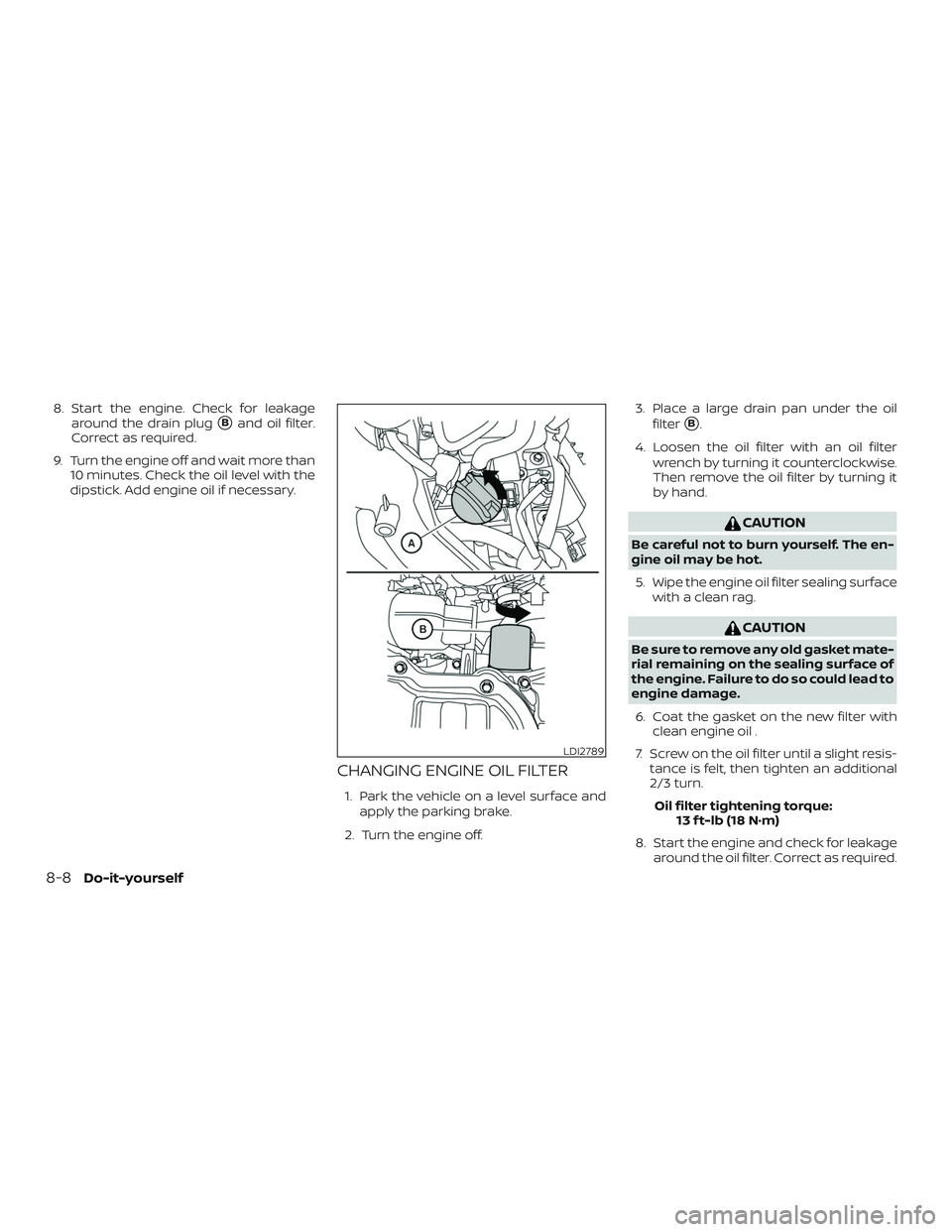
8. Start the engine. Check for leakage
around the drain plug
�Band oil filter.
Correct as required.
9. Turn the engine off and wait more than
10 minutes. Check the oil level with the
dipstick. Add engine oil if necessary.
CHANGING ENGINE OIL FILTER
1. Park the vehicle on a level surface and
apply the parking brake.
2. Turn the engine off.3. Place a large drain pan under the oil
filter
�B.
4. Loosen the oil filter with an oil filter
wrench by turning it counterclockwise.
Then remove the oil filter by turning it
by hand.
CAUTION
Be careful not to burn yourself. The en-
gine oil may be hot.
5. Wipe the engine oil filter sealing surface
with a clean rag.
CAUTION
Be sure to remove any old gasket mate-
rial remaining on the sealing surface of
the engine. Failure to do so could lead to
engine damage.
6. Coat the gasket on the new filter with
clean engine oil .
7. Screw on the oil filter until a slight resis-
tance is felt, then tighten an additional
2/3 turn.
Oil filter tightening torque:
13 f t-lb (18 N·m)
8. Start the engine and check for leakage
around the oil filter. Correct as required.
LDI2789
8-8Do-it-yourself
Page 277 of 354
BRAKE FLUID
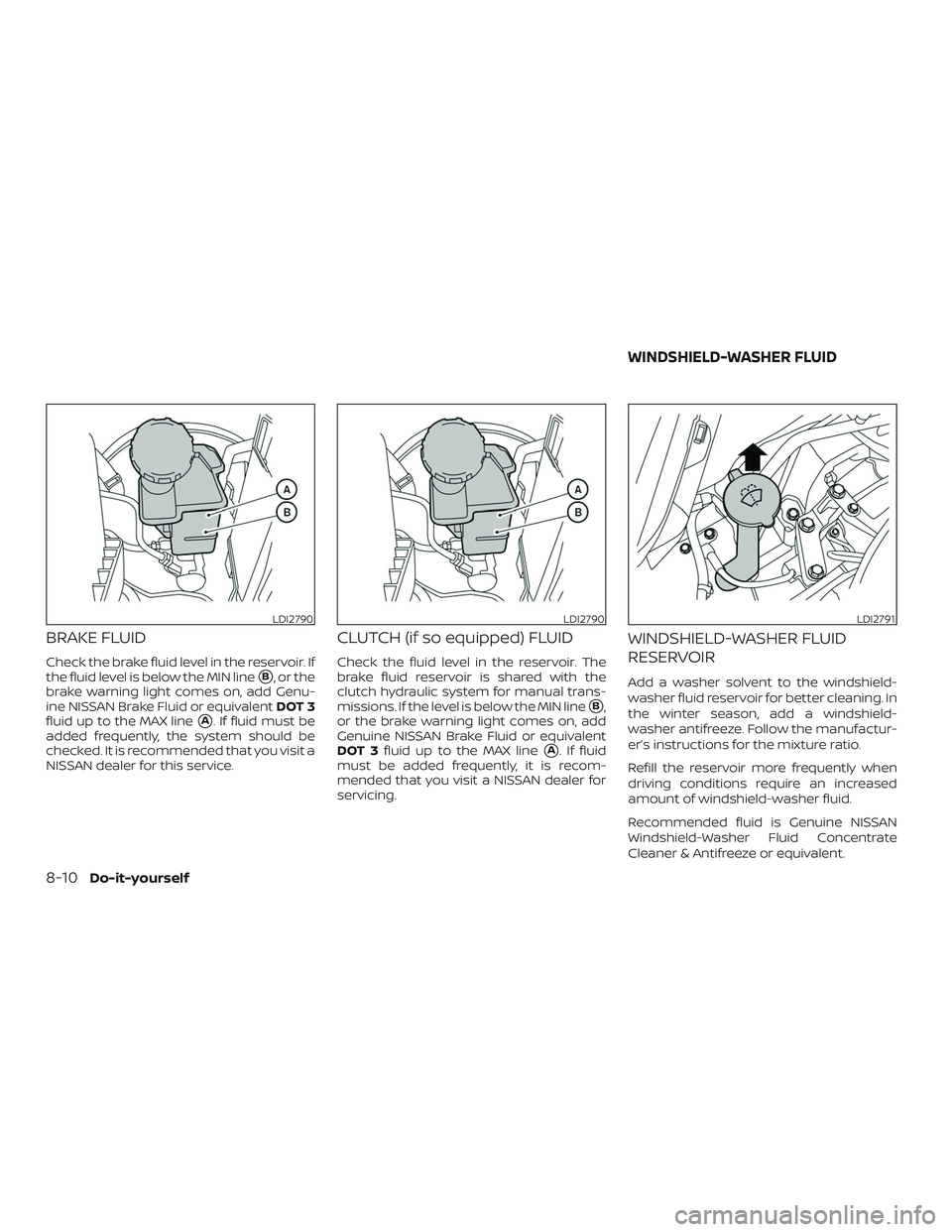
Check the brake fluid level in the reservoir. If
the fluid level is below the MIN line
�B, or the
brake warning light comes on, add Genu-
ine NISSAN Brake Fluid or equivalentDOT 3
fluid up to the MAX line
�A. If fluid must be
added frequently, the system should be
checked. It is recommended that you visit a
NISSAN dealer for this service.
CLUTCH (if so equipped) FLUID
Check the fluid level in the reservoir. The
brake fluid reservoir is shared with the
clutch hydraulic system for manual trans-
missions. If the level is below the MIN line
�B,
or the brake warning light comes on, add
Genuine NISSAN Brake Fluid or equivalent
DOT 3fluid up to the MAX line
�A. If fluid
must be added frequently, it is recom-
mended that you visit a NISSAN dealer for
servicing.
WINDSHIELD-WASHER FLUID
RESERVOIR
Add a washer solvent to the windshield-
washer fluid reservoir for better cleaning. In
the winter season, add a windshield-
washer antifreeze. Follow the manufactur-
er’s instructions for the mixture ratio.
Refill the reservoir more frequently when
driving conditions require an increased
amount of windshield-washer fluid.
Recommended fluid is Genuine NISSAN
Windshield-Washer Fluid Concentrate
Cleaner & Antifreeze or equivalent.
LDI2790LDI2790LDI2791
WINDSHIELD-WASHER FLUID
8-10Do-it-yourself
Page 284 of 354
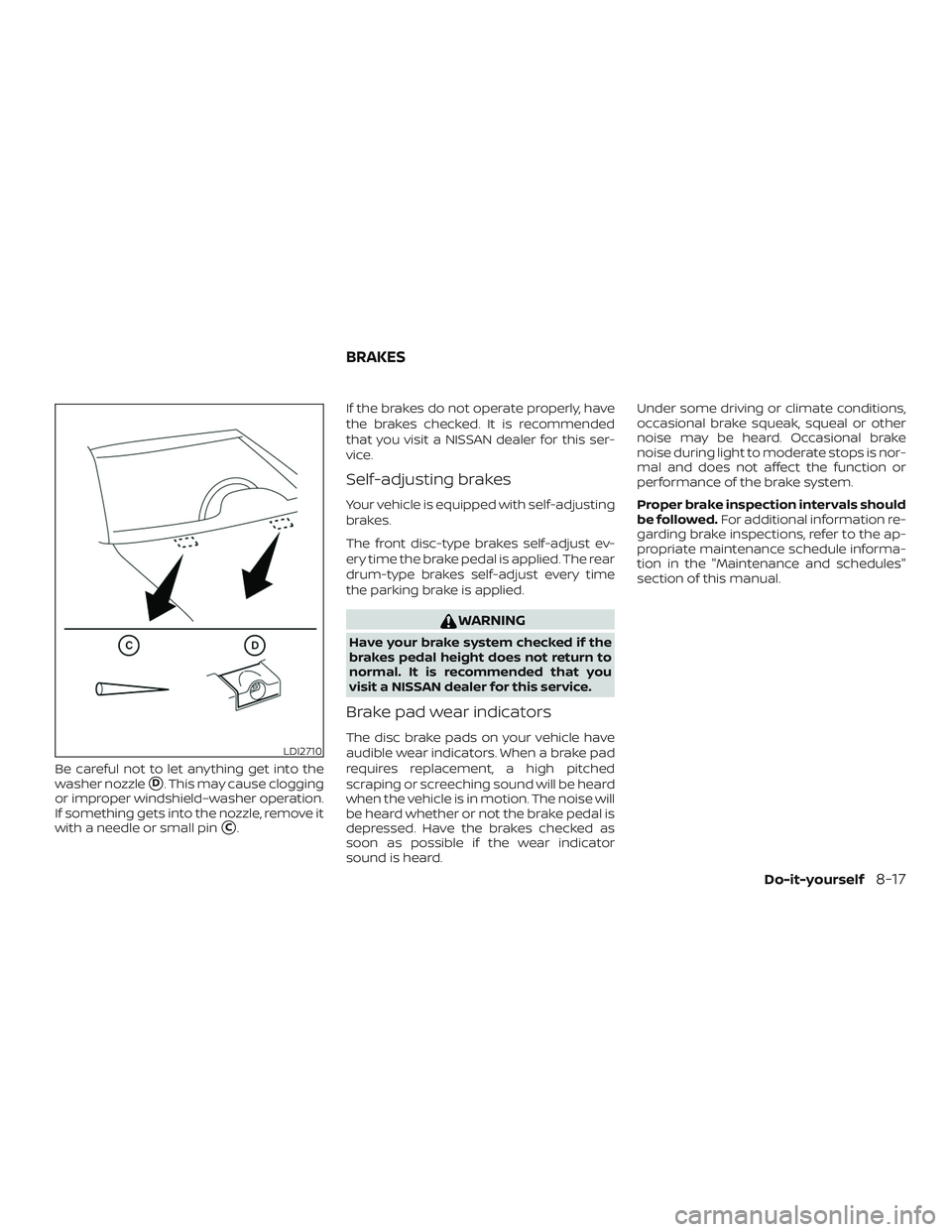
Be careful not to let anything get into the
washer nozzle
�D. This may cause clogging
or improper windshield–washer operation.
If something gets into the nozzle, remove it
with a needle or small pin
�C.If the brakes do not operate properly, have
the brakes checked. It is recommended
that you visit a NISSAN dealer for this ser-
vice.
Self-adjusting brakes
Your vehicle is equipped with self-adjusting
brakes.
The front disc-type brakes self-adjust ev-
ery time the brake pedal is applied. The rear
drum-type brakes self-adjust every time
the parking brake is applied.
WARNING
Have your brake system checked if the
brakes pedal height does not return to
normal. It is recommended that you
visit a NISSAN dealer for this service.
Brake pad wear indicators
The disc brake pads on your vehicle have
audible wear indicators. When a brake pad
requires replacement, a high pitched
scraping or screeching sound will be heard
when the vehicle is in motion. The noise will
be heard whether or not the brake pedal is
depressed. Have the brakes checked as
soon as possible if the wear indicator
sound is heard.Under some driving or climate conditions,
occasional brake squeak, squeal or other
noise may be heard. Occasional brake
noise during light to moderate stops is nor-
mal and does not affect the function or
performance of the brake system.
Proper brake inspection intervals should
be followed.For additional information re-
garding brake inspections, refer to the ap-
propriate maintenance schedule informa-
tion in the "Maintenance and schedules"
section of this manual.LDI2710
BRAKES
Do-it-yourself8-17
Page 286 of 354
PASSENGER COMPARTMENT
WARNING
Never use a fuse of a higher or lower
amperage rating than that specified on
the fuse box cover. This could damage
the electrical system or electronic con-
trol units or cause a fire.
If any electrical equipment does not oper-
ate, check for an open fuse.NOTE:
The fuse box is located on the driver’s
side of the instrument panel.
1. Be sure the ignition switch and the
headlight switch are OFF.
2. Remove the fuse box cover
�Awith a
suitable tool. Use a cloth to avoid dam-
aging the trim.
3. Locate the fuse that needs to be re-
placed.
4. Remove the fuse with the fuse puller
�B.5. If the fuse is open
�C, replace it with an
equivalent good fuse
�D.
6. Push the fuse box cover to install.
If a new fuse also opens, have the electrical
system checked and repaired. It is recom-
mended that you visit a NISSAN dealer for
this service.
LDI2712LDI2713
Do-it-yourself8-19
Page 287 of 354
Extended storage switch
If any electrical equipment does not oper-
ate, remove the extended storage switch
and check for an open fuse.
NOTE:
The extended storage switch is used for
long term vehicle storage. Even if the ex-
tended storage switch is broken it is not
necessary to replace it. Replace only the
open fuse in the switch with a new fuse.How to replace the extended storage
switch:
1. To remove the extended storage
switch, be sure the ignition switch is in
the OFF or LOCK position.
2. Be sure the headlight switch is in the
OFF position.
3. Remove the fuse box cover.
4. Pinch the locking tabs
�Aand�Bfound
on each side of the storage switch.
5. Pull the storage switch straight out
from the fuse box
�C.
CAUTION
Be careful not to allow children to swal-
low the battery or removed parts.
LDI2747
BATTERY REPLACEMENT
8-20Do-it-yourself
Page 289 of 354
For Canada:
This device complies with Industry
Canada licence-exempt RSS standard(s).
Operation is subject to the following two
conditions: (1) this device may not cause
interference, and (2) this device must ac-
cept any interference, including interfer-
ence that may cause undesired opera-
tion of the device.HEADLIGHTS
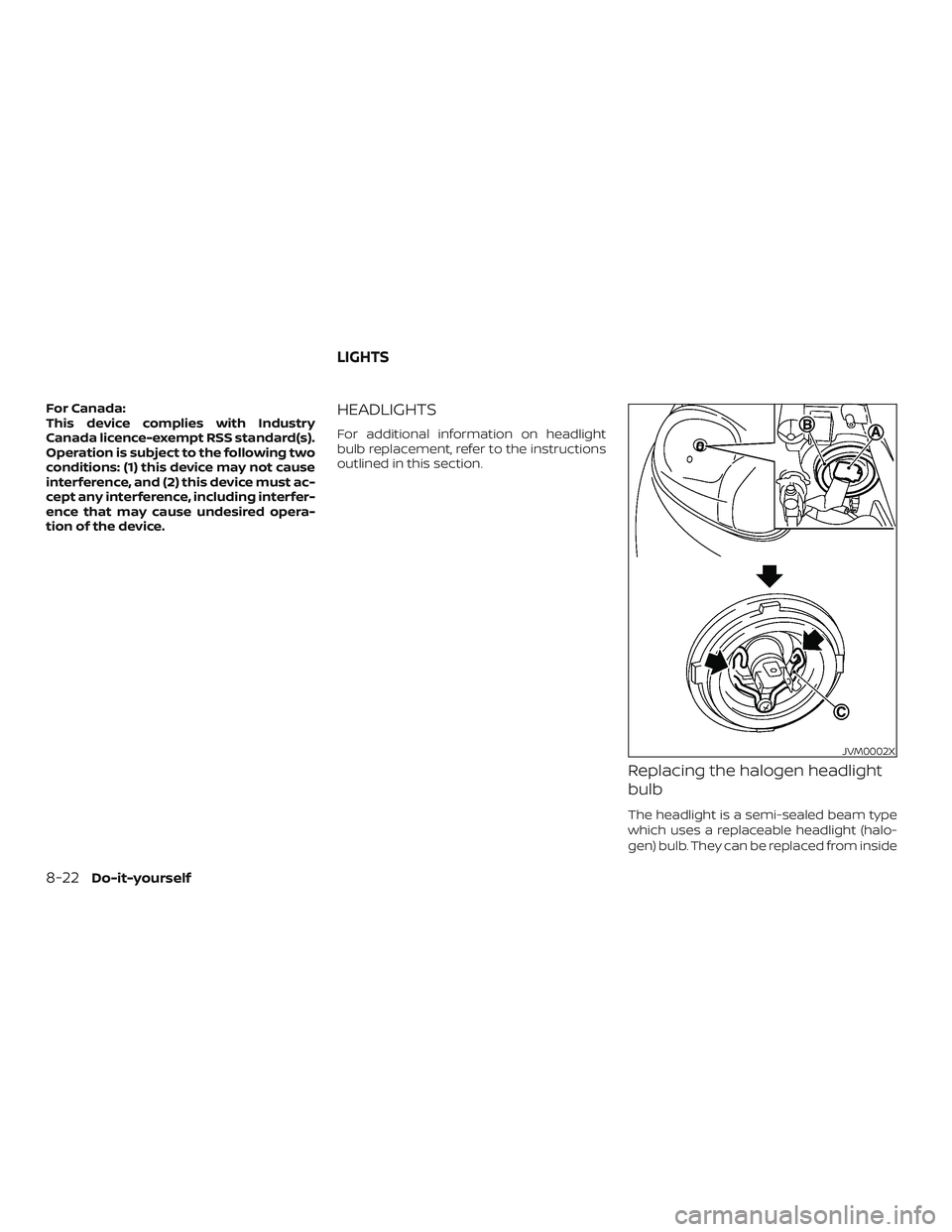
For additional information on headlight
bulb replacement, refer to the instructions
outlined in this section.
Replacing the halogen headlight
bulb
The headlight is a semi-sealed beam type
which uses a replaceable headlight (halo-
gen) bulb. They can be replaced from inside
JVM0002X
LIGHTS
8-22Do-it-yourself