2018 NISSAN SENTRA tow
[x] Cancel search: towPage 400 of 507
2WD models with manual
transmission
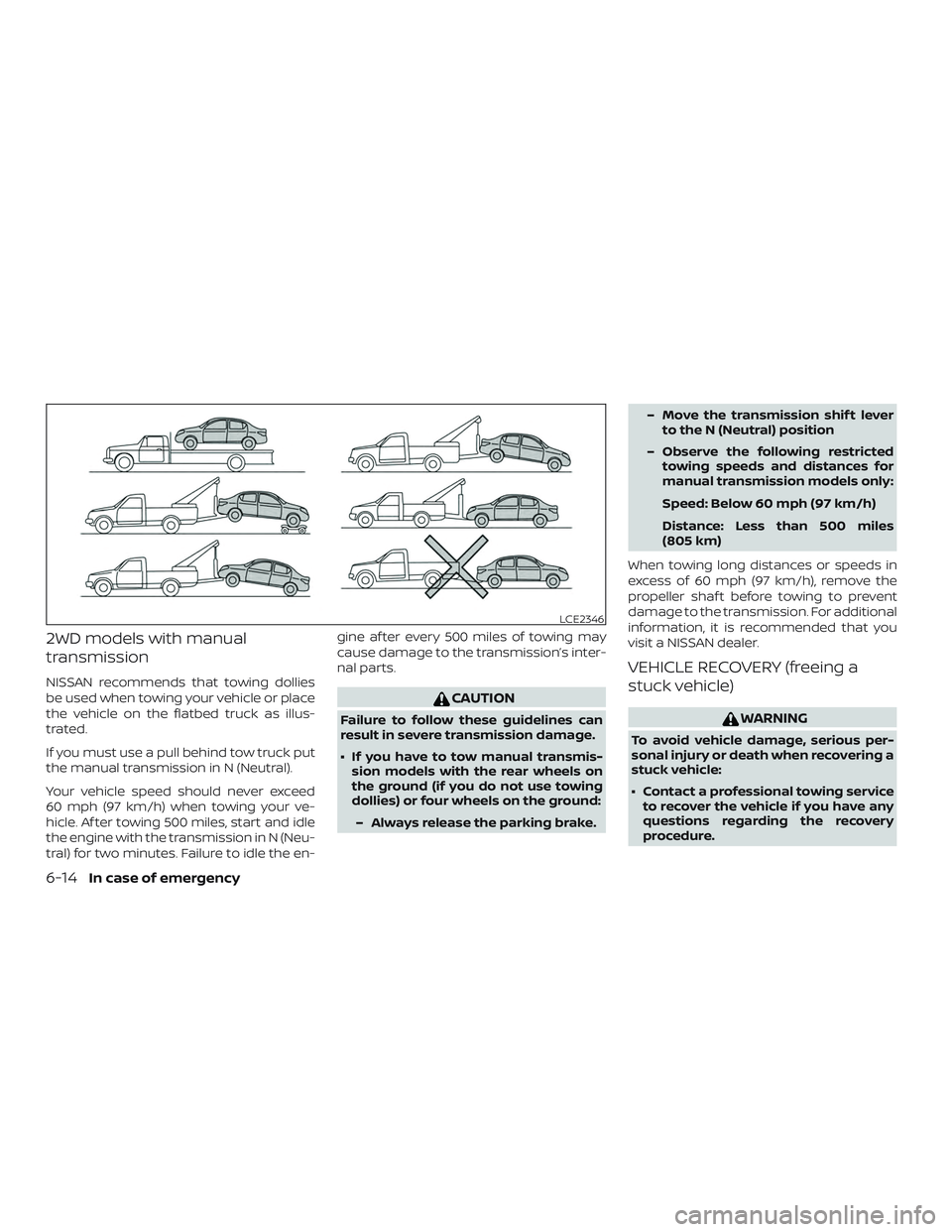
NISSAN recommends that towing dollies
be used when towing your vehicle or place
the vehicle on the flatbed truck as illus-
trated.
If you must use a pull behind tow truck put
the manual transmission in N (Neutral).
Your vehicle speed should never exceed
60 mph (97 km/h) when towing your ve-
hicle. Af ter towing 500 miles, start and idle
the engine with the transmission in N (Neu-
tral) for two minutes. Failure to idle the en-gine af ter every 500 miles of towing may
cause damage to the transmission’s inter-
nal parts.
CAUTION
Failure to follow these guidelines can
result in severe transmission damage.
∙ If you have to tow manual transmis-
sion models with the rear wheels on
the ground (if you do not use towing
dollies) or four wheels on the ground:
– Always release the parking brake. – Move the transmission shif t lever
to the N (Neutral) position
– Observe the following restricted towing speeds and distances for
manual transmission models only:
Speed: Below 60 mph (97 km/h)
Distance: Less than 500 miles
(805 km)
When towing long distances or speeds in
excess of 60 mph (97 km/h), remove the
propeller shaf t before towing to prevent
damage to the transmission. For additional
information, it is recommended that you
visit a NISSAN dealer.
VEHICLE RECOVERY (freeing a
stuck vehicle)
WARNING
To avoid vehicle damage, serious per-
sonal injury or death when recovering a
stuck vehicle:
∙ Contact a professional towing service to recover the vehicle if you have any
questions regarding the recovery
procedure.
LCE2346
6-14In case of emergency
Page 401 of 507
∙ Tow chains or cables must be at-tached only to main structural mem-
bers of the vehicle.
∙ Do not use the vehicle tie-downs to tow or free a stuck vehicle.
∙ Only use devices specifically designed for vehicle recovery and follow the
manufacturer’s instructions.
∙ Always pull the recovery device straight out from the front of the ve-
hicle. Never pull at an angle.
∙ Route recovery devices so they do not touch any part of the vehicle except
the attachment point.
If your vehicle is stuck in sand, snow, mud,
etc., use a tow strap or other device de-
signed specifically for vehicle recovery. Al-
ways follow the manufacturer’s instruc-
tions for the recovery device.Rocking a stuck vehicle
WARNING
∙ Stand clear of a stuck vehicle.
∙ Do not spin your tires at high speed. This could cause them to explode and
result in serious injury. Parts of your
vehicle could also overheat and be
damaged.
If your vehicle is stuck in sand, snow, mud,
etc., use the following procedure: 1. Turn off the Vehicle Dynamic Control (VDC) System.
2. Make sure the area in front and behind the vehicle is clear of obstructions.
3. Turn the steering wheel right and lef t to clear an area around the front tires.
4. Slowly rock the vehicle forward and backward.
∙ Shif t back and forth between R (Re- verse) and D (Drive) (Continuously
Variable Transmission models) or 1st
(Low) and R (Reverse) (manual trans-
mission models). ∙ Apply the accelerator as little as pos-
sible to maintain the rocking motion.
∙ Release the accelerator pedal before shif ting between R (Reverse) and D
(Drive) (Continuously Variable Trans-
mission models) or 1st (Low) and R
(Reverse) (manual transmission
models).
∙ Do not spin the tires above 35 mph (55 km/h).
5. If the vehicle cannot be freed af ter a few tries, contact a professional towing
service to remove the vehicle.
In case of emergency6-15
Page 406 of 507
If you choose to use a tire dressing, take the
following precautions:∙ Use a water-based tire dressing. The coating on the tire dissolves more easily
than with an oil-based tire dressing.
∙ Apply a light coat of tire dressing to help prevent it from entering the tire
tread/grooves (where it would be diffi-
cult to remove).
∙ Wipe off excess tire dressing using a dry towel. Make sure the tire dressing is
completely removed from the tire
tread/grooves.
∙ Allow the tire dressing to dry as recom- mended by the tire dressing manufac-
turer. Occasionally remove loose dust from the
interior trim, plastic parts and seats using a
vacuum cleaner or sof t bristled brush. Wipe
the vinyl and leather (if so equipped) sur-
faces with a clean, sof t cloth dampened in
mild soap solution, then wipe clean with a
dry, sof t cloth.
Regular care and cleaning is required in
order to maintain the appearance of the
leather (if so equipped).
Before using any fabric protector, read the
manufacturer’s recommendations. Some
fabric protectors contain chemicals that
may stain or bleach the seat material.
Use a cloth dampened only with water to
clean the meter and gauge lens.
WARNING
Do not use water or acidic cleaners (hot
steam cleaners) on the seat. This can
damage the seat or occupant classifi-
cation sensor. This can also affect the
operation of the air bag system and re-
sult in serious personal injury.
CAUTION
∙ Never use benzine, thinner or any
similar material.
∙ Small dirt particles can be abrasive and damaging to leather surfaces
and should be removed promptly. Do
not use saddle soap, car waxes, pol-
ishes, oils, cleaning fluids, solvents,
detergents or ammonia-based clean-
ers as they may damage the leather’s
natural finish.
∙ Never use fabric protectors unless recommended by the manufacturer.
∙ Do not use glass or plastic cleaner on meter or gauge lens covers. It may
damage the lens cover.
CLEANING INTERIOR
7-4Appearance and care
Page 407 of 507
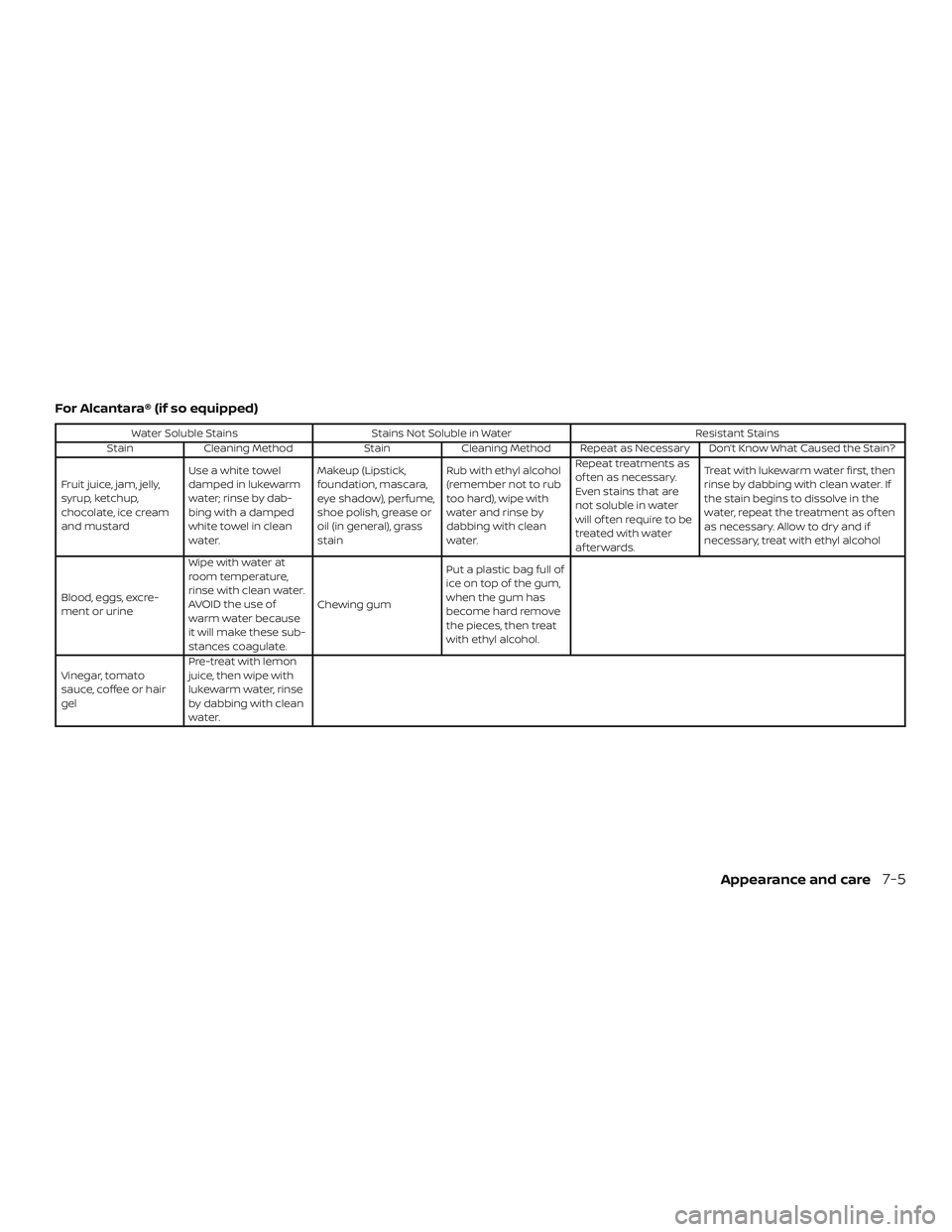
For Alcantara® (if so equipped)
Water Soluble StainsStains Not Soluble in Water Resistant Stains
Stain Cleaning Method StainCleaning Method Repeat as Necessary Don’t Know What Caused the Stain?
Fruit juice, jam, jelly,
syrup, ketchup,
chocolate, ice cream
and mustard Use a white towel
damped in lukewarm
water; rinse by dab-
bing with a damped
white towel in clean
water. Makeup (Lipstick,
foundation, mascara,
eye shadow), perfume,
shoe polish, grease or
oil (in general), grass
stainRub with ethyl alcohol
(remember not to rub
too hard), wipe with
water and rinse by
dabbing with clean
water.Repeat treatments as
of ten as necessary.
Even stains that are
not soluble in water
will of ten require to be
treated with water
af terwards.Treat with lukewarm water first, then
rinse by dabbing with clean water. If
the stain begins to dissolve in the
water, repeat the treatment as of ten
as necessary. Allow to dry and if
necessary, treat with ethyl alcohol
Blood, eggs, excre-
ment or urine Wipe with water at
room temperature,
rinse with clean water.
AVOID the use of
warm water because
it will make these sub-
stances coagulate.
Chewing gum
Put a plastic bag full of
ice on top of the gum,
when the gum has
become hard remove
the pieces, then treat
with ethyl alcohol.
Vinegar, tomato
sauce, coffee or hair
gel Pre-treat with lemon
juice, then wipe with
lukewarm water, rinse
by dabbing with clean
water.
Appearance and care7-5
Page 458 of 507
Care of wheels
∙ Wash the wheels when washing the ve-hicle to maintain their appearance.
∙ Clean the inner side of the wheels when the wheel is changed or the underside
of the vehicle is washed.
∙ Do not use abrasive cleaners when washing the wheels.
∙ Inspect wheel rims regularly for dents or corrosion. Such damage may cause
loss of pressure or poor seal at the tire
bead.
∙ NISSAN recommends waxing the road wheels to protect against road salt in
areas where it is used during winter.
Spare tire (TEMPORARY USE ONLY
spare tire)
When replacing a wheel without the TPMS
such as the spare tire, the TPMS will not
function. Observe the following precautions if the
TEMPORARY USE ONLY spare tire must be
used. Otherwise, your vehicle could be
damaged or involved in an accident:
WARNING
∙ The spare tire should be used for
emergency use only. It should be re-
placed with the standard tire at the
first opportunity to avoid possible tire
or differential damage.
∙ Drive carefully while the TEMPORARY USE ONLY spare tire is installed. Avoid
sharp turns and abrupt braking while
driving.
∙ Periodically check spare tire inflation pressure. Always keep the pressure of
the TEMPORARY USE ONLY spare tire
at 420 kPa, 4.2 bar (60 psi).
∙ With the TEMPORARY USE ONLY spare tire installed do not drive the vehicle
at speeds faster than 50 mph
(80 km/h).
∙ When driving on roads covered with snow or ice, the TEMPORARY USE
ONLY spare tire should be used on the
rear wheels and the original tire used
on the front wheels (drive wheels). ∙ Tire tread of the TEMPORARY USE
ONLY spare tire will wear at a faster
rate than the standard tire. Replace
the spare tire as soon as the tread
wear indicators appear.
∙ Do not use the spare tire on other vehicles.
∙ Do not use more than one spare tire at the same time.
∙ Do not tow a trailer when the TEMPO- RARY USE ONLY spare tire is installed.
CAUTION
∙ Do not use tire chains on a TEMPO-RARY USE ONLY spare tire. Tire chains
will not fit properly and may cause
damage to the vehicle.
∙ Because the TEMPORARY USE ONLY spare tire is smaller than the original
tire, ground clearance is reduced. To
avoid damage to the vehicle, do not
drive over obstacles. Also, do not drive
the vehicle through an automatic car
wash since it may get caught.
8-46Do-it-yourself
Page 475 of 507

10 Technical and consumer information
Recommended fluids/lubricants and
capacities...................................... 10-2
Fuel recommendation ....................... 10-4
Engine oil and oil filter
recommendations .......................... 10-7
Air conditioner system (if so equipped)
refrigerant and oil recommendations ........10-8
Specifications .................................. 10-9
Engine ...................................... 10-9
Wheels and tires ............................ 10-10
Dimensions and weights ...................10-10
When traveling or registering in another
country ......................................... 10-11
Vehicle identification ........................... 10-11
Vehicle Identification Number (VIN)
plate ........................................ 10-11
Vehicle identification number
(chassis number) ............................ 10-11
Engine serial number ....................... 10-12
F.M.V.S.S./C.M.V.S.S. certification label ........10-12 Emission control information label
.........10-12
Tire and Loading Information label .........10-13
Air conditioner specification label
(if so equipped) ............................. 10-13
Installing front license plate ....................10-13
Vehicle loading information ...................10-14
Terms ...................................... 10-14
Vehicle load capacity ....................... 10-15
Loading tips ................................ 10-17
Measurement of weights ...................10-17
Towing a trailer ................................ 10-18
Flat towing ................................. 10-18
Uniform tire quality grading ....................10-18
Emission control system warranty .............10-19
Reporting safety defects ......................10-20
Readiness for Inspection/Maintenance (I/M)
test ............................................ 10-21
Event Data Recorders (EDR) ....................10-21
Owner’s Manual/Service Manual order
information ................................... 10-22
Page 478 of 507

FUEL RECOMMENDATION
MRA8DE
Use unleaded regular gasoline with an oc-
tane rating of at least 87 AKI (Anti-Knock
Index) number (Research octane number
91).
MR16DDT
NISSAN recommends the use of unleaded
premium gasoline with an octane rating of
at least 91 AKI (Anti-Knock Index) number
(Research octane number 96). If unleaded
premium gasoline is not available, you may
use unleaded regular gasoline with an oc-
tane rating of at least 87 AKI number (re-
search octane number 91), but you may
notice a decrease in performance.
CAUTION
∙ Only vehicles with the E-85 filler doorlabel can operate on E-85. Fuel system
or other damage can occur if E-85 is
used in vehicles that are not designed
to run on E-85.
∙ Using a fuel other than that specified could adversely affect the emission
control system, and may also affect
the warranty coverage. ∙ Under no circumstances should a
leaded gasoline be used, because this
will damage the three-way catalyst.
∙ Do not use a fuel containing more than 15% ethanol in your vehicle. Your
vehicle is not designed to run on a fuel
containing more than 15% ethanol.
Using a fuel containing more than 15%
ethanol in a vehicle not specifically
designed for a fuel containing more
than 15% ethanol can adversely affect
the emission control devices and sys-
tems of the vehicle. Damage caused
by such fuel is not covered by the
NISSAN New Vehicle Limited Warranty.
∙ Do not use fuel that contains the oc- tane booster methylcyclopentadienyl
manganese tricarbonyl (MMT). Using
fuel containing MMT may adversely
affect vehicle performance and ve-
hicle emissions. Not all fuel dispens-
ers are labeled to indicate MMT con-
tent, so you may have to consult your
gasoline retailer for more details.
Note that Federal and California laws
prohibit the use of MMT in reformu-
lated gasoline. ∙ U.S. government regulations require
ethanol dispensing pumps to be iden-
tified by a small, square, orange and
black label with the common abbre-
viation or the appropriate percentage
for that region.
Gasoline specifications
NISSAN recommends using gasoline that
meets the World-Wide Fuel Charter (WWFC)
specifications where it is available. Many of
the automobile manufacturers developed
this specification to improve emission con-
trol system and vehicle performance. Ask
your service station manager if the gaso-
line meets the WWFC specifications.
Reformulated gasoline
Some fuel suppliers are now producing re-
formulated gasolines. These gasolines are
specially designed to reduce vehicle emis-
sions. NISSAN supports efforts towards
cleaner air and suggests that you use re-
formulated gasoline when available.
10-4Technical and consumer information
Page 489 of 507
∙ Vehicle Capacity Weight, Loadlimit, Total load capacity - maxi-
mum total weight limit specified
of the load (passengers and
cargo) for the vehicle. This is the
maximum combined weight of
occupants and cargo that can be
loaded into the vehicle. If the ve-
hicle is used to tow a trailer, the
trailer tongue weight must be in-
cluded as part of the cargo load.
This information is located on the
Tire and Loading Information la-
bel.
∙ Cargo capacity - permissible weight of cargo, the subtracted
weight of occupants from the
load limit.VEHICLE LOAD CAPACITY
Do not exceed the load limit of your
vehicle shown as “The combined
weight of occupants and cargo” on
the Tire and Loading Information la-
bel. Do not exceed the number of
occupants shown as “Seating Ca-
pacity” on the Tire and Loading Infor-
mation label.
To get “the combined weight of oc-
cupants and cargo”, add the weight
of all occupants, then add the total
luggage weight. Examples are
shown in the following illustration.
Technical and consumer information10-15