Page 447 of 547

CHECKING ENGINE COOLANT
LEVEL
Check the coolant levelin the reservoir
when the engine is cold. If the coolant
level is below the MIN level
�B, add coolant
to the MAX level
�A. If the reservoir is empty,
check the coolant level in the radiator
when the engine is cold. If there is insuffi-
cient coolant in the radiator, fill the radiator
with coolant up to the filler opening and
also add it to the reservoir up to the MAX
level
�A. This vehicle contains Genuine NISSAN Long
Life Antifreeze/Coolant (blue). The life ex-
pectancy of the factory-fill coolant is
105,000 miles (168,000 km) or 7 years. Mixing
any other type of coolant or the use of
non-distilled water will reduce the life ex-
pectancy of the factory-fill coolant. For ad-
ditional information, refer to the "Mainte-
nance and schedules" section of this
manual.
If the cooling system frequently requires
coolant, have it checked. It is recom-
mended that you visit a NISSAN dealer
for this service. For additional information on the location
of the engine coolant reservoir, refer to “En-
gine compartment check locations” in this
section.
CHANGING ENGINE COOLANT
A NISSAN dealer can change the engine
coolant. The service procedure can be
found in the NISSAN Service Manual.
Improper servicing can result in reduced
heater performance and engine over-
heating.
WARNING
∙ To avoid the danger of being scalded,
never change the coolant when the
engine is hot.
∙ Never remove the radiator or engine coolant reservoir cap when the en-
gine is hot. Serious burns could be
caused by high pressure fluid escap-
ing from the radiator.
∙ Avoid direct skin contact with used coolant. If skin contact is made, wash
thoroughly with soap or hand cleaner
as soon as possible.
∙ Keep coolant out of the reach of chil- dren and pets.Type A (if so equipped)
LDI2810
Type B (if so equipped)
LDI3211
Do-it-yourself8-5
Page 451 of 547

3. Place a large drain pan under the oilfilter
�B.
4. Remove pins
�Afrom the right engine
protector located inside right wheel
well, remove protector. Remove oil filter
�Bwith an oil filter wrench by turning it
counterclockwise. Then remove the oil
filter by turning it by hand.
CAUTION
Be careful not to burn yourself. The en-
gine oil may be hot.
5. Wipe the engine oil filter sealing surface with a clean rag.
CAUTION
∙ Be sure to remove any old gasketmaterial remaining on the sealing
surface of the engine. Failure to do
so could lead to an oil leak and en-
gine damage.
∙ The dipstick must be inserted in place to prevent oil spillage from
the dipstick hole when filling the
engine with oil. 6. Coat the gasket on the new filter with
clean engine oil.
7. Screw on the oil filter until a slight resis- tance is felt, then tighten an additional
2/3 turn.
8. Start the engine and check for leakage around the oil filter. Correct as required.
9. Turn the engine off and wait more than 10 minutes. Check the oil level. Add en-
gine oil if necessary.
CAUTION
∙ NISSAN recommends using GenuineNISSAN CVT Fluid NS-3 (or equivalent)
ONLY in NISSAN CVTs. Do not mix with
other fluids.
∙ Do not use Automatic Transmission Fluid (ATF) or manual transmission
fluid in a NISSAN CVT, as it may dam-
age the CVT. Damage caused by the
use of fluids other than as recom-
mended is not covered under
NISSAN’s New Vehicle Limited
Warranty.
∙ Using fluids that are not equivalent to Genuine NISSAN CVT Fluid NS-3 may
also damage the CVT. Damage caused
by the use of fluids other than as rec-
ommended is not covered under
NISSAN’s New Vehicle Limited
Warranty.
When checking or replacement of CVT fluid
is required, it is recommended that you visit
a NISSAN dealer for this service.
CONTINUOUSLY VARIABLE
TRANSMISSION (CVT) FLUID
Do-it-yourself8-9
Page 452 of 547

WARNING
∙ Use only new fluid from a sealed con-tainer. Old, inferior or contaminated
fluid may damage the brake system.
The use of improper fluids can dam-
age the brake system and affect the
vehicle’s stopping ability.
∙ Clean the filler cap before removing.
∙ Brake fluid is poisonous and should be stored carefully in marked contain-
ers out of reach of children.
CAUTION
Do not spill the fluid on any painted sur-
faces. This will damage the paint. If fluid
is spilled, immediately wash the surface
with water.
Check the fluid level in the reservoir. If the
brake fluid is below the MIN line
�B, the
brake warning light will illuminate. Add
brake fluid up to the MAX line
�A. For addi-
tional information on brake fluid type, refer
to “Recommended fluids/lubricants and
capacities” in the “Technical and consumer
information” section of this manual.
If the brake fluid must be added frequently,
the brake system should be thoroughly
checked. It is recommended that you visit a
NISSAN dealer for this service.
WINDSHIELD-WASHER FLUID
RESERVOIR
Fill the windshield-washer fluid reservoir
periodically. Add windshield-washer fluid
when the low windshield-washer fluid
warning light (if so equipped) comes on or
the “Low Washer Fluid” warning message (if
so equipped) shows on the vehicle infor-
mation display or when there is no fluid in
the dip tube.
LDI2815LDI3130
BRAKE FLUID WINDSHIELD-WASHER FLUID
8-10Do-it-yourself
Page 457 of 547
Vehicles operated in high temperatures or
under severe conditions require frequent
checks of the battery fluid level.NOTE:
Do not try to open the top of the battery.
The Type C battery is not equipped with
removable vent caps. If low battery fluid is
suspected, it is recommended you see a
NISSAN dealer for this service.JUMP STARTING
If jump starting is necessary, refer to “Jump
starting” in the “In case of emergency” sec-
tion of this manual. If the engine does not
start by jump starting, the battery may
have to be replaced. It is recommended
that you visit a NISSAN dealer for this ser-
vice.
Battery (Type C) (if so equipped)
LDI2817
Do-it-yourself8-15
Page 459 of 547
1. Visually inspect the belt for signs of un-usual wear, cuts, fraying or looseness. If
the belt is in poor condition or is loose,
have it replaced or adjusted. It is recom-
mended that you visit a NISSAN dealer
for this service.
2. Have the belt checked regularly for condition and tension in accordance
with the maintenance schedule found
in the "Maintenance and schedules"
section of this manual.
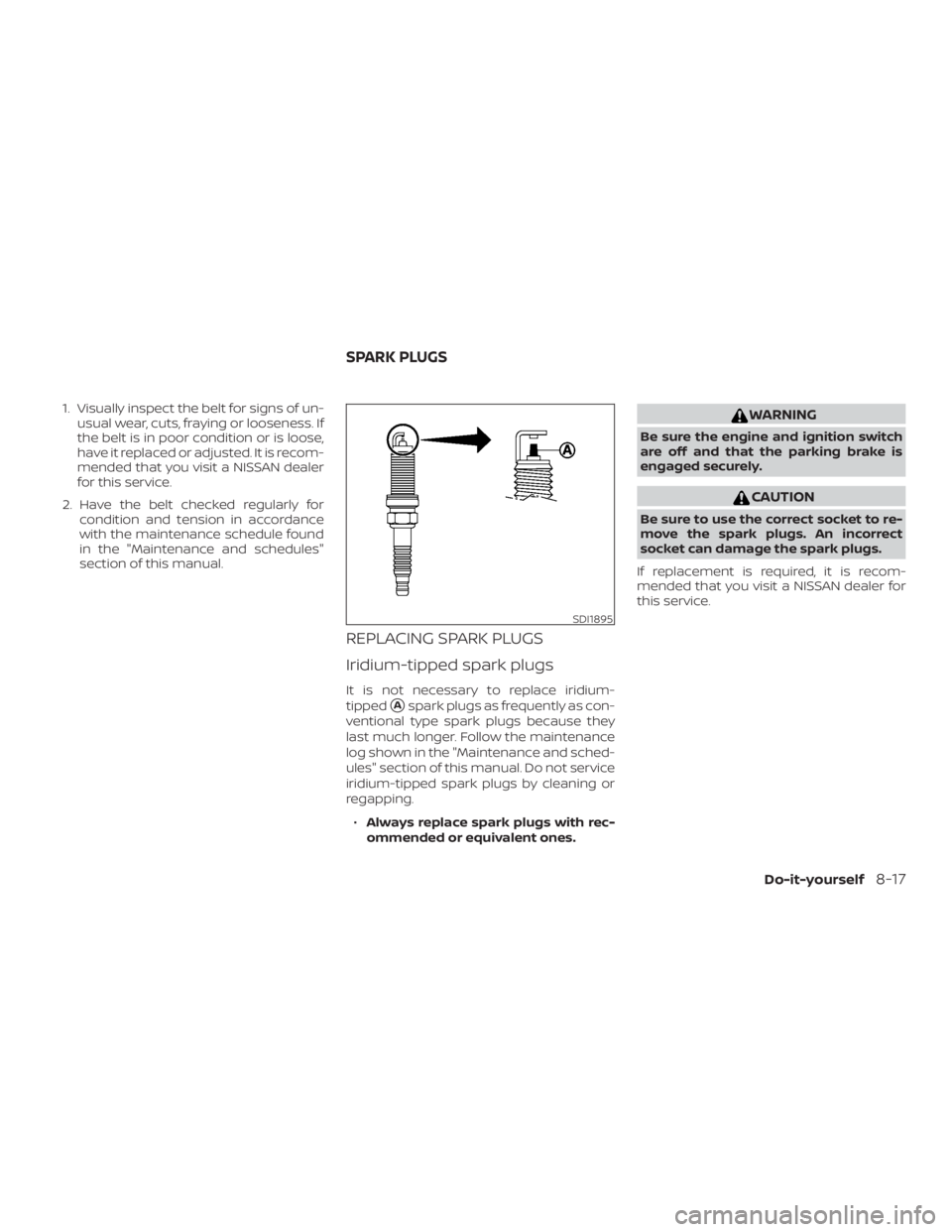
REPLACING SPARK PLUGS
Iridium-tipped spark plugs
It is not necessary to replace iridium-
tipped
�Aspark plugs as frequently as con-
ventional type spark plugs because they
last much longer. Follow the maintenance
log shown in the "Maintenance and sched-
ules" section of this manual. Do not service
iridium-tipped spark plugs by cleaning or
regapping.
∙ Always replace spark plugs with rec-
ommended or equivalent ones.
WARNING
Be sure the engine and ignition switch
are off and that the parking brake is
engaged securely.
CAUTION
Be sure to use the correct socket to re-
move the spark plugs. An incorrect
socket can damage the spark plugs.
If replacement is required, it is recom-
mended that you visit a NISSAN dealer for
this service.
SDI1895
SPARK PLUGS
Do-it-yourself8-17
Page 460 of 547

The viscous paper type filter element
should not be cleaned and reused. Replace
it according to the maintenance log shown
in the "Maintenance and schedules" sec-
tion of this manual.
To remove the air cleaner filter:1. Pinch the retaining clips
�Ainward to
unlock, move tab
�Bfrontward, and re-
move air duct
�Cupward.
NOTE:
Do not bend retaining clips outward or
they may break. 2. Unlatch the retaining clips
�Dand
move air cleaner cover
�Eforward.
3. Remove air cleaner filter.
Follow the removal instruction in reverse
order to install air cleaner filter, air cleaner
cover and air cleaner duct.
NOTE:
Af ter installing a new air cleaner filter,
make sure the air cleaner cover and air
cleaner duct are seated correctly and all
the retaining clips are latched.
WARNING
∙ Operating the engine with the air cleaner removed can cause you or
others to be burned. The air cleaner
not only cleans the air, it stops the
flame if the engine backfires. If it isn’t
there, and the engine backfires, you
could be burned. Do not drive with the
air cleaner removed, and be careful
when working on the engine with the
air cleaner removed.
∙ Never pour fuel into the throttle body or attempt to start the engine with
the air cleaner removed. Doing so
could result in serious injury.
IN-CABIN MICROFILTER
The in-cabin microfilter restricts the entry
of airborne dust and pollen particles and
reduces some objectionable outside
odors. The filter is located behind the glove
box. For additional information, refer to the
“Maintenance and schedules” section of
this manual for change intervals.
If replacement is required, it is recom-
mended that you visit a NISSAN dealer for
this service.
LDI3139LDI3141
AIR CLEANER
8-18Do-it-yourself
Page 462 of 547
3. Once the wipers are in the service po-sition, push the release tab
�B.
4. Move the wiper blade down
�Cand re-
move.
5. Insert the new wiper blade onto the wiper arm until it clicks into place.
6. Rotate the wiper blade so the dimple is in the groove. 7. Finally, lif t the windshield wiper and
washer lever to the mist position
�D
once and release. This action will cause
the wipers to resume the set position.
CAUTION
∙ Af ter wiper blade replacement, returnthe wiper arm to its original position;
otherwise it may be damaged when
the hood is opened.
∙ Make sure the wiper blades contact the glass; otherwise the arms may be
damaged from wind pressure. If you wax the surface of the hood, be care-
ful not to let wax get into the washer nozzle
�F. This may cause clogging or improper
windshield-washer operation. If wax gets
into the nozzle, remove it with a needle or
small pin
�E.
LDI2475LDI2477
LDI2820
8-20Do-it-yourself
Page 463 of 547

Rear window wiper blade
If checking or replacement is required, it is
recommended that you visit a NISSAN
dealer for this service.If the brakes do not operate properly, have
the brakes checked. It is recommended
that you visit a NISSAN dealer for this ser-
vice.
Self-adjusting brakes
Your vehicle is equipped with self-adjusting
brakes.
The front and rear disc-type brakes self-
adjust every time the brake pedal is ap-
plied.
WARNING
Have your brake system checked if the
brake pedal height does not return to
normal. It is recommended that you
visit a NISSAN dealer for this service.
Brake pad wear indicators
The disc brake pads on your vehicle have
audible wear indicators. When a brake pad
requires replacement, a high pitched
scraping or screeching sound will be heard
when the vehicle is in motion. The noise will
be heard whether or not the brake pedal is
depressed. Have the brakes checked as
soon as possible if the wear indicator
sound is heard.Under some driving or climate conditions,
occasional brake squeak, squeal or other
noise may be heard. Occasional brake
noise during light to moderate stops is nor-
mal and does not affect the function or
performance of the brake system.
Proper brake inspection intervals should
be followed.
For additional information re-
garding brake inspections, refer to the ap-
propriate maintenance schedule informa-
tion in the "Maintenance and schedules"
section of this manual.
BRAKES
Do-it-yourself8-21

