Page 326 of 428
∙ Use the correct jack-up points. Neveruse any other part of the vehicle for
jack support.
∙ Never jack up the vehicle more than necessary.
∙ Never use blocks on or under the jack.
∙ Do not start or run the engine while vehicle is on the jack. It may cause the
vehicle to move. This is especially true
for vehicles with limited slip
differentials.
∙ Do not allow passengers to stay in the vehicle while it is on the jack.
∙ Never run the engine with a wheel(s) off the ground. It may cause the ve-
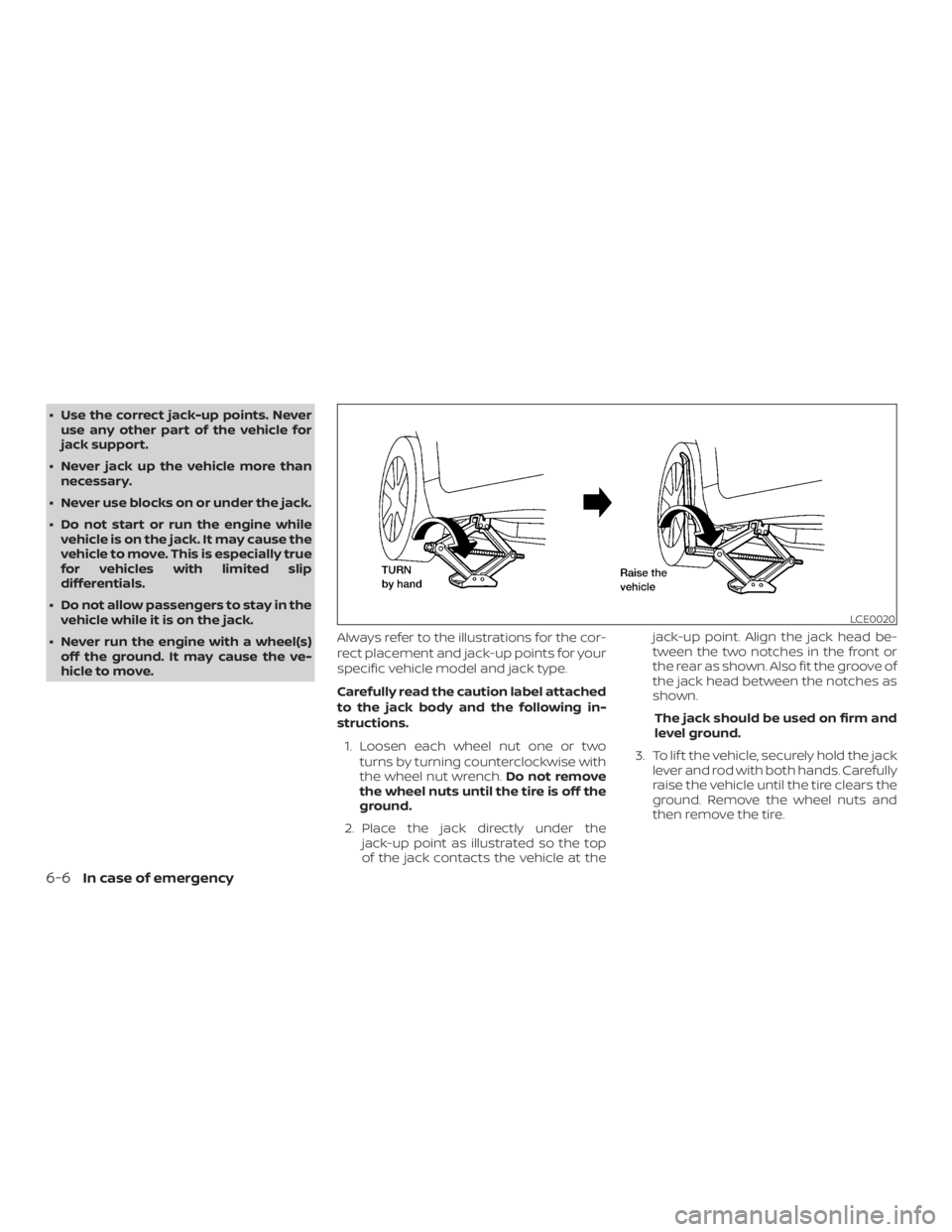
hicle to move. Always refer to the illustrations for the cor-
rect placement and jack-up points for your
specific vehicle model and jack type.
Carefully read the caution label attached
to the jack body and the following in-
structions.
1. Loosen each wheel nut one or two turns by turning counterclockwise with
the wheel nut wrench. Do not remove
the wheel nuts until the tire is off the
ground.
2. Place the jack directly under the jack-up point as illustrated so the top
of the jack contacts the vehicle at the jack-up point. Align the jack head be-
tween the two notches in the front or
the rear as shown. Also fit the groove of
the jack head between the notches as
shown.
The jack should be used on firm and
level ground.
3. To lif t the vehicle, securely hold the jack lever and rod with both hands. Carefully
raise the vehicle until the tire clears the
ground. Remove the wheel nuts and
then remove the tire.
Page 342 of 428
MOST COMMON FACTORS
CONTRIBUTING TO VEHICLE
CORROSION
Most vehicle corrosion is caused by:∙ The accumulation of moisture- retaining dirt and debris in body panel
sections, cavities, and other areas.
∙ Damage to paint and other protective coatings caused by gravel and stone
chips or minor traffic collisions.
ENVIRONMENTAL FACTORS
INFLUENCE THE RATE OF
CORROSION
Moisture
Accumulation of sand, dirt and water on
the vehicle body underside can accelerate
corrosion. Wet floor coverings will not dry
completely inside the vehicle and should
be removed for drying to avoid floor panel
corrosion.
Relative humidity
Corrosion will be accelerated in areas of
high relative humidity, especially those ar-
eas where the temperatures stay above freezing and where atmospheric pollution
exists and road salt is used.
Temperature
High temperatures accelerate the rate of
corrosion to those parts which are not well
ventilated.
Air pollution
Industrial pollution, the presence of salt in
the air in coastal areas, or heavy road salt
use accelerates the corrosion process.
Road salt also accelerates the disintegra-
tion of paint surfaces.
PROTECT YOUR VEHICLE FROM
CORROSION
∙ Wash and wax your vehicle of ten to
keep the vehicle clean.
∙ Always check for minor damage to the paint and repair it as soon as possible.
∙ Keep drain holes at the bottom of the doors open to avoid water accumula-
tion.
∙ Check the underbody for accumulation of sand, dirt or salt. If present, wash with
water as soon as possible.
Page 364 of 428
3. Replace the battery with a new one.Recommended battery: CR2032 or
equivalent.
∙ Do not touch the internal circuit andelectric terminals as doing so could
cause a malfunction.
∙ Hold the battery by the edges. Hold- ing the battery across the contact
points will seriously deplete the stor-
age capacity.
∙ Make sure that the + side faces the bottom of the lower part.
4. Close the lid securely as illustrated with
�Cand�D.
5. Operate the buttons to check the op- eration.
It is recommended that you visit a NISSAN
dealer if you need assistance for replace-
ment. FCC Notice:
For USA:
This device complies with Part 15 of the
FCC Rules. Operation is subject to the fol-
lowing two conditions: (1) This device
may not cause harmful interference, and
(2) this device must accept any interfer-
ence received, including interference
that may cause undesired operation.
Note:
Changes or modifications not expressly
approved by the party responsible for
compliance could void the user’s author-
ity to operate the equipment.
For Canada:
This device complies with Industry
Canada licence-exempt RSS standard(s).
Operation is subject to the following two
conditions: (1) this device may not cause
interference, and (2) this device must ac-
cept any interference, including interfer-
ence that may cause undesired opera-
tion of the device.
HEADLIGHTS
For additional information on headlight
bulb replacement, refer to the instructions
outlined in this section.
Replacing the halogen headlight
bulb (if so equipped)
The headlight is a semi-sealed beam type
which uses a replaceable headlight (halo-
gen) bulb. They can be replaced from inside
the engine compartment without remov-
ing the headlight assembly.
If headlight bulb replacement is required, it
is recommended that you visit a NISSAN
dealer for this service.