2018 NISSAN LEAF warning light
[x] Cancel search: warning lightPage 360 of 435
WINDSHIELD-WASHER FLUID
RESERVOIR
Fill the windshield-washer fluid reservoir
periodically. Add windshield-washer fluid
when the low windshield-washer fluid
warning light (if so equipped) comes on.
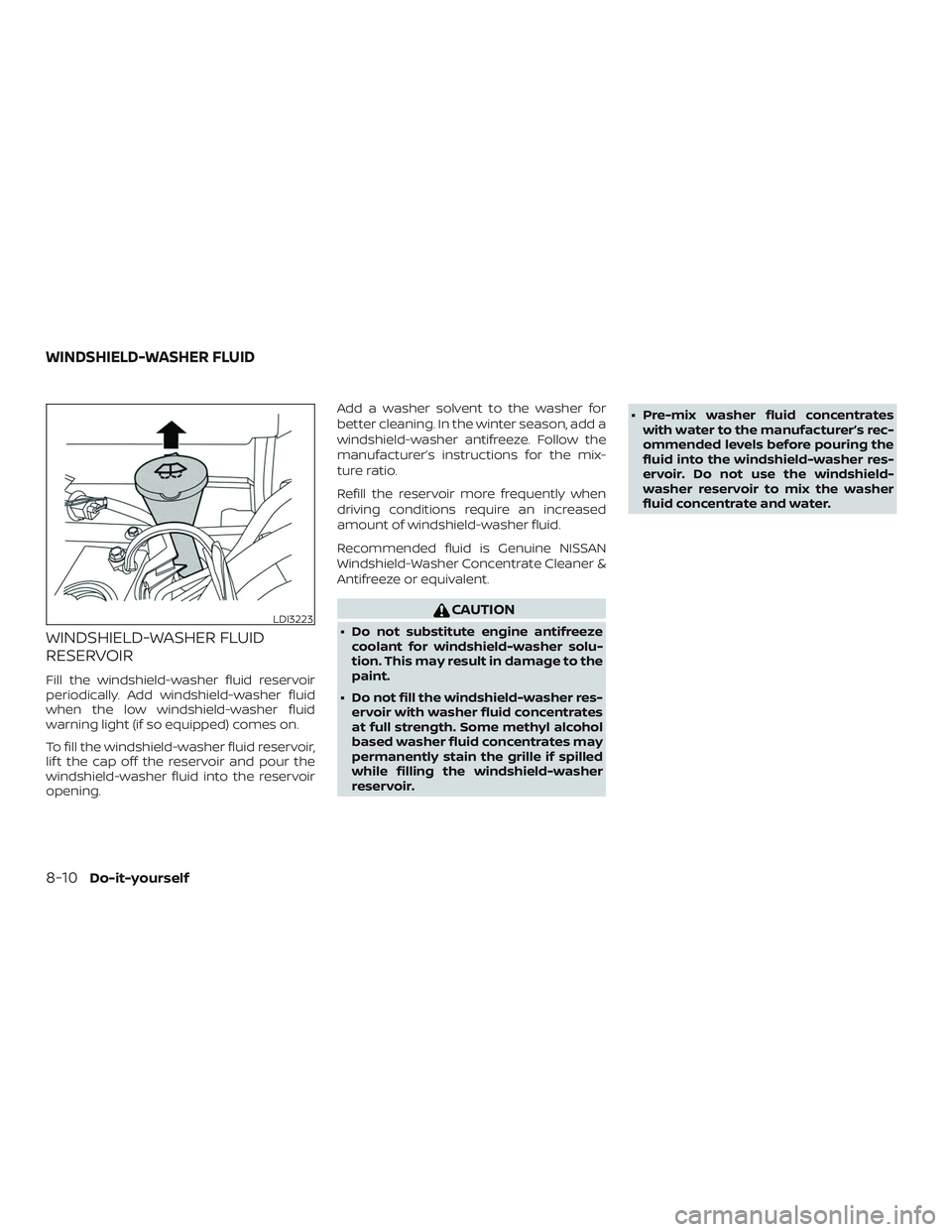
To fill the windshield-washer fluid reservoir,
lif t the cap off the reservoir and pour the
windshield-washer fluid into the reservoir
opening.Add a washer solvent to the washer for
better cleaning. In the winter season, add a
windshield-washer antifreeze. Follow the
manufacturer’s instructions for the mix-
ture ratio.
Refill the reservoir more frequently when
driving conditions require an increased
amount of windshield-washer fluid.
Recommended fluid is Genuine NISSAN
Windshield-Washer Concentrate Cleaner &
Antifreeze or equivalent.
CAUTION
∙ Do not substitute engine antifreeze
coolant for windshield-washer solu-
tion. This may result in damage to the
paint.
∙ Do not fill the windshield-washer res- ervoir with washer fluid concentrates
at full strength. Some methyl alcohol
based washer fluid concentrates may
permanently stain the grille if spilled
while filling the windshield-washer
reservoir. ∙ Pre-mix washer fluid concentrates
with water to the manufacturer’s rec-
ommended levels before pouring the
fluid into the windshield-washer res-
ervoir. Do not use the windshield-
washer reservoir to mix the washer
fluid concentrate and water.LDI3223
WINDSHIELD-WASHER FLUID
8-10Do-it-yourself
Page 377 of 435

If you have a flat tire, refer to “Flat tire” in
the “In case of emergency ” section of
this manual.
TIRE PRESSURE
Tire Pressure Monitoring System
(TPMS)
WARNING
Radio waves could adversely af-
fect electric medical equipment.
Those who use a pacemaker
should contact the electric medi-
cal equipment manufacturer for
the possible influences before
use.
This vehicle is equipped with the Tire
Pressure Monitoring System (TPMS).
It monitors tire pressure of all tires
except the spare. When the low tire
pressure warning light is lit and the
“Tire Pressure Low – Add Air” warning
appears in the vehicle information
display, one or more of your tires is
significantly under-inflated. If
equipped, the system also displays
pressure of all tires (except the spare tire) on the display screen by send-
ing a signal from a sensor that is
installed in each wheel.
The TPMS will activate only when the
vehicle is driven at speeds above
16 mph (25 km/h). Also, this system
may not detect a sudden drop in tire
pressure (for example a flat tire while
driving).
For additional information, refer to
“Low tire pressure warning light” in
the “Instruments and controls” sec-
tion, “Tire Pressure Monitoring Sys-
tem (TPMS)” in the “Starting and driv-
ing” section and “Flat tire” in the “In
case of emergency” section of this
manual.
Tire inflation pressure
Check the tire pressures (including
the spare) of ten and always prior to
long distance trips. The recom-
mended tire pressure specifications
are shown on the F.M.V.S.S./C.M.V.S.S.
certification label or the Tire and
Loading Information label under theLicense plate light
JVC0014X
WHEELS AND TIRES
Do-it-yourself8-27
Page 386 of 435
∙ The original tires have built-intread wear indicators. When the
wear indicators are visible, the
tire(s) should be replaced.
∙ Tires degrade with age and use. Have tires, including the spare,
over 6 years old checked by a
qualified technician because
some tire damage may not be
obvious. Replace the tires as
necessary to prevent tire failure
and possible personal injury.
∙ Improper service of the spare tire may result in serious per-
sonal injury. If it is necessary to
repair the spare tire, it is recom-
mended that you visit a NISSAN
dealer for this service.
∙ For additional information re- garding tires, refer to “Impor-
tant Tire Safety Information”
(US) or “Tire Safety Information”
(Canada) in the Warranty Infor-
mation Booklet.
Replacing wheels and tires
When replacing a tire, use the same size,
tread design, speed rating and load carry- ing capacity as originally equipped. For ad-
ditional information, refer to “Wheels and
tires” in the “Technical and consumer infor-
mation” section of this manual.
WARNING
∙ The use of tires other than those rec-
ommended or the mixed use of tires
of different brands, construction
(bias, bias-belted or radial), or tread
patterns can adversely affect the ride,
braking, handling, Vehicle Dynamic
Control (VDC) system, ground clear-
ance, body-to-tire clearance, tire
chain clearance, speedometer cali-
bration, headlight aim and bumper
height. Some of these effects may
lead to accidents and could result in
serious personal injury.
∙ If your vehicle was originally equipped with four tires that were the
same size and you are only replacing
two of the four tires, install the new
tires on the rear axle. Placing new tires
on the front axle may cause loss of
vehicle control in some driving condi-
tions and cause an accident and per-
sonal injury. ∙ If the wheels are changed for any rea-
son, always replace with wheels
which have the same off-set dimen-
sion. Wheels of a different off-set
could cause premature tire wear, de-
grade vehicle handling characteris-
tics, affect the VDC system and/or in-
terference with the brake
discs/drums. Such interference can
lead to decreased braking efficiency
and/or early brake pad wear. For ad-
ditional information on wheel off-set
dimensions, refer to “Wheels and
tires” in the “Technical and consumer
information” section of this manual.
∙ When replacing a wheel without the TPMS such as the spare tire, the TPMS
will not function and the low tire pres-
sure warning light will flash for ap-
proximately 1 minute. The light will re-
main on af ter 1 minute. Have your
tires replaced and/or TPMS system
reset as soon as possible. It is recom-
mended that you visit a NISSAN dealer
for this service.
∙ Replacing tires with those not origi- nally specified by NISSAN could affect
the proper operation of the TPMS.
8-36Do-it-yourself
Page 392 of 435

Seats:Check seat position controls such
as seat adjusters, seatback recliner, etc., to
ensure they operate smoothly and all
latches lock securely in every position.
Check that the head restraints/headrests
move up and down smoothly and the locks
(if so equipped) hold securely in all latched
positions.
Seat belts: Check that all parts of the seat
belt system (for example, buckles, anchors,
adjusters and retractors) operate properly
and smoothly, and are installed securely.
Check the belt webbing for cuts, fraying,
wear or damage.
Steering wheel: Check for changes in the
steering system, such as excessive free
play, hard steering or strange noises.
Warning lights and chimes: Make sure all
warning lights and chimes are operating
properly.
Windshield defroster: Check that the air
comes out of the defroster outlets properly
and in sufficient quantity when operating
the heater or air conditioner.
Windshield wiper and washer*: Check
that the wipers and washer operate prop-
erly and that the wipers do not streak.Under the hood and vehicle
The maintenance items listed here should
be checked periodically (for example, each
time you check the engine oil or refuel).
Battery*: Check the fluid level in each cell.
The fluid should be at the bottom of the
filler opening. Vehicles operated in high
temperatures or under severe conditions
require frequent checks of the battery fluid
level.
NOTE:
Care should be taken to avoid situations
that can lead to potential battery dis-
charge and potential no-start conditions
such as:
1. Installation or extended use of elec-
tronic accessories that consume bat-
tery power when the engine is not
running (Phone chargers, GPS, DVD
players, etc.).
2. Vehicle is not driven regularly and/or
only driven short distances.
In these cases, the battery may need to
be charged to maintain battery health. Brake fluid level*:
Make sure that the brake
fluid level is between the MIN and MAX lines
on the reservoir.
Engine coolant level*: Check the coolant
level when the engine is cold.
Engine drive belt*: Make sure the drive belt
is not frayed, worn, cracked or oily.
Engine oil level*: Check the level af ter
parking the vehicle on a level surface with
the engine off. Wait more than 15 minutes
for the oil to drain back into the oil pan.
Exhaust system: Make sure there are no
loose supports, cracks or holes. If the
sound of the exhaust seems unusual or
there is a smell of exhaust fumes, immedi-
ately have the exhaust system inspected. It
is recommended that you visit a NISSAN
dealer for this service. For additional infor-
mation, refer to “Exhaust gas (carbon mon-
oxide)” in the “Starting and driving” section
of this manual.
Fluid leaks: Check under the vehicle for
fuel, oil, water or other fluid leaks af ter the
vehicle has been parked for a while. Water
dripping from the air conditioner af ter use
is normal. If you should notice any leaks or if
fuel fumes are evident, check for the cause
and have it corrected immediately.
9-4Maintenance and schedules
Page 427 of 435

11 Index
A
ActiveRideControl(ARC)..........5-60
Air bag (See supplemental restraint
system) .................... .1-42
Air bag system Front (See supplemental front impact
airbagsystem)..............1-53
Air bag warning labels ............1-63
Airbagwarninglight..........1-63, 2-17
Air bag warning light,
supplemental ..............1-63, 2-17
Air cleaner housing filter ..........8-15
Air conditioner Air conditioner operation ....4-34,4-40
Air conditioner specification label . .10-12
Air conditioner system refrigerant and
oil recommendations ..........10-7
Air conditioner system refrigerant
recommendations ............10-7
Heater and air conditioner .......4-39
Heater and air conditioner
(manual) ..................4-31
Servicing air conditioner ........4-42
Air flow charts .................4-35
Alarm system (See vehicle
security system) ...............2-34
Anchor point locations ...........1-25
Antenna ....................4-64
Antifreeze ....................5-61
Anti-lock brake warning light ........2-11
Anti-lock Braking System (ABS) ......5-54Audible reminders
..............2-20
Audiosystem.................4-42 AM/FMradio............4-48,4-50
AM radio operation ...........4-50
AMradioreception............4-43
Auxliliary (AUX) devices operation . . .4-52
Bluetooth® audio .............4-59
FM radio operation ............4-51
FMradioreception............4-43
iPod®Player................4-56
iPod® player operation .........4-56
Radio ....................4-42
Steering wheel audio control
switch....................4-63
USB Connections .............4-54
USBinterface...............4-53
Autolightswitch ...............2-42
Automatic Automatic power window switch . . .2-60
Automatic door locks .............3-6
Automatic Emergency Braking
(AEB) ....................2 -11, 5-41
B
Battery..................5-61,8-11 Charge warning light ...........2-12
Battery replacement .............8-21
Keyfob...................8-21
NISSAN Intelligent Key® .........8-21
Before starting the engine .........5-13
Belt(Seedrivebelt)..............8-13
Blind Spot Warning (BSW) ..........5-22Bluetooth® audio
...............4-59
Bluetooth® hands-free phone
system .....................4-68
Bluetooth® connections ........4-84
Connecting procedure .........4-73
Phone indicators .............4-72
Text messaging .............4-80
Booster seats .................1-39
Brake Anti-lock Braking System (ABS) ....5-54
Brakefluid..................8-9
Brakelight(Seestoplight).......8-25
B
rakesystem...............5-54
Brakewarninglight............2-11
Brakewearindicators.......2-20,8-17
Parking brake operation .........5-21
Self-adjustingbrakes ..........8-17
Brakeassist................. .5-55
Brakefluid....................8-9
Brakes......................8-17
Brakesystem.................5-54
Break-in schedule ..............5-49
Brightness/contrast button .........4-8
Brightness control Instrument panel .............2-44
Bulb check/instrument panel .......2-11
Bulb replacement ..............8-25
C
Capacities and recommended fuel/
lubricants....................10-2
Page 428 of 435

Cargocover...................2-53
Cargo (See vehicle loading
information)..................10-13
Car phone or CB radio............4-68
Check tire pressure ..............2-31
Childrestraints........1-18, 1-19, 1-21, 1-23 LATCH (Lower Anchors and Tethers
forCHildren)System ...........1-23
Precautions on child
restraints.........1-21, 1-28, 1-34, 1-39
Top tether strap anchor point
locations.................. .1-25
Child restraint with top tether strap . . . .1-25
Child safety rear door lock ..........3-6
Chimes, audible reminders .........2-20
Cleaningexteriorandinterior......7-2,7-4
Clockset.....................4-6
Coldweatherdriving.............5-61
Continuously Variable Transmission
(CVT) .......................5-15
Continuously Variable Transmission
(CVT) fluid ...................8-9
Driving with Continuously Variable
Transmission (CVT) ............5-15
Transmission shif t selector
lockrelease.................5-18
Control panel buttons .............4-3
Brightness/contrast button .......4-8
Controls Audio controls (steering wheel) .....4-63
Heater and air conditioner controls
(automatic).................4-39
Heater and air conditioner controls
(manual) ...................4-31 Coolant
Capacities and recommended
fuel/lubricants...............10-2
Changing engine coolant .........8-5
Checking engine coolant level ......8-5
Corrosionprotection..............7-7
Cruisecontrol .................5-39
Cupholders...................2-51
Curtain side-impact and rollover
airbag..................... .1-59
D
Daytime Running Light System .......2-43
Defroster switch Rear window and outside mirror
defrosterswitch...........2-40,4-41
Rear window defroster switch . .2-40, 4-33
Dimensions and weights ...........10-9
Dimmer switch for instrument panel . . .2-44
Display......................2-21
Display controls (see
control panel buttons) .............4-3
Door locks ..................3-4,3-5
Door open warning light ...........2-13
Drivebelt.....................8-13
Driving Cold weather driving ...........5-61
Driving with Continuously Variable
Transmission (CVT) ............5-15
Precautions when starting
anddriving..................5-2
Drivingthevehicle...............5-15 E
Economy - fuel .................5-51
Emergency engine shutoff ..........5-11
Emission control information label . . . .10-11
Emission control system warranty . . . .10-18
Engine Before starting the engine ........5-13
Capacities and recommended
fuel/lubricants...............10-2
Changing engine coolant .........8-5
Changing engine oil ............8-6
Changing engine oil filter .........8-8
Checking engine coolant level ......8-5
Checking engine oil level .........8-5
Engine compartment check
locations...................8-3
Engine cooling system ..........8-4
Engine oil ...................8-5
Engine oil and oil filter
recommendation .............10-6
Engine oil pressure warning light ....2-13
Engine oil viscosity .............10-6
Engine serial number ...........10-11
Engine specifications ...........10-8
Starting the engine ............5-14
EventDatarecorders............10-20
Exhaust gas (Carbon monoxide) .......
5-2
Explanation of maintenance items .....9-2
Explanation of scheduled maintenance
items .......................9-5
Extended storage switch ..........2-48
11-2
Page 429 of 435

F
Flashers (See hazard
warning flasher switch) ............6-2
Flattire....................6-3,6-3
Floormatpositioningaid...........7-5
Fluid Brakefluid..................8-9
Capacities and recommended
fuel/lubricants...............10-2
Continuously Variable Transmission
(CVT) fluid ...................8-9
Engine coolant ...............8-4
Engine oil ...................8-5
F.M.V.S.S. certification label ..........10-11
Foglightswitch................2-45
Front air bag system (See
supplemental restraint system) ......1-53
Frontseats................... .1-2
Fuel Capacities and recommended
fuel/lubricants...............10-2
Fuel economy ...............5-51
Fuel-filler door lock opener lever ....3-24
Fuel gauge ..................2-8
Fueloctanerating.............10-5
Fuel recommendation ..........10-3
Fuelefficientdrivingtips...........5-50
Fuel-filler door .................3-24
Fuel gauge ....................2-8
Fuses .......................8-18
Fusiblelinks...................8-19 G
Gauge Fuel gauge ..................2-8
Odometer ..................2-6
Speedometer ..............2-5,2-6
Tachometer .................2-7
Trip odometer .............2-5,2-6
General maintenance .............9-2
Glovebox....................2-51
Grocery hooks .................2-53
H
Hands-free phone system,
Bluetooth®...................4-68
Hazard warning flasher switch ........6-2
Headlight and turn signal switch ......2-41
Headlightcontrolswitch...........2-41
Headlights ...................8-23
Headrestraints ................ .1-5
Heated seat switches ............2-45
Heater Heater and air conditioner .......4-39
Heater and air conditioner
(manual) ...................4-31
Heater operation ..........4-33,4-41
Hill start assist system ............5-60
Hood ...................... .3-21
Hook Luggage hook ...............2-52
Horn.......................2-45 I
Ignition switch Push-button ignition switch .......5-9
Immobilizer system ...........2-36,5-13
Important vehicle information label . . . .10-11
In-cabinmicrofilter ..............8-15
Increasing fuel economy ...........5-51
Indicator NISSAN Intelligent Key® battery
discharge indicator ............5-12
Indicator lights and audible reminders
(See warning/indicator lights and audible
reminders) ....................2-17
Informationdisplay............. .2-21
Instrument brightness control .......2-44
Instrument panel .............0-6,2-2
Instrument panel dimmer switch .....2-44
Integr
ated Dynamics-control Module . . .5-59
Intelligent Around View Monitor ......4-15
Intelligent Engine Brake (I-EB) ........5-59
Intelligent Key system Key operating range ............3-8
Mechanical key ...............3-3
Remote keyless entry operation ....3-12
Troubleshooting guide ..........3-16
Warning signals ..............3-16
Intelligent Trace Control (I-TC) ........5-59
Interiorlight...................2-61
iPod®Player ..................4-56
ISOFIX child restraints .............1-23
J
Jumpstarting...............6-9,8-12
11-3
Page 430 of 435

K
Key.........................3-2
Key fob battery replacement ........8-21
Keyless entry With Intelligent Key system
(See Intelligent Key system) .......3-12
Keys NISSAN Intelligent Key® ..........3-6
NISSAN Vehicle Immobilizer
Systemkeys.................3-3
L
Labels Air conditioner specification label . . .10-12
Emission control information label . .10-11
Engine serial number ...........10-11
F.M.V.S.S. certification label ........10-11
Tire and Loading Information label . .10-12
Vehicle identification number (VIN) . .10-10
Vehicle identification number (VIN)
plate.....................10-10
Warning labels (for SRS) ..........1-63
LATCH (Lower Anchors and Tethers
forCHildren)System .............1-23
Launch bar menu ................4-8
License plate Installing the license plate .......10-12
Liftgate......................3-21
Light Airbagwarninglight........1-63, 2-17
Brakelight(Seestoplight)........8-25
Bulb check/instrument panel ......2-11
Bulb replacement .............8-25 Charge warning light
...........2-12
ExteriorandInteriorlights........8-25
Foglights..................8-23
Foglightswitch..............2-45
Headlight and turn signal switch ....2-41
Headlightcontrolswitch.........2-41
Headlights .................8-23
Interiorlight.................2-61
Lightbulbs.................8-23
Low tire pressure warning light .....2-13
Low windshield-washer fluid
warninglight................2-15
Passenger air bag and status light . . .1-53
Personal lights ...............2-62
Security indicator light ..........2-19
Trunklight..................2-63
Warning/indicator lights and
audible reminders .............2-17
Lights ......................8-23 Maplights..................2-62
Lock Child safety rear door lock ........3-6
Door locks ................3-4,3-5
Fuel-filler door lock opener lever . . . .3-24
Power door locks ..............3-5
Lowfuelwarninglight ......2-13,2-15,2-31
Low tire pressure warning light .......2-13
Low windshield-washer fluid
warninglight..................2-15
Luggage hook .................2-52
Luggage rack (see roof rack) .....2-54,2-55
Luggage (See vehicle loading
information)..................10-13 M
Maintenance General maintenance ...........9-2
Insidethevehicle..............9-3
Maintenance precautions .........8-2
Outsidethevehicle.............9-2
Seat belt maintenance ..........1-17
Under the hood and vehicle .......9-4
Maintenance log ................9-13
Maintenance requirements ..........9-2
Maintenance schedules ............9-7
Maintenance under severe operation
conditions....................9-12
Malfunctionindicatorlight..........2-18
Manual front seat adjustment ........1-3
Maplights....................2-62
Menu button ...................4-6
Meters and gauges ...............2-4
Instrument brightness control .....2-44
Mirror Outsidemirrors..............3-28
Rearview ..................3-28
Vanitymirror................3-27
Mirrors......................3-28
Moving Object Detection (MOD) ......4-26
N
NISSAN Anti-Thef t System .......2-35,5-12
NissanConnect® Owner's Manual ......
4-2
NISSAN Intelligent Key® ............3-6
NISSAN Intelligent Key® battery
discharge indicator ..............5-12
11-4