2018 NISSAN JUKE belt
[x] Cancel search: beltPage 294 of 1672
.Do not drive across steep slopes.
Instead drive either straight up or
straight down the slopes. Off-road
vehicles can tip over sideways much
more easily than they can forward or
backward.
. Many hills are too steep for any
vehicle. If you drive up them, you
may stall. If you drive down them,
you may not be able to control your
speed. If you drive across them, you
may roll over.
. Do not shift ranges while driving on
downhill grades as this could cause
loss of control of the vehicle.
. Stay alert when driving to the top of
a hill. At the top there could be a
drop-off or other hazard that could
cause an accident.
. If your engine stalls or you cannot
make it to the top of a steep hill,
never attempt to turn around. Your
vehicle could tip or roll over. Always
back straight down in R (Reverse)
range. Never back down in N (Neu-
tral) , using only the brake, as this
could cause loss of control. .
Heavy braking going down a hill
could cause your brakes to overheat
and fade, resulting in loss of control
and an accident. Apply brakes
lightly and use a low range to
control your speed.
. Unsecured cargo can be thrown
around when driving over rough
terrain. Properly secure all cargo
so it will not be thrown forward
and cause injury to you or your
passengers.
. To avoid raising the center of gravity
excessively, do not exceed the rated
capacity of the roof rack (if so
equipped) and evenly distribute the
load. Secure heavy loads in the
cargo area as far forward and as
low as possible. Do not equip the
vehicle with tires larger than speci-
fied in this manual. This could cause
your vehicle to roll over.
. Do not grip the inside or spokes of
the steering wheel when driving off-
road. The steering wheel could
move suddenly and injure your
hands. Instead drive with your fin-
gers and thumbs on the outside of
the rim. .
Before operating the vehicle, ensure
that the driver and all passengers
have their seat belts fastened.
. Always drive with the floor mats in
place as the floor may became hot.
. Lower your speed when encounter-
ing strong crosswinds. With a higher
center of gravity, your vehicle is
more affected by strong side winds.
Slower speeds ensure better vehicle
control.
. Do not drive beyond the perfor-
mance capability of the tires, even
with AWD engaged.
. For AWD equipped vehicles, do not
attempt to raise two wheels off the
ground and shift the transmission to
any drive or reverse position with
the engine running. Doing so may
result in drivetrain damage or un-
expected vehicle movement which
could result in serious vehicle da-
mage or personal injury.
. Do not attempt to test an AWD
equipped vehicle on a 2-wheel dy-
namometer (such as the dynam-
ometers used by some states for
emissions testing) , or similar equip-
Page 295 of 1672
ment even if the other two wheels
are raised off the ground. Make sure
you inform test facility personnel
that your vehicle is equipped with
AWD before it is placed on a
dynamometer. Using the wrong test
equipment may result in drivetrain
damage or unexpected vehicle
movement which could result in
serious vehicle damage or personal
injury.
. When a wheel is off the ground due
to an unlevel surface, do not spin
the wheel excessively (AWD model) .
. Accelerating quickly, sharp steering
maneuvers or sudden braking may
cause loss of control.
. If at all possible, avoid sharp turning
maneuvers, particularly at high
speeds. Your vehicle has a higher
center of gravity than a conventional
passenger car. The vehicle is not
designed for cornering at the same
speeds as conventional passenger
cars. Failure to operate this vehicle
correctly could result in loss of
control and/or a rollover accident.
. Always use tires of the same type,
size, brand, construction (bias, bias- belted or radial) , and tread pattern
on all four wheels. Install traction
devices on the front wheels when
driving on slippery roads and drive
carefully.
. Be sure to check the brakes imme-
diately after driving in mud or water.
See “Brake system” (P.5-35) for wet
brakes.
. Avoid parking your vehicle on steep
hills. If you get out of the vehicle
and it rolls forward, backward or
sideways, you could be injured.
. Whenever you drive off-road
through sand, mud or water as deep
as the wheel hub, more frequent
maintenance may be required. See
the maintenance schedule shown in
the “9. Maintenance and schedules”
section.
. Spinning the front wheels on slip-
pery surfaces may cause the AWD
warning light to flash and the AWD
system to automatically switch from
the AWD mode to the 2WD mode.
This could reduce traction.
Page 349 of 1672
JVA0024X
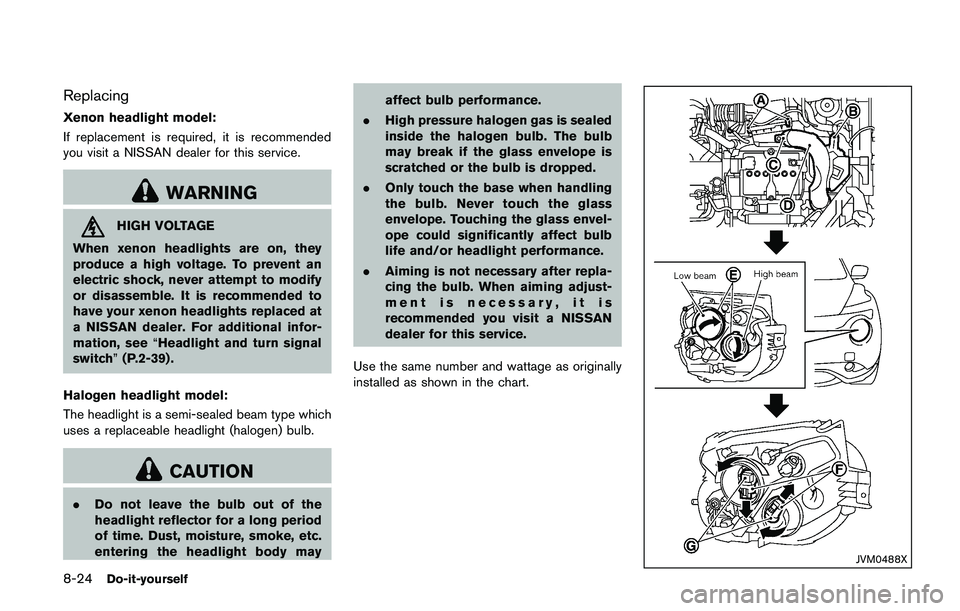
Positioning hook(s)
The illustration shows the location of the floor
mat positioning hook(s) .
SEAT BELTS
The seat belts can be cleaned by wiping them
with a sponge dampened in a mild soap
solution. Allow the belts to dry completely in
the shade before using them.
See “Seat belts” (P.1-10).
Page 363 of 1672
in poor condition or loose, have it replaced
or adjusted. It is recommended you visit a
NISSAN dealer for this service.
2. Have the belt condition checked regularly.
Page 425 of 1672

WARNING
.It is extremely dangerous to
ride in a cargo area inside the
vehicle. In a collision, people
riding in these areas are more
likely to be seriously injured or
killed.
.Do not allow people to ride in
any area of your vehicle that is
not equipped with seats and
seat belts.
.Be sure everyone in your ve-
hicle is in a seat and using a
seat belt properly.
TERMS
It is important to familiarize yourself with
the following terms before loading your
vehicle:
.Curb Weight (actual weight of your
vehicle) - vehicle weight including:
standard and optional equipment,
fluids, emergency tools, and spare tire assembly. This weight
does not
include passengers and cargo.
.GVW (Gross Vehicle Weight) - curb
weight plus the combined weight of
passengers and cargo.
.GVWR (Gross Vehicle Weight Rat-
ing) - maximum total combined
weight of the unloaded vehicle, pas-
sengers, luggage, hitch, trailer tongue
load and any other optional equip-
ment. This information is located on
the F.M.V.S.S./C.M.V.S.S. label.
.GAWR (Gross Axle Weight Rating) -
maximum weight (load) limit specified
for the front or rear axle. This informa-
tion is located on the F.M.V.S.S./C.M.
V.S.S. label.
.GCWR (Gross Combined Weight
Rating) - The maximum total weight
rating of the vehicle, passengers,
cargo, and trailer.
.Vehicle Capacity Weight, Load limit,
Total load capacity - maximum total
weight limit specified of the load
(passengers and cargo) for the vehi-
cle. This is the maximum combined weight of occupants and cargo that
can be loaded into the vehicle. If the
vehicle is used to tow a trailer, the
trailer tongue weight must be in-
cluded as part of the cargo load. This
information is located on the Tire and
Loading Information label.
.Cargo capacity - permissible weight
of cargo, the subtracted weight of
occupants from the load limit.
VEHICLE LOAD CAPACITY
Do not exceed the load limit of your
vehicle shown as “The combined weight
of occupants and cargo” on the Tire and
Loading Information label. Do not exceed
the number of occupants shown as
“Seating Capacity” on the Tire and
Loading Information label.
To get “the combined weight of occu-
pants and cargo”, add the weight of all
occupants, then add the total luggage
weight. Examples are shown in the
following illustration.
Technical and consumer information10-15
VEHICLE LOADING INFORMATION
Page 434 of 1672

Corrosion protection .................................................... 7-7
Cover, Cargo cover ................................................... 2-49
Cruise control .............................................................. 5-26
Cup holders ................................................................. 2-47
CVT, Driving with CVT (Continuously
Variable Transmission) .............................................. 5-14
D
Daytime running light system .................................. 2-42
Defroster switch, Rear window and outside
mirror defroster switch .............................................. 2-38
Dimensions and weights ....................................... 10-10
Displaying Climate control ....................................... 4-34
Door open warning light ........................................... 2-17
Drive belt ...................................................................... 8-12
DrivingAll-wheel drive (AWD) ....................................... 5-29
Cold weather driving .......................................... 5-39
Driving with CVT (Continuously
Variable Transmission) ....................................... 5-14
Driving with manual transmission .................... 5-19
Precautions when starting and driving ............. 5-2
Safety precautions ................................................. 5-7
E
Economy, Fuel ............................................................. 5-29
Elapsed time .................................................... 2-13, 2-30
Electric power steering ............................................. 5-34
Electric power steering warning light .................... 2-17
Emission control information label ...................... 10-12
Emission control system maintenance .................... 9-8
Emission control system warranty ....................... 10-20
EngineBefore starting the engine ................................ 5-12
Break-in schedule ................................................ 5-27 Capacities and
recommended fluids/lubricants ........................ 10-2
Changing engine coolant ..................................... 8-5
Changing engine oil and filter ............................. 8-6
Checking engine coolant level ............................ 8-5
Checking engine oil level ..................................... 8-5
Coolant temperature gauge .............................. 2-10
Emergency engine shut off ...................... 5-11, 6-3
Engine block heater ............................................ 5-40
Engine compartment check locations ............... 8-3
Engine cooling system .......................................... 8-4
Engine oil .................................................................. 8-5
Engine oil and oil filter recommendation ....... 10-7
Engine oil viscosity .............................................. 10-8
Engine serial number ........................................ 10-11
Engine specifications .......................................... 10-9
High temperature warning light ....................... 2-18
If your vehicle overheats .................................... 6-11
Starting the engine ............................................. 5-13
Event Data Recorders (EDR) ............................... 10-22
Exhaust gas (carbon monoxide) ............................... 5-2
Explanation of scheduled maintenance items ....... 9-5
Extended storage fuse warning ................................ 2-9
F
F.M.V.S.S./C.M.V.S.S. certification label ............ 10-12
Filter Air cleaner housing filter .................................... 8-14
Changing engine oil and filter ............................. 8-6
Flashers (See hazard warning flasher switch) ...... 6-2
Flat tire ............................................................................ 6-3
Flat towing ................................................................. 10-18
Floor mat cleaning ........................................................ 7-5
Fluid Brake and clutch fluid ........................................... 8-9 Capacities and
recommended fluids/lubricants ........................ 10-2
Continuously Variable Transmission
(CVT) fluid ................................................................ 8-8
Engine coolant ........................................................ 8-4
Engine oil .................................................................. 8-5
Window washer fluid ............................................. 8-9
FM-AM radio with Compact Disc (CD) player .... 4-45
FM-AM-SAT radio with Compact Disc (CD)
player (Type A) ............................................................ 4-53
FM-AM-SAT radio with Compact Disc (CD)
player (Type B) ............................................................ 4-62
Fog light switch .......................................................... 2-44
Front manual seat adjustment ................................... 1-3
Front passenger air bag and status light ............. 1-46
Front seat, Front seat adjustment ............................ 1-3
Front-seat active head restraints .............................. 1-9
Fuel Capacities and
recommended fluids/lubricants ........................ 10-2
Distance to empty ............................................... 2-13
Fuel economy ....................................................... 5-29
Fuel information .................................................... 10-4
Fuel octane rating ............................................... 10-4
Fuel-filler cap ........................................................ 3-18
Fuel-filler door ...................................................... 3-18
Gauge ..................................................................... 2-11
Fuel Efficient Driving Tips ........................................ 5-28
Fuses ............................................................................. 8-17
Fusible links ................................................................. 8-18
G
Gas cap ........................................................................ 3-18
Gauge .............................................................................. 2-5 Engine coolant temperature gauge ................ 2-10
Fuel gauge ............................................................ 2-11
Page 436 of 1672

Inside the vehicle .................................................... 9-3
Maintenance log .................................................. 9-15
Maintenance precautions ..................................... 8-2
Maintenance requirements ................................... 9-2
Maintenance schedules ........................................ 9-7
Maintenance under severe
driving conditions ................................................ 9-14
Outside the vehicle ................................................ 9-2
Seat belt maintenance ....................................... 1-15
Standard maintenance .......................................... 9-7
Maintenance schedules .............................................. 9-7
Making a call ................................................................ 4-92
Malfunction indicator light (MIL) ............................. 2-22
Manual air conditioner ............................................... 4-29
Manual front seat adjustment .................................... 1-3
Map lights ..................................................................... 2-54
Mechanical key (Intelligent Key system) ................. 3-3
Meter Trip computer ....................................................... 2-13
Meters and gauges ...................................................... 2-5 Instrument brightness control ........................... 2-43
Mirror Inside mirror .......................................................... 3-21
Outside mirrors .................................................... 3-22
Vanity mirror .......................................................... 3-23
Monitor, RearView Monitor ........................................ 4-8
Moonroof ...................................................................... 2-52
Moving Object Detection (MOD) ........................... 4-24
N
Navigation system voice commands ..................... 4-99
New vehicle break-in ................................................. 5-27
NISSAN Vehicle Immobilizer System .................... 2-34
NISSAN Voice Recognition System ...................... 4-96
NissanConnect App smartphone integration ...... 4-75
O
Odometer ....................................................................... 2-7
Off-road recovery ......................................................... 5-6
Oil Capacities and
recommended fluids/lubricants ........................ 10-2
Changing engine oil and filter ............................. 8-6
Checking engine oil level ..................................... 8-5
Engine oil .................................................................. 8-5
Engine oil viscosity .............................................. 10-8
One Shot Call ............................................................. 4-91
Outside air temperature display.............................. 2-12
Outside mirrors ........................................................... 3-22
Overheat, If your vehicle overheats ....................... 6-11
Owner’s Manual/Service Manual
order information ...................................................... 10-22
P
Panic alarm .................................................................. 3-13
Parking Brake break-in ...................................................... 5-35
Parking brake operation ..................................... 5-25
Parking on hills ..................................................... 5-33
Phone Car phone or CB radio ...................................... 4-80
Phone settings ............................................................ 4-96
Power Electric power steering ...................................... 5-34
Moonroof ............................................................... 2-52
Power door lock ..................................................... 3-4
Power outlet .......................................................... 2-46
Power windows .................................................... 2-50
Precautions Audio operation .................................................... 4-35
Braking precautions ............................................ 5-35 Child restraints ..................................................... 1-19
Cruise control ....................................................... 5-26
Driving safety ........................................................... 5-7
Maintenance ............................................................. 8-2
Seat belt usage .................................................... 1-10
Supplemental restraint system ......................... 1-38
When starting and driving .................................... 5-2
Push starting ................................................................ 6-11
Push-button ignition switch ............................ 5-9, 5-10
R
Radio ............................................................................. 4-35 Car phone or CB radio ...................................... 4-80
Steering wheel audio controls ......................... 4-73
Rapid air pressure loss ............................................... 5-6
Readiness for inspection/maintenance
(I/M) test .................................................................... 10-21
Rear door lock, Child safety rear door lock .......... 3-6
Rear seats ...................................................................... 1-4
Rear window and outside mirror
defroster switch .......................................................... 2-38
Rear window wiper and washer switch ............... 2-37
RearView Monitor ......................................................... 4-8
Recorders, Event data ............................................ 10-22
Registering in another country ............................. 10-10
Registering with NissanConnect App ................... 4-75
Remote keyless entry function, For Intelligent
Key system ................................................................... 3-12
Reporting safety defects ....................................... 10-20
Roadside assistance program ................................... 6-2
Rollover ........................................................................... 5-6
Roof, Moonroof ........................................................... 2-53
Page 437 of 1672

S
SafetyChild seat belts .................................................... 1-16
Reporting safety defects ................................. 10-20
Seat adjustment Front manual seat adjustment ............................. 1-3
Front seats ............................................................... 1-3
Seat belt(s) Child safety ........................................................... 1-16
Infants ..................................................................... 1-17
Injured persons .................................................... 1-12
Larger children ..................................................... 1-17
Precautions on seat belt usage ....................... 1-10
Pregnant women .................................................. 1-12
Seat belt cleaning .................................................. 7-7
Seat belt extenders ............................................. 1-15
Seat belt hooks .................................................... 1-15
Seat belt maintenance ....................................... 1-15
Seat belt warning light ....................................... 2-20
Seat belts .............................................................. 1-10
Seat belts with pretensioners .......................... 1-52
Shoulder belt height adjustment ..................... 1-14
Small children ....................................................... 1-17
Three-point type .................................................. 1-12
Seat(s) Heated seats ........................................................ 2-45
Seats .......................................................................... 1-2
Security system (NISSAN Vehicle Immobilizer
System) , Engine start ................................................ 2-34
Security system, Vehicle security system ............. 2-33
Servicing air conditioner ........................................... 4-35
Setting climate eco .................................................... 4-34
Shift lever Shift lock release ................................................. 5-18
Shift lock release Transmission ......................................................... 5-18 Shifting
CVT (Continuously Variable Transmission) .... 5-14
Manual transmission ........................................... 5-19
Shoulder belt height adjustment, For
front seats .................................................................... 1-14
Siri
ŠEyes Free ............................................................ 4-76
SOURCE select switch ............................................ 4-73
Spare tire .......................................................... 8-41, 10-9
Spark plugs .................................................................. 8-13
Speedometer ................................................................. 2-7
Standard maintenance ................................................ 9-7
Starting Before starting the engine ................................ 5-12
Jump starting ........................................................... 6-9
Precautions when starting and driving ............. 5-2
Push starting ......................................................... 6-11
Starting the engine ............................................. 5-13
Status light, Front passenger air bag .................... 1-46
Steering Electric power steering ...................................... 5-34
Steering wheel switch for audio controls ..... 4-73
Tilting steering column ....................................... 3-20
Storage ......................................................................... 2-47
Sun visors ..................................................................... 3-21
Supplemental air bag warning labels .................... 1-54
Supplemental air bag warning light ........... 1-54, 2-20
Supplemental restraint system ................................ 1-38 Precautions on supplemental
restraint system .................................................... 1-38
Switch Audio control steering wheel switch .............. 4-73
Autolight switch ................................................... 2-40
Fog light switch ................................................... 2-44
Hazard warning flasher switch ............................ 6-2
Headlight switch .................................................. 2-40
Power door lock switch ........................................ 3-5 Rear window and outside mirror
defroster switch ................................................... 2-38
Turn signal switch ................................................ 2-43
Vehicle dynamic control (VDC) off switch .... 2-44T
Tachometer ..................................................................... 2-9
Temperature display ................................................... 2-12
Temperature gauge, Engine coolant
temperature gauge ..................................................... 2-10
Text messaging ........................................................... 4-93
Theft (NISSAN Vehicle Immobilizer System) ,
Engine start .................................................................. 2-34
Three-way catalyst ....................................................... 5-3
Tilt steering column .................................................... 3-20
Tire pressure, Low tire pressure warning light .... 2-18
Tires
Flat tire ...................................................................... 6-3
Low tire pressure warning system ..................... 5-3
Tire and Loading information label .... 8-30, 10-12
Tire chains ............................................................. 8-37
Tire dressing ............................................................ 7-4
Tire pressure ......................................................... 8-28
Tire pressure monitoring
system (TPMS) .............................................. 5-3, 6-3
Tire rotation ........................................................... 8-38
Types of tires ........................................................ 8-36
Uniform tire quality grading ............................. 10-19
Wheel/tire size ..................................................... 10-9
Wheels and tires ................................................. 8-28
Tonneau cover (see cargo cover) .......................... 2-49
Touch screen ................................................................. 4-4
Towing Flat towing ........................................................... 10-18
Tow truck towing ................................................. 6-13
Towing a trailer ................................................... 10-18
11-5