2018 MITSUBISHI OUTLANDER PHEV spark plug
[x] Cancel search: spark plugPage 31 of 538
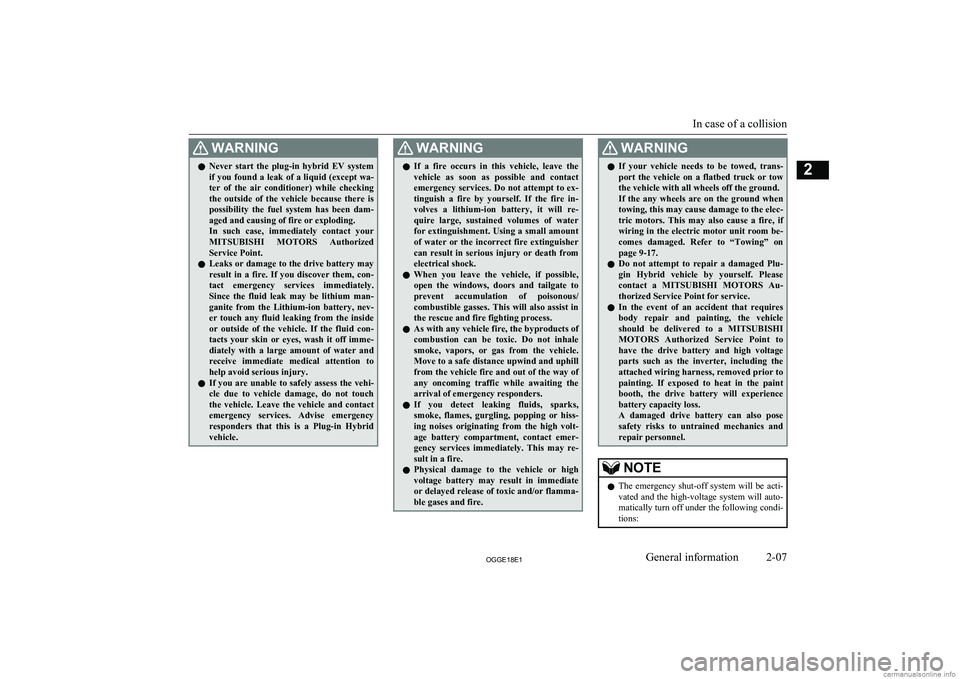
WARNINGlNever start the plug-in hybrid EV system
if you found a leak of a liquid (except wa-
ter of the air conditioner) while checking the outside of the vehicle because there is
possibility the fuel system has been dam- aged and causing of fire or exploding.
In such case, immediately contact your
MITSUBISHI MOTORS Authorized
Service Point.
l Leaks or damage to the drive battery may
result in a fire. If you discover them, con-
tact emergency services immediately.
Since the fluid leak may be lithium man- ganite from the Lithium-ion battery, nev- er touch any fluid leaking from the inside
or outside of the vehicle. If the fluid con- tacts your skin or eyes, wash it off imme-
diately with a large amount of water and receive immediate medical attention to
help avoid serious injury.
l If you are unable to safely assess the vehi-
cle due to vehicle damage, do not touch the vehicle. Leave the vehicle and contact
emergency services. Advise emergency responders that this is a Plug-in Hybrid
vehicle.WARNINGl If a fire occurs in this vehicle, leave the
vehicle as soon as possible and contact
emergency services. Do not attempt to ex- tinguish a fire by yourself. If the fire in-
volves a lithium-ion battery, it will re- quire large, sustained volumes of water for extinguishment. Using a small amount
of water or the incorrect fire extinguisher
can result in serious injury or death from electrical shock.
l When you leave the vehicle, if possible,
open the windows, doors and tailgate to
prevent accumulation of poisonous/ combustible gasses. This will also assist in
the rescue and fire fighting process.
l As with any vehicle fire, the byproducts of
combustion can be toxic. Do not inhale
smoke, vapors, or gas from the vehicle. Move to a safe distance upwind and uphill
from the vehicle fire and out of the way of any oncoming traffic while awaiting the
arrival of emergency responders.
l If you detect leaking fluids, sparks,
smoke, flames, gurgling, popping or hiss-
ing noises originating from the high volt- age battery compartment, contact emer-
gency services immediately. This may re- sult in a fire.
l Physical damage to the vehicle or high
voltage battery may result in immediate or delayed release of toxic and/or flamma- ble gases and fire.WARNINGl If your vehicle needs to be towed, trans-
port the vehicle on a flatbed truck or tow
the vehicle with all wheels off the ground.
If the any wheels are on the ground when towing, this may cause damage to the elec-
tric motors. This may also cause a fire, if
wiring in the electric motor unit room be- comes damaged. Refer to “Towing” on
page 9-17.
l Do not attempt to repair a damaged Plu-
gin Hybrid vehicle by yourself. Please contact a MITSUBISHI MOTORS Au-
thorized Service Point for service.
l In the event of an accident that requires
body repair and painting, the vehicle should be delivered to a MITSUBISHI
MOTORS Authorized Service Point to
have the drive battery and high voltage parts such as the inverter, including the
attached wiring harness, removed prior to
painting. If exposed to heat in the paint booth, the drive battery will experiencebattery capacity loss.
A damaged drive battery can also pose
safety risks to untrained mechanics and
repair personnel.NOTEl The emergency shut-off system will be acti-
vated and the high-voltage system will auto- matically turn off under the following condi-
tions:
In case of a collision
2-07OGGE18E1General information2
Page 38 of 538

E5: Petrol fuel containing up to 2.7 % (m/m)
oxygen or up to 5.0 % (V/V) ethanol – Eg.
EN 228 compliant unleaded petrol
E10: Petrol fuel containing up to 3.7 % (m/m) oxygen or up to 10.0 % (V/V) ethanol
– Eg. EN 228 compliant unleaded petrol
The petrol engine are compatible with E5
type petrol (containing 5 % ethanol) and E10 type petrol (containing 10 % ethanol) con-forming to European standards EN 228.CAUTIONl Do not use more than 10 % concentration of
ethanol (grain alcohol) by volume.
Use of more than 10 % concentration may
lead to damage to your vehicle fuel system,
engine, engine sensors and exhaust system.Filling the fuel tank
E00200204393WARNINGlWhen handling fuel, comply with the safe-
ty regulations displayed by garages and
filling stations.
l Gasoline is highly flammable and explo-
sive. You could be burned or seriously in-
jured when handling it. When refueling
your vehicle, always put the operation mode of the power switch in OFF and
keep away from flames, sparks, and smoking materials. Always handle fuel in
well-ventilated outdoor areas.WARNINGl Before removing the fuel cap, be sure to
get rid of your body’s static electricity bytouching a metal part of the car or fuel
pump. Any static electricity on your body could create a spark that ignites fuel va-
pour.
l Perform the whole refueling process
(opening the fuel tank filler door, remov-
ing the fuel cap, etc.) by yourself. Do not let any other person come near the fuel tank filler. If you allowed a person to help
you and that person was carrying static electricity, fuel vapour could be ignited.
l Do not perform charging and refueling at
the same time. If you charged with staticelectricity, fuel vapour could be ignited by
the discharge spark.
l Do not move away from the fuel tank fill-
er until refueling is finished. If you moved
away and did something else (for exam- ple, sitting on a seat) part-way through
the refueling process, you could pick up a fresh charge of static electricity.
l Be careful not to inhale fuel vapour. Fuel
contains toxic substances.
l Keep the doors and windows closed while
refueling the vehicle. If they were open, fuel vapour could get into the cabin.
l If the tank cap must be replaced, use only
a MITSUBISHI MOTORS genuine part.CAUTIONl The fuel in the fuel tank may not be con-
sumed and it may stagnate for a long timeCAUTIONdepending on the use situation of the vehi-cle, the quality of fuel may change, and it
may have a bad influence on the engine or the parts of a fuel system.
Observe the following instructions for pre- vention.
• Press the battery charge switch to start the
engine within three months at once.
Refer to “Battery charge mode switch” on page 7-28.
• Refill the fuel more than 15 litres at once
within three months. If the fuel remaining display will be below half, you can refill
the fuel more than 15 litres certainly.
Refer to “Fuel remaining display screen” on page 6-09.
Fuel tank capacity
45 litres
Refueling
1. Before filling with fuel, stop the plug-in
hybrid EV system.
2. The fuel tank filler is located on the rear
left side of your vehicle.
Filling the fuel tank
2-14OGGE18E1General information2
Page 53 of 538

WARNING•Do not open the tailgate, for example to
remove or place an item in the cargo area.
Charging may affect the operation of elec-
tric medical devices and result in serious personal injury or death.
l Do not charge when the EV charging ca-
ble is coiled up.
Doing so the cable may be heated abnor- mally and this might result in fire.
l Before charging, make sure that there is
no foreign matter such as dust at the nor-
mal charge port and the normal charge connector.
At this time, do not touch the normal
charge port.
l When the normal charge connector is
connected to the charge port, prevent for- eign matter such as water or dust from
entering in the connection.
Connection with foreign matter such as
water or dust may cause fire or an electric shock. Do not perform charging if there
might be strong exposure to water at the connection.
l Never pull the cable to remove the plug.
And never submerge the EV charging
connector, control box or plug in water.
l Please observe the following in order to
prevent accidents during charging such as
electrocution.
• Only use the EV charging cable that is
supplied with the vehicle.WARNING• Do not charge another vehicle by the
EV charging cable. The cable may overheat and this may result in a fire.
• When charging outdoors, make sure to
use an outlet that is protected from wa-
ter entering.
• Do not perform charging with the vehi-
cle covered by a car cover, except for
the MITSUBISHI MOTORS GENU-
INE car cover.
• Do not connect or disconnect the plug
and connector with wet hands.
l While it is normal for the connector and
charging cable to become warm during charging, discontinue use immediately if
the connector or charging cable becomes hot to the touch.
l While it is normal for the control box to
become warm during charging, discontin-
ue use immediately if the control box be- comes hot to the touch.
l If abnormal smells are detected or the ve-
hicle produces smoke, quickly stop charg-
ing.
l Do not perform charging in a poorly ven-
tilated area or in an enclosed area. Keep
sparks, cigarettes, and flames away from
the auxiliary battery.
Flammable gas generated from the auxili- ary battery during charging may be trap- ped, resulting in explosion.
If charging is inevitably required, venti-
late the area well.WARNINGl Grasp the normal charge connector when
connecting or disconnecting the EVcharging cable.
Grasping the cable may damage the cable
and could cause an electric shock, short circuit, and/or fire.CAUTIONl During charging, the cooling fans inside the
engine compartment may automatically be operated even if the operation mode of the
power switch is in OFF.
Keep your hands away from the cooling fan during charging.
l Do not perform charging from other power
source like a generator. Doing so could cause a malfunction.NOTEl If the charge connector is not easily connec-
ted to the charge port due to foreign materialentering, never force the connection. Doing so could damage the charging equipment or
the vehicle. Please contact a MITSUBISHI
MOTORS Authorized Service Point.
l The on board charger is only for rated AC
220-240V outlets.
Normal charging (charging method with rated AC 220-240V outlet)
3-11OGGE18E1Charging3
Page 420 of 538
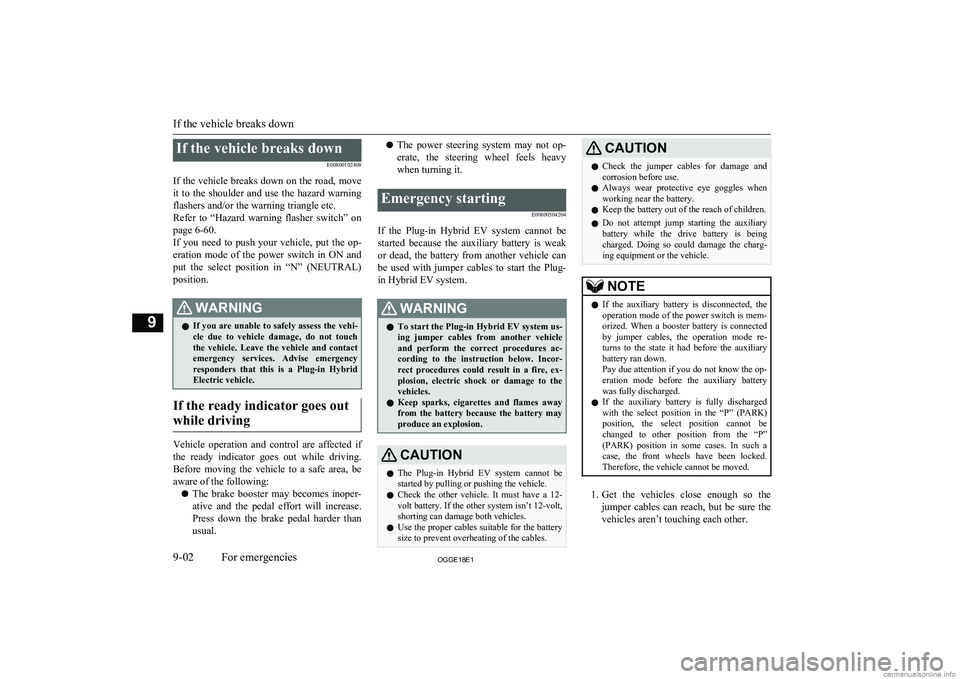
If the vehicle breaks downE00800102408
If the vehicle breaks down on the road, move it to the shoulder and use the hazard warning
flashers and/or the warning triangle etc.
Refer to “Hazard warning flasher switch” on page 6-60.
If you need to push your vehicle, put the op-
eration mode of the power switch in ON and put the select position in “N” (NEUTRAL) position.WARNINGl If you are unable to safely assess the vehi-
cle due to vehicle damage, do not touch
the vehicle. Leave the vehicle and contact emergency services. Advise emergency
responders that this is a Plug-in Hybrid Electric vehicle.
If the ready indicator goes out
while driving
Vehicle operation and control are affected if
the ready indicator goes out while driving.
Before moving the vehicle to a safe area, be aware of the following:
l The brake booster may becomes inoper-
ative and the pedal effort will increase.
Press down the brake pedal harder than usual.
l The power steering system may not op-
erate, the steering wheel feels heavy when turning it.Emergency starting
E00800504204
If the Plug-in Hybrid EV system cannot be
started because the auxiliary battery is weak or dead, the battery from another vehicle can
be used with jumper cables to start the Plug-
in Hybrid EV system.
WARNINGl To start the Plug-in Hybrid EV system us-
ing jumper cables from another vehicle
and perform the correct procedures ac-
cording to the instruction below. Incor-
rect procedures could result in a fire, ex- plosion, electric shock or damage to the
vehicles.
l Keep sparks, cigarettes and flames away
from the battery because the battery may
produce an explosion.CAUTIONl The Plug-in Hybrid EV system cannot be
started by pulling or pushing the vehicle.
l Check the other vehicle. It must have a 12-
volt battery. If the other system isn’t 12-volt, shorting can damage both vehicles.
l Use the proper cables suitable for the battery
size to prevent overheating of the cables.CAUTIONl Check the jumper cables for damage and
corrosion before use.
l Always wear protective eye goggles when
working near the battery.
l Keep the battery out of the reach of children.
l Do not attempt jump starting the auxiliary
battery while the drive battery is being charged. Doing so could damage the charg-
ing equipment or the vehicle.NOTEl If the auxiliary battery is disconnected, the
operation mode of the power switch is mem-
orized. When a booster battery is connected
by jumper cables, the operation mode re- turns to the state it had before the auxiliary
battery ran down.
Pay due attention if you do not know the op- eration mode before the auxiliary battery
was fully discharged.
l If the auxiliary battery is fully discharged
with the select position in the “P” (PARK)
position, the select position cannot be changed to other position from the “P”
(PARK) position in some cases. In such a case, the front wheels have been locked.
Therefore, the vehicle cannot be moved.
1. Get the vehicles close enough so the
jumper cables can reach, but be sure the vehicles aren’t touching each other.
If the vehicle breaks down
9-02OGGE18E1For emergencies9
Page 421 of 538

2.Turn off all lamps, heater and other elec-
trical loads.
3. Set the parking brake firmly on each ve-
hicle. Set the gear of the other vehicle in
“P” (PARK) position (with A/T) or in
“N” (Neutral) position (with M/T) and
stop the engine.WARNINGl When connecting the jumper cable, stop
the engine in the other vehicle. Otherwise,
the cables or your clothes may be caught by the fan or drive belt and personal in-jury could result.
l The cooling fan turns on and off depend-
ing on the coolant temperature. Do not bring your hands close to the fan while
the engine is running or the Plug-in Hy- brid EV System is operating.
4. Open the bonnet, remove the fuse cover
of the main fuse block.
Refer to “Bonnet” on page 11-04 and
“Fuses: Engine compartment” on page
11-17.
5. Open the cover of the jumper cable ter-
minal in the main fuse block.
NOTEl You cannot rescue another vehicle’s dis-
charged battery by connecting jumper cables
while using this jumper cable terminal.
6. Connect one end of one jumper cable
to the jumper cable terminal (A) of your
vehicle, and the other end
to the posi-
tive (+) terminal of the booster battery (B).
Connect one end of the other jumper ca- ble
to the negative (-) terminal of the
booster battery, and the other end
to
the designated ground location of your
vehicle.WARNINGl When connecting the jumper cables, do
not connect the positive (+) cable to the
negative (-) terminal. Otherwise sparks
might cause explosion of the battery.
Emergency starting
9-03OGGE18E1For emergencies9
Page 449 of 538

WARNINGlIf it is necessary to do work in the engine
compartment with the plug-in hybrid EV
system starting, be especially careful that
your clothing, hair, etc., does not become caught by the cooling fans, drive belts, orother moving parts.
l After performing the maintenance, make
sure that no tools or cloths are left behind in the engine compartment. If they are left
behind, a fire or damage to the vehicle
may occur.
l The cooling fans can turn on automatical-
ly even if the plug-in hybrid EV system is
stopping. Put the operation mode of the
power switch in OFF to be safe while you work in the engine compartment.
l Make sure that the engine and Plug-in
Hybrid EV system has cooled down be- fore removing the radiator cap and EV cooling system reserve tank cap, because
hot steam or boiling water will otherwise
gush from the filler port and may scald you.
l Do not smoke, cause sparks or allow open
flames around fuel or auxiliary battery.
The fumes are flammable.
l Be extremely cautious when working
around the auxiliary battery. It contains
poisonous and corrosive sulphuric acid.
l Do not get under your vehicle with just
the body jack supporting it. Always use
automotive jack stands.WARNINGl Improper handling of components and
materials used in the vehicle can endangeryour personal safety. We recommend you to consult a specialist for necessary infor- mation.
l The components inside the engine room
might be very hot to the touch.
To avoid being burnt, make sure all com- ponents have sufficiently cooled before beginning an inspection. These compo-
nents are affixed with the label indicating precautions for handling. Follow the in-
structions on the label.
1- Brake fluid reservoir (RHD)
2- Engine oil level dipstick
3- Engine oil cap
4- Brake fluid reservoir (LHD)
5- Washer fluid reservoir
6- EV cooling system reservoir
7- Engine coolant reservoir
Catalytic converter
E01000202495
The exhaust gas scavenging devices used with the catalytic converter are extremely ef- ficient for the reduction of noxious gases.
The catalytic converter is installed in the ex- haust system.
It is important to keep the engine properly
tuned to ensure proper catalyst operation and prevent possible catalyst damage.WARNINGl As with any vehicle, do not park or oper-
ate this vehicle in areas where combusti- ble materials such as dry grass or leaves
can come in contact with a hot exhaust
since a fire could occur.
l Paint should not be applied to the catalyt-
ic converter.NOTEl Use fuel of the type recommended in
“Fuel
selection” on page 2-13.
Catalytic converter
11-03OGGE18E1Maintenance11
Page 486 of 538
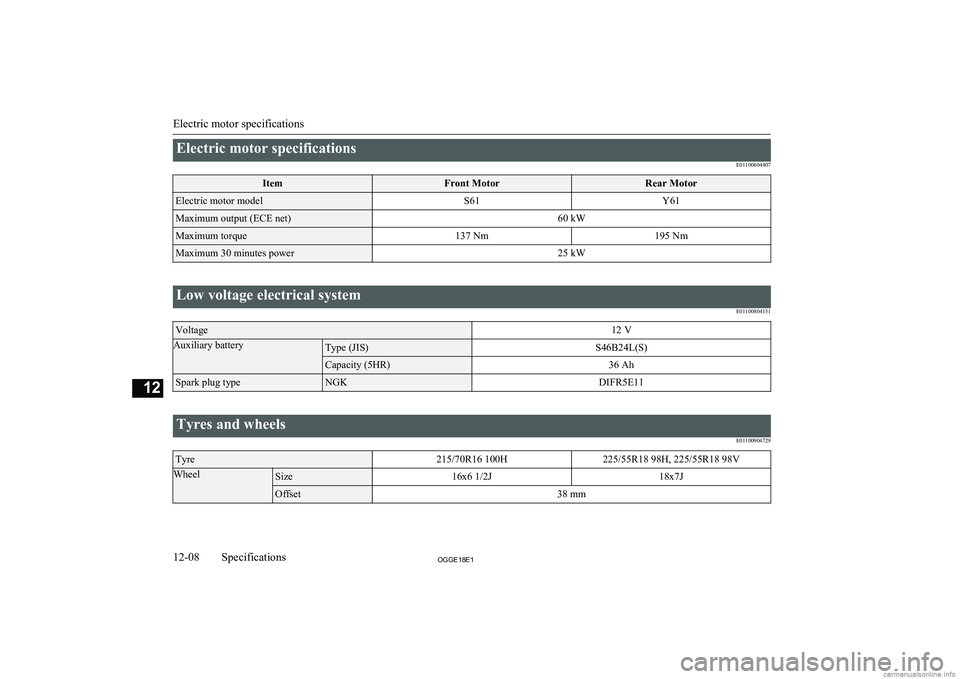
Electric motor specificationsE01100604407ItemFront MotorRear MotorElectric motor modelS61Y61Maximum output (ECE net)60 kWMaximum torque137 Nm195 NmMaximum 30 minutes power25 kW
Low voltage electrical systemE01100804151Voltage12 VAuxiliary batteryType (JIS)S46B24L(S)Capacity (5HR)36 AhSpark plug typeNGKDIFR5E11
Tyres and wheelsE01100904729Tyre215/70R16 100H225/55R18 98H, 225/55R18 98VWheelSize16x6 1/2J18x7JOffset38 mm
Electric motor specifications
12-08OGGE18E1Specifications12
Page 494 of 538

Pretensioner....................................................... 5-15
Puncture Tyre repair kit............................................... 9-07
Q
Quick charging (charging methodwith quick charger).......................................... 3-17
R
Ready indicator................................................. 6-48
Rear combination lamps Bulb capacity.............................................. 11-24
Replacement................................................ 11-29
Rear Cross Traffic Alert.................................... 7-83
Rear fog lamp Bulb capacity.............................................. 11-24
Replacement................................................ 11-29
Switch........................................................... 6-62
Rear Motor coolant..........................................12-10
Rear room lamp................................................. 8-78 Bulb capacity.............................................. 11-25
Rear turn-signal lamps
Bulb capacity.............................................. 11-24
Replacement..................................... 11-27,11-29
Rear window demister switch........................... 6-67
Rear-view camera............................................7-102
Rear-view mirror Inside............................................................. 7-07
Outside.......................................................... 7-09
Refill capacities............................................... 12-10
Regenerative braking level selector (paddle).... 7-19
Replacement of lamp bulbs............................. 11-23
Reversing lamp Bulb capacity.............................................. 11-24
Replacement................................................ 11-29
Reversing sensor system................................... 7-94
Roof carrier precaution....................................7-115
Room lamp........................................................ 8-78
S
S-AWC (Super-All Wheel Control).................. 7-21
Safe driving techniques..................................... 7-02
Safety and disposal information for used engine oil................................................. 2-17
Seat belt Adjustable seat belt anchor........................... 5-12
Child restraint................................................5-15
Force limiter.................................................. 5-15
Inspection...................................................... 5-25
Pregnant women restraint............................. 5-14
Pretensioner...................................................5-15
Seat belt reminder..............................................5-11
Seat belts........................................................... 5-09
Seat Adjustment.................................................... 5-02
Front seats..................................................... 5-03
Head restraints.............................................. 5-05
Heated seats.................................................. 5-04
Making a flat seat.......................................... 5-08
Making a luggage area.................................. 5-06
Rear seat........................................................ 5-05
Security alarm system....................................... 4-27
Select position indicator.................................... 7-17
Selector lever (Joystick type)............................ 7-16
Service precaution........................................... 11-02
Side turn-signal lamps
Bulb capacity.............................................. 11-24
Snow traction device (tyre chains).................. 11-13
Snow tyres....................................................... 11-12
Spark plug....................................................... 12-08
Specifications.................................................. 12-02
Speed Limiter.................................................... 7-47
Starting and stopping the Plug-in Hy- brid EV System................................................ 7-14
Steering Steering wheel height adjustment................. 7-07
Stop lamps
Bulb capacity.............................................. 11-24
Storage spaces................................................... 8-80
Sun visors.......................................................... 8-72
Sunglasses holder.............................................. 8-82
Sunroof.............................................................. 4-36
Super-All Wheel Control (S-AWC).................. 7-21
Supplemental restraint system...........................5-26 Caution for installing the child re-straint in vehicles with front pas-
senger’s airbag.....................................5-15,5-28
Servicing....................................................... 5-36
System check screen..........................................6-12
T
Tail lampsBulb capacity.............................................. 11-24
Tailgate.............................................................. 4-19
Tank capacity.................................................... 2-14
Time Setting...................................................... 8-45
Tools.................................................................. 9-06 Storage.......................................................... 9-06
Alphabetical index
13- 4 OGGE18E1Alphabetical index