2018 MERCEDES-BENZ SPRINTER roof
[x] Cancel search: roofPage 138 of 294

Drivingin wet conditions
Hydroplaning
GWARNING
There is adanger of hydroplaning occurring,
eve nif you are drivin gslowly and your tires
hav esufficien ttread depth, dependin gon th e
dept hof water on th eroad. There is aris kof
an accident.
Fo rthis reason ,avoid tire rut sand brake care-
fully.
Therefore, in heav yrain or other condition sin
whic hhydroplaning can occur ,drive as follows:
Rreduce your speed
Ravoid tire rut s
Rapply thebrake swit hcar e
Drivin gon flooded road s
!Do notdrive through floode dareas. Chec k
th edept hof any water befor edrivin gthrough
it .Drive slowly through standin gwater. Oth-
erwise ,water may ente rth evehicle interio ror
th eengin ecompartment. Thi scan damage
th eelectronic component sin th eengin eor
th eautomatic transmission. Water can also
be drawn in by th eengine's air suction nozzles
and this can cause engin edamage.
If you hav eto drive on stretches of road on whic h
water has collected, please bear in min dthat :
Rthewater level of standin gwater should no t
be abov eth elowe redg eof th efron tbumper
Ryou mus tno tdrive faste rthan walkin gspeed
Drivin gin winter
General notes
GWARNING
If you shift down on aslipper yroad surfac ein
an attempt to increase th eengine's braking
effect ,th edrive wheels could los etheir grip.
There is an increase ddanger of skidding and
accidents .
Do no tshift down fo radditional engin ebrak-
in g on aslipper yroad surface.
GDANGER
If th eexhaus tpipe is blocke dor adequat e
ventilation is no tpossible, poisonous gases
suc has carbon monoxide (CO) may ente rth e
vehicle. Thi sis th ecase, e.g. if th evehicle
becomes trappe din snow. There is aris kof
fatal injury.
If you leav eth eengin eor th eauxiliar yheatin g
running ,mak esur eth eexhaus tpipe and are a
around th evehicle are clear of snow. To
ensur ean adequat esupply of fresh air, ope n a
window on th esid eof th evehicle that is no t
facin ginto th ewind.
Hav eyour vehicle winterproofed at aqualified
specialis tworkshop in goo dtime at th eonset of
winter.
iDo no tcover th eradiator ,e.g. wit h awinte r
cover .The measurement sof th eon-boar d
diagnostic system may otherwise return inac-
curat evalues. Some of these values are
legally prescribed and mus ttherefore always
be exact .
Observ eth enote sin th e"Winte roperation "sec -
tion (
Ypage 250).
Slipper yroad surfaces
GWARNING
If you shift down on aslipper yroad surfac ein
an attempt to increase th eengine's braking
effect ,th edrive wheels could los etheir grip.
There is an increase ddanger of skidding and
accidents .
Do no tshift down fo radditional engin ebrak-
in g on aslipper yroad surface.
GWARNING
The outsid etemperature indicator is no t
designed to serve as an ice-warnin gdevic e
and is therefore unsuitable fo rthat purpose.
Indicated temperature sjust abov eth efreez -
in g poin tdo no tguarantee that th eroad sur -
fac eis free of ice. The road may still be icy,
especially in wooded areas or on bridges.
!Vehicles wit hautomatic transmissio nmay
roll only briefly in th eneutral position N.Pro-
136Driving tips
Driving and parking
Page 155 of 294

Problems with PARKTRONIC
ProblemPossible causes/consequences andMSolutions
Only the red segments in
the PARKTRONIC warn-
ing displays are lit.
In addition, a warning
tone sounds for approx.
two seconds
PARKTRONIC is deacti-
vated after approx-
imately 20 seconds.
The indicator lamp of the
f button lights up
and the red segments in
the PARKTRONIC warn-
ing display go out.PARKTRONIC has malfunctioned and has switched itself off.
XIf problems persist, have PARKTRONIC checked at a qualified spe- cialist workshop.
The PARKTRONIC warn-
ing displays implausible
distances.
For example, all the seg-
ments may be lit even
though there is no obsta-
cle present.The PARKTRONIC sensors are dirty or iced up.
XClean the PARKTRONIC sensors (Ypage 237).
XTurn the key to position 2in the ignition lock.
The license plate or other parts attached near the sensors may not be
secured correctly.
XCheck the license plate and attachment parts near the sensors for
correct seating.
An external radio or ultrasonic source may be causing interference.
XCheck PARKTRONIC functions in a different location.
Rear view camera
Important safety notes
The rear view camera is only an aid. It cannot
replace your own awareness of the immediate
surroundings. You are responsible for safe
maneuvering, parking and pulling away. When
maneuvering, parking and pulling away, make
sure that there are no persons, animals or
objects in the maneuvering area.
The rear view camera is a visual parking aid.
Information on operation can be found in the
separate Audio 15 supplement.
The camera is in the middle of the roof above the
high-mounted brake lamp (
Ypage 237).
You can find information on cleaning the camera
in the "Maintenance and care" section
(
Ypage 237).
Working mode
ADR (working speed governor)
General notes
When activated, ADR automatically increases
the engine speed to a preset speed or a speed
you have set.
iAfter a cold start, the idling speed of the
engine is increased automatically. If the pre-
set working speed is lower than the increased idling speed, the working speed is only
reached once the engine has completed the
warm-up phase.
It is only possible to activate ADR with the
vehicle stationary and the parking brake
applied.
The selector lever of the automatic transmis-
sion must be in position P.
Working mode153
Driving and parking
Z
Page 215 of 294

Useful information
This Operator's Manual describes all models as
well as standard and optional equipment of your
vehicle that were available at the time of going
to print. Country-specific variations are possi-
ble. Note that your vehicle may not be equipped
with all of the described functions. This also
applies to systems and functions relevant to
safety.
Read the information on qualified specialist
workshops (
Ypage 27).
Loading guidelines
Important safety notes
GWARNING
As a result of improperly placed or unevenly
distributed loads, the center of gravity of the
load being transported may be too high or too
far back. This can significantly impair handling
as well as steering and braking characteris-
tics. There is a risk of an accident.
Always make sure that the center of gravity of
the load is:
Rbetween the axles
and
Ras low as possible, near the rear axle.
GWARNING
When objects are unsecured or inadequately
secured, they can slip, turn over or be thrown
about, striking vehicle occupants. This also
applies to:
Rluggage or loads
Ra rear bench seat which has been removed
and is being transported in the vehicle in an
exceptional case.
There is a risk of injury, particularly in the
event of braking maneuvers or abrupt
changes in direction.
Always stow objects in such a way that they
cannot be tossed about. Before traveling,
secure objects, luggage or loads to prevent
them slipping or tipping over. If you remove a
rear bench seat, it is advisable to store it out- side the vehicle.
GWARNING
When the permissible wheel loads, axle loads
and/or the maximum permissible gross vehi-
cle weight are exceeded, driving safety is
compromised. The handling as well as steer-
ing and braking characteristics may be signif-
icantly impaired. Overloaded tires may over-
heat, causing them to burst. There is a risk of
an accident.
When transporting a load, always observe the
permissible wheel loads, axle loads and the
maximum permissible gross vehicle weight
for the vehicle (including occupants).
GWARNING
When you load the roof, the center of gravity
of the vehicle rises and the driving character-
istics change. If you exceed the maximum roof
load, the driving characteristics, as well as
steering and braking, will be greatly impaired.
There is a risk of an accident.
Never exceed the maximum roof load and
adjust your driving style.
!If you are using a roof carrier, observe the
maximum roof load and maximum roof carrier
load.
You will find information about the maximum
roof load in the "Technical data" section
(
Ypage 287) and information about roof carri-
ers in the "Carrier systems" section
(
Ypage 217).
RDo not stack luggage or loads higher than the
backrests.
RStow objects preferably in the cargo com-
partment.
RWhen transporting luggage, always use the
cargo tie-down rings and a parcel net, if pres-
ent.
RUse cargo tie-down rings and fasteners which
are suitable for the weight and size of the
load.
Always observe the operating instructions of the respective manufacturer when using suitable
load securing aids or tie downs. In particular, the
information on service life.
Loading guidelines213
Transporting loads
Z
Page 219 of 294

Installing/removing cargo tie-down
rings for the load rails
GWARNING
If th ecargo tie-down rin gis no tproperly
installed, it may slip or become detached in
th eevent of abrup tchanges in direction ,brak -
ing maneuvers or an accident. This may caus e
objects ,luggag eor th eload to slip, ti pove ror
be tosse dabout ,striking vehicl eoccupants.
Ther eis aris kof injury.
Before usin gth ecargo tie-down rings, always
mak esur ethey are properly installed and
canno tbe moved.
XTo install: slide thecargo tie-down rin g
throug h arecess in th eloadin grail close to
th eload until lockin gmechanism :engage s
in th erecess .
iWhen you pull lockin gmechanism :up and
out of th erecess ,th ecargo tie-down rin gis
able to mov ewithin th eloadin grail. Mak e
sur ethat lockin gmechanism :is always
engage din arecess .
XCheckth ecargo tie-down rin gfor fir mseat -
ing .
XTo remove: pull lockingmechanism :up
and pull th ecargo tie-down rin gtowards th e
lockin gmechanism and out of th eloadin grail
throug h arecess .
Carrier systems
Roof carrier
GWARNIN G
When you load th eroof, th ecenter of gravit y
of th evehicl erises and th edriving character-
istics change. If you exceed th emaximum roo f
load, th edriving characteristics ,as well as
steering and braking ,will be greatl yimpaired.
Ther eis aris kof an accident.
Never exceed th emaximum roo fload and
adjust your driving style.
You can fin dinformation about th emaximum
roo fload in th e"Technical data" section
(
Ypage 287).
!Mak esur ethat:
Rth escrews for th eroo fcarrie rare tightened
in th esliding blocks to atorque of
6. 0 – 7.4lb-ft (8 –10 Nm)
Rth ebolts, when tightened, do no ttouch th e
rails .
Rtheslot nut sare no tlocate din th earea of
th eplastic caps.
Rth eslot nut shav eth eright cross-section .
Rthemounting rails in th einterior are free of
dirt .
Rthescrews are retightened evenly after
approximately 30 0mile s(50 0km).
We recommen dtha tyou only use roo fracks
tested and approve dby Sprinter. These help
avoid vehicl edamage.
!If you wan tto retrofit securin grails, hav eit
don eat aqualified specialist workshop .You
could otherwise damage th evehicle.
:Securin grail s
Carrier systems217
Transporting loads
Z
Page 220 of 294

It is possible to install a roof carrier if your vehi-
cle is equipped with securing rails on the roof.
Special mountings (sliding blocks) are available
as accessories.
These mounting elements are available at any
authorized Sprinter Dealer.
Ladder carrier
Example: ladder rack on Chassis Cab
:
Front ladder rack
;Rear ladder rack
Pay attention to the important safety notes in
the "Loading guidelines" section (
Ypage 213).
You can find information about the maximum
ladder rack load in the "Technical data" section
(
Ypage 217).
You will find information about cleaning and
care in the "Notes on care" (
Ypage 234) and
"Power washers" (Ypage 235) sections.
218Carrier systems
Transporting loads
Page 228 of 294

If the: indicator lamp in the instrument
cluster goes on, drain the fuel filter with the
water separator immediately.
iWe recommend that you have this mainte-
nance work carried out at a qualified special-
ist workshop.
XPark the vehicle safely and secure it from roll-
ing away.
XSwitch off the auxiliary heating system .
XSwitch off the engine.
XOpen the hood (Ypage 219).
XPlace a suitable receptacle under drain
hose :.
XTurn the key to position 2in the ignition lock.
XOpen drain plug ;immediately until the
water/fuel mixture flows out of drain hose :.
XScrew in drain plug;as soon as approx-
imately 0.2 qt (0.2 l)of the water/fuel mixture
has been collected.
The electrical fuel pump automatically halts
the flow of the water/fuel mixture after
30 seconds.
XAfter draining, turn the key back to position 0
in the ignition lock.
XDispose of the collected water/fuel mixture
in an environmentally responsible manner,
e.g. at a qualified specialist workshop.
XCheck drain plug ;. The drain plug must be
closed.
When the engine is running and drain hose ;
is open, fuel is lost through drain hose :.
XClose the hood (Ypage 220).
If the : indicator lamp does not go out after
draining:
XDrain the fuel filter again.
XIf the : indicator lamp does not go out
after draining for the second time, have the
cause checked immediately at a qualified spe-
cialist workshop.
Vehicle interior
Air filter for the rear-compartment air
conditioning
!
Regularly check the air filters for visible dirt.
Clean or replace a dirty filter mat. The dirt may
otherwise lead to damage to the air-condi-
tioning system.
Filter magazine, located on the roof in the rear
compartment
An increased amount of sand or dust may collect in the air filter of the rear-compartment air con-
ditioning when you drive on dusty or sandy
roads.
XTo remove the filter mat: carefully pry
cover :out of recesses ;and remove.
XRemove the filter mat from the air duct.
XTo clean the filter mat: wash the dirty filter
mat with clear water.
XLeave the filter mat to dry.
iThe filter mat must not be cleaned or dried in
a machine.
XTo install the filter mat: insert the filter mat
into the air duct.
XReplace and engage cover :.
Maintenance
General notes
HEnvironmental note
Observe measures to protect the environ-
ment when working on the vehicle. You must
observe the legal requirements when dispos-
ing of service products, e.g. engine oil. This
also includes all components, e.g. filters,
which have come into contact with service
products. Any qualified specialist workshop
can provide information about this.
Dispose of empty containers, cleaning cloths
and care products in an environmentally
responsible manner. Comply with the instruc-
tions for use of the care products.
226Maintenance
Maintenance and care
Page 230 of 294
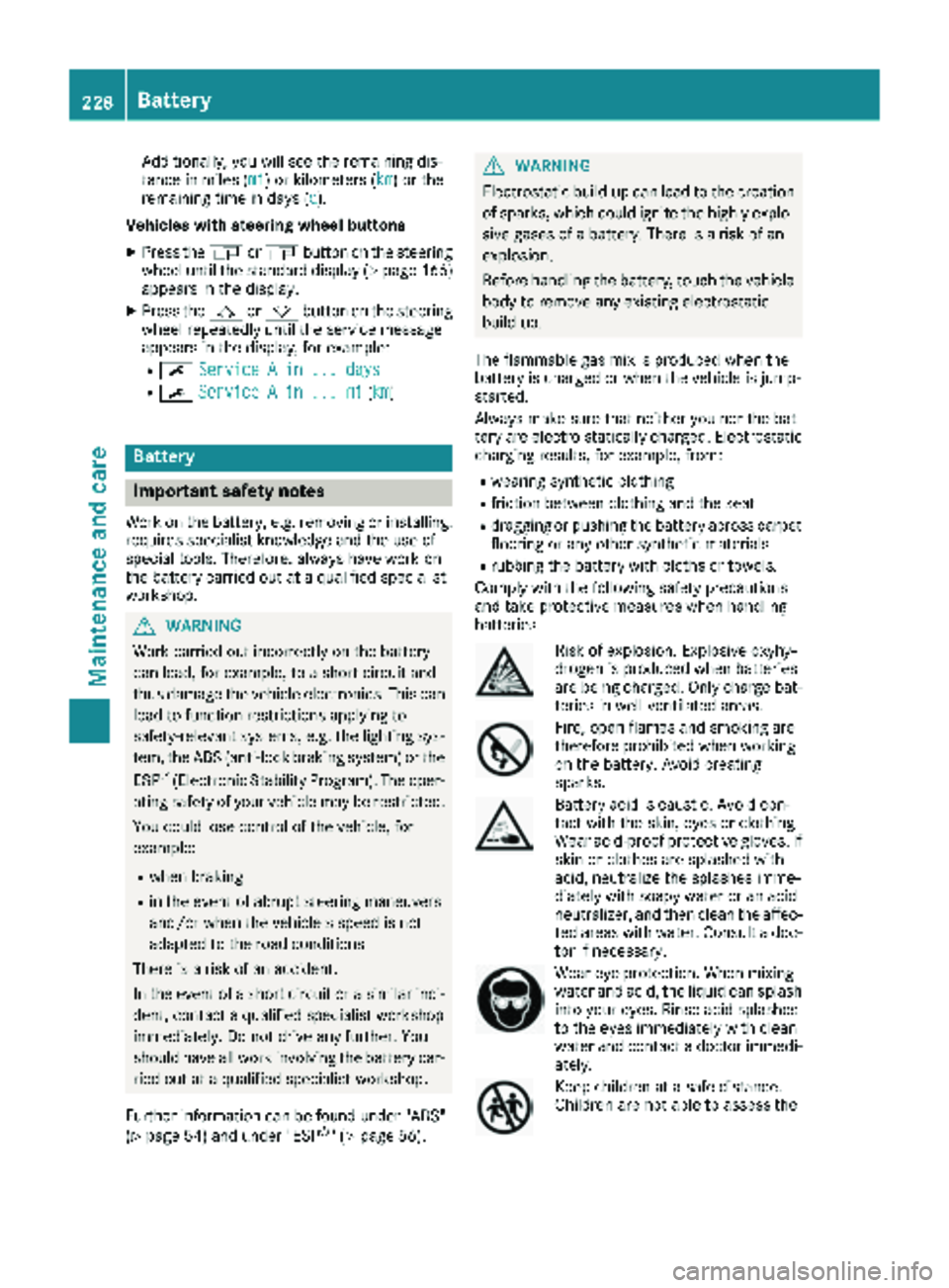
Additionally, you will see the remaining dis-
tance in miles (mi) or kilometers ( km) or the
remaining time in days ( d).
Vehicles with steering wheel buttons
XPress the VorU button on the steering
wheel until the standard display (Ypage 166)
appears in the display.
XPress the &or* button on the steering
wheel repeatedly until the service message
appears in the display, for example:
R¯ Service A in ... days
R¯Service A in ... mi(km)
Battery
Important safety notes
Work on the battery, e.g. removing or installing,
requires specialist knowledge and the use of
special tools. Therefore, always have work on
the battery carried out at a qualified specialist
workshop.
GWARNING
Work carried out incorrectly on the battery
can lead, for example, to a short circuit and
thus damage the vehicle electronics. This can
lead to function restrictions applying to
safety-relevant systems, e.g. the lighting sys-
tem, the ABS (anti-lock braking system) or the
ESP
®(Electronic Stability Program). The oper-
ating safety of your vehicle may be restricted.
You could lose control of the vehicle, for
example:
Rwhen braking
Rin the event of abrupt steering maneuvers
and/or when the vehicle's speed is not
adapted to the road conditions
There is a risk of an accident.
In the event of a short circuit or a similar inci-
dent, contact a qualified specialist workshop
immediately. Do not drive any further. You
should have all work involving the battery car- ried out at a qualified specialist workshop.
Further information can be found under "ABS"
(
Ypage 54) and under "ESP®" (Ypage 56).
GWARNING
Electrostatic build-up can lead to the creation of sparks, which could ignite the highly explo-
sive gases of a battery. There is a risk of an
explosion.
Before handling the battery, touch the vehicle
body to remove any existing electrostatic
build-up.
The flammable gas mix is produced when the
battery is charged or when the vehicle is jump-
started.
Always make sure that neither you nor the bat-
tery are electro statically charged. Electrostatic
charging results, for example, from:
Rwearing synthetic clothing
Rfriction between clothing and the seat
Rdragging or pushing the battery across carpet
flooring or any other synthetic materials
Rrubbing the battery with cloths or towels.
Comply with the following safety precautions
and take protective measures when handling
batteries.
Risk of explosion. Explosive oxyhy-
drogen is produced when batteries
are being charged. Only charge bat-
teries in well-ventilated areas.
Fire, open flames and smoking are
therefore prohibited when working
on the battery. Avoid creating
sparks.
Battery acid is caustic. Avoid con-
tact with the skin, eyes or clothing.
Wear acid-proof protective gloves. If
skin or clothes are splashed with
acid, neutralize the splashes imme-
diately with soapy water or an acid
neutralizer, and then clean the affec-
ted areas with water. Consult a doc- tor if necessary.
Wear eye protection. When mixing
water and acid, the liquid can splash
into your eyes. Rinse acid splashes
to the eyes immediately with clean
water and contact a doctor immedi-
ately.
Keep children at a safe distance.
Children are not able to assess the
228Battery
Maintenance and care
Page 237 of 294
!Make sure that:
Rthe side windows and the roof are com-
pletely closed
Rthe climate control blower is switched off
Rthe windshield wiper switch is at position0
The vehicle could otherwise be damaged.
You can wash the vehicle in an automatic car
wash from the very start.
Wash off excess dirt before cleaning the vehicle
in an automatic car wash.
After putting the vehicle through an automatic
car wash, wipe off wax from:
Rthe rear view camera lens (Ypage 237)
Rthe windshield
Rthe windshield wiper blades
This will prevent smears and reduce wiping
noises caused by residue on the windshield.
Washing by hand
In some countries, washing by hand is only
allowed at specially equipped washing bays.
Observe the legal requirements of the country
you are currently in when washing by hand.
XDo not use hot water and do not wash the
vehicle in direct sunlight.
XUse a soft car sponge.
XUse a mild cleaning agent, e.g. a car shampoo
approved for use with Sprinter vehicles.
XThoroughly hose down the vehicle with a gen-
tle jet of water.
XDo not point the water jet directly towards the
air inlets.
XUse plenty of water and rinse out the sponge
frequently.
XRinse the vehicle with clean water and dry
thoroughly with a chamois.
XDo not let the cleaning agents dry on the
paintwork.
When using the vehicle in winter, remove all
traces of road salt deposits carefully and as
soon as possible.
Power washers
GWARNING
The water jet from a circular jet nozzle (dirt
blasters) can cause invisible exterior damage
to the tires or chassis components. Compo-
nents damaged in this way may fail unexpect-
edly. There is a risk of an accident.
Do not use power washers with circular jet
nozzles to clean the vehicle. Have damaged
tires or chassis components replaced imme-
diately.
!Under no circumstances use power washers
in the vehicle interior. The pressurized water
and associated spray produced by the power washer could cause extensive damage to the
vehicle.
!Observe the minimum distance to be main-
tained between the nozzle of the high-pres-
sure cleaner and the object to be cleaned:
Rapproximately 2.2 ft(70 cm) when using
round-jet nozzles
Rapproximately 1 ft (30 cm) when using 25°
flat-spray jets and concentrated-power jets
Keep the water jet moving while cleaning. To
avoid causing damage, do not point the water jet directly at:
Rdoor joints
Rbrake hoses
Relectrical components
Relectrical connections
Rseals
Rdrive train, especially not at the intermedi-
ate bearing of the propeller shaft
Rrear view camera
Keep a minimum distance of 1.6 ft(50 cm).
Cleaning the engine
!Water must not enter intake or ventilation
openings. When cleaning with high pressure
water or steam cleaners, the spray must not
be aimed directly at electrical components or
the terminals of electrical lines.
Preserve the engine after the engine has been
cleaned. Protect the belt drive system from
exposure to the preservative agent.
Also observe the information under "Power
washers" (
Ypage 235).
Care235
Maintenance and care
Z