2018 MERCEDES-BENZ G-CLASS SUV roof rack
[x] Cancel search: roof rackPage 22 of 549

Pr
otection of the environment
+ ENVIRONMENTAL
NOTEEnvironmental
dama gedue tooperating conditions and
personal driving style The pollutant emission of
your vehicle is
directly related tothewa yyo u operate your
ve hicle.
Help toprotect the environment byoperating
yo ur vehicle in an environmentally responsi‐
ble manner. Please obser vethefo llowing rec‐
ommendations on ope rating conditions and
pe rsonal driving style.
Operating conditions: #
Make sure that the tyre pressure is cor‐
re ct. #
Do not car ryany unnecessary weight
(e.g. roof luggage rack s once you no
lon ger need them). #
Adhere tothe service inter vals.
A regularly serviced vehicle will contri b‐
ute toenvironmen tal pr otection. #
Alw ays ha vemaintenance workcar ried
out at a qualified specialist workshop.
Pe rsonal driving style: #
Do not depress the accelera tor pedal
when starting the engine. #
Do not warm upthe engine while the
ve hicle is stationar y. #
Drive carefully and maintain a suitable
di st ance from theve hicle in front. #
Avoid frequent, sudden acceleration
and braking. #
Change gear in good time and use each
ge ar on lyup toÔ of its maximum
engine speed. #
Switch off the engine in stationary traf‐
fi c, e.g. byusing the ECO start/ stop
function. #
Drive fuel-ef ficiently. Obser vethe ECO
display for a fuel-ef ficient driving style. Ta
ke -back of end-of-life vehicles
EU countries onl y:
Mercedes-Benz will take back your end-of-life
ve hicle for environment-friendly disposal in
accordance with the European Union(EU) End-
of-Life Vehicles Directive.
A network of vehicle take -ba ckpoints and dis‐
mantlers has been es tablished foryo uto return
yo ur vehicle. You can lea veit at any of these
points free of charge . This makes an impor tant
contribution toclosing there cycling circle and
conse rving resources.
Fo r fur ther information about there cycling and
disposal of end-of-li fevehicles, and theta ke-
back conditions, please visit the national
Mercedes-Benz website foryo ur count ry. Gene
ral no tes 19
Page 85 of 549

*
NO
TEMalfunction caused bysnow and
ice Snow and ice may lead
toa malfunction of
th e sliding sunroof. #
Only open the sliding sunroof if it is free
of snow and ice. *
NO
TEDama gecaused byprotru ding
objects Objects
that pr otru de from the sliding sun‐
ro of may damage the sealing strips. #
Do not allow anything toprotru de from
th e sliding sunroof. *
NO
TEImpo rtant points toremember
when a roof rack isfitted When a
roof rack isfitted, raising or opening
th e sliding sunroof may be limited. #
Check whe ther the sliding sunroof can
be raised or opened when a roof rack is
fi tted. #
If in doubt, do not raise or open the
sliding sunroof. 1
Raising
2 Opening
3 Closing/lo wering #
Tostart automatic operation: pressthe
3 button be yond the point of resis tance
or pull and release it. #
Tointer rupt automatic operation: briefly
press the3 button in any direction.
The opening/closing process will be stop‐
ped.
Au tomatic reve rsing function of the sliding
sunroof
If th ere is an object obstructing the sliding sun‐
ro of during the closing process, the sliding sun‐
ro of will open again automaticall y.The automatic
re ve rsing function is only an aid and is not a sub‐
st itute foryo ur attentiveness. #
When closing, make sure that no body parts
are in the closing area. &
WARNING Risk of entrapment even wi th
th ere ve rsing feature active
The reve rse function does not react in partic‐
ular:
R tosoft, light and thin objects, e.g. fingers 82
Opening and closing
Page 111 of 549
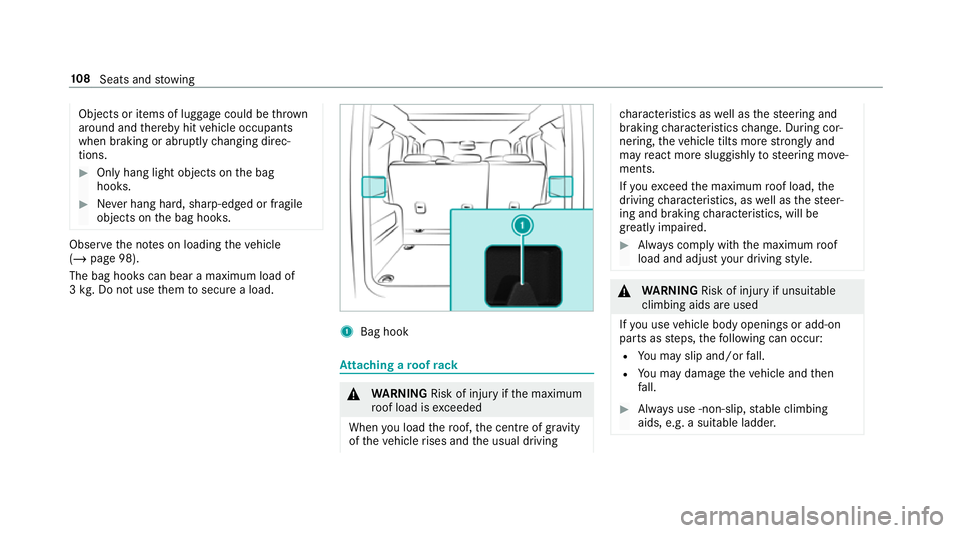
Objects or items of luggage could be
thrown
around and thereby hit vehicle occupants
when braking or abruptly changing direc‐
tions. #
Onlyhang light objects on the bag
hooks. #
Never hang hard, sharp-edged or fragile
objects on the bag hooks. Obser
vethe no tes on loading theve hicle
(/ page 98).
The bag hooks can bear a maximum load of
3 kg . Do not use them tosecure a load. 1
Bag hook At
taching a roof rack &
WARNING Risk of inju ryifth e maximum
ro of load is exceeded
When you load thero of, the cent reof gr avity
of theve hicle rises and the usual driving ch
aracteristics as well as thesteering and
braking characteristics change. During cor‐
nering, theve hicle tilts more strongly and
may react more sluggishly tosteering mo ve‐
ments.
If yo uexc eed the maximum roof load, the
driving characteristics, as well as thesteer‐
ing and braking characteristics, will be
great lyimpaired. #
Alw ays comply with the maximum roof
load and adjust your driving style. &
WARNING Risk of inju ryif unsuitable
climbing aids are used
If yo u use vehicle body openings or add-on
parts as steps, thefo llowing can occur:
R You may slip and/or fall.
R You may damage theve hicle and then
fa ll. #
Alw ays use ‑non-slip, stable climbing
aids, e.g. a suitable ladder. 108
Seats and stowing
Page 112 of 549

*
NO
TEStepping on the wheel ar chflares
and bumpers may damage them If
yo u use the wheel ar chflares and bumpers
as a step, they may be dama ged or de tach
from theve hicle. #
Only use the two mar kedsteps on the
re ar bumper as a climbing aid. *
NO
TEVehicle damage due tonon-
appr ovedro of racks The
vehicle could be damaged byroof racks
which ha venot been tested and appr ovedby
Mercedes-Benz. #
Only use roof rack s appr ovedfor
Mercedes-Benz. #
Depending on theve hicle equipment,
ensure that when thero of rack isfitted,
th e sliding sunroof can be fully raised. #
Position the load on thero of rack in
such a wayth at theve hicle will not sus‐
ta in damage even when it is in motion. *
NO
TEMaximum pe rmitted roof load The
weight of thero of luggage, including the
ro of rack , must not exceed the maximum
permitted roof load.
The maximum roof load is 150kg ifth ere are
at least thre e pairs of support feet.
This applies if the load is distributed evenly
across the entire roof sur face. The maximum
load for each pair of roof rack support feet is
50 kg. When
theve hicle is at a standstill and when at
least thre e pairs of support feet are used, the
maximum permitted roof load of 150kg may be
exc eeded bya maximum of 150kg , e.g. when a
ro of tent is used. Alw ays comply with thero of
ra ck manufacturer's ins tallation instructions. *
NO
TEDama getothe co vers The co
vers may be dama ged and scratched
when being opened. #
Use the disassembly tool pr ovided in
th eve hicle tool bag. #
Do not use me tallic or hard objects. Seats and
stowing 109
Page 113 of 549

#
Remo vethero of rack before ins talling
th e co vers. Bear in mind
thefo llowing related topic:
R Vehicle tool kit overview(/ page418)
An inco rrectly attached roof rack or an incor rect
ro of load can become de tach ed from theve hicle.
It is essential tocomply wi th thero of rack manu‐
fa cturer's ins tallation instructions. #
Carefully remo vethe co vers 1 inthe direc‐
tion of the ar row with the disassembly tool. #
Attach thero of rack atthe securing points
2. #
Comply with thero of rack manufacturer's
ins tallation instructions. #
Secure the load on thero of rack. Cup holders
Fi
tting the cup holder in or removing it from
the centre console &
WARNING ‑ Risk of accident or inju ry
when using the cup holder while the
ve hicle is in motion
The cup holder cannot hold a container
secure while theve hicle is in motion.
If yo u use a cup holder while theve hicle is in
motion, the conta iner may be flung around
and liquids could be spilled. The vehicle
occupants may come into contact with the
liquid and if it is hot, they could be scalded.
Yo u could be distracted from traf fic condi‐
tions and you may lose cont rol of theve hicle. #
Only use the cup holder when theve hi‐
cle is stationar y. #
Only use the cup holder for containers
of theright size. #
Alw ays close the conta iner, particularly
if th e liquid is hot. #
Toremo ve: slide the catch 2forw ards and
pull out the cup holder 1. #
Tofit: inse rtthe cup holder 1and slide
back the catch 2.
% The cup holder rubber mat can be remo ved
fo r cleaning, e.g. using clean, luk ewarm
wate r.
% Obser vethe no tes on loading theve hicle
(/ page 98). 11 0
Seats and stowing