2018 MERCEDES-BENZ E-CLASS WAGON run flat
[x] Cancel search: run flatPage 123 of 506
#Closethe loc kable stow age spaces
before starting a journe y.
#Alwaysstow and secure heavy, hard,
pointe d, sharp-edged, fragile or bulky
objects in the trunk/load compartment.
Obser vethe no tes on loading theve hicle.
&
WARNING Risk offire from placing
objects in the mobile phone stowage
compartment
If yo uplac e objects inthe mobile phone
stow age compartment, they may heat up
exc essively and even catch fire .
#Do not place additional objects, espe‐
cially those mode of me tal, in the
mobile phone stowage compartment.
* NO
TEDama getoobjects caused by
placing them in the mobile phone stow‐
age compartment
If yo u place objects in the mobile phone
stow age compartment, these may be dam‐
aged byelectromagnetic fields.
#Do not place credit cards, storage
media or other objects sensitive to
electromagnetic fields in the mobile
phone stowage compartment.
* NO
TEDama getothe mobile phone
stow age compartment caused byliquids
If liquids enter the mobile phone stowage
compartment, the compartment may be
damaged.
#Ensure that no liquids enter the mobile
phone stowage compartment.
RDepending on theve hicle equipment, the
mobile phone is connected totheve hicle's
ex terior antenna via thech arging module.
RThe charging function and wireless connec‐
tion of the mobile phone totheve hicle's
ex terior antenna are only available if the igni‐
tion is switched on.
RSmall mobile phones may not be able tobe
ch arge d in every position of the mobile
phone stowage compartment.
RLargemobile phones which do not rest flat in
th e mobile phone stowage compartment may
not be able tobe charge d or connec ted with
th eve hicle's exterior antenna.
RThe mobile phone may heat up during the
ch arging process. The mobile phone can be
cooled in the mobile phone stowage com‐
partment when the air conditioning sy stem is
switched on. The cooling output in the
mobile phone stowage compartment is high‐
est when the controller in theglov e box is
closed.
RTo ensure more ef ficient charging and con‐
nection with theve hicle's exterior antenna,
re mo vethe pr otective co ver from the mobile
phone.
Seats and stowing 12
1
Page 342 of 506
Emergency
Re moving the saf etyve st
The saf etyve sts are located in the saf etyve st
compart ments in the driver's and front
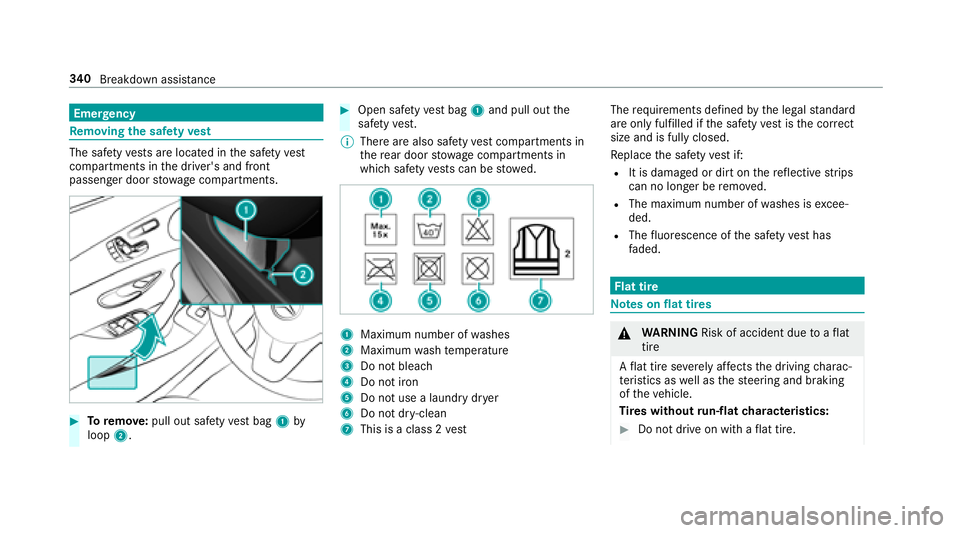
passenger door stowage compartments.
#Toremo ve:pull out safe tyvest bag 1by
loop 2.
#Open saf etyve st bag 1and pull out the
saf etyve st.
% There are also saf etyve st compart ments in
th ere ar door stowage compartments in
which saf etyve sts can be stowed.
1Maximum number of washes
2Maximum wash temp erature
3Do not bleach
4Do not iron
5Do not use a laundry dr yer
6Do not dr y-clean
7This is a class 2 vest The
requ irements defined bythe legal standard
are only fulfille difth e saf etyve st isthe cor rect
size and is fully closed.
Re place the saf etyve st if:
RIt is damaged or dirt on there flective strips
can no longer be remo ved.
RThe maximum number of washes is excee‐
ded.
RThe fluorescence of the saf etyve st has
fa ded.
Flat tire
Note s on flat tires
&
WARNING Risk of accident due toaflat
tire
A flat tire se verely affects the driving charac‐
te rist ics as well as thesteering and braking
of theve hicle.
Ti re s without run-flat characteristics:
#Do not drive on with a flat tire.
34 0
Breakdown assis tance
Page 343 of 506
#Changetheflat tire immediately with
th e emer gency spa rewheel or spare
wheel. Alternativel y,consult a qualified
specialist workshop.
Ti re s with run-flat characteristics:
#Observ eth e information and warning
no tes on MOExtended tires (run-flat
tires).
In theeve nt of a flat tire, thefo llowing options
are available depending on your vehicle's equip‐
ment:
RVe hicles with MOExtended tires: it is pos‐
sible tocontinue the journey for a short
period of time. Make sure you observ eth e
no tes on MOExtended tires (run-flat tires)
(
→page 341).
RVe hicles with a TIREFIT kit: you can repair
th e tire so that it is possible tocontinue the
jou rney for a short period of time. Todo this,
use the TIREFIT kit (
→page 342).
RVe hicles with Mercedes-Benz
mbrace®(USA only): you can make a call for Ro
adside Assis tance via theove rhead control
panel in the case of a breakdown
(
→page 294).
RAll vehicles: change the wheel
(→page 384).
MOExtended tires (tires with run-flat proper‐
ties)
& WARNING Risk of accident when driving
in li mp-home mode
When driving in emergency mode the han‐
dling characteristics are impaired, e.g. when
cornering, when accelerating stronglyand
when braking.
#Do not exceed the specified maximum
speed.
#Av oid any abrupt steering and driving
maneuvers as well as driving over
obs tacles (curbs, pot holes, off-road).
This applies, in part icular,toa loaded
ve hicle.
#Stop driving in the emer gency mode if
yo u notice:
Rbanging noise
Rvehicle vibration
Rsmoke which smells like rubber
Rcontinuous ESP®inter vention
Rcrac ksin tire side walls
#After driving in emergency mode ha ve
th erims checkedby aqu alified special‐
ist workshop with rega rd totheir fur ther
use.
#The defective tire must be replaced in
eve rycase.
With MOExtended tires (run-flat tires), you can
continue todrive your vehicle even if there is a
tot al loss of pressure in one or more tires. How‐
eve r,th e tire af fected must not show any clearly
visible damage.
Yo u can recognize MOExtended tires bythe
MOExtended marking which appears onthe side
wa ll of the tire.
Breakdown assis tance 34
1
Page 345 of 506
#If tire sealant has been swallowed,
immediately rinse out the mouth thor‐
oughly and drink plenty of water.Do not
induce vomiting and seek medical
attention immediately.
#Change out of any clo thes conta mina‐
te d with tire sealant immediatel y.
#If allergicreactions occur, seek medical
attention immediatel y.
*NO
TEOverheating due tothe tire infla‐
tion compressor running too long
#Do not runth e tire inflation compressor
fo r longer than ten minu tes without
inter ruption.
Comply with the manufacturer's saf etyno tes in
th est icke r on the tire inflation compressor.
Ha ve the tire sealant bottle replaced everyfour
ye ars at a qualified specialist workshop.
#Do not remo veany fore ign objects which
ha ve penetra tedth e tire.
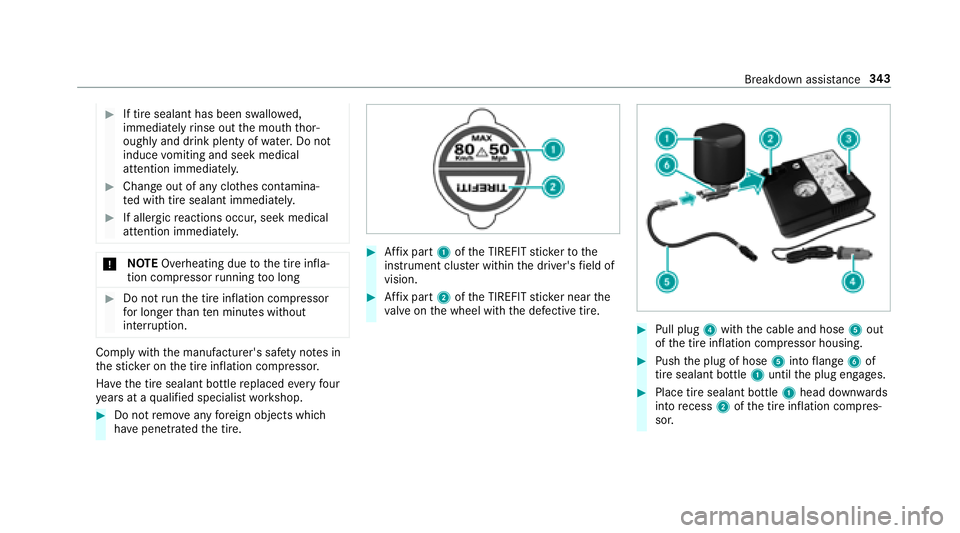
#Af fix pa rt1 ofthe TIREFIT sticke rto the
instrument clus ter within the driver's field of
vision.
#Af fix pa rt2 ofthe TIREFIT sticke r near the
va lve on the wheel with the defective tire.
#Pull plug 4with the cable and hose 5out
of the tire inflation compressor housing.
#Push the plug of hose 5into flange 6of
tire sealant bottle 1until the plug engages.
#Place tire sealant bottle 1head down wards
into recess 2ofthe tire inflation compres‐
sor.
Breakdown assis tance 34
3
Page 346 of 506
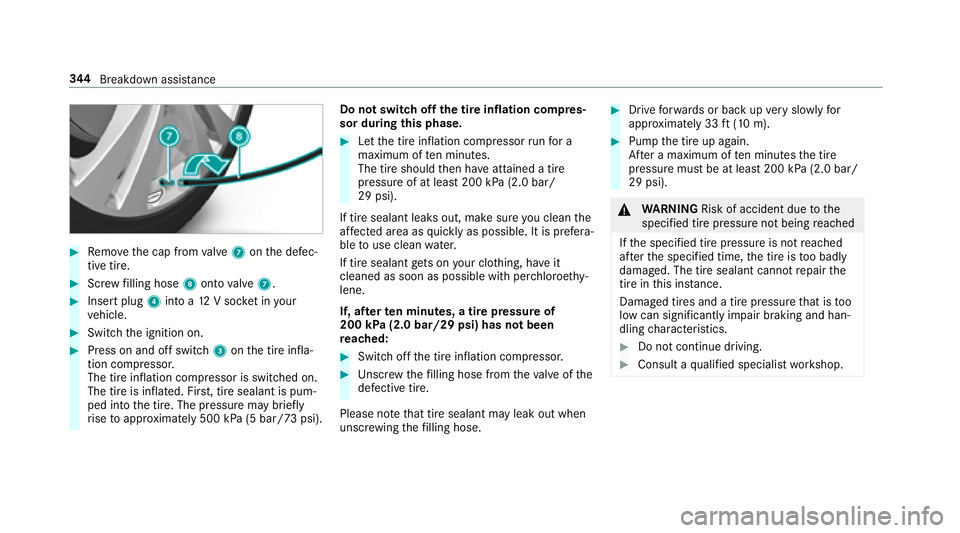
#Remo vethe cap from valve 7 onthe defec‐
tive tire.
#Scr ew filling hose 8onto valve 7.
#Insert plug 4into a 12V soc ket in your
ve hicle.
#Switch the ignition on.
#Press on and off switch 3onthe tire infla‐
tion compressor.
The tire inflation compressor is switched on.
The tire is inflated. Fir st, tire sealant is pum‐
ped into the tire. The pressure may brief ly
ri se toappr oximately 500 kPa (5 bar/73 psi). Do not switch off
the tire inflation compres‐
sor du ring this phase.
#Let the tire inflation compressor runfo r a
maximum of ten minu tes.
The tire should then ha veattained a tire
pressure of at least 200 kPa (2.0 bar/
29 psi).
If tire sealant leaks out, make sure you clean the
af fected area as quickly as possible. It is prefera‐
ble touse clean water.
If tire sealant gets on your clo thing, ha veit
cleaned as soon as possible with per chloroe thy‐
lene.
If, af terte n minutes, a tire pressure of
200 kPa (2.0 bar/29 psi) has not been
re ached:
#Switch off the tire inflation compressor.
#Un scr ew thefilling hose from theva lve of the
defective tire.
Please no tethat tire sealant may leak out when
unscr ewing thefilling hose.
#Drive forw ards or back up very slowly for
appr oximately 33 ft(10 m).
#Pump the tire up again.
Af ter a maximum of ten minu testh e tire
pressure must be at least 200 kPa (2.0 bar/
29 psi).
& WARNING Risk of accident due tothe
specified tire pressure not being reached
If th e specified tire pressure is not reached
af te rth e specified time, the tire is too badly
damaged. The tire sealant cannot repair the
tire in this ins tance.
Dama ged tires and a tire pressure that is too
low can significantly impair braking and han‐
dling characteristics.
#Do not continue driving.
#Consult a qualified specialist workshop.
34 4
Breakdown assis tance
Page 382 of 506
Changing a wheel
Notes on selecting, mounting and replacing
tires
Mercedes -AMG vehicles: be sure toobser ve
th e no tes in the Supplement. Otherwise, you
may not recognize dangers.
Yo u can ask for information rega rding permitte d
wheel/tire combinations at an authorized
Mercedes-Benz Center.
& WARNING Risk of accident due toincor‐
re ct dimensions of wheels and tires
If wheels and tires of the wrong size are
ins talled, the wheel brakes or wheel suspen‐
sion components may be damaged.
#Alw aysre place wheels and tires with
th ose that fulfill the specifications of
th e original part.
When replacing wheels, make sure tofit th e
cor rect:
RDesignation
RModel
When replacing tires, make sure toins tallth e
cor rect:
RDesignation
RManufactu rer
RModel
&
WARNING Risk of injury thro ugh exceed‐
ing the specified tire load rating or the
permissible speed rating
Exceeding the specified tire load rating or
th e permissible speed rating may lead totire
damage andtothe tires bur sting.
#Therefore, only use tire types and sizes
appr ovedfo ryo ur vehicle model.
#Obser vethe tire load rating and speed
ra ting requ ired foryo ur vehicle.
* NO
TEDama getovehicle and tires due to
non-app rove d tire types and sizes
Fo r saf etyre asons, only use wheels, tires
and accessories which havebeen appr oved
fo ryo ur vehicle byMercedes-Benz.
These tires ha vebeen specially adap tedfo r
use with the control sy stems, e.g. ABS or
ESP
®, and are mar ked as follo ws :
RMO = Mercedes-Benz Original
RMOE = Mercedes-Benz Original Extended
(run-flat tires only for cer tain wheels)
RMO1 = Mercedes-Benz Original (only cer‐
tain AMG tires)
Cer tain characteristics, e.g. handling, vehicle
noise emissions or fuel consum ption, may
ot herwise be adversely af fected. In addition,
when driving wi tha load, tire dimension var‐
iations could cause the tires tocome into
contact wi th the body and axle components.
This could result in damage tothe tires or the
ve hicle.
380
Wheels and tires
Page 384 of 506
Observethefo llowing when selecting, ins talling
and replacing tires:
ROnly use tires and wheels of the same type
(summer tires, winter tires, MOEx tended
tires) and the same make.
ROnly mount wheels of the same size on one
axle (left and right).
It is only permissible tomount a dif fere nt
wheel size in theeve nt of a flat tire in order
to drive tothe specialist workshop.
ROnly mount tires of the cor rect size onto the
wheels.
RVe hicles with a tire pressure monitoring
sy stem: All mounte d wheels must be equip‐
ped with functioning sensors forth e tire
pressure monitoring sy stem.
RAt temp eratures below 45 °F (7 °C), use win‐
te r tires or all-season tires mar ked M+S for
all wheels.
Wi nter tires bearing thei snowflake sym‐
bol in addition tothe M+S marking pr ovide
th e best possible grip in wintry road condi‐
tions.
RFo r M+S tires, only use tires with the same
tread.
RObser vethe maximum permissible speed for
th e M+S tires mounted.
If th is is below theve hicle's maximum speed,
th is must be indicated in an appropriate label
in the driver's field of vision.
RBreak in new tires at moderate speeds for
th efirs t 60 miles (100 km).
RRe place the tires af ter six years at the latest,
re ga rdless of wear.
RWhen replacing with tires that do n otfea‐
ture run-flat characteristics: Vehicles with
MOExtended tires are not equipped with a
TIREFIT kit at thefa ctor y.Equip theve hicle
with a TIREFIT kit af terre placing with tires
th at do not feature run-flat characteristics,
e.g. winter tires.
Fo r more information on wheels and tires, con‐
ta ct a qualified specialist workshop.
Be sure toalso observ eth efo llowing fur ther
re lated subjects:
RNo tes on tire pressure (→page 361)
RTire and Loading Info rmation placard
(→page 367)
RTi re size designation, load-beari ng capacity,
speed rating and load ind ex(→page 375)
RTire pressure table (→page 363)
Note s on inter changing wheels
&
WARNING Risk of injury thro ugh dif fer‐
ent wheel sizes
Inter changing the front and rear wheels if the
wheels or tires ha vediffere nt dimensions
may se verely impair the driving characteris‐
tics.
The wheel brakes or wheel suspension com‐
ponents may also be damaged.
#Ro tate front and rear wheels only ifth e
wheels and tires are of the same dimen‐
sions.
382 Wheels and tires