Page 339 of 486
#Loadtheve hicle cor rectly onto the
transpo rter.
#Secure theve hicle on all four wheels
wit h suit abletensioning stra ps.
#Do not exceed the maximum permissi‐
ble speed of 35 mph(6 0 km/h) when
transpo rting.
* NO
TEDama getotheve hicle from secur‐
ing it incor rectly
#Af ter loading, theve hicle must be
secured at all four wheels. Otherwise,
th eve hicle could be damaged.
#A minimum dis tance of 8 in (20 cm) up
and 4 in (10 cm) down must bekept to
th e transport platform.
#Secure theve hicle on all four wheels af ter
loading. 4MATIC
vehicles/ve hicles with automatic
transmission
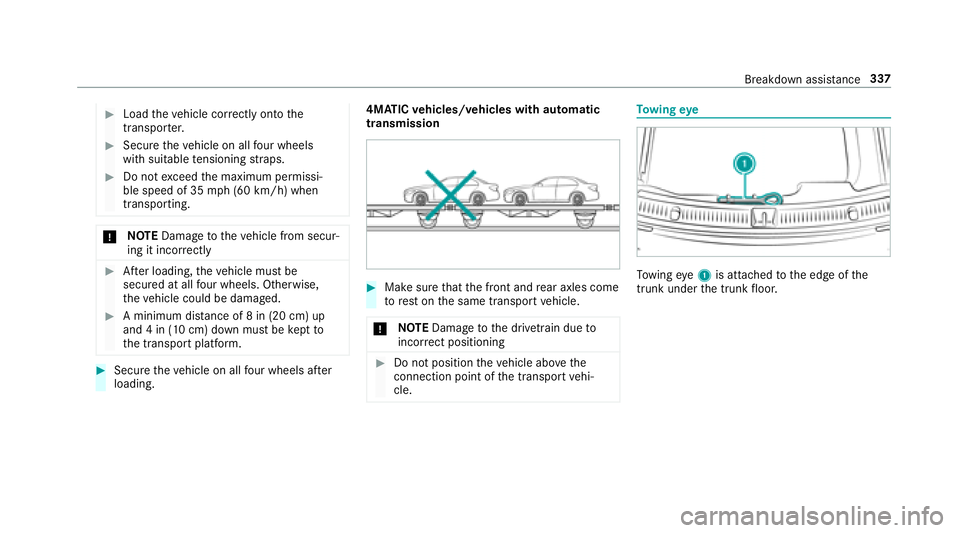
#Make sure that the front and rear axles come
to rest on the same transport vehicle.
* NO
TEDama getothe driv etra in due to
incor rect positioning
#Do not position theve hicle abo vethe
connection point of the transport vehi‐
cle.
To wing eye
Towing eye1 is attached tothe edge of the
trunk under the trunk floor.
Breakdown assis tance 337
Page 341 of 486

color and fuserating. The fuse ratings are li sted
in the fuse assignment diagram.
Fu se assignment diag ram: onthe fuse box in
th e trunk (
→page 341).
* NO
TEDama geor malfunctions caused
by moisture
Moisture may cause dama getothe electrical
sy stem or cause it tomalfunction.
#When the fuse box is open, make sure
th at no moisture can enter the fuse
box.
#When closing the fuse box, make sure
th at the seal of the lid is positioned cor‐
re ctly on the fuse box.
If a newly inser ted fuse also blo ws, ha vethe
cause traced and rectified at a qualified special‐
ist workshop.
Ensure thefo llowing before replacing a fuse:
RThe vehicle is secured against rolling away.
RAll electrical consumers are switched off.
RThe ignition is switched off. The electrical fuses are located in
various fuse
bo xes:
RFu se box in the engine compartment on the
driver's side (→page 339)
RFu se box on the driver's side of the cockpit
(→page 340)
RFu se box in the front-passen gerfo ot we ll
(→page 340)
RFu se box in the trunk on theright-hand side
of theve hicle, when vie wed in the direction
of tr avel (
→page 341)
Fuse box in the engine compa rtment
Prerequisites
Observ eth e no tes on electrical fuses
(
→page 338).
Ha ve thefo llowing readily available:
RA dry clo th
RA screwdriver Opening
&
WARNING Risk of injury from usingthe
windshield wipers while the engine hood
is open
When the engine hood is open and the wind‐
shield wipers are set in motion, you can be
trapped bythe wiper linkage.
#Alw ays switch off the windshield wipers
and ignition before opening the engine
hood.
Breakdown assis tance 339
Page 343 of 486
#Open cover1 inthe direction of the ar row
and remo veit.
Fuse box in the trunk
Re quirements
Obser vethe no tes on electrical fuses
(
→page 338).
#Fo ld up co ver1 inthe direction of the
ar row .
The fuse assignment diagram is in a recess on
th e side of the fuse box.
Breakdown assis tance 34
1
Page 369 of 486
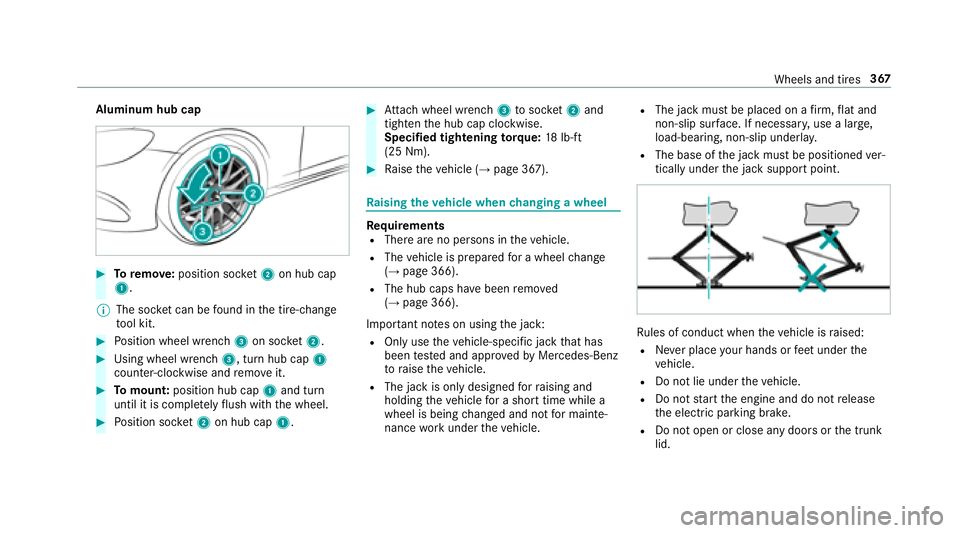
Aluminum hub cap
#Toremo ve:position soc ket2 on hub cap
1.
% The soc ket can be found inthe tire-change
to ol kit.
#Po sition wheel wrench 3on soc ket2.
#Using wheel wrench 3, turn hub cap1
counter-clo ckwise and remo veit.
#To mount: position hub cap 1and turn
until it is compl etely flush withth e wheel.
#Po sition soc ket2 on hub cap 1.
#Attach wheel wrench 3tosoc ket2 and
tighten the hub cap clockwise.
Specified tightening torq ue: 18lb-ft
(25 Nm).
#Ra ise theve hicle (→page 367).
Ra ising theve hicle when changing a wheel
Re quirementsRThere are no persons in theve hicle.
RThe vehicle is prepared for a wheel change
(→page 366).
RThe hub caps ha vebeen remo ved
(→page 366).
Impor tant no tes on using the jack:
ROnly use theve hicle-specific jack that has
been tested and appr ovedby Mercedes-Benz
to raise theve hicle.
RThe jack is only designed forra ising and
holding theve hicle for a short time while a
wheel is being changed and not for mainte‐
nance workunder theve hicle.
RThe jack must be placed on a firm ,fl at and
non-slip sur face. If necessar y,use a lar ge,
load-bearing, non-slip underla y.
RThe base ofthe jack must be positioned ver‐
tically under the jack support point.
Ru les of conduct when theve hicle is raised:
RNe ver place your hands or feet under the
ve hicle.
RDo not lie under theve hicle.
RDo not start the engine and do not release
th e electric parking brake.
RDo not open or close any doors or the trunk
lid.
Wheels and tires 367
Page 375 of 486
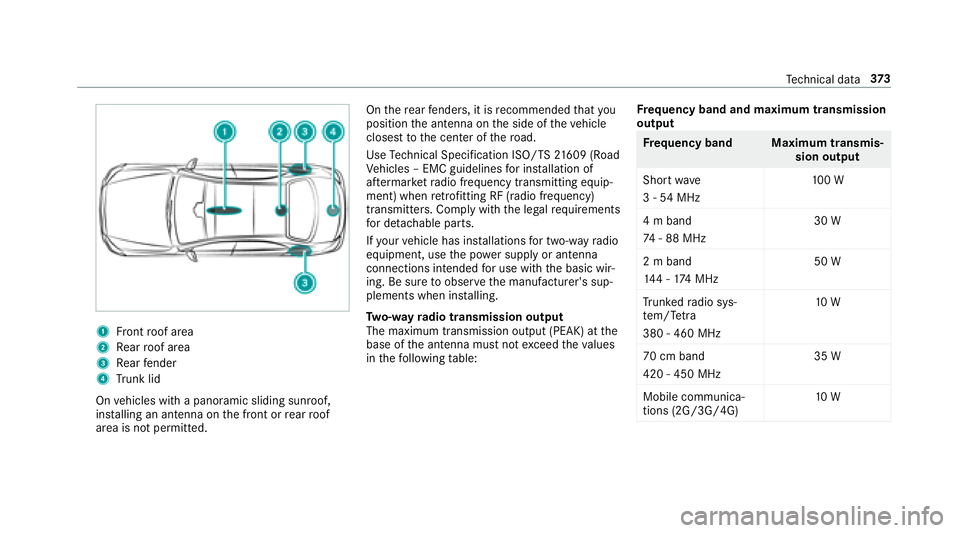
1Front roof area
2Re ar roof area
3Re ar fender
4Trunk lid
On vehicles with a panoramic sliding sunroof,
ins talling an antenna on the front or rear roof
area is not permitted. On
there ar fende rs, it is recommended that you
position the antenna on the side of theve hicle
closest tothe center of thero ad.
Use Tech nical Specification ISO/TS 21609 (Road
Ve hicles – EMC guidelines for ins tallation of
af te rm arke tra dio frequency transmitting equip‐
ment) when retrofitting RF (radio frequency)
transmitters. Co mply wi th th e legal requirements
fo r de tach able parts.
If yo ur vehicle has ins tallations for two-w ayradio
equipment, use the po wer supp lyor antenna
connections intended for use with the basic wir‐
ing. Be sure toobser vethe manufacturer's sup‐
plements when ins talling.
Tw o-w ayradio transmission output
The maximum transmission output (PEAK) at the
base of the antenna must not exceed theva lues
in thefo llowing table: Fr
equency band and maximum transmission
output
Fr equency band Maximum transmis‐
sion output
Sho rtwa ve
3 - 54 MHz 10
0 W
4 m band
74 - 88 MHz 30 W
2 m band
14 4 - 174 MHz 50 W
Tr unked radio sys‐
te m/T etra
380 - 460 MHz 10
W
70 cm band
420 - 450 MHz 35 W
Mobile communica‐
tions (2G/3G/4G) 10
W
Tech nical da ta37
3
Page 376 of 486
Thefollowing can be used in theve hicle without
re strictions:
RRF transmitter wi tha maximum transmission
output of up to100 mW
RRF transmitters with transmitter frequencies
inthe 380 - 410 MHz frequency band and a
maximum transmission output of up to2 W
(trunked radio sy stem/T etra )
RMobile phones (2G/3G/4G)
There are no restrictions when positioning the
antenna on the outside of theve hicle forth efo l‐
lowing frequency bands:
RTr unked radio sy stem/T etra
R70 cm band
R2G/3G/4G
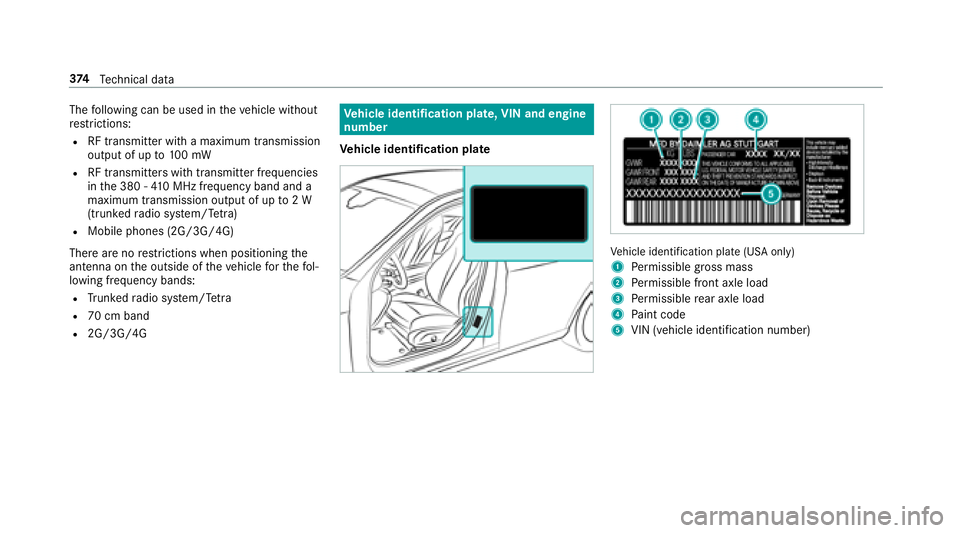
Ve hicle identification plate, VIN and engine
number
Ve hicle identification plate
Vehicle identification plate (USA only)
1
Pe rm issible grossmass
2Pe rm issible front axle load
3Perm issible rear axle load
4Pa int code
5VIN (vehicle identification number)
37 4
Tech nical da ta
Page 385 of 486
E 400 4MATIC
Wheelbase113.1 in
(28 73mm)
Ve hicle height 56.7 in
(1439 mm)
Tu rning radius 38.1ft
(1 1. 61 m)
We ights and loads
Please no tethat forth e specified vehicle data:
RItems of optional equipment increase the
curb weight and reduce the maximum pay‐
load.
Ro of load and trunk load
All models
Maximum roof load 165 lb (75 kg)
Tech nical da ta383
Page 428 of 486
Displaymessages
Possible causes/consequences and MSolutions
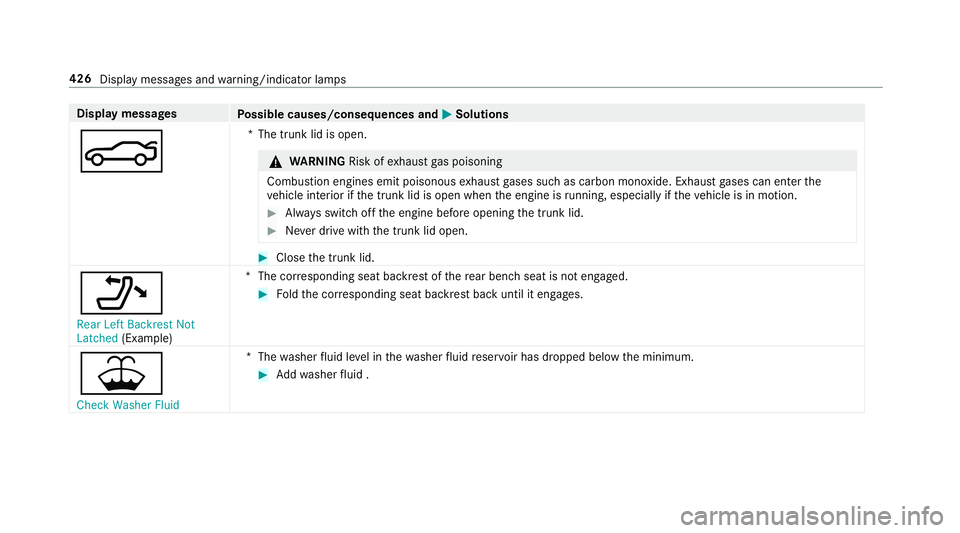
N
*The trunk lid is open.
&
WARNING Risk ofexhaust gas poisoning
Combustion engines emit poisonous exhaust gases such as carbon monoxide. Exhaust gases can enter the
ve hicle interior if the trunk lid is open when the engine is running, especially if theve hicle is in motion.
#Alw ays switch off the engine before opening the trunk lid.
#Ne ver drive with the trunk lid open.
#Close the trunk lid.
_
5HDU /HIW %DFNUHVW 1RW
/DWFKHG (Example) *T
he cor responding seat backrest of there ar bench seat is not engaged.
#Foldthe cor responding seat backrest back until it engages.
¥
&KHFN :DVKHU )OXLG *T
hewasher fluid leve l in thewa sher fluid reser voir has dropped below the minimum.
#Ad dwa sher fluid .
426
Display messages and warning/indicator lamps