2018 MERCEDES-BENZ E-CLASS COUPE trailer
[x] Cancel search: trailerPage 188 of 486
draw bars might not be identified as such or be
measured incor rectly. Only use Parking Pilot on
le ve l, high-grip ground.
Do not use Parking Pilot, forex ample, in thefo l‐
lowing situations:
RIn extreme weather conditions such as ice or
pac ked snow or in heavy rain.
RIfyo u are transport ing a loadthat pr otru des
be yond theve hicle.
RIfth e parking space is on a steep downhill or
uphill gradient.
RIf yo u ha veins talled snow chains.
Pa rking Pilot may also display parking spaces
th at are not suitable for parking, e.g.:
RPa rking spaces where parking is prohibited.
RPa rking spaces on unsuitable sur faces.
Pa rking Pilot will not assist youwit h parking
spaces at right angles tothe direction of tr avel
in thefo llowing situations:
RIf two parking spaces are located immedi‐
ately next toeach other.
RIfth e parking space is directly next toa low
obs tacle such as a low curb.
Pa rking Pilot will not assist you with parking
spaces parallel or at right angles tothe direction
of tr avel in thefo llowing situations:
RIf th e parking space is on a curb.
RIfth e parking space is bordered byan obsta‐
cle, e.g. a tree, a post or a trailer.
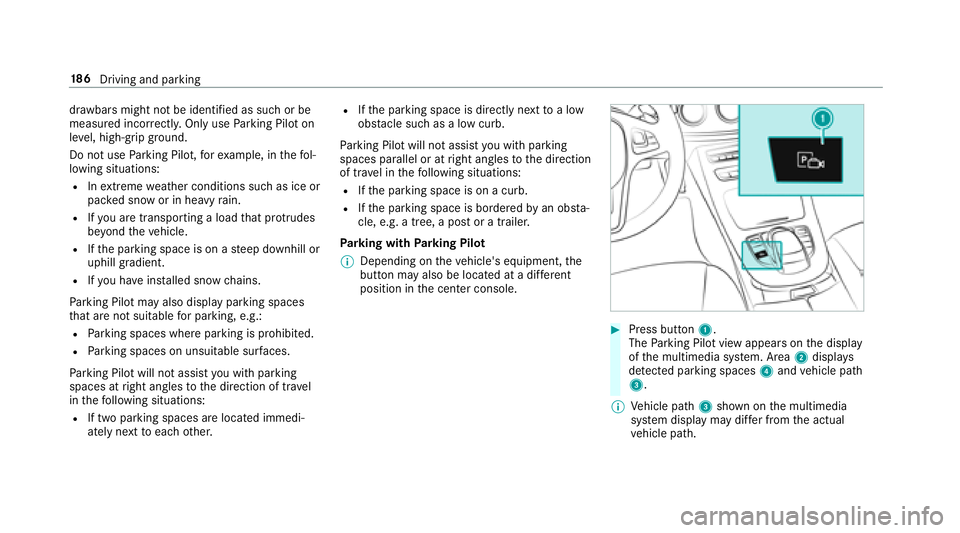
Pa rking with Parking Pilot
% Depending on theve hicle's eq uipment,the
but
ton may also be located at a dif fere nt
position in the center console.
#Press button 1.
The Parking Pilot view appears on the display
of the multimedia sy stem. Area 2displa ys
de tected park ing spaces 4and vehicle path
3.
% Vehicle path 3shown on the multimedia
sy stem display may dif fer from the actual
ve hicle path.
18 6
Driving and pa rking
Page 192 of 486
you can mo vetheve hicle back toits original
position, if necessar y.
Whilst theve hicle is being par ked with Parking
Pilot, you can inter rupt the process totake con‐
trol of theve hicle with Remo teParking Pilot and
maneuver it into its final position.
Yo u can find fur ther information in the operating
instructions forth eRe mo teParking Pilot app
http://www.me rcedes.me.
Sy stem limitations
Sn owfa ll or heavy rain may lead toa parking
space being measured inaccurately or, in cer tain
cases, toconnection problems wi th the mobile
phone. Parking spaces that are partial ly occu‐
pied bytrailer dr awbars might not be identified
as such or be measured incor rectl y.Only use
Re mo teParking Pilot on a le vel, high-grip sur‐
fa ce. The park ing space must be at least 2 ft
(0.60 m) wider than theve hicle without the out‐
side mir rors.
Do not use Remo teParking Pilot, forex ample, in
th efo llowing situations:
RIn extreme weather conditions such as ice or
pac ked snow or in heavy rain.
RIfyo u are transport ing a loadthat pr otru des
be yond theve hicle.
RIfyo u ha veinstalled snow chains.
RIfth e parking space is on a downhill or uphill
incline.
Re mo teParking Pilot is canceled if, among other
th in
gs, one of thefo llowing actions is car ried
out:
RYo uswit choff Parking Pilot.
RYo u press a butto n onthe SmartK ey.
RESP®inter venes.
During the parking procedure, you must not
st and more than appr ox.10 ft(3.0 m) away from
th eve hicle. Otherwise, the procedure will be
inter rupte d and a cor responding message will be
displa yed on the mobile phone. If you mo ve
closer totheve hicle, youwill beable tocontinue
th e procedure.
Fu rther information on canceling the function
can be found inthe operating instructions for
th eRe mo teParking Pilot app. Operating
Remo tePark ing Pilot
&
WARNING Risk of accident due to
objects located abo veor below the
de tection range of Parking Pilot
If th ere are objects abo veor below the
de tection range, thefo llowing situations may
arise:
RPa rking Pilot may steer too ear ly.
RThe vehicle may not stop in front of these
objects.
This could cause a collision.
#In these situations, do not use Parking
Pilot.
Objects located abo veor below the de tection
ra nge of Parking Pilot are not de tected when the
parking space is being measured. These are also
not take n into account when the parking maneu‐
ve r is calculated, forex ample overhanging loads,
ove rhangs or loading ramp s of truc ksorthe
boundaries of the parking space. In some cir‐
cums tances, Parking Pilot may therefore guide
yo u into the parking space prematurely.
19 0
Driving and pa rking
Page 196 of 486

&WARNING Risk of accident caused by
limited de tection per form ance of Drive
Aw ayAssist
Drive AwayAssist cannot al ways clearly iden‐
tify objects and traf fic situations.
In such cases, Drive AwayAssist might:
RWarnyouwit hout reason and limit the
ve hicle speed.
RNot warnyou or not limittheve hicle
speed.
#Alw ays pay careful attention tothe traf‐
fi c situation; do not rely on Driv eAw ay
Assist alone.
#Be prepared tobrake or swer veif nec‐
essar y.
Drive AwayAssist is only an aid. It is not a sub‐
st itute foryo ur attention tothe sur roundings.
The responsibility for safe maneu vering and
pa rking remains with you. Make sure that no
persons, animals or objects etc. are in the
maneu vering range. A
risk of a collision may arise in thefo llowing sit‐
uations, forex ample:
RIfth e driver mixes up the accelera tor and
brake pedals.
RIf th e wrong gear is selecte d.
The Drive AwayAssist function is active under
th efo llowing conditions:
RIf Pa rking Assist PARKTRONI Cis activated.
REver ytime thege ar is changed tok orh
when theve hicle is at a standstill.
RIf th e de tected obs tacle is less than appr ox.
3.3 ft(1.0 m) away.
RIfth e maneuvering assis tance function is
acti vated in the multimedia sy stem.
Drive AwayAssist is unavailable on inclines and
when driving with a trailer.
Cross Traf fic Alert
% Also read the instructions on Blind Spot
Assist (
→page 198).
Ve hicles with Blind Spot Assis t:Dr ivers can
also be warned of any crossing traf fic when re
ve rsing out of a parking space. If a critical sit‐
uation is de tected, a warning symbol appears on
th e camera image of the multimedia sy stem. If
th e driver does n
otrespond tothewa rning, the
ve hicle's brakes can be applied automaticall y.To
do this, the function uses thera dar sensors in
th e bumper. The area adjacent totheve hicle is
continually monitored.
If th era dar sensors are obstructed byvehicles
or other objects, de tection is not possible.
The Cross Traf fic Alert function is acti veunder
th efo llowing conditions:
RIf Blind Spot Assist is activated.
RIf th eve hicle is reve rsing at walking pace.
RIfth e maneuvering assis tance function is
acti vated in the multimedia sy stem.
Cross Traf fic Alert is una vailable on inclines and
when driving with a trailer.
19 4
Driving and pa rking
Page 202 of 486
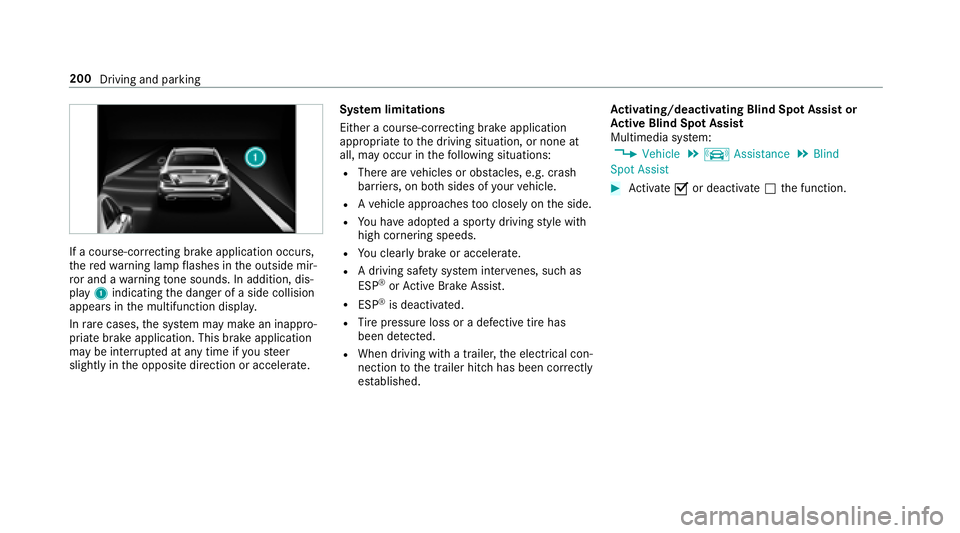
If a course-correcting brake application occurs ,
th ere dwa rning lamp flashes in the outside mir‐
ro r and a warning tone sounds. In addition, dis‐
pl ay 1 indicating the danger of a side collision
appears in the multifunction displa y.
In rare cases, the sy stem may make an inappro‐
priate brake application. This brake application
may be inter rupte d at any time if yousteer
slightly in the opposite direction or accelera te. Sy
stem limitations
Either a course-cor recting brake application
appropria teto the driving situation, or none at
all, may occur in thefo llowing situations:
RThere are vehicles or obs tacles, e.g. crash
barr iers, on bo thsides of your vehicle.
RAve hicle approaches too closely on the side.
RYo u ha veadop ted a sporty driving style with
high cornering speeds.
RYo u clear lybrake or accelera te.
RA driving safe ty system inter venes, such as
ESP®or Active Brake Assi st.
RESP®is deacti vated.
RTire pressure loss or a defective tire has
been de tected.
RWhen driving wi tha trailer, the electrical con‐
nection tothe trailer hitch has been cor rectly
es tablished. Ac
tivating/deactivating Blind Spot Assi stor
Ac tive Blind Spot Assi st
Multimedia sy stem:
,9HKLFOH.k $VVLVWDQFH.%OLQG
6SRW $VVLVW
#Ac tivate Oor deacti vate ª the function.
200
Driving and parking
Page 204 of 486

If a lane-correcting brake application occurs , dis‐
play 1appears in the multifunction displa y.
Sy stem limitations
No lane-cor recting brake application occurs in
th efo llowing situations:
RYo u clear lyand actively steer, brake or accel‐
erate.
RYo u ha veswitched on the turn signal indica‐
to r.
RA driving safe ty system inter venes, such as
ESP®, Ac tive Brake Assi stor Active Blind
Spot Assi st.
RYo u ha veadop ted a sporty driving style with
high cornering speeds or high rates of accel‐
eration.
RESP®is deactivated.
RWhen driving with a trailer, the electrical con‐
nection tothe trailer has been cor rectly
es tablished.
RIf a loss of tire pressure or a defective tire
has been de tected and displ ayed.
The sy stem may be impaired or may not function
in thefo llowing situations:
RThere is poor visibility, e.g. duetoinsuf ficient
illumination of thero ad, highly variable shade
conditions, or due torain, sno w,fog or heavy
spr ay.
RThere is glare, e.g. from the sun, reflections
or oncoming traf fic.
RThere is dirt on the windshield in the vicinity
of the multifunction camera or the camera is
fo gged up, damaged or obscured.
RNo or se veral, unclear lane markings are
present for one lane, e.g. in a construction
area.
RThe lane markings are worn, dark or co vered.
RThe dis tance totheve hicle in front is too
small and the lane markings thus cannot be
de tected.
RThe lane markings change quickl y,e.g. lanes
branch off, cross one ano ther or mer ge.
RThe road is very nar row and winding.
Ve hicles with Driving Assistance pac kage or
Driving Assistance Plus pa ckage: Active Lane
Ke eping Assist uses radar sensors tomonitor
se veral areas around theve hicle. If thera dar
sensors in there ar bumper are dirty or co vered
with snow ,th e sy stem may be impaired or may
not function. If an obs tacle in the lane in which
yo u are driving has been de tected, no lane-cor‐
re cting brake application occurs .
Switching on Active Lane Keeping Assist
&
WARNING Risk of accident despite
Ac tive Lane Keeping Assist warning
A lane-cor recting brake application cannot
al wa ys bring theve hicle back into the origi‐
nal lane.
202 Driving and parking
Page 337 of 486
%Vehicles with automatic transmission: If
th e automatic transmission cannot be shif‐
te dto position i, havetheve hicle trans‐
por tedaw ay (
→page 336). A towing vehicle
with lifting equipment is requiredforve hicle
transport.
* NO
TEDama gedue to to wing away at
exc essively high speeds or over long dis‐
ta nces
The driv etra in could be damaged when tow‐
ing at excessively high speeds or over long
dis tances.
#A towing speed of 30 mph (50 km/h)
must not be exceeded.
#Atowing dis tance of 30 miles (50 km)
must not be exceeded.
&
WARNING Risk of accident when towing
a ve hicle which is too heavy
If th eve hicle being tow- star ted or towe d
aw ay is heavier than the permissible gross
mass of your vehicle, thefo llowing situations
can occur:
RThe towing eye may become de tach ed.
RThe vehicle/trailer combination may
swer veoreve nov erturn.
#If ano ther vehicle is tow- star ted or
to we daw ay, its weight must not exceed
th e permissible gross mass of your ow n
ve hicle.
If a vehicle must be tow star ted or towe daw ay,
its weight must not exceed the permissible gross
mass of theto wing vehicle.
#Information on the permissible gross mass of
th eve hicle can be found on theve hicle iden‐
tification plate .
#Ve hicles with automatic transmission: Do
not open the driver's door or front passenger
door, otherwise the automatic transmission
automatically shifts toposition j.
#Installth eto wing eye (→page 338).
#Attach theto w bar.
* NO
TEDama gedue toincor rect connec‐
tion
#Only connect theto w rope or tow bar to
th eto wing eyes.
#Deactivate the automatic locking mechanism
(→page 62).
#Do not activate the HOLD function.
#Deactivate Active Brake Assi st(→page 159).
#Ve hicles with automatic transmission:
Shift the automatic transmission toposition
i.
#Re lease the electric parking brake.
Breakdown assis tance 335
Page 338 of 486
&WARNING Risk of accident due tolimi‐
te d saf ety-re lated functions during the
to wing process
Saf ety-re lated functions are limited or no lon‐
ge rav ailable in thefo llowing situations:
Rth e ignition is switched off.
Rthe brake sy stem or po werst eering sys‐
te m is malfunctioning.
Rth e energy supply or the on-board electri‐
cal sy stem is malfunctioning.
When your vehicle is then towe daw ay, signif‐
icantly more ef fort may be requ ired tosteer
and brake than is no rmally requ ired.
#Use a tow bar.
#Make sure that thesteering wheel can
mo vefreely, before towing theve hicle
aw ay.
* NO
TEDama gedue toexcessive tracti ve
po we r
Ifyo u pull away sharpl y,the tractive po wer
may be too high and theve hicles could be
damaged.
#Pull away slowly and smoo thly.
Loading the vehicle for transport
#Obser vethe no tes on towing away
(→page 334).
#Connect theto w bar totheto wing eyeto
load theve hicle.
#Ve hicles with automatic transmission:
Shift the automatic transmission toposition
i.
% Ve
hicles with automatic transmission:
The au tomatic transmission may be loc ked
in position jintheeve nt of damage tothe
electrics. Toshift toi, pr ovide the on-
board electrical sy stem with po wer
(
→page 330).
#Load theve hicle onto the transpor ter.
#Ve hicles with automatic transmission:
Shift the automatic transmission toposition
j.
#Use the electric parking brake tosecure the
ve hicle and pr event it from rolling away.
#Only secure theve hicle bythe wheels.
Ve hicles with ADS PLUS (Adaptive Damping
Sy stem PLUS)
&
WARNING Risk of accident when trans‐
porting vehicles with AIR BODY CON‐
TROL
The reduced damping forc es on theve hicle
being transpor ted can cause theve hicle/
trailer combination tostart toswing.
As a result, when transporting vehicles with
AIR BODY CONTROL theve hicle/trailer com‐
bination may start toskid. Consequentl y,yo u
could lose control of your vehicle.
There is a risk of accident and injur y.
336
Breakdown assis tance
Page 362 of 486
Uniform Tire Quality Grading Standards: a
uniform standard tograde thequ ality of tires
with rega rd totread quality, tire traction and
te mp erature characteristics. The quality grading
assessment is made bythe manufacturer follow‐
ing specifications from theU. S. go vernment. The
qu ality grade of a tire is imprinted on the side
wa ll of the tire.
Re commended tire pressure :th ere commen‐
ded tire pressure is the tire pressure specified
fo rth e tires mounted totheve hicle at thefa c‐
to ry.
The tire and information table conta insthere c‐
ommended tire pressure for cold tires, the maxi‐
mum permissible load and the maximum permis‐
sible vehicle speed.
The tire pressure table conta insthere commen‐
ded tire pressure for cold tires under various
operating conditions, i.e. loading and/or speed
of theve hicle.
Increased vehicle weight due tooptional
equipment: the combined weight of all standard
and optional equipment available forth eve hicle, re
ga rdless of whe ther it is actually ins talled on
th eve hicle or not.
Rim: the part of the wheel on which the tire is
mounted.
GA WR (Gross Axle Weight Rating): the GAWR
is the maximum gross axle load. The actual load
on an axle must ne verexc eed the gross axle
we ight rating. The gross axl e
we ight rati
ng can
be found on theve hicle identification plate on
th e B‑pillar on the driver's side.
Speed rating: the speed rating is pa rtof the tire
identification. It specifies the speed range for
which a tire is appr oved.
GV W (Gross Vehicle Weight): the gross vehicle
we ight comprises thewe ight of theve hicle
including fuel, tools, the spare wheel, accesso‐
ri es ins talled, occupants, luggage and the trailer
dr aw bar nose weight, if applicable. The gross
ve hicle weight must not exceed the gross vehicle
we ight rating GVWR as specified on theve hicle
identification plate on the B‑pillar on the driver's
side.
GV WR (Gross Vehicle Weight Rating): the
GV WR is the maximum permitted gross weight of
the fully laden vehicle (weight of theve hicle
including all accessories, occupants, fuel, lug‐
ga ge and the trailer dr awbar nose weight if appli‐
cable). The gross vehicle weight rating is speci‐
fi ed on theve hicle identification plate on the
B‑pillar on the driver's side.
Maximum weight of the laden vehicle: the
maximum weight is the sum of the unladen
we ight of theve hicle, thewe ight of the accesso‐
ri es, the maximum load and thewe ight of
optional equipment ins talled at thefa ctor y.
Kilopascal (kPa): metricunit for tire pressure .
6.9 kPa cor responds to1 psi. Ano ther unit for
tire pressure is bar.100 kilop ascal (kPa
) equals
1 bar.
Load index: in additiontothe load-bearing
index, the load index may also be imprinted on
th e side wall of the tire. This specifies the load-
bearing capacity of the tire more precisel y.
Curb weight: thewe ight of a vehicle with stand‐
ard equipment including the maximum capacity
of fuel, oil and coolant. It also includes the air
conditioning sy stem and optional equipment if
360
Wheels and tires