Page 295 of 326
R
wear excessively and/or unevenly R
have an adverse effect on fuel consumption
Overinflated tires
G WARNING
Tires with excessively high pressure can burst
becaus et he ya re damaged mor ee asily by
road debris ,p otholes etc .Ina ddition, they
also suffer fro mi rregular wear, which can
severely impair th eb raking properties and the
driving characteristics. Ther eisar isk of an
accident.
Avoid tir ep ressures that are too high in all the
tires, including th es pare wheel.
Overinflated tires may: R
increase th eb raking distanceR
adversely affect handling R
wear excessively and/or unevenly R
have an adverse effect on ride comfort R
be mor es usceptible to damage
Maximu mt ir ep re ssures
C
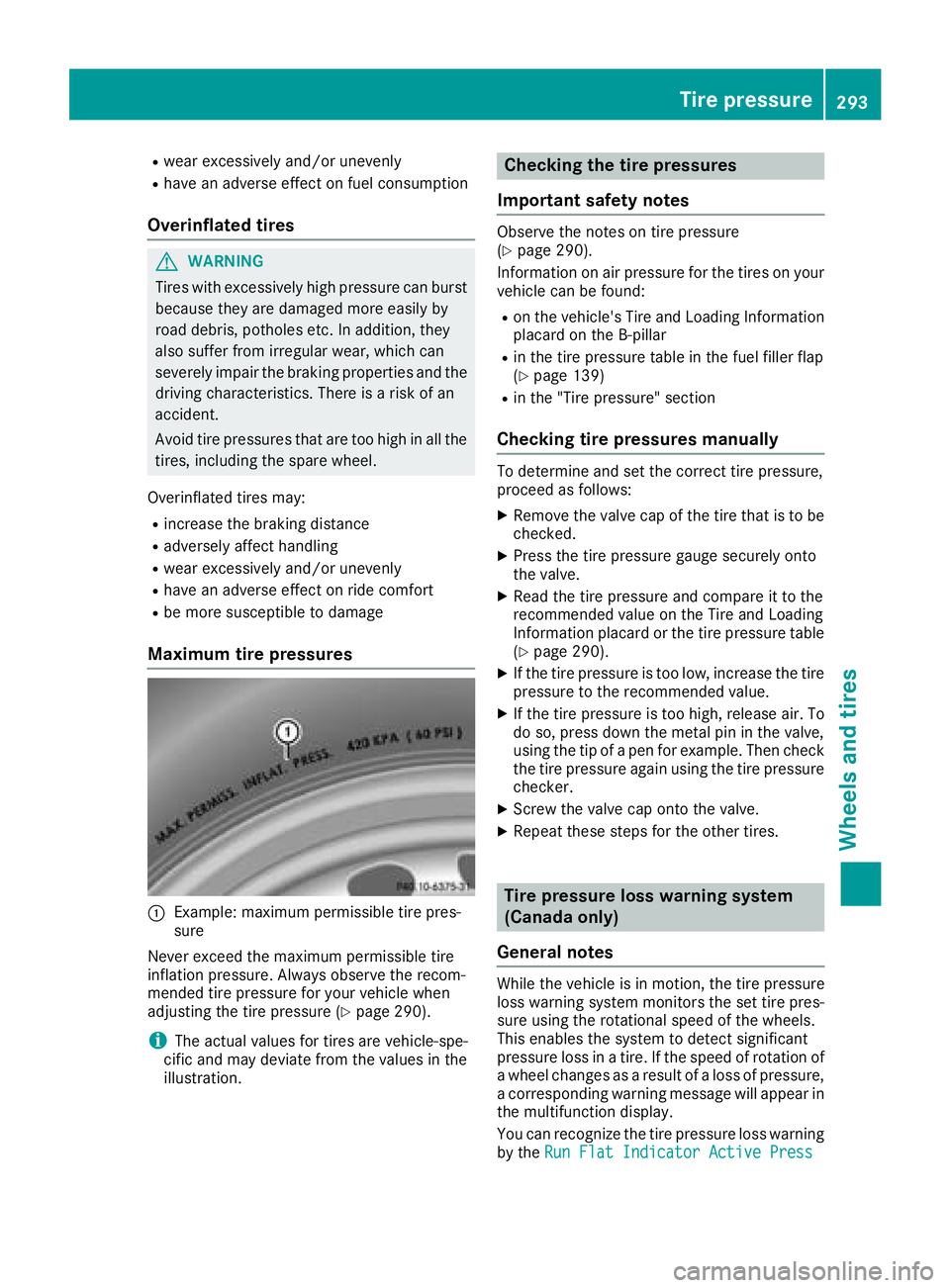
Example: maximum permissible tir ep res-
sure
Never exceed th em aximum permissible tire
inflatio np ressure. Always observe th er ecom-
mended tir ep ressure for your vehicle when
adjustin gt he tir ep ressure ( Y
page 290).
i The actual values for tires are vehicle-spe-
cific and may deviat ef ro mt he values in the
illustration. Checking th et ir ep re ssures
Important safety notes Observe th en otes on tir ep ressure
( Y
page 290).
Information on air pressure for th et ires on your
vehicle can be found: R
on th ev ehicle's Tire and Loadin gI nf ormation
placar dont he B-pillar R
in th et ir ep ressure table in th ef uel filler flap
( Y
page 139) R
in th e" Tire pressure" section
Checking tir ep re ssures manuallyTo determine and set th ec orrec tt ir ep ressure,
proceed as follows: X
Remov et he valve cap of th et ir et ha tistob e
checked. X
Pres st he tir ep ressure gauge securely onto
th ev alve. X
Read th et ir ep ressure and compare it to the
recommended value on th eT ire and Loading
Information placar dort he tir ep ressure table
( Y
page 290). X
If th et ir ep ressure is too low, increase th et ire
pressure to th er ecommended value. X
If th et ir ep ressure is too high, releas ea ir. To
do so, pres sd own th em etal pin in th ev alve,
using th et ip of ap en for example. Then check
th et ir ep ressure again using th et ir ep ressure
checker. X
Screw th ev alve cap ont ot he valve.X
Repeat these steps for th eo ther tires.
Tir ep re ssur el oss warning system
(Canada only)
General notes While th ev ehicle is in motion, th et ir ep ressure
loss warning system monitors th es et tir ep res-
sure using th er otational speed of th ew heels.
This enables th es ystem to detect significant
pressure loss in at ire. If th es peed of rotation of
aw heel changes as ar esult of al oss of pressure,
ac orresponding warning message will appear in
th em ultifunction display.
You can recognize th et ir ep ressure loss warning
by the Run Flat Indicato rA ctive PressTir ep re ssure 293
Wheels and tires Z
Page 309 of 326
PSI (pounds per squar ei nch)As tandard unit of measure for tire pressure.
Aspect ratio Relationship between tire height and tire width
in percent.
Tire pressure This is pressure inside the tire applying an out-
ward force to each square inch of the tire's sur-
face. The tire pressure is specified in pounds per
square inch (psi), in kilopascal (kPa) or in bar.
The tire pressure should only be corrected when
the tires are cold.
Cold tire pressure The tires are cold: R
if the vehicle has been parked with the tires
out of direct sunlight for at least three hours
and R
if the vehicle has not been driven further than
1m ile (1.6 km)
Tread The part of the tire that comes into contact with
the road.
Bead The tire bead ensures that the tire sits securely
on the wheel. There are several steel wires in the
bead to prevent the tire from coming loose from
the wheel rim.
Sidewall The part of the tire between the tread and the
bead.
Weight of optional extras
The combined weight of those optional extras
that weigh more than the replaced standard
parts and more than 2.3 kg (5 lbs). These
optional extras, such as high-performance
brakes, level control, ar oof rack or ah igh-per-
formanc eb attery, are not included in the curb
weight and the weight of the accessories.
TIN (Tire Identification Number)
This is au nique identifier which can be used by
at ire manufacturer to identify tires, for example
for ap roduct recall, and thus identify the pur-
chasers. The TIN is made up of the manufactur-
er's identity code, tire size, tire type code and
the manufacturing date. Load bearing index The load bearing index (also load index) is ac ode
that contains the maximum load bearing capa-
city of at ire.
Traction Traction is the result of friction between the tires
and the road surface.
Treadwear indicators Narrow bars (tread wear bars) that are distrib-
uted over the tire tread. If the tire tread is level
with the bars, the wear limit of
Page 311 of 326
Securing the vehicle to prevent it from
rolling away
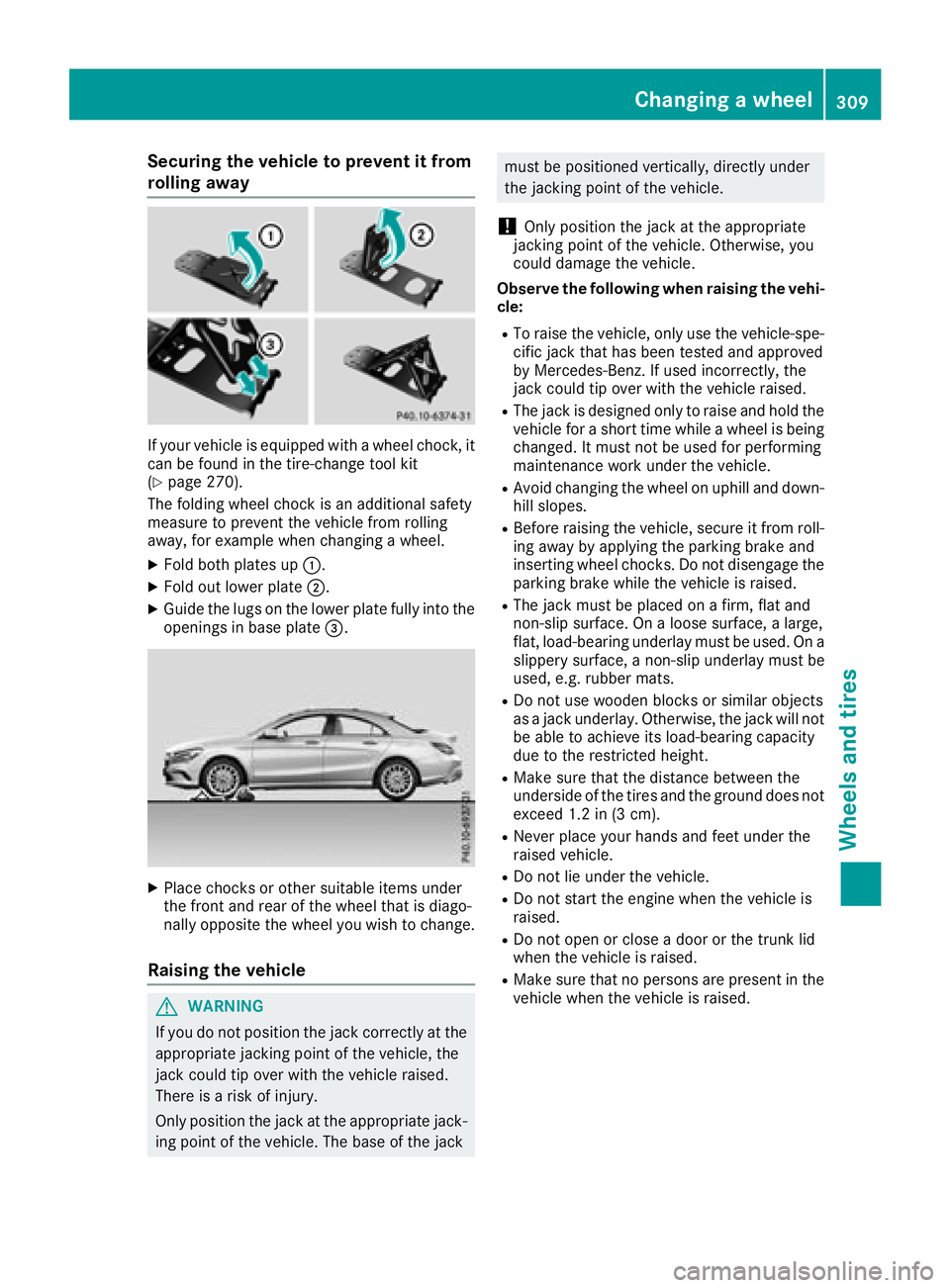
If your vehicle is equippe dw ith aw heel chock ,i t
can be found in the tire-change tool kit
( Y
page 270).
The folding wheel chock is an additional safety
measure to prevent the vehicle from rolling
away ,f or example when changing aw heel.X
Fold both plates up C .X
Fold out lower plate D .X
Guide the lugs on the lower plate fully into the
openings in base plate
Page 313 of 326
bolts to come loose. As ar esult, you could
lose aw heel while driving .T here is ar isk of
accident.
Never oil or grease wheel bolts. In the event of
damage to the threads, contact aq ualified
specialist workshop immediately. Have the
damaged wheel bolts or hub threads
replaced/renewed. Do not continue driving.
G WARNING
If you tighten the wheel bolts or wheel nuts
when the vehicle is raised, the jack could tip
over. There is ar isk of injury.
Only tighten the wheel bolts or wheel nuts
when the vehicle is on the ground.
Always pay attention to the instructions and
safety notes in the "Changing aw heel" section
( Y
page 307).
Only use wheel bolts that have been designed
for the wheel and the vehicle. For safety rea-
sons, Mercedes-Benz recommends that you
only use wheel bolts which have been approved
for Mercedes-Benz vehicles and the respective
wheel.
! To preven td amage to the paintwork, hold
the wheel securely against the wheel hub
while screwin gint he first wheel bolt.
X
Clean the wheel and wheel hub contact sur-
faces. X
Place the new wheel on the wheel hub and
push it on. X
Tighten the wheel bolts until they are finger-
tight. Lowering the vehicle
G WARNING
The wheels could work loose if the wheel nuts
and bolts are not tightened to the specified
tightenin gt orque. There is ar isk of accident.
Have the tightenin gt orque immediately
checked at aq ualified specialist workshop
after aw heel is changed. X
Place the ratchet wrenc ho nt ot he hexagon
nut of the jack so that the letters AB are visi-
ble. X
Turn the ratchet wrenc hu ntil the vehicle is
onc ea gain standing firmly on the ground. X
Place the jack to one side.
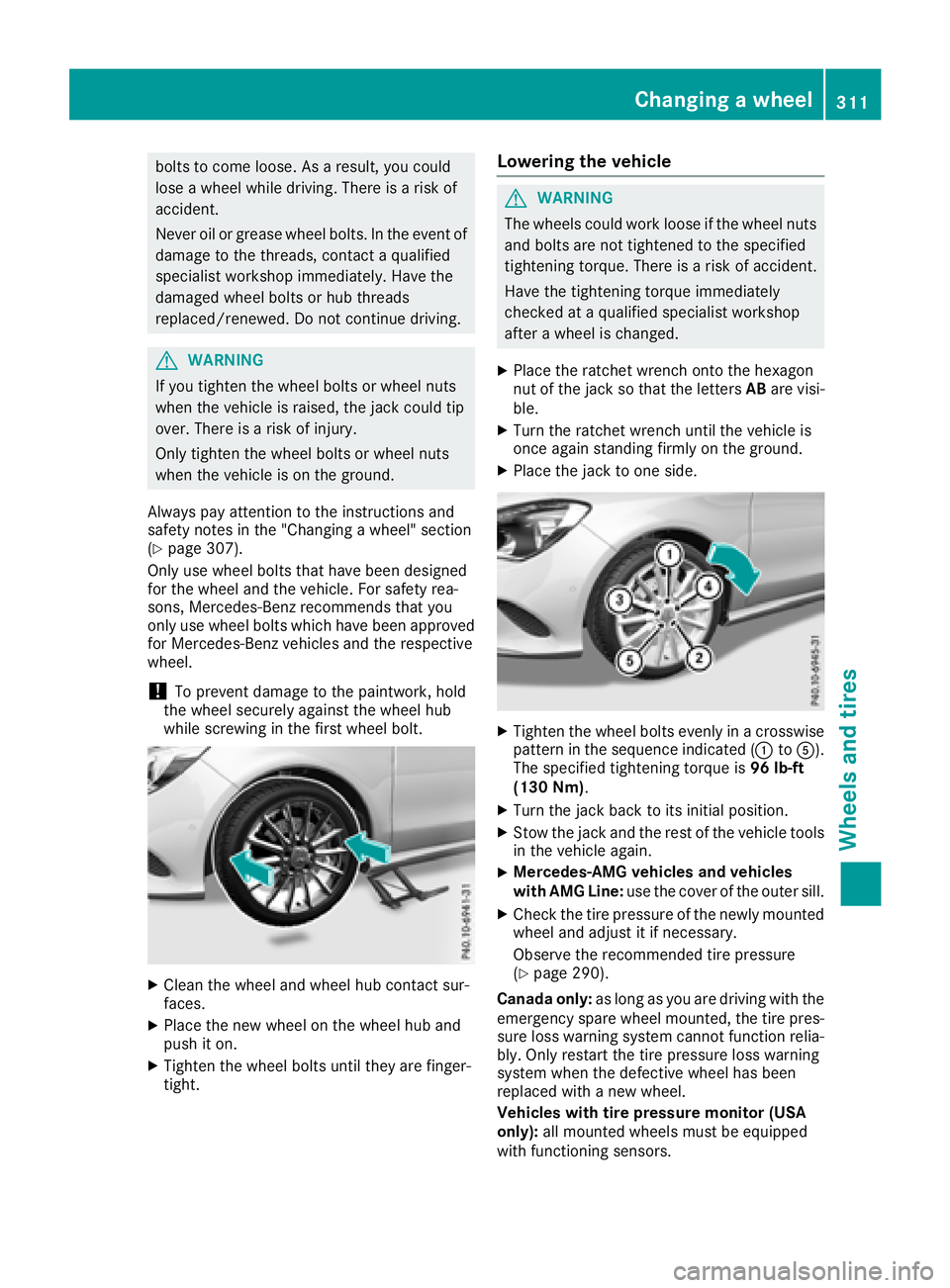
X
Tighten the wheel bolts evenly in ac rosswise
pattern in the sequence indicated ( C to