2018 MERCEDES-BENZ CLA wheel
[x] Cancel search: wheelPage 66 of 326

sensor technology to assess the traffic situa-
tion.
Situation-dependent braking assistance is capa-
ble of reacting to moving objects that have
alread yb een detected as such at least once
over the period of observation, up to vehicle
speeds of around 155 mph (250 km/h).
Situation-dependent braking assistance can
also detect stationary objects, up to vehicle
speeds of around 44 mph (70 km/h). X
Keep the brake pedal depressed until the
emergency braking situation is over.
ABS prevents the wheels from locking.
The brakes will work normally agai ni f:R
you release the brake pedal. R
there is no longer any danger of ac ollision.R
no obstacle is detected in front of your vehi-
cle.
Situation-dependent braking assistance is then
deactivated.
Important safety notes
i Observe the "Important safety notes" sec-
tion for driving safety systems ( Y
page 61).
G WARNING
Adaptive Brake Assist does not react: R
to people or animals R
to oncoming vehicles R
to crossing traffic R
when cornering
As ar esult, Adaptive Brake Assist may not
intervene in all critical conditions. There is a
risk of an accident.
Always pay careful attention to the traffic sit-
uation and be ready to brake.
G WARNING
Adaptive Brake Assist cannot always clearly
identify objects and complex traffic situa-
tions.
In such cases, Adaptive Brake Assist might: R
intervene unnecessarily R
not intervene
There is ar isk of an accident. Always pay careful attention to the traffic sit-
uation and be ready to brake. Terminate the
intervention in an on-critical driving situation.
Due to the nature of the system, complex but
non-critical driving conditions may also cause
Active Brake Assist to intervene.
Even if Active Brake Assist is not available due to
am alfunction in the radar sensor system, the
brake system is still available with full brake
boosting effect and BAS.
ESP ®
(Electronic Stability Program)
General notes
i Observe the "Important safety notes" sec-
tion ( Y
page 61).
ESP ®
monitors driving stability and traction ,i .e.
power transmission between the tires and the
road surface.
If ESP ®
detects that the vehicle is deviating from
the direction desired by the driver, one or more
wheels are braked to stabilize the vehicle. The
engine output is also modified to keep the vehi-
cle on the desired course within physical limits.
ESP ®
assists the driver when pulling awa yo n
wet or slippery roads. ESP ®
can also stabilize
the vehicle during braking.
ETS/4ETS (Electronic Traction System)
i Observe the "Important safety notes" sec-
tion ( Y
page 61).
ETS traction control is part of ESP ®
.Onv ehicles
with 4MATIC, 4ETS is part of ESP ®
.
Traction control brakes the drive wheels indi-
vidually if they spin. This enables you to pull
awa ya nd accelerate on slippery surfaces, for
example if the road surface is slippery on one
side. In addition, more drive torque is transfer-
red to the wheel or wheels with traction.
Traction control remains active, even if you
deactivate ESP ®
.
Important safety notes
i Observe the "Important safety notes" sec-
tion ( Y
page 61).64
Driving safety systems
Safety
Page 70 of 326
You should therefore adapt your drivin gs tyle
to the differen th andlin gc haracteristics. Have
the brak es yste mc hecked at aq ualified spe-
cialist workshop.
Please observ et he information on warnin ga nd
indicator lamps ( Y
page 220)
( Y
page 220) as well as on display messages
( Y
page 194).
ADAPTIVE BRAKE ADAPTIVE BRAKE enhances braking safet ya nd
offers increased braking comfort .Ina ddition to
the braking function ,A DA PTIVE BRAKE also has
the HOL Df unction ( Y
page 157) and hill start
assist ( Y
page 125).
STEER CONTROL
Genera li nformationSTEER CONTROL helps you by transmitting a
noticeable steerin gf orc etot he steerin gw heel
in the direction required for vehicle stabilization.
This steerin ga ssistanc eisp rovided in particular
if: R
both right wheels or both left wheels are on a
wet or slippery road surfac ew hen you brakeR
the vehicle begins to skid
Important safet yn otes
i Observe the "Importan ts afet yn otes" sec-
tion ( Y
page 61).
No steerin ga ssistanc eisp rovided from STEER
CONTROL, if: R
ESP ®
is malfunctioningR
the steerin gism alfunctioning
If ESP ®
is malfunctioning, you will be assisted
further by the electrical power steering.
Protection against theft
Immobilizer
The immobilizer prevent sy our vehicle from
being started without the correc tS martKey. X
To activat ew ith th eS martKey: remove the
SmartKey from the ignition lock. X
To activat ew ith KEYLESS-GO start-func-
tion or KEYLESS-GO: switc ht he ignition off
and open the driver's door. X
To deactivate: switc hont he ignition.
When leaving the vehicle, always tak et he
SmartKey with you and lock the vehicle. Anyone
can star tt he engin eifav alid SmartKey has been
left inside the vehicle.
i The immobilizer is always deactivate dw hen
you star tt he engine.
In the even tt hat the engin ec annot be started
(yet the vehicle's battery is charged), the sys-
tem is not operational. Contact an authorized
Mercedes-Ben zC enter or call
1-800-FOR-MERCedes (in the USA )o r
1-800-387-010 0( in Canada).
ATA (anti-theft alar ms ystem)
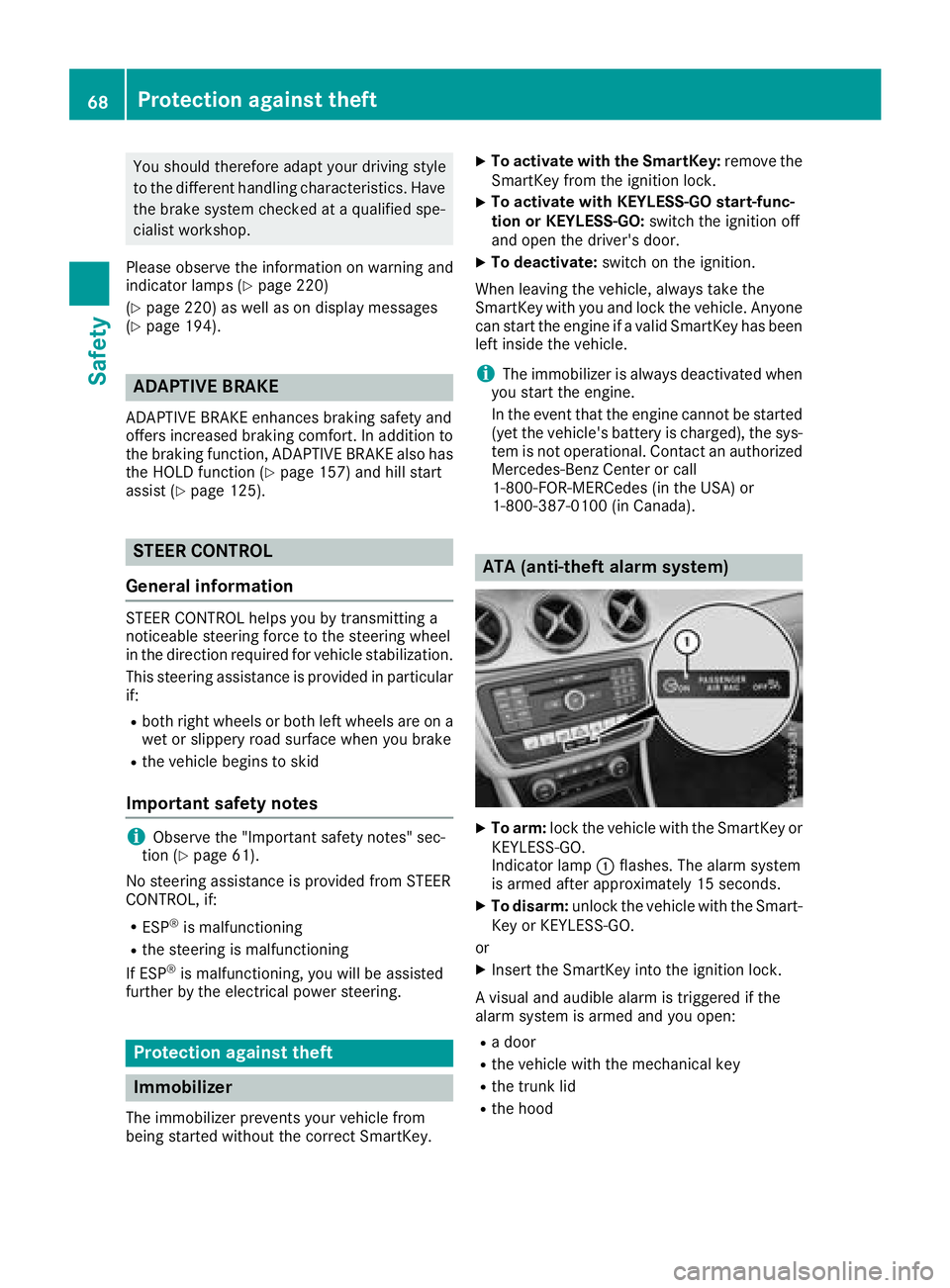
X
To arm: lock the vehicle with the SmartKe yo r
KEYLESS-GO.
Indicator lamp C flashes. The alarm system
is armed after approximately 15 seconds. X
To disarm: unlock the vehicle with the Smart-
Key or KEYLESS-GO.
or X
Insert the SmartKe yi nt ot he ignition lock.
Av isual and audible alarm is triggered if the
alarm system is armed and you open: R
ad oor R
the vehicle with the mechanical key R
the trun kl id R
the hood68
Protection against theft
Safety
Page 79 of 326
Meanwhile, the fuel filler flap will not be locked
or unlocked.
You cannot unlock the vehicle centrally from the
inside if the vehicle has been locked with the
SmartKey or KEYLESS-GO.
You can open ad oor from inside the vehicle
even if it has been locked. You can open the rear
doors from inside the vehicle unless they are
secured by the child-proof lock ( Y
page 60).
If the vehicle has previously been locked with
the SmartKey from the outside, opening ad oor
from the inside will trigger the anti-theft alarm
system. Switch off the alarm ( Y
page 68).
If al ocked door is opened from the inside, the
previous unlock status of the vehicle will be
taken into consideration if: R
the vehicle was locked using the locking but-
ton for the central locking, or R
if the vehicle was locked automatically
The vehicle will be fully unlocked if it had previ-
ously been fully unlocked. If only the driver's
door had been previously unlocked, only the
door which has been opened from the inside is
unlocked.
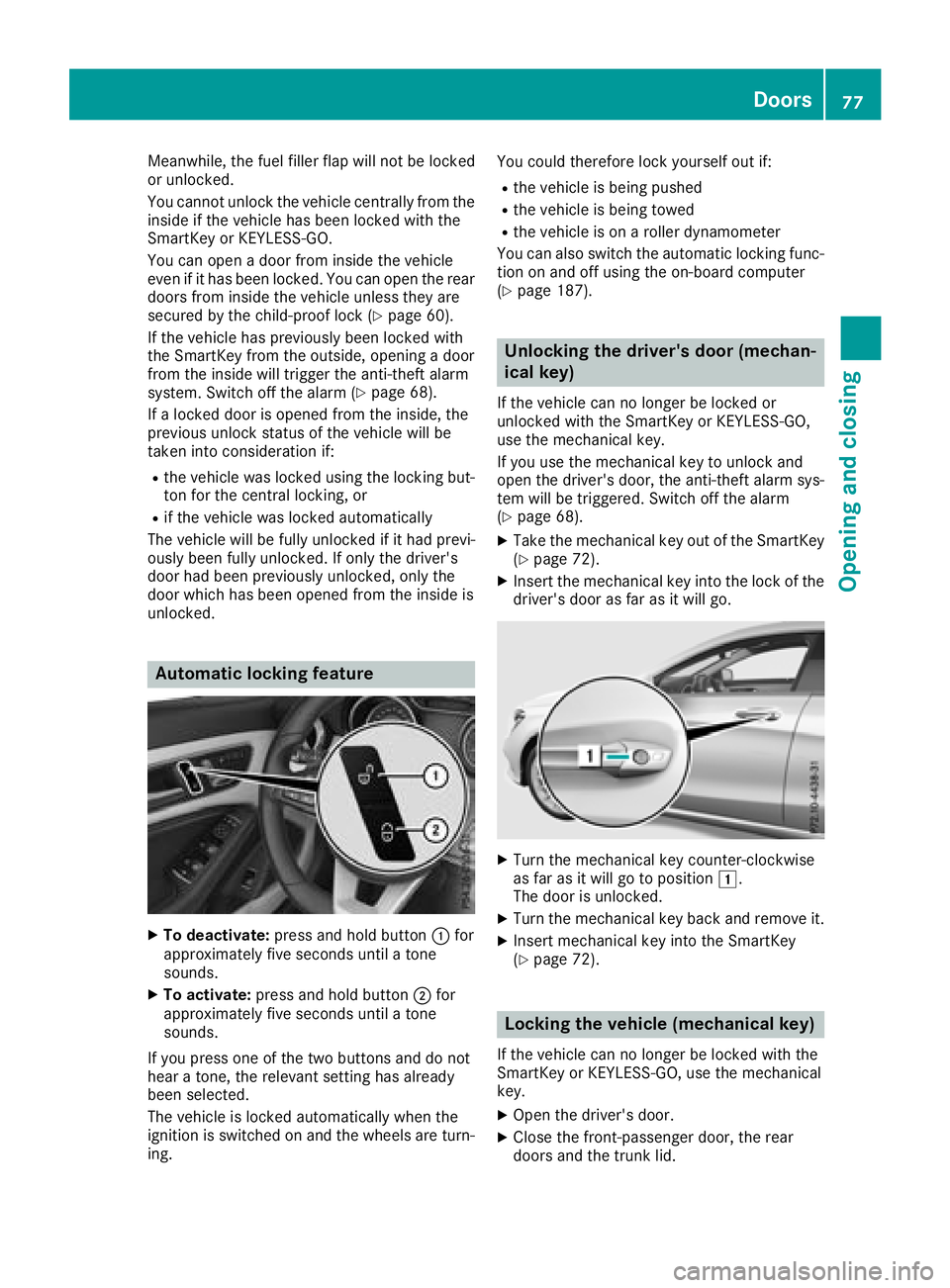
Automatic lockin gf eature
X
To deactivate: press and hold button C for
approximately five seconds until at one
sounds. X
To activate: press and hold button D for
approximately five seconds until at one
sounds.
If you press one of the two buttons and do not
hear at one, the relevant settin gh as already
been selected.
The vehicle is locked automatically when the
ignition is switched on and the wheels are turn-
ing. You could therefore lock yourself out if: R
the vehicle is being pushed R
the vehicle is being towed R
the vehicle is on ar oller dynamometer
You can also switch the automatic locking func-
tion on and off using the on-board computer
( Y
page 187).
Unlocking the driver's door (mechan-
ical key) If the vehicle can no longer be locked or
unlocked with the SmartKey or KEYLESS-GO,
use the mechanical key.
If you use the mechanical key to unlock and
open the driver's door, the anti-theft alarm sys-
tem will be triggered. Switch off the alarm
( Y
page 68). X
Take the mechanical key out of the SmartKey
( Y
page 72). X
Insert the mechanical key into the lock of the
driver's door as far as it will go.
X
Turn the mechanical key counter-clockwise
as far as it will go to position G .
The door is unlocked. X
Turn the mechanical key back and remove it. X
Insert mechanical key into the SmartKey
( Y
page 72).
Locking the vehicle (mechanical key)
If the vehicle can no longer be locked with the
SmartKey or KEYLESS-GO, use the mechanical
key. X
Open the driver's door. X
Close the front-passenger door, the rear
doors and the trunk lid. Doors 77
Opening and closing Z
Page 92 of 326
Correct driver's seat position
G WARNING
You coul dl ose control of your vehicle if you do
th ef ollowin gw hile driving:R
adjust th ed river' ss eat ,h ead restraint,
steering wheel or mirrors R
fasten th es eat belt
Ther eisar is kofana ccident.
Adjust th ed river' ss eat ,h ead restraint ,s te er-
ing wheel and mirror and fasten your seat belt
before starting th ee ng ine.
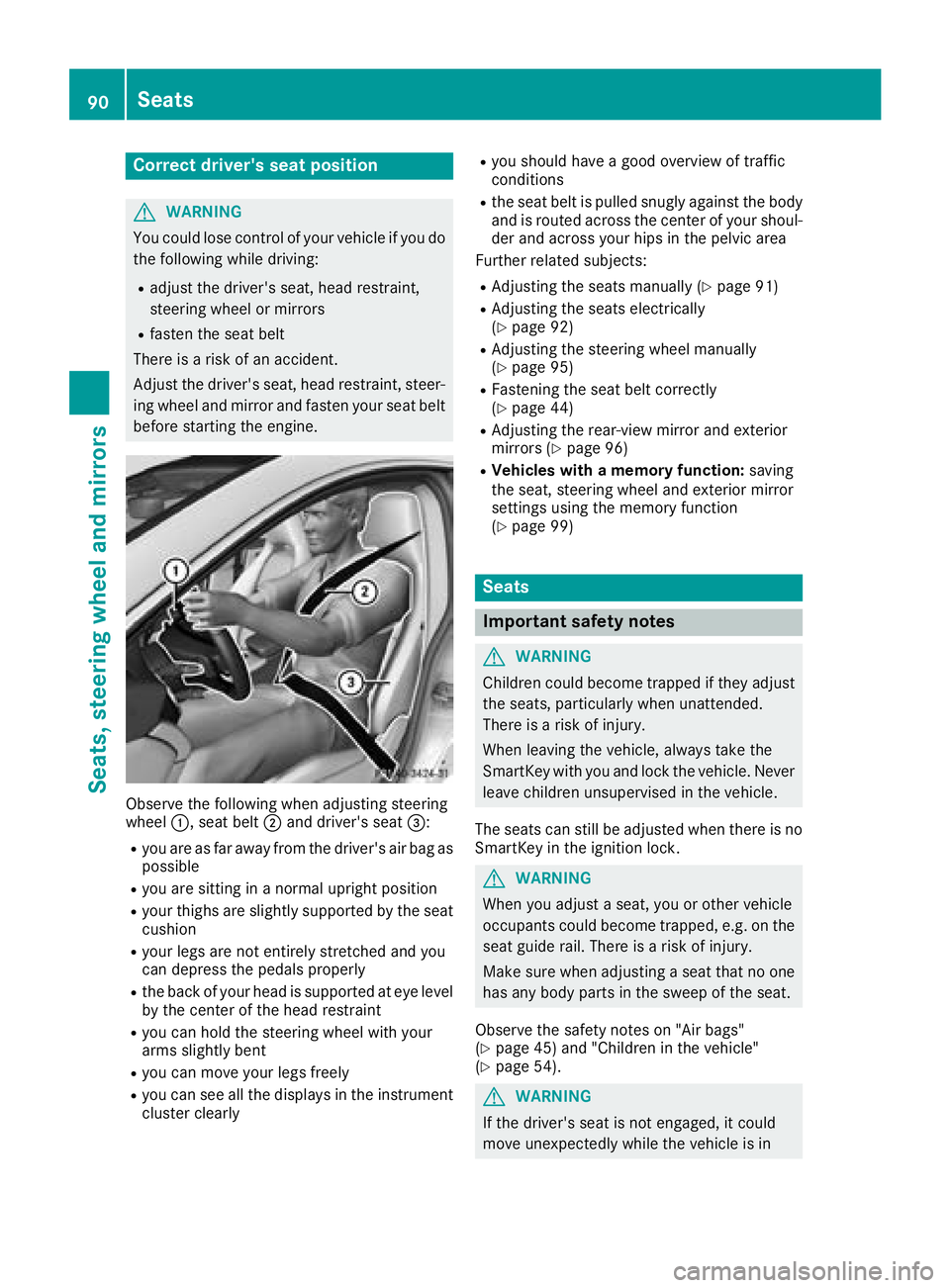
Observ et he followin gw hen adjusting steering
wheel C ,s eat belt D and driver' ss eat
Page 93 of 326
motion. This could cause you to lose control of
the vehicle. There is ar isk of an accident.
Always make sure that the driver' ss eat is
engage db efore starting the vehicle.
G WARNING
You could lose control of you rv ehicl eify ou do
the following while driving: R
adjust the driver' ss eat, head restraint,
steering whee lorm irrorsR
fasten the seat belt
There is ar isk of an accident.
Adjust the driver' ss eat, head restraint, steer-
ing whee la nd mirror and fasten you rs eat belt
before starting the engine.
G WARNING
If you adjust the seat height carelessly ,y ou or
other vehicl eo ccupants could be trappe da nd
thereby injured. Children in particular could
accidentally press the electrica ls eat adjust-
ment buttons and become trapped. There is a
risk of injury.
Whil em oving the seats, make sure that your
hands or other body parts do not get under the
lever assembly of the seat adjustment sys-
tem.
! To avoi dd amage to the seats and the seat
heating, observe the following information: R
keep liquid sf rom spilling on the seats. If
liquid is spilled on the seats, dry them as
soon as possible. R
if the seat covers are damp or wet, do not
switch on the seat heating. The seat heat-
ing should als on ot be used to dry the seats.R
clean the seat covers as recommended;
see the "Interior care" section. R
do not transport heavy loads on the seats.
Do not place sharp objects on the seat
cushions, e.g. knives, nail sort ools. The
seats should only be occupied by passen-
gers, if possible. R
when the seat heating is in operation, do
not cover the seats with insulating materi-
als ,e .g. blankets, coats, bags ,s eat covers,
child seats or booster seats. ! Make sure that there are no objects in the
footwel lu nder or behind the seats when mov-
ing the seats back. There is ar isk that the
seats and/or the objects could be damaged.
i Further related subjects: R
cargo compartment enlargement (folding
down the rear seats) ( Y
page 240)
Adjusting the seats manually
Vehicles without the seating comfort
package
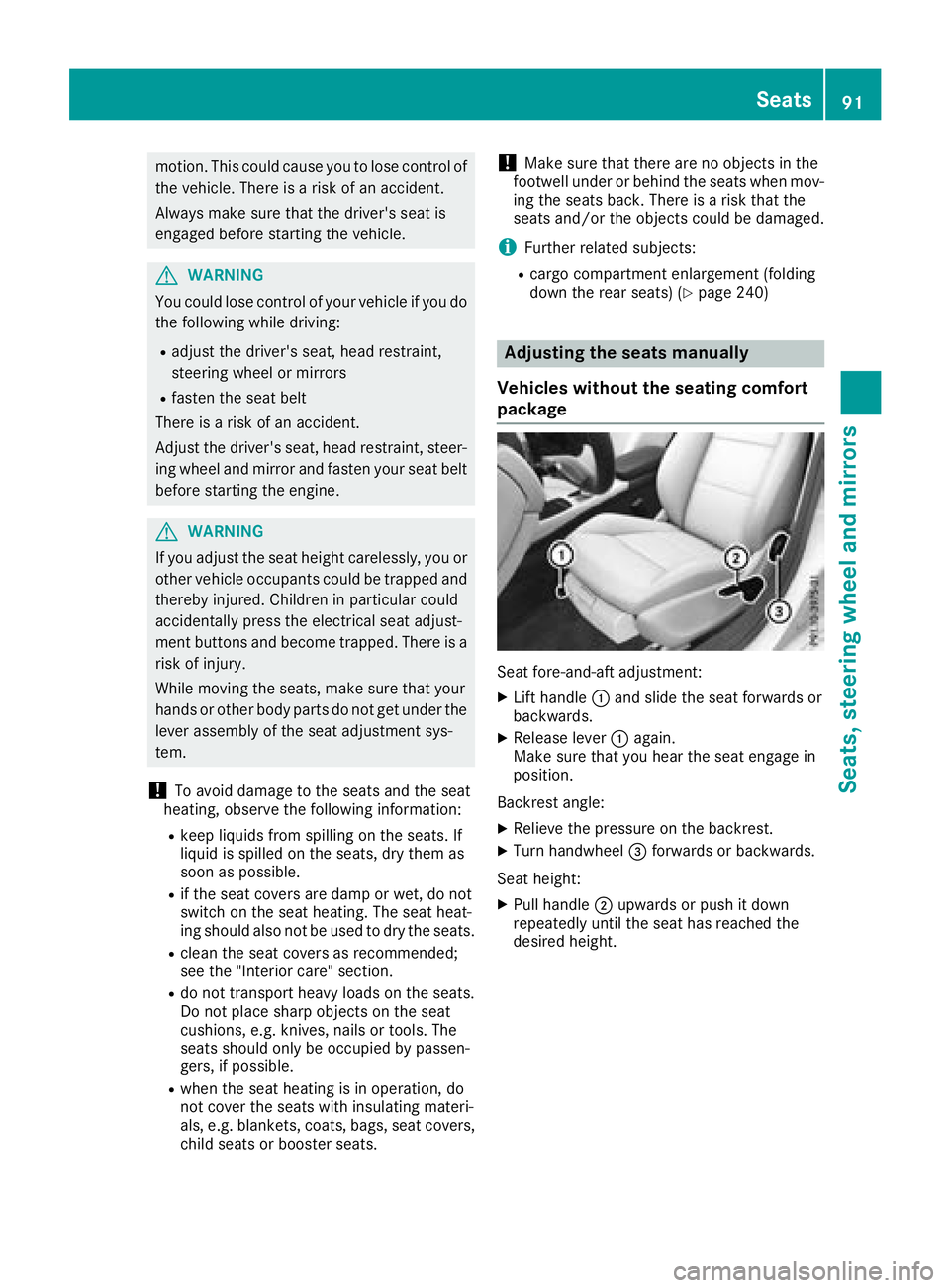
Seat fore-and-aft adjustment: X
Lift handle C and slid et he seat forwards or
backwards. X
Release lever C again.
Make sure that you hear the seat engage in
position.
Backrest angle: X
Relieve the pressure on the backrest. X
Turn handwheel
Page 94 of 326
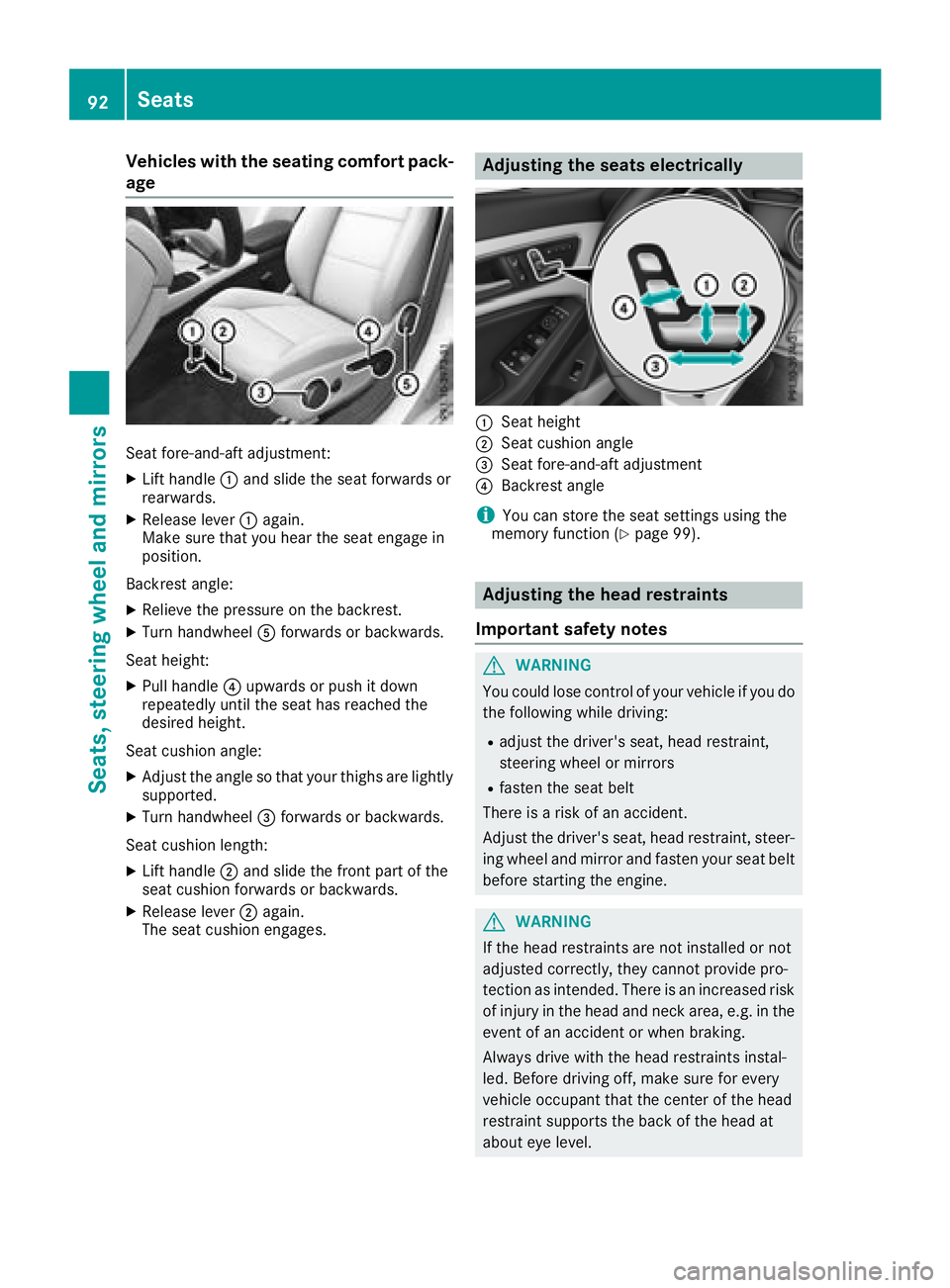
Vehicles with the seatin gc om fort pack-
age
Sea tf ore-and-aft adjustment:X
Lif th an dle C and slid et he sea tf orward so r
rearwards. X
Releas el ev er C again.
Make sure tha ty ou hea rt he sea te ngage in
position.
Backrest angle: X
Relieve the pressure on the backrest. X
Turn handwheel
Page 97 of 326

Problems with the seat heating Problem
Possible causes/consequences and P Solutions
The seat heating has
switched off prematurely
or cannot be switched
on. The on-board voltage is too low because too many electrical consum-
ers are switched on. X
Switch off electrical consumers that you do not need, such as the
rear window defroster or interior lighting.
Once the battery is sufficiently charged, the seat heating will switch
back on automatically.
Steering wheel
Important safety notes
G WARNING
You could lose control of your vehicle if you do
the following while driving: R
adjust the driver's seat, head restraint,
steering wheel or mirrors R
fasten the seat belt
There is ar isk of an accident.
Adjust the driver's seat, head restraint ,s teer-
ing wheel and mirror and fasten your seat belt
before startin gt he engine.
G WARNING
Children could injure themselves if they
adjust the steering wheel. There is ar isk of
injury.
When leaving the vehicle, always take the
SmartKey with you and lock the vehicle. Never
leave children unsupervised in the vehicle.
Adjusting the steering wheel
G WARNING
If the steering wheel is unlocked while the
vehicle is in motion, it could change position
unexpectedly. This could cause you to lose
control of the vehicle. There is ar isk of an
accident.
Before startin go ff, make sure the steering
wheel is locked. Never unlock the steering
wheel while the vehicle is in motion. C
Release lever D
Adjust st he steering wheel height
Page 99 of 326
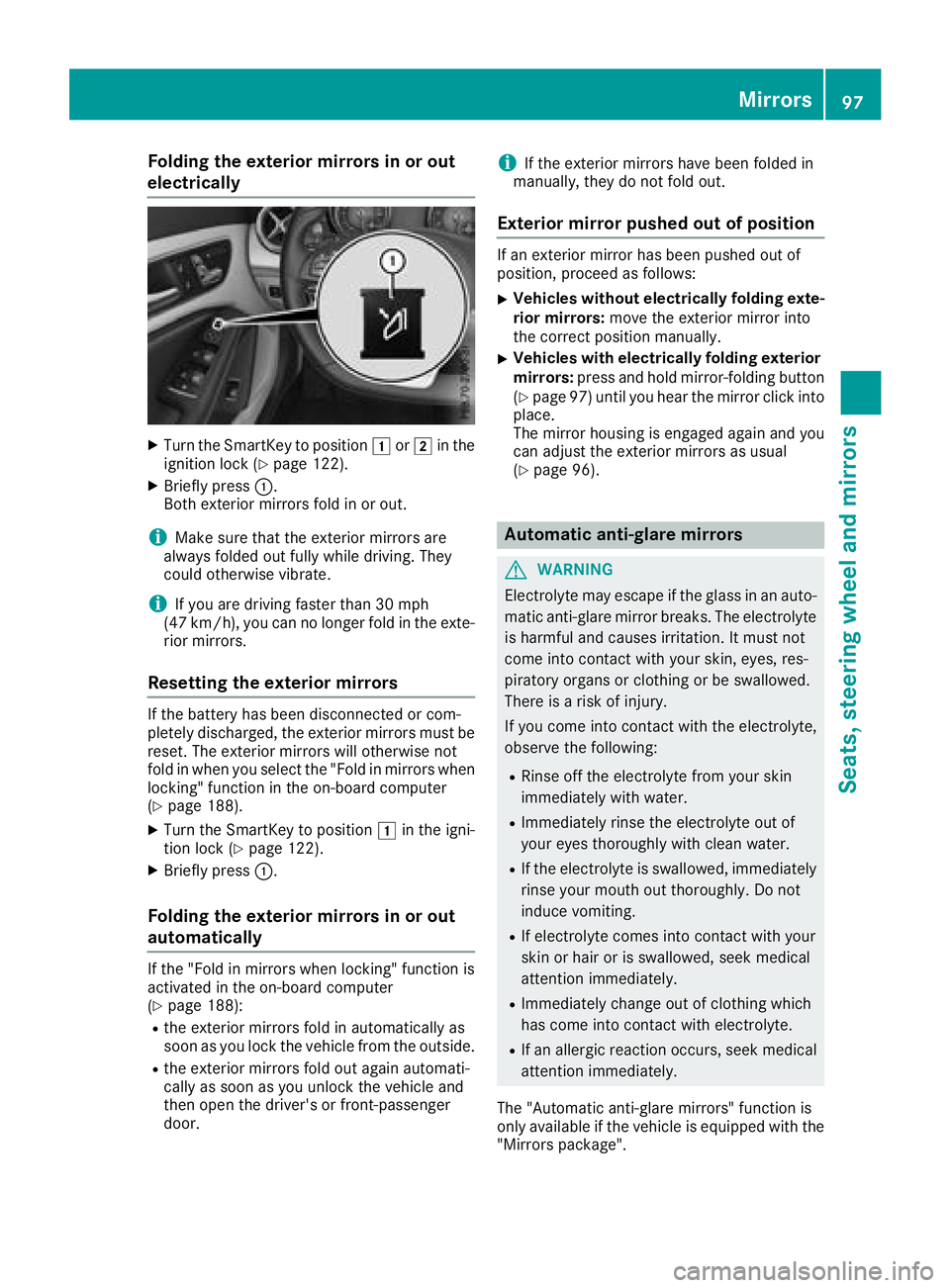
Folding th ee xterior mirrors in or out
electrically X
Turn th eS ma rtKey to position G or H in th e
ignition loc k( Y
page 122).X
Briefly press C .
Both exterio rm irror sf ol dinoro ut .
i Mak es ure that th ee xter io rm irror sa re
always folded out fully while driving .T hey
could otherwise vibrate .
i If you are driving faste rt ha n30m ph
(47 km/h), you can no longer fol dint he exte -
rio rm irrors.
Resetting th ee xterior mirrorsIf th eb attery has been disconnected or com-
pletely discharged, th ee xter io rm irror sm ust be
reset .T he exterio rm irror sw ill otherwise no t
fol dinw hen you select th e" Fold in mirror sw hen
locking" function in th eo n-bo ard computer
( Y
page 188). X
Turn th eS ma rtKey to position G in th ei gni-
tion loc k( Y
page 122).X
Briefly press C .
Folding th ee xterior mirrors in or out
automatically If th e" Fold in mirror sw hen locking" function is
activated in th eo n-bo ard computer
( Y
page 188): R
th ee xter io rm irror sf ol dina utomatically as
soo nasy ou loc kt he vehicl ef ro mt he outside .R
th ee xter io rm irror sf ol do ut again automati-
call yass oo nasy ou unlock th ev ehicl ea nd
then open th ed river' sorf ront-pa ssenger
door . i If th ee xter io rm irror sh ave been folded in
manually, they do no tf ol do ut .
Exterior mirror pushed out of position If an exterio rm irror has been pushed out of
position ,p rocee dasf ollows :X
Vehicles without electricall yf olding exte-
rior mirrors : mov et he exterio rm irror int o
th ec orre ct position manually. X
Vehicles with electricall yf olding exterior
mirrors : press and hold mirror-foldin gb utto n
( Y
page 97 )u ntil yo uh ea rt he mirror click into
place.
The mirror housing is engaged agai na nd you
can adjus tt he exterio rm irrors as usual
( Y
page 96).
Automati ca nti-glare mirrors
G WARNING
Electrolyte ma ye scape if the glas sinana ut o-
matic anti-glare mirror breaks .T he electrolyte
is harmfu la nd causes irritation. It must not
come into contact with your skin, eyes, res-
piratory organs or clothing or be swallowed.
There is ar is kofi njury.
If yo uc ome into contact with the electrolyte,
observe the following: R
Rinse off the electrolyte from your skin
immediatel yw it hw at er.R
Immediately rins et he electrolyte ou to f
your eyes thoroughl yw it hc lean water.R
If the electrolyte is swallowed, immediately
rins ey ou rm outh ou tt horoughly. Do not
induce vomiting. R
If electrolyte come si nto contact with your
ski norh ai roriss wallowed, see km edical
attentio ni mmediately. R
Immediately change ou tofc lothing which
ha sc ome into contact with electrolyte. R
If an allergi cr eactio no ccurs, see km edical
attentio ni mmediately.
The "Automatic anti-glare mirrors "f unctio ni s
onl ya vailable if the vehicl eise quippe dw it ht he
"Mirrors package". Mirrors 97
Seats, steering wheel an dm irrors Z