2018 MAZDA MODEL 3 4-DOOR air condition
[x] Cancel search: air conditionPage 443 of 624
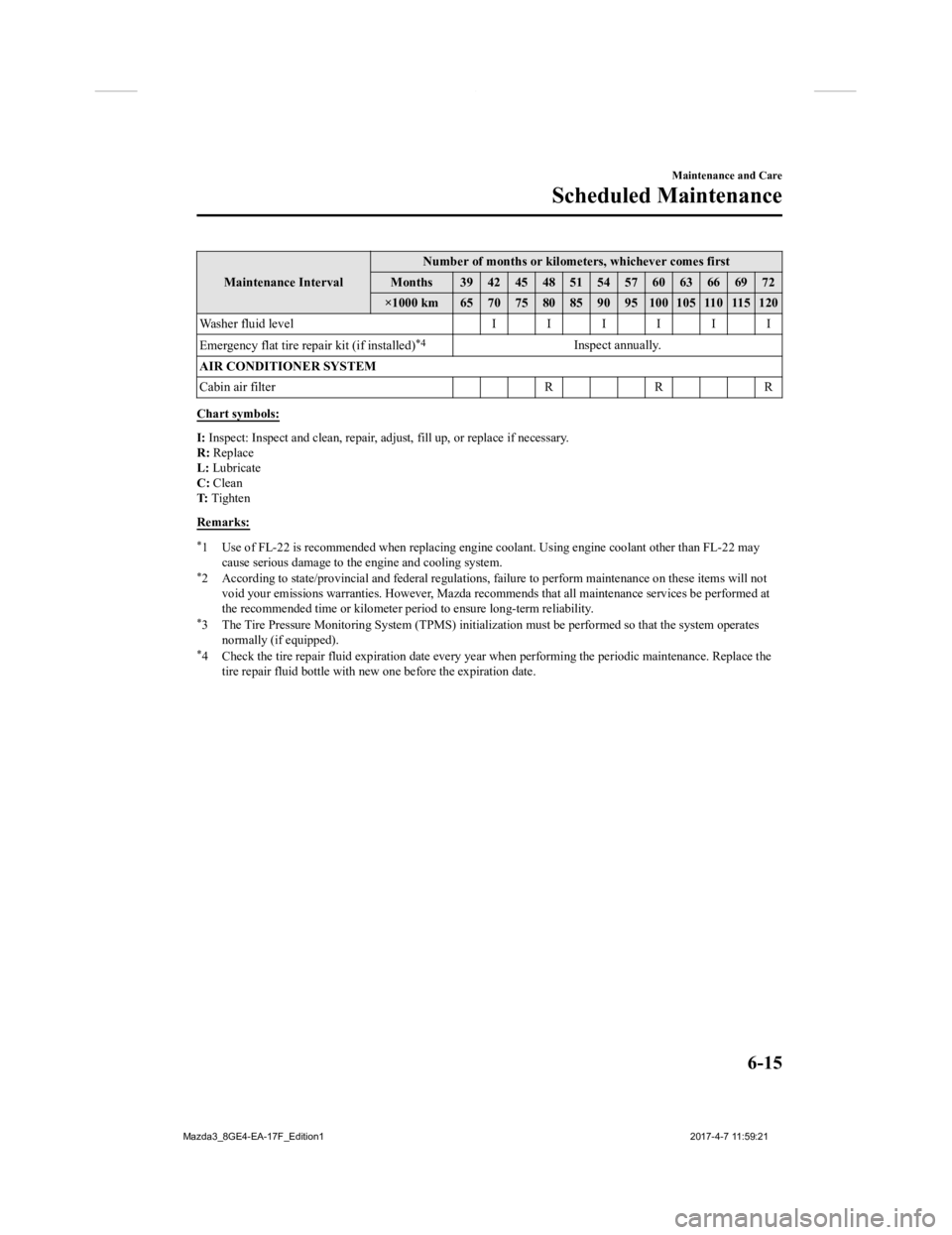
Maintenance IntervalNumber of months or kilometers, whichever comes first
Months 39 42 45 48 51 54 57 60 63 66 69 72
×1000 km 65 70 75 80 85 90 95 100 105 110 115 120
Washer fluid level IIIIII
Emergency flat tire repair kit (if installed)
*4Inspect annually.
AIR CONDITIONER SYSTEM
Cabin air filter RRR
Chart symbols:
I: Inspect: Inspect and clean, re pair, adjust, fill up, or replac e if necessary.
R: Replace
L: Lubricate
C: Clean
T: Tighten
Remarks:
*1 Use of FL-22 is recommended wh en replacing engine coolant. Using engine coolant other than FL-22 may
cause serious damage to the engine and cooling system.
*2 According to state/provincial and federal regulations, failure to perform maintenance on these items will not void your emissions warranties. However, Mazda recommends that all maintenance services be performed at
the recommended time or kilomete r period to ensure long-term reliability.
*3 The Tire Pressure Monitoring Sy stem (TPMS) initialization must be performed so that the system operates
normally (if equipped).
*4 Check the tire repair fluid exp iration date every year when performing the periodic maintenance. Replace the
tire repair fluid bottle with new one before the expiration date.
Maintenance and Care
Scheduled Maintenance
6-15
Mazda3_8GE4-EA-17F_Edition1 2017-4-7 11:59:21
Page 455 of 624

Brake/Clutch Fluid
▼Inspecting Brake/Clutch Fluid Level
WA R N I N G
If the brake/clutch fluid level is low, have
the brakes inspected:
A low brake/clutch
fluid level is dangerous.
A low level could indicate brake lining wear
or a brake system leak which could cause
the brakes to fail and lead to an accident.
The brakes and clutch draw fluid from the
same reservoir.
Inspect the fluid level in the reservoir
regularly. It should be kept between the
MAX and MIN lines.
The level normally drops with
accumulated distance, a condition
associated with wear of brake and clutch
linings. If it is excessively low, have the
brake/clutch system inspected by an
Authorized Mazda Dealer.
Wa s h e r F l u i d
▼ Inspecting Washer Fluid Level
WA R N I N G
Use only windshield washer fluid or plain
water in the reservoir:
Using radiator antifreeze as washer
fluid is
dangerous. If sprayed on the windshield, it
will dirty the windshield, affect your
visibility, and could result in an accident.
Using Washer Fluid Without Anti-freeze
Protection in Cold Weather:
Operating your vehicle in temperatures
below 4 degrees C (40 degrees F) using
washer fluid without anti-freeze protection
is dangerous as it could cause impaired
windshield vision and result in an accident.
In cold weather, always use washer fluid
with anti-freeze protection.
NOTE
State or local regulations may restrict the
use of volatile organic compounds
(VOCs), which are commonly used as
anti-freeze agents in washer fluid. A
washer fluid with limited VOC content
should be used only if it provides adequate
freeze resistance for all regions and
climates in which the vehicle will be
operated.
Maintenance and Care
Owner Maintenance
6-27
Mazda3_8GE4-EA-17F_Edition1 2017-4-7 11:59:21
Page 466 of 624

Tires
For reasons of proper performance, safety,
and better fuel economy, always maintain
recommended tire inflation pressures and
stay within the recommended load limits
and weight distribution.
WA R N I N G
Using Different Tire Types:
Driving your vehicle with different types of
tires is dangerous. It could cause poor
handling and poor braking; leading to loss
of control.
Except for the limited use of the temporary
spare tire, use only the same type tires
(radial, bias-belted, bias-type) on all four
wheels.
Using Wrong-Sized Tires:
Using any other tire size than what is
specified for the vehicle (page 9-10) is
dangerous. It could seriously affect ride,
handling, ground clearance, tire clearance,
and speedometer calibration. This could
cause you to have an accident. Use only
tires that are the correct size specified for
the vehicle.
▼ Tire Inflation Pressure
WA R N I N G
Always
inflate the tires to the correct
pressure:
Overinflation or underinflation of tires is
dangerous. Adverse handling or
unexpected tire failure could result in a
serious accident.
Refer to Tires on page 9-10.
Use only a Mazda-genuine tire valve cap:
Use of a non-genuine part is dangerous as
the correct tire air pressure cannot be
maintained if the tire valve becomes
damaged. If the vehicle is driven under this
condition, the tire air pressure will decrease
which could result in a serious accident. Do
not use any part for the tire valve cap that
is not a Mazda-genuine part.
Inspect all tire pressures monthly
(including the spare) when the tires are
cold. Maintain recom mended pressures for
the best ride, handling, and minimum tire
wear.
Refer to the specification charts (page 9-
10).
(With tire pressure monitoring system)
After adjusting the tire pressure,
initialization of the tire pressure
monitoring system is necessary to make
the system operate normally.
Refer to Tire Pressure Monitoring System
Initialization on page 4-148.
NOTE
Always check tire pressure when tires
are cold.
Warm tires normally exceed
recommended pressures. Do not release
air from warm tires to adjust the
pressure.
Underinflation can cause reduced fuel
economy, uneven and accelerated tire
wear, and poor sealing of the tire bead,
which will deform the wheel and cause
separation of tire from rim.
Maintenance and Care
Owner Maintenance
6-38
Mazda3_8GE4-EA-17F_Edition1 2017-4-7 11:59:21
Page 468 of 624

▼Replacing a Tire
WA R N I N G
Always use tires that are in good condition:
Driving with worn tires is dangerous.
Reduced braking, steering, and traction
could result in an accident.
Replace all four tires at the same time:
Replacing just one tire is dangerous. It
could cause poor handling and poor
braking resulting in loss of vehicle control.
Mazda strongly recommends that you
replace all four tires at the same time.
If a tire wears evenly, a wear indicator will
appear as a solid band across the tread.
Replace the tire when this happens.
New tread Tread wear indicator
Worn tread
You should replace the tire before the band
crosses the entire tread.
(With tire pressure monitoring system)
After adjusting th e tire pressure,
initialization of the tire pressure
monitoring system is necessary to make
the system operate normally.
Refer to Tire Pressure Monitoring System
Initialization on page 4-148.
NOTE
Tires degrade over time, even when they
are not being used on the road. It is
recommended that tires generally be
replaced when they are 6 years or older.
Heat caused by hot climates or frequent
high loading conditions can accelerate the
aging process. You should replace the
spare tire when you replace the other road
tires due to the aging of the spare tire. The
period in which the tire was manufactured
(both week and year) is indicated by a
4-digit number.
Refer to Tire Labeling on page 8-25.
▼ Temporary Spare Tire
Inspect the temporary spare tire at least
monthly to make su
re it is properly
inflated and stored.
NOTE
The temporary spare tire condition
gradually deteriorates even if it has not
been used.
The temporary spare tire is easier to
handle because of its construction which is
lighter and smaller t han a conventional
tire. This tire should be used only for an
emergency and only for a short distance.
Use the temporary spare tire only until the
conventional tire is repaired, which should
be as soon as possible.
Refer to Tires on page 9-10.
CAUTION
Do not use your temporary spare tire rim
with a snow tire or a conventional tire.
Neither will properly fit and could
damage both tire and rim.
Maintenance and Care
Owner Maintenance
6-40
Mazda3_8GE4-EA-17F_Edition1 2017-4-7 11:59:21
Page 488 of 624

DESCRIPTIONFUSE
RATING PROTECTED COMPONENT
19 ST HEATER 15 A Heated steering wheel
*
20AT 15 A Transaxle control system
21 R.WIPER 15 A Rear window wiper
*
22A/C 7.5 A Air conditioner
23 ENGINE3 15 A Engine control system
24 ENGINE2 15 A Engine control system
25 ENGINE1 15 A Engine control system
26 GLOW SIG 5 A ―
27 EVVT 20 A Engine control system
28 WIPER 20 A Front window wiper and washer
29 DCDC REG 30 A ―
30 EPB L
FUEL.P2 30 A
Electric parking brake (EPB) (LH)
*
31 ADD FAN DE 40 A ―
32 P.WINDOW1 30 A Power windows
33 H/L LOW R 15 A Headlight low beam (RH)
*2
34 H/L LOW L HID L 15 AHeadlight (LH)*1, Headlight low beam (LH)*2
35 METER110 A Instrument cluster
36 IG2 30 A For protection of various circuits
37 EPB R
LPG 30 A
Electric parking brake (EPB) (RH)
*
38 FUEL.P3
FA N D E 40 A ―
39 DCDC DE 40 A ―
40 SRS1 7.5 A Air bag
41 ENGINE. IG1 15 A Engine control system
42 C/U IG1 15 A For protection of various circuits
43 METER3 10 A ―
*1 With LED headlights*2 With halogen headlights
Maintenance and Care
Owner Maintenance
6-60*Some models.
Mazda3_8GE4-EA-17F_Edition1 2017-4-7 11:59:21
Page 520 of 624

Overheating
If the high engine coolant temperature
warning light turns on, the vehicle loses
power, or you hear a loud knocking or
pinging noise, the engine is probably too
hot.
WA R N I N G
Pull over to a safe location, then switch
the ignition off and make sure the fan is not
running before attempting to work near
the cooling fan:
Working near the cooling fan when it is
running is dangerous. The fan could
continue running indefinitely even if the
engine has stopped and the engine
compartment temperature is high. You
could be hit by the fan and seriously
injured.
Do not remove either cooling
system cap when the engine and radiator
are hot:
When the engine and radiator are hot,
scalding coolant and steam may shoot out
under pressure and cause serious injury.
Open the hood ONLY after steam is no
longer escaping from the engine:
Steam from an overheated engine is
dangerous. The escaping steam could
seriously burn you.
If the high engine coolant temperature
warning light turns on:
1. Drive safely to the side of the road and
park off the right-of-way.
2. Put a vehicle with an automatic transaxle in park (P), a manual
transaxle in neutral.
3. Apply the parking brake.
4. Turn off the air conditioner.
5. Check whether coolant or steam is
escaping from the engine
compartment.
If steam is coming from the engine
compartment:
Do not go near the front of the vehicle.
Stop the engine.
Wait until the steam dissipates, then
open the hood and start the engine.
If neither coolant nor steam is
escaping:
Open the hood and idle the engine
until it cools.
CAUTION
If the cooling fan does not operate
while the engine is running, the engine
temperature will increase. Stop the
engine and call an Authorized Mazda
Dealer.
6. Make sure the cooling fan is operating, then turn off the engine after the
temperature has decreased.
7. When cool, check the coolant level. If it is low, look for coolant leaks from
the radiator and hoses.
If Trouble Arises
Overheating
7-20
Mazda3_8GE4-EA-17F_Edition1 2017-4-7 11:59:21
Page 529 of 624

SignalWarning
Check Engine LightIf this light illuminates while driving, the vehicle may have a
problem. It is important to
note the driving cond itions when the light illuminated and consult an Authorized Mazda
Dealer.
The check engine light may illumi nate in the following cases:
The fuel tank level being very low or approaching empty.The engine's electrical system has a problem.The emission control system has a problem.The fuel-filler cap is missing or not tightened securely.
If the check engine light remains on, or it flashes continuousl y, do not drive at high speeds
and consult an Authorized Mazd a Dealer as soon as possible.
Automatic Trans-
axle Warning Light*
The indication/light illuminates when the transaxle has a problem.
CAUTION
If the automatic transaxle warning indication/ light illuminates, the transaxle has an electri‐
cal problem. Continuing to drive your Mazda in this condition could cause damage to your
transaxle. Consult an Authorized Mazda Dealer as soon as possible.
(Turns on)
TCS/DSC Indicator
Light If the light stays on, the TCS, DSC or the brake assist system
may have a malfunction and
they may not operate correctly. Take your vehicle to an Authori zed Mazda Dealer.
Air Bag/Seat Belt
Pretensioner System Wa r n i n g L i g h t A system malfunction is
indicated if the warning light constantly flashes, constantly illu-
minates or does not illuminate a t all when the ignition is switched ON. If any of these
occur, consult an Authorized Mazd a Dealer as soon as possible. The system may not oper-
ate in an accident.WARNING
Never tamper with the air bag/pretensioner systems and always have an Authorized Mazda
Dealer perform all servicing and repairs:
Self-servicing or tampering with the systems is dangerous. An air bag/pretensioner could
accidentally activate or become disabled causing serious injury or death.
If Trouble Arises
Warning/Indicator Lights and Warning Sounds
*Some models.7-29
Mazda3_8GE4-EA-17F_Edition1 2017-4-7 11:59:21
Page 530 of 624
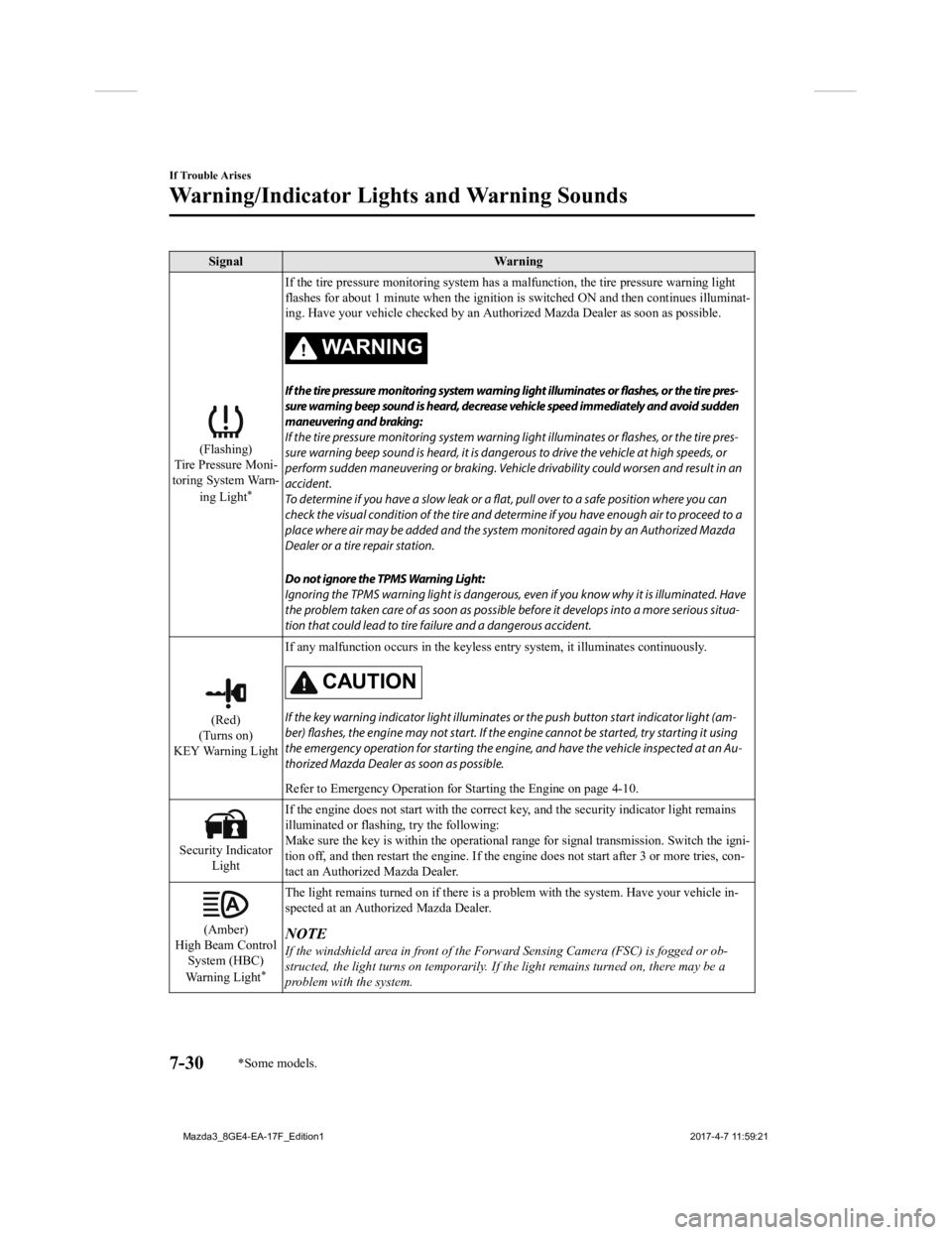
SignalWarning
(Flashing)
Tire Pressure Moni-
toring System Warn-
ing Light
*
If the tire pressure m onitoring system has a malfunction, the t ire pressure warning light
flashes for about 1 minute when the ignition is switched ON and then continues illuminat-
ing. Have your vehicle checked by an Authorized Mazda Dealer as soon as possible.
WARNING
If the tire pressure monitoring system warning light illuminates or flashes, or the tire pres‐
sure warning beep sound is heard, decrease vehicle speed immediately and avoid sudden
maneuvering and braking:
If the tire pressure monitoring system warning light illuminates or flashes, or the tire pres‐
sure warning beep sound is heard, it is dangerous to drive the vehicle at high speeds, or
perform sudden maneuvering or braking. Vehicl e drivability could worsen and result in an
accident.
To determine if you have a slow leak or a flat, pull over to a safe position where you can
check the visual condition of the tire and determine if you have enough air to proceed to a
place where air may be added and the system monitored again by an Authorized Mazda
Dealer or a tire repair station.
Do not ignore the TPMS Warning Light:
Ignoring the TPMS warning light is dangerous, even if you know why it is illuminated. Have
the problem taken care of as soon as possible before it develops into a more serious situa‐
tion that could lead to tire failure and a dangerous accident.
(Red)
(Turns on)
KEY Warning Light If any malfunction occurs in the keyless entry system, it illum
inates continuously.
CAUTION
If the key warning indicator light illuminates or the push button start indicator light (am‐
ber) flashes, the engine may not start. If the en gine cannot be started, try starting it using
the emergency operation for starting the engine , and have the vehicle inspected at an Au‐
thorized Mazda Dealer as soon as possible.
Refer to Emergency Operation for Starting the Engine on page 4- 10.
Security Indicator
Light If the engine does not start with the correct key, and the secu
rity indicator light remains
illuminated or flashing, try the following:
Make sure the key is within the operational range for signal transmission. Switch the igni-
tion off, and then restart the e ngine. If the engine does not s tart after 3 or more tries, con-
tact an Authorized Mazda Dealer.
(Amber)
High Beam Control System (HBC)
Wa r n i n g L i g h t
*
The light remains turned on if th ere is a problem with the system. Have your vehicle in-
spected at an Authorized Mazda Dealer.
NOTE
If the windshield area in fr ont of the Forward Sensing Camera (FSC) is fogged or ob-
structed, the light turns on temporarily. If the light remains turned on, there may be a
problem with the system.
If Trouble Arises
Warning/Indicator Lights and Warning Sounds
7-30*Some models.
Mazda3_8GE4-EA-17F_Edition1 2017-4-7 11:59:21