2018 LINCOLN MKX belt
[x] Cancel search: beltPage 35 of 603

following drawings compare the ideal fit(center) to a shoulder belt uncomfortablyclose to the neck and a shoulder belt that
could slip off the shoulder. The drawings alsoshow how the lap belt should be low andsnug across the child's hips.
32
MKX (CD9) Canada/United States of America, enUSA, Edition date: 201707, First Printing
Child SafetyE142596 E142597
Page 36 of 603

If the booster seat slides on the vehicle seatupon which it is being used, placing arubberized mesh sold as shelf or carpet linerunder the booster seat may improve thiscondition. Do not introduce any item thickerthan this under the booster seat. Check withthe booster seat manufacturer's instructions.
CHILD RESTRAINT POSITIONING
WARNINGS
Airbags can kill or injure a child in achild seat. Never place a rear-facingchild seat in front of an active airbag. If youmust use a forward-facing child seat in thefront seat, move the vehicle seat upon whichthe child seat is installed all the way back.When possible, all children age 12 and undershould be properly restrained in a rearseating position. If all children cannot beseated and restrained properly in a rearseating position, properly restrain the largestchild in the front seat.
WARNINGS
Always carefully follow the instructionsand warnings provided by themanufacturer of any child restraint todetermine if the restraint device isappropriate for your child's size, height,weight, or age. Follow the child restraintmanufacturer's instructions and warningsprovided for installation and use inconjunction with the instructions andwarnings provided by your vehiclemanufacturer. A safety seat that is improperlyinstalled or utilized, is inappropriate for yourchild's height, age, or weight or does notproperly fit the child may increase the risk ofserious injury or death.
Never let a passenger hold a child onhis or her lap while your vehicle ismoving. The passenger cannot protect thechild from injury in a crash, which may resultin serious injury or death.
WARNINGS
Never use pillows, books, or towels toboost a child. They can slide aroundand increase the likelihood of injury or deathin a crash.
Always restrain an unoccupied childseat or booster seat. These objectsmay become projectiles in a crash or suddenstop, which may increase the risk of seriousinjury.
Never place, or allow a child to place,the shoulder belt under a child's armor behind the back because it reduces theprotection for the upper part of the body andmay increase the risk of injury or death in acrash.
To avoid risk of injury, do not leavechildren or pets unattended in yourvehicle.
33
MKX (CD9) Canada/United States of America, enUSA, Edition date: 201707, First Printing
Child Safety
Page 37 of 603

Recommendations for attaching child safety restraints for children
Use any attachment method as indicated below by X
Combined weight ofchild and child seatRestraint TypeSafety belt onlySafety belt andLATCH (loweranchors and toptether anchor)
Safety belt and toptether anchorLATCH (loweranchors only)LATCH (loweranchors and toptether anchor)
XXUp to 65 lb(29.5 kg)Rear facing childseat
XOver 65 lb(29.5 kg)Rear facing childseat
XXXUp to 65 lb(29.5 kg)Forward facingchild seat
XXOver 65 lb(29.5 kg)Forward facingchild seat
Note:The child seat must rest tightly againstthe vehicle seat upon which it is installed. Itmay be necessary to lift or remove the headrestraint. See Seats (page 150).
CHILD SAFETY LOCKS
When these locks are set, the rear doorscannot be opened from the inside.
34
MKX (CD9) Canada/United States of America, enUSA, Edition date: 201707, First Printing
Child Safety
Page 39 of 603

PRINCIPLE OF OPERATION
WARNINGS
Always drive and ride with yourseatback upright and the lap belt snugand low across the hips.
To reduce the risk of injury, make surechildren sit where they can be properlyrestrained.
Never let a passenger hold a child onhis or her lap while your vehicle ismoving. The passenger cannot protect thechild from injury in a crash.
All occupants of your vehicle, includingthe driver, should always properly weartheir safety belts, even when an airbagsupplemental restraint system is provided.Failure to properly wear your safety beltcould seriously increase the risk of injury ordeath.
WARNINGS
It is extremely dangerous to ride in acargo area, inside or outside of avehicle. In a crash, people riding in theseareas are more likely to be seriously injuredor killed. Do not allow people to ride in anyarea of your vehicle that is not equipped withseats and safety belts. Be sure everyone inyour vehicle is in a seat and using a safetybelt properly.
In a rollover crash, an unbelted personis significantly more likely to die thana person wearing a safety belt.
Each seating position in your vehiclehas a specific safety belt assemblywhich is made up of one buckle and onetongue that are designed to be used as apair. 1) Use the shoulder belt on the outsideshoulder only. Never wear the shoulder beltunder the arm. 2) Never swing the safety beltaround your neck over the inside shoulder.3) Never use a single belt for more than oneperson.
WARNINGS
When possible, all children 12 years oldand under should be properlyrestrained in a rear seating position. Failureto follow this could seriously increase therisk of injury or death.
Safety belts and seats can become hotin a vehicle that has been closed up insunny weather; they could burn a small child.Check seat covers and buckles before youplace a child anywhere near them.
Front and rear seat occupants,including pregnant women, shouldwear safety belts for optimum protection inan accident.
All seating positions in your vehicle have lapand shoulder safety belts. All occupants ofthe vehicle should always properly wear theirsafety belts, even when an airbagsupplemental restraint system is provided.
The safety belt system consists of:
•Lap and shoulder safety belts.
•Shoulder safety belt with automaticlocking mode, (except driver safety belt).
36
MKX (CD9) Canada/United States of America, enUSA, Edition date: 201707, First Printing
Seatbelts
Page 40 of 603

•Height adjuster at the front outboardseating positions.
•Safety belt pretensioner at the frontoutboard seating positions.
•Belt tension sensor at the front outboardpassenger seating position.
•Safety belt warning light and chime.
•Crash sensors and monitoring systemwith readiness indicator.
The safety belt pretensioners at the frontseating positions are designed to tighten thesafety belts when activated. In frontal andnear-frontal crashes, the safety beltpretensioners may be activated alone or, ifthe crash is of sufficient severity, togetherwith the front airbags. The pretensioners mayalso activate when a Safety Canopy airbagis deployed.
FASTENING THE SEATBELTS
Standard belts shown, inflatable belts similar
The front outboard and rear safety restraintsin the vehicle are combination lap andshoulder belts.
1. Insert the belt tongue into the properbuckle (the buckle closest to the directionthe tongue is coming from) until you heara snap and feel it latch. Make sure yousecurely fasten the tongue in the buckle.
2. To unfasten, press the release buttonand remove the tongue from the buckle.
Using a Sliding Clip (If Equipped)
37
MKX (CD9) Canada/United States of America, enUSA, Edition date: 201707, First Printing
SeatbeltsE71880 E67017 E142587 E142588 E200788
Page 41 of 603

Slide the clip away from the tongue so thereis no loose webbing when an occupant orchild seat is buckled up. You can also usethe sliding clip to raise the tongue andprevent it from rattling or to ease access tothe tongue.
Using Seatbelts During Pregnancy
WARNING
Always ride and drive with yourseatback upright and properly fastenyour seatbelt. Fit the lap portion of theseatbelt snugly and low across the hips.Position the shoulder portion of the seatbeltacross your chest. Pregnant women mustfollow this practice. See the following figure.
Pregnant women should always wear theirseatbelt. Position the lap belt portion of acombination lap and shoulder belt low acrossthe hips below the belly and worn as tightas comfort allows. Position the shoulder beltto cross the middle of the shoulder and thecenter of the chest.
Seatbelt Locking Modes
WARNING
After a crash, have a qualifiedtechnician check all the seatbelts tomake sure the seatbelts including theautomatic locking retractor feature for childrestraints operate properly. We recommendreplacing any system that has damage ordoes not operate properly. Failure to do socan result in personal injury or death in theevent of a sudden stop or another crash.
All safety restraints in the vehicle arecombination lap and shoulder belts. Thedriver seatbelt has the vehicle sensitivelocking mode. The front outboard passengerand rear seat seatbelts have both the vehiclesensitive locking mode and the automaticlocking mode.
38
MKX (CD9) Canada/United States of America, enUSA, Edition date: 201707, First Printing
SeatbeltsE142590
Page 42 of 603

Vehicle Sensitive Mode
This is the normal retractor mode, whichallows free shoulder belt length adjustmentto your movements and locking in responseto vehicle movement. For example, if thedriver brakes suddenly or turns a cornersharply, or the vehicle receives an impact ofabout 5 mph (8 km/h) or more, thecombination seatbelts lock to help reduceforward movement of the driver andpassengers.
In addition, the retractor is designed to lockif you pull the webbing out too quickly. If theseatbelt retractor locks, slowly lower theheight adjuster to allow the seatbelt toretract. If the retractor does not unlock, pullthe seatbelt out slowly then feed a smalllength of webbing back toward the stowedposition. For rear seatbelts, recline the rearseat backrest or push the seat backrestcushion away from the seatbelt. Feed a smalllength of webbing back toward the stowedposition.
Automatic Locking Mode
In this mode, the shoulder belt automaticallypre-locks. The belt still retracts to removeany slack in the shoulder belt. The automaticlocking mode is not available on the driverseatbelt.
When to Use the Automatic Locking Mode
Use this mode any time a child safety seat,except a booster, is installed in passengerfront or rear seating positions. Properlyrestrain children 12 years old and under in arear seating position whenever possible.See Child Safety (page 19).
How to Use the Automatic Locking Mode
Non-inflatable seatbelts
1.Buckle the combination lap and shoulderbelt.
2. Grasp the shoulder portion and pulldownward until you pull the entire beltout. As the belt retracts, you will hear aclicking sound. This indicates the seatbeltis now in the automatic locking mode.
Rear outboard inflatable seatbelts (secondrow only–if equipped)
39
MKX (CD9) Canada/United States of America, enUSA, Edition date: 201707, First Printing
SeatbeltsE142591
Page 43 of 603
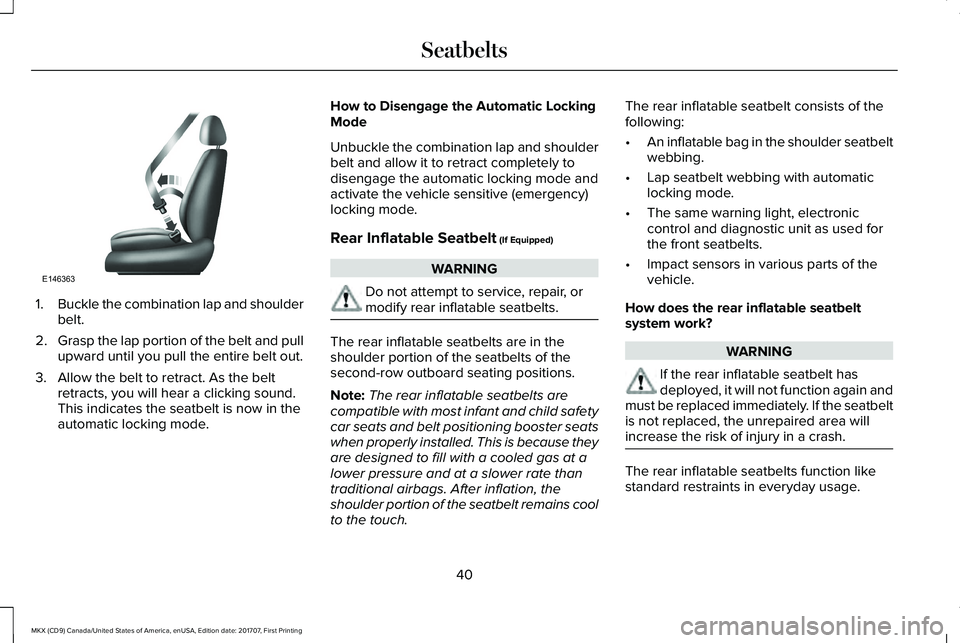
1.Buckle the combination lap and shoulderbelt.
2.Grasp the lap portion of the belt and pullupward until you pull the entire belt out.
3. Allow the belt to retract. As the beltretracts, you will hear a clicking sound.This indicates the seatbelt is now in theautomatic locking mode.
How to Disengage the Automatic LockingMode
Unbuckle the combination lap and shoulderbelt and allow it to retract completely todisengage the automatic locking mode andactivate the vehicle sensitive (emergency)locking mode.
Rear Inflatable Seatbelt (If Equipped)
WARNING
Do not attempt to service, repair, ormodify rear inflatable seatbelts.
The rear inflatable seatbelts are in theshoulder portion of the seatbelts of thesecond-row outboard seating positions.
Note:The rear inflatable seatbelts arecompatible with most infant and child safetycar seats and belt positioning booster seatswhen properly installed. This is because theyare designed to fill with a cooled gas at alower pressure and at a slower rate thantraditional airbags. After inflation, theshoulder portion of the seatbelt remains coolto the touch.
The rear inflatable seatbelt consists of thefollowing:
•An inflatable bag in the shoulder seatbeltwebbing.
•Lap seatbelt webbing with automaticlocking mode.
•The same warning light, electroniccontrol and diagnostic unit as used forthe front seatbelts.
•Impact sensors in various parts of thevehicle.
How does the rear inflatable seatbeltsystem work?
WARNING
If the rear inflatable seatbelt hasdeployed, it will not function again andmust be replaced immediately. If the seatbeltis not replaced, the unrepaired area willincrease the risk of injury in a crash.
The rear inflatable seatbelts function likestandard restraints in everyday usage.
40
MKX (CD9) Canada/United States of America, enUSA, Edition date: 201707, First Printing
SeatbeltsE146363