2018 LINCOLN MKX service
[x] Cancel search: servicePage 43 of 603
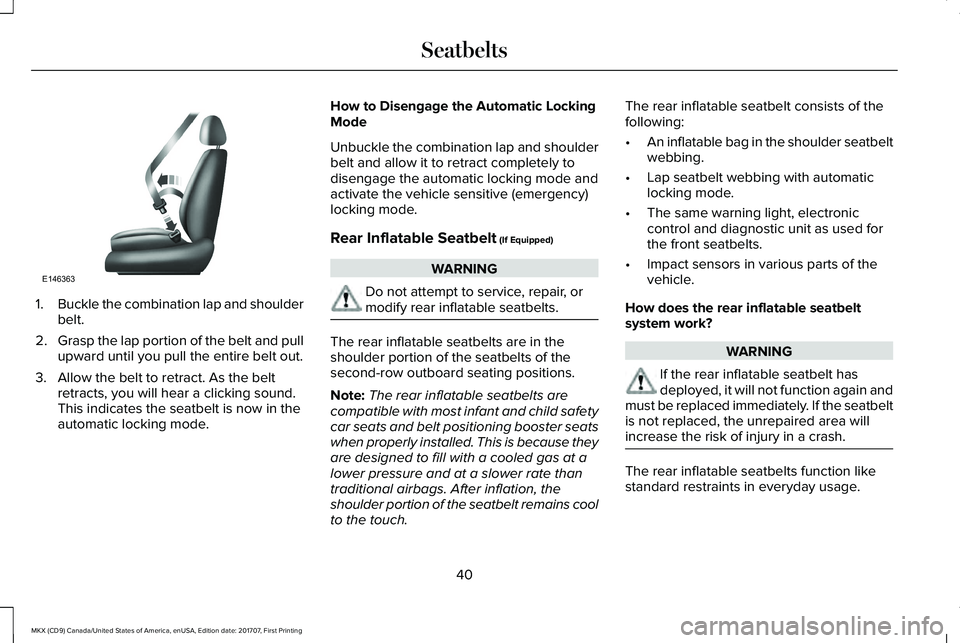
1.Buckle the combination lap and shoulderbelt.
2.Grasp the lap portion of the belt and pullupward until you pull the entire belt out.
3. Allow the belt to retract. As the beltretracts, you will hear a clicking sound.This indicates the seatbelt is now in theautomatic locking mode.
How to Disengage the Automatic LockingMode
Unbuckle the combination lap and shoulderbelt and allow it to retract completely todisengage the automatic locking mode andactivate the vehicle sensitive (emergency)locking mode.
Rear Inflatable Seatbelt (If Equipped)
WARNING
Do not attempt to service, repair, ormodify rear inflatable seatbelts.
The rear inflatable seatbelts are in theshoulder portion of the seatbelts of thesecond-row outboard seating positions.
Note:The rear inflatable seatbelts arecompatible with most infant and child safetycar seats and belt positioning booster seatswhen properly installed. This is because theyare designed to fill with a cooled gas at alower pressure and at a slower rate thantraditional airbags. After inflation, theshoulder portion of the seatbelt remains coolto the touch.
The rear inflatable seatbelt consists of thefollowing:
•An inflatable bag in the shoulder seatbeltwebbing.
•Lap seatbelt webbing with automaticlocking mode.
•The same warning light, electroniccontrol and diagnostic unit as used forthe front seatbelts.
•Impact sensors in various parts of thevehicle.
How does the rear inflatable seatbeltsystem work?
WARNING
If the rear inflatable seatbelt hasdeployed, it will not function again andmust be replaced immediately. If the seatbeltis not replaced, the unrepaired area willincrease the risk of injury in a crash.
The rear inflatable seatbelts function likestandard restraints in everyday usage.
40
MKX (CD9) Canada/United States of America, enUSA, Edition date: 201707, First Printing
SeatbeltsE146363
Page 50 of 603

PRINCIPLE OF OPERATION
WARNINGS
Airbags do not inflate slowly or gently,and the risk of injury from a deployingairbag is the greatest close to the trimcovering the airbag module.
All occupants of your vehicle, includingthe driver, should always properly weartheir seatbelts, even when an airbagsupplemental restraint system is provided.Failure to properly wear your seatbelt couldseriously increase the risk of injury or death.
Even with advanced restraints systems,properly restrain children 12 and underin a rear seating position. Failure to followthis could seriously increase the risk of injuryor death.
Do not place your arms on the airbagcover or through the steering wheel.Failure to follow this instruction could resultin personal injury.
WARNINGS
Keep the areas in front of the airbagsfree from obstruction. Do not affixanything to or over the airbag covers.Objects could become projectiles duringairbag deployment or in a sudden stop.Failure to follow this instruction could resultin personal injury or death.
Airbags can kill or injure a child in achild restraint. Never place arear-facing child restraint in front of an activeairbag. If you must use a forward-facing childrestraint in the front seat, move the seat uponwhich the child restraint is installed all theway back.
Do not attempt to service, repair, ormodify the supplementary restraintsystem or associated components. Failureto follow this instruction could result inpersonal injury or death.
Several airbag system components gethot after inflation. To reduce the riskof injury, do not touch them after inflation.
WARNINGS
If a supplementary restraint systemcomponent has deployed, it will notfunction again. Have the system andassociated components inspected as soonas possible. Failure to follow this instructioncould result in personal injury or death.
The airbags are a supplemental restraintsystem and are designed to work with theseatbelts to help protect the driver and rightfront passenger from certain upper bodyinjuries. Airbags do not inflate slowly; thereis a risk of injury from a deploying airbag.
Note:You will hear a loud bang and see acloud of harmless powdery residue if anairbag deploys. This is normal.
47
MKX (CD9) Canada/United States of America, enUSA, Edition date: 201707, First Printing
Supplementary Restraints System
Page 55 of 603

Note:When the passenger airbag statusindicator off light is illuminated, thepassenger (seat mounted) side airbag maybe disabled to avoid the risk of airbagdeployment injuries.
After all occupants have adjusted their seatsand put on seatbelts, it is very important thatthey continue to sit properly. A properlyseated occupant sits upright, leaning againstthe seatback, and centered on the seatcushion, with their feet comfortably extendedon the floor. Sitting improperly can increasethe chance of injury in a crash event. Forexample, if an occupant slouches, lies down,turns sideways, sits forward, leans forwardor sideways, or puts one or both feet up, thechance of injury during a crash greatlyincreases.
If you think that the status of the passengerairbag off indicator lamp is incorrect, checkfor the following:
•Objects lodged underneath the seat.
•Objects between the seat cushion andthe center console.
•Objects hanging off the seatback.
•Objects stowed in the seatback mappocket.
•Objects placed on the occupant's lap.
•Cargo interference with the seat
•Other passengers pushing or pulling onthe seat.
•Rear passenger feet and knees restingor pushing on the seat.
The conditions listed above may cause theweight of a properly seated occupant to beincorrectly interpreted by the front passengersensing system. The person in the frontpassenger seat may appear heavier or lighterdue to the conditions described in the listabove.
Make sure the front passengersensing system is operatingproperly. See Crash Sensors andAirbag Indicator (page 55).
If the airbag readiness light is lit, do thefollowing:
The driver and adult passengers shouldcheck for objects lodged underneath thefront passenger seat, or cargo interferingwith the seat.
If there are lodged objects, or cargo isinterfering with the seat, take the followingsteps to remove the obstruction:
•Pull the vehicle over.
•Switch the vehicle off.
•Driver and adult passengers shouldcheck for any objects lodged underneaththe front passenger seat or cargointerfering with the seat.
•Remove the obstruction(s) (if found).
•Restart the vehicle.
•Wait at least two minutes and verify thatthe airbag readiness light is no longerilluminated.
•If the airbag readiness light remainsilluminated, this may or may not be aproblem due to the front passengersensing system.
Do not attempt to repair or service thesystem. Take your vehicle immediately to anauthorized dealer.
52
MKX (CD9) Canada/United States of America, enUSA, Edition date: 201707, First Printing
Supplementary Restraints SystemE67017
Page 56 of 603

If it is necessary to modify an advanced frontairbag system to accommodate a personwith disabilities, contact the Ford CustomerRelationship Center. See Getting theServices You Need (page 280).
SIDE AIRBAGS
WARNINGS
Do not place objects or mountequipment on or near the airbag cover,on the side of the seatbacks (of the frontseats), or in front seat areas that may comeinto contact with a deploying airbag. Failureto follow these instructions may increase therisk of personal injury in the event of a crash.
Do not use accessory seat covers. Theuse of accessory seat covers mayprevent the deployment of the side airbagsand increase the risk of injury in an accident.
Do not lean your head on the door. Theside airbag could injure you as itdeploys from the side of the seatback.
WARNINGS
Do not attempt to service, repair, ormodify the seat airbag supplementalrestraint systems, its fuses or the seat coveron a vehicle containing seat airbags as youcould be seriously injured or killed. Contactyour authorized dealer as soon as possible.
If the side airbag has deployed, theairbag will not function again. The sideairbag system (including the seat) must beinspected as soon as possible. If the airbagis not replaced, the unrepaired area willincrease the risk of injury in a crash.
The side airbags are on the outboard sideof the seatbacks of the front seats. Theairbag was designed to inflate between thedoor panel and occupant to further enhancethe protection provided to occupants incertain side impact crashes.
The system consists of the following:
•A label or embossed side panelindicating that side airbags are fitted toyour vehicle.
•Side airbags inside the driver and frontpassenger seatbacks.
•Front passenger sensing system.
Crash sensors and monitoringsystem with readiness indicator.See Crash Sensors and AirbagIndicator (page 55).
53
MKX (CD9) Canada/United States of America, enUSA, Edition date: 201707, First Printing
Supplementary Restraints SystemE152533 E67017
Page 57 of 603
The design and development of the sideairbag system included recommendedtesting procedures that were developed bya group of automotive safety experts knownas the Side Airbag Technical Working Group.These recommended testing procedureshelp reduce the risk of injuries related to thedeployment of side airbags.
DRIVER AND PASSENGER KNEE
AIRBAGS
Note:Keep the glove box door closed whiledriving for optimal performance of thepassenger knee airbag during a crash.
Note:To reduce risk of injury, do not obstructor place objects in the deployment path ofthe knee airbag.
A driver knee airbag is located under orwithin the instrument panel. A passengerknee airbag is located within or under theglove box door. During a crash, the restraintscontrol module may activate the driver andpassenger knee airbags based on crashseverity and occupant conditions. Undercertain crash and occupant conditions, the
driver and passenger knee airbag maydeploy but the driver front airbag may notactivate. As with front and side airbags, it isimportant to be properly seated andrestrained to reduce the risk of death orserious injury.
Make sure the knee airbags areoperating properly. See CrashSensors and Airbag Indicator(page 55).
SAFETY CANOPY™
WARNINGS
Do not place objects or mountequipment on or near the headliner atthe siderail that may come into contact witha deploying curtain airbag. Failure to followthese instructions may increase the risk ofpersonal injury in the event of a crash.
Do not lean your head on the door. Thecurtain airbag could injure you as itdeploys from the headliner.
WARNINGS
Do not attempt to service, repair, ormodify the curtain airbags, its fuses,the A, B, C or D pillar trim, or the headlineron a vehicle containing curtain airbags asyou could be seriously injured or killed.Contact your authorized dealer as soon aspossible.
All occupants of your vehicle includingthe driver should always wear theirsafety belts even when an airbagsupplemental restraint system and curtainairbag is provided. Failure to properly wearyour safety belt could seriously increase therisk of injury or death.
To reduce risk of injury, do not obstructor place objects in the deploymentpath of the curtain airbag.
If the curtain airbags have deployed,the curtain airbags will not functionagain. The curtain airbags (including the A,B, C and D pillar trim and headliner) must beinspected and serviced by an authorizeddealer. If the curtain airbag is not replaced,the unrepaired area will increase the risk ofinjury in a crash.
54
MKX (CD9) Canada/United States of America, enUSA, Edition date: 201707, First Printing
Supplementary Restraints SystemE67017
Page 59 of 603

Your vehicle has a collection of crash andoccupant sensors which provide informationto the restraints control module. Therestraints control module deploys (activates)the front seatbelt pretensioners, driverairbag, passenger airbag, knee airbag(s), seatmounted side airbags, the Safety Canopyand optional rear inflatable seatbelts. Basedon the type of crash, the restraints controlmodule deploys the appropriate safetydevices.
The restraints control module also monitorsthe readiness of the above safety devicesplus the crash and occupant sensors. Thereadiness of the safety system is indicatedby a warning indicator light in the instrumentcluster or by a backup tone if the warninglight is not working. Routine maintenance ofthe airbag is not required.
A difficulty with the system is indicated byone or more of the following:
•The readiness light will not illuminateimmediately after the ignition is switchedon.
•The readiness light either flashes or stayslit.
•A series of five beeps will be heard. Thetone pattern repeats periodically until theproblem, the light or both are repaired.
If any of these things happen, evenintermittently, have the supplementalrestraint system serviced at an authorizeddealer immediately. Unless serviced, thesystem may not function properly in theevent of a crash.
The seatbelt pretensioners and the frontairbag supplemental restraint system aredesigned to activate when the vehiclesustains frontal deceleration sufficient tocause the restraints control module to deploya safety device.
The fact that the seatbelt pretensioners orfront airbags did not activate for both frontseat occupants in a crash does not meanthat something is wrong with the system.Rather, it means the restraints control moduledetermined the accident conditions (crashseverity, belt usage) were not appropriate toactivate these safety devices.
•The design of the front airbags is toactivate only in frontal and near-frontalcrashes (not rollovers, side impacts orrear impacts) unless the crash causessufficient frontal deceleration.
•The design of the seatbelt pretensionersand optional rear inflatable seatbelts isto activate in frontal, near-frontal and sidecrashes, and in rollovers.
•The knee airbag(s) may deploy based oncrash severity and occupant conditions.
56
MKX (CD9) Canada/United States of America, enUSA, Edition date: 201707, First Printing
Supplementary Restraints SystemE67017
Page 66 of 603

Note:Do not use remote start if your fuellevel is low.
The remote start button is on thetransmitter.
This feature allows you to start your vehiclefrom outside the vehicle. The transmitter hasan extended operating range.
Vehicles with automatic climate control canbe configured to operate when the vehicleis remote started. See Automatic ClimateControl (page 145).
Many states and provinces have restrictionsfor the use of remote start. Check your localand state or provincial laws for specificrequirements regarding remote startsystems.
The remote start system does not work if:
•The ignition is on.
•The alarm system is triggered.
•You switch off the feature in theinformation display. See GeneralInformation (page 118).
•The hood is open.
•The transmission is not in park (P).
•The vehicle battery voltage is too low.
•The service engine soon light is on.
Remote Starting Your Vehicle
Note: You must press each button withinthree seconds of each other. If you do notfollow this sequence, your vehicle does notstart remotely, the direction indicators donot flash twice and the horn does not sound.
The tag with your transmitter details thestarting procedure.
To remote start your vehicle:
1. Press the lock button.
2.Press the remote start button twice. Theexterior lamps flash twice.
The horn sounds if the system fails to start.See General Information (page 118).
The power windows do not work duringremote starting and the radio does not turnon automatically.
The parking lamps remain on and the vehiclewill run for 5, 10, or 15 minutes, dependingon the setting. See General Information(page 118).
Extending the Vehicle Run Time
To extend the engine running time durationof your vehicle during remote start, repeatsteps 1 and 2 while the engine is running. Ifyou programmed the duration to last 10minutes, the second 10 minutes will beginafter what is left of the first activation time. For example, if your vehicle had beenrunning from the first remote start for 5minutes, your vehicle continues to run nowfor a total of 20 minutes. You can extendthe remote start up to a maximum of 35minutes.
Wait at least five seconds before remotestarting after the engine stops running.
63
MKX (CD9) Canada/United States of America, enUSA, Edition date: 201707, First Printing
Keys and Remote ControlsE138625 E138626
Page 115 of 603

TachometerA
Information displayB
SpeedometerC
Fuel gaugeD
Engine coolant temperature gaugeE
Information Display
Odometer
Located in the bottom of the informationdisplay. Registers the accumulated distanceyour vehicle has traveled.
Trip Computer
See General Information (page 118).
Vehicle Settings and Personalization
See General Information (page 118).
Fuel Gauge
Note:The fuel gauge may vary slightly whenyour vehicle is moving or on a gradient.
Switch the ignition on. The fuel gauge willindicate approximately how much fuel is leftin the fuel tank. The arrow adjacent to thefuel pump symbol indicates on which side ofyour vehicle the fuel filler door is located.
The needle should move toward F when yourefuel your vehicle. If the needle points to Eafter adding fuel, this indicates your vehicleneeds service soon.
After refueling some variability in needleposition is normal:
•It may take a short time for the needle toreach full after leaving the gas station.This is normal and depends upon theslope of pavement at the gas station.
•The fuel amount dispensed into the tankis a little less or more than the gaugeindicated. This is normal and dependsupon the slope of pavement at the gasstation.
•If the gas station nozzle shuts off beforethe tank is full, try a different gas pumpnozzle.
•There is a small reserve left in the tankwhen the fuel gauge reaches empty.
112
MKX (CD9) Canada/United States of America, enUSA, Edition date: 201707, First Printing
Instrument Cluster