2018 LINCOLN MKX child lock
[x] Cancel search: child lockPage 37 of 603

Recommendations for attaching child safety restraints for children
Use any attachment method as indicated below by X
Combined weight ofchild and child seatRestraint TypeSafety belt onlySafety belt andLATCH (loweranchors and toptether anchor)
Safety belt and toptether anchorLATCH (loweranchors only)LATCH (loweranchors and toptether anchor)
XXUp to 65 lb(29.5 kg)Rear facing childseat
XOver 65 lb(29.5 kg)Rear facing childseat
XXXUp to 65 lb(29.5 kg)Forward facingchild seat
XXOver 65 lb(29.5 kg)Forward facingchild seat
Note:The child seat must rest tightly againstthe vehicle seat upon which it is installed. Itmay be necessary to lift or remove the headrestraint. See Seats (page 150).
CHILD SAFETY LOCKS
When these locks are set, the rear doorscannot be opened from the inside.
34
MKX (CD9) Canada/United States of America, enUSA, Edition date: 201707, First Printing
Child Safety
Page 38 of 603

The childproof locks are located on the rearedge of each rear door and must be setseparately for each door.
Left-Hand Side
Turn counterclockwise to lock and clockwiseto unlock.
Right-Hand Side
Turn clockwise to lock and counterclockwiseto unlock.
35
MKX (CD9) Canada/United States of America, enUSA, Edition date: 201707, First Printing
Child SafetyE112197
Page 39 of 603

PRINCIPLE OF OPERATION
WARNINGS
Always drive and ride with yourseatback upright and the lap belt snugand low across the hips.
To reduce the risk of injury, make surechildren sit where they can be properlyrestrained.
Never let a passenger hold a child onhis or her lap while your vehicle ismoving. The passenger cannot protect thechild from injury in a crash.
All occupants of your vehicle, includingthe driver, should always properly weartheir safety belts, even when an airbagsupplemental restraint system is provided.Failure to properly wear your safety beltcould seriously increase the risk of injury ordeath.
WARNINGS
It is extremely dangerous to ride in acargo area, inside or outside of avehicle. In a crash, people riding in theseareas are more likely to be seriously injuredor killed. Do not allow people to ride in anyarea of your vehicle that is not equipped withseats and safety belts. Be sure everyone inyour vehicle is in a seat and using a safetybelt properly.
In a rollover crash, an unbelted personis significantly more likely to die thana person wearing a safety belt.
Each seating position in your vehiclehas a specific safety belt assemblywhich is made up of one buckle and onetongue that are designed to be used as apair. 1) Use the shoulder belt on the outsideshoulder only. Never wear the shoulder beltunder the arm. 2) Never swing the safety beltaround your neck over the inside shoulder.3) Never use a single belt for more than oneperson.
WARNINGS
When possible, all children 12 years oldand under should be properlyrestrained in a rear seating position. Failureto follow this could seriously increase therisk of injury or death.
Safety belts and seats can become hotin a vehicle that has been closed up insunny weather; they could burn a small child.Check seat covers and buckles before youplace a child anywhere near them.
Front and rear seat occupants,including pregnant women, shouldwear safety belts for optimum protection inan accident.
All seating positions in your vehicle have lapand shoulder safety belts. All occupants ofthe vehicle should always properly wear theirsafety belts, even when an airbagsupplemental restraint system is provided.
The safety belt system consists of:
•Lap and shoulder safety belts.
•Shoulder safety belt with automaticlocking mode, (except driver safety belt).
36
MKX (CD9) Canada/United States of America, enUSA, Edition date: 201707, First Printing
Seatbelts
Page 41 of 603

Slide the clip away from the tongue so thereis no loose webbing when an occupant orchild seat is buckled up. You can also usethe sliding clip to raise the tongue andprevent it from rattling or to ease access tothe tongue.
Using Seatbelts During Pregnancy
WARNING
Always ride and drive with yourseatback upright and properly fastenyour seatbelt. Fit the lap portion of theseatbelt snugly and low across the hips.Position the shoulder portion of the seatbeltacross your chest. Pregnant women mustfollow this practice. See the following figure.
Pregnant women should always wear theirseatbelt. Position the lap belt portion of acombination lap and shoulder belt low acrossthe hips below the belly and worn as tightas comfort allows. Position the shoulder beltto cross the middle of the shoulder and thecenter of the chest.
Seatbelt Locking Modes
WARNING
After a crash, have a qualifiedtechnician check all the seatbelts tomake sure the seatbelts including theautomatic locking retractor feature for childrestraints operate properly. We recommendreplacing any system that has damage ordoes not operate properly. Failure to do socan result in personal injury or death in theevent of a sudden stop or another crash.
All safety restraints in the vehicle arecombination lap and shoulder belts. Thedriver seatbelt has the vehicle sensitivelocking mode. The front outboard passengerand rear seat seatbelts have both the vehiclesensitive locking mode and the automaticlocking mode.
38
MKX (CD9) Canada/United States of America, enUSA, Edition date: 201707, First Printing
SeatbeltsE142590
Page 42 of 603

Vehicle Sensitive Mode
This is the normal retractor mode, whichallows free shoulder belt length adjustmentto your movements and locking in responseto vehicle movement. For example, if thedriver brakes suddenly or turns a cornersharply, or the vehicle receives an impact ofabout 5 mph (8 km/h) or more, thecombination seatbelts lock to help reduceforward movement of the driver andpassengers.
In addition, the retractor is designed to lockif you pull the webbing out too quickly. If theseatbelt retractor locks, slowly lower theheight adjuster to allow the seatbelt toretract. If the retractor does not unlock, pullthe seatbelt out slowly then feed a smalllength of webbing back toward the stowedposition. For rear seatbelts, recline the rearseat backrest or push the seat backrestcushion away from the seatbelt. Feed a smalllength of webbing back toward the stowedposition.
Automatic Locking Mode
In this mode, the shoulder belt automaticallypre-locks. The belt still retracts to removeany slack in the shoulder belt. The automaticlocking mode is not available on the driverseatbelt.
When to Use the Automatic Locking Mode
Use this mode any time a child safety seat,except a booster, is installed in passengerfront or rear seating positions. Properlyrestrain children 12 years old and under in arear seating position whenever possible.See Child Safety (page 19).
How to Use the Automatic Locking Mode
Non-inflatable seatbelts
1.Buckle the combination lap and shoulderbelt.
2. Grasp the shoulder portion and pulldownward until you pull the entire beltout. As the belt retracts, you will hear aclicking sound. This indicates the seatbeltis now in the automatic locking mode.
Rear outboard inflatable seatbelts (secondrow only–if equipped)
39
MKX (CD9) Canada/United States of America, enUSA, Edition date: 201707, First Printing
SeatbeltsE142591
Page 43 of 603
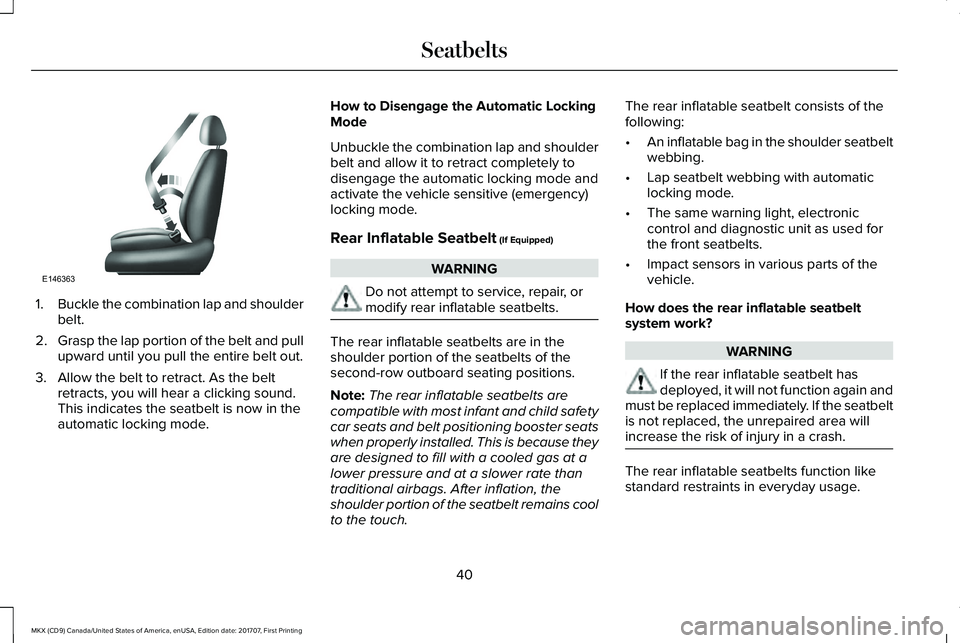
1.Buckle the combination lap and shoulderbelt.
2.Grasp the lap portion of the belt and pullupward until you pull the entire belt out.
3. Allow the belt to retract. As the beltretracts, you will hear a clicking sound.This indicates the seatbelt is now in theautomatic locking mode.
How to Disengage the Automatic LockingMode
Unbuckle the combination lap and shoulderbelt and allow it to retract completely todisengage the automatic locking mode andactivate the vehicle sensitive (emergency)locking mode.
Rear Inflatable Seatbelt (If Equipped)
WARNING
Do not attempt to service, repair, ormodify rear inflatable seatbelts.
The rear inflatable seatbelts are in theshoulder portion of the seatbelts of thesecond-row outboard seating positions.
Note:The rear inflatable seatbelts arecompatible with most infant and child safetycar seats and belt positioning booster seatswhen properly installed. This is because theyare designed to fill with a cooled gas at alower pressure and at a slower rate thantraditional airbags. After inflation, theshoulder portion of the seatbelt remains coolto the touch.
The rear inflatable seatbelt consists of thefollowing:
•An inflatable bag in the shoulder seatbeltwebbing.
•Lap seatbelt webbing with automaticlocking mode.
•The same warning light, electroniccontrol and diagnostic unit as used forthe front seatbelts.
•Impact sensors in various parts of thevehicle.
How does the rear inflatable seatbeltsystem work?
WARNING
If the rear inflatable seatbelt hasdeployed, it will not function again andmust be replaced immediately. If the seatbeltis not replaced, the unrepaired area willincrease the risk of injury in a crash.
The rear inflatable seatbelts function likestandard restraints in everyday usage.
40
MKX (CD9) Canada/United States of America, enUSA, Edition date: 201707, First Printing
SeatbeltsE146363
Page 108 of 603

Pull up the window switch and hold within afew seconds of the window reaching thebounce-back position. The window travelsup with no bounce-back protection. Thewindow stops if you release the switchbefore the window fully closes.
Window Lock
Press the control to lock or unlock the rearwindow controls. It illuminates when youlock the rear window controls.
Accessory Delay
You can use the window switches for severalminutes after you switch the ignition off oruntil you open either front door.
GLOBAL OPENING AND CLOSING
(If Equipped)
You can use the remote control to operatethe windows with the ignition off.
Note:You can enable or disable this featurein the information display or see anauthorized dealer. See General Information(page 118).
Note:To operate this feature, accessorydelay must not be active.
Opening the Windows
You can only open the windows for a shorttime after you unlock your vehicle with theremote control. After you unlock your vehicle,press and hold the remote control unlockbutton to open the windows. Release thebutton once movement starts. Press the lockor unlock button to stop movement.
Closing the Windows
WARNING
When closing the power windows, youshould verify they are free ofobstructions and make sure that children andpets are not in the proximity of the windowopenings.
To close the windows, press and hold theremote control lock button. Release thebutton once movement starts. Press the lockor unlock button to stop movement.
EXTERIOR MIRRORS
Power Exterior Mirrors
WARNING
Do not adjust the mirrors when yourvehicle is moving. This could result inthe loss of control of your vehicle, seriouspersonal injury or death.
105
MKX (CD9) Canada/United States of America, enUSA, Edition date: 201707, First Printing
Windows and MirrorsE144072
Page 593 of 603

Automatic Transmission..............................188Automatic Transmission AdaptiveLearning............................................................192Brake-Shift Interlock Override..........................191If Your Vehicle Gets Stuck In Mud orSnow..................................................................192Push Button Shift Transmission.......................188SelectShift Automatic™ Transmission.............190
Automatic Transmission Fluid Check - 2.7LEcoBoost™/3.7L............................................321Adding Transmission Fluid ..............................322Checking the Transmission Fluid Level ........321
Autowipers.......................................................94Autowipers Settings.............................................94
Auxiliary Power Points..................................167110 Volt AC Power Point.....................................16712 Volt DC Power Point......................................167Locations................................................................167
AWDSee: All-Wheel Drive...........................................193
B
BatterySee: Changing the 12V Battery.......................324
Blind Spot Information System.................244Switching the System Off and On..................245System Errors......................................................245
Using the Blind Spot InformationSystem..............................................................244
Body Styling Kits...........................................342Bonnet LockSee: Opening and Closing the Hood............308
Booster Seats..................................................30Types of Booster Seats........................................31
Brake Fluid Check........................................323Brakes..............................................................199General Information............................................199
Breaking-In......................................................271Bulb Specification Chart.............................329
C
Cabin Air Filter...............................................148California Proposition 65...............................12Capacities and Specifications - 2.7LEcoBoost™....................................................387Alternative Engine Oil for Extremely ColdClimates...........................................................392Specifications......................................................388
Capacities and Specifications - 3.7L........394Alternative Engine Oil for Extremely ColdClimates...........................................................399Specifications......................................................395
Capacities and Specifications....................381Cargo Nets.....................................................257
Car WashSee: Cleaning the Exterior...............................334
Catalytic Converter.......................................185On-Board Diagnostics (OBD-II)........................186Readiness for Inspection and Maintenance(I/M) Testing.......................................................187
Center Console.............................................169Changing a Bulb...........................................328Headlamp.............................................................329LED Lamps...........................................................329
Changing a Fuse..........................................305Fuses.....................................................................305
Changing a Road Wheel.............................373Dissimilar Spare Wheel and Tire AssemblyInformation.......................................................374Stowing the flat tire ...........................................377Tire Change Procedure....................................375
Changing the 12V Battery..........................324Changing the Engine Air Filter..................332Changing the Wiper Blades......................326Changing the Rear Window WiperBlade.................................................................326Changing the Windshield Wiper Blades......326
Checking MyKey System Status.................69Checking the Wiper Blades.......................326Child Restraint and SeatbeltMaintenance..................................................44Child Restraint Positioning...........................33
590
MKX (CD9) Canada/United States of America, enUSA, Edition date: 201707, First Printing
Index