2018 LINCOLN CONTINENTAL ECU
[x] Cancel search: ECUPage 30 of 615

9. Attach the tether strap (if the childrestraint is equipped).
10. Before placing the child in the seat,forcibly move the seat forward and backto make sure the seat is securely heldin place. To check this, grab the seat atthe belt path and attempt to move itside to side and forward and back.There should be no more than 1 in(2.5 cm) of movement for properinstallation.
We recommend checking with a NHTSACertified Child Passenger Safety Technicianto make certain the child restraint is properlyinstalled. In Canada, check with TransportCanada for referral to a Child Car Seat Clinic.
Using Lower Anchors and Tethers for
CHildren (LATCH)
WARNING: Do not attach two childsafety restraints to the same anchor. In acrash, one anchor may not be strong enoughto hold two child safety restraint attachmentsand may break, causing serious injury ordeath.
WARNING: Depending on where yousecure a child restraint, and depending onthe child restraint design, you may blockaccess to certain seatbelt buckle assembliesand LATCH lower anchors, rendering thosefeatures potentially unusable. To avoid riskof injury, make sure occupants only useseating positions where they are able to beproperly restrained.
The LATCH system is composed of threevehicle anchor points: two lower anchorswhere the seatback and seat cushion meet(called the seat bight) and one top tetheranchor behind that seating position.
LATCH compatible child safety seats havetwo rigid or webbing mounted attachmentsthat connect to the two lower anchors at theLATCH equipped seating positions in yourvehicle. This type of attachment methodeliminates the need to use seatbelts to attachthe child restraint, however the seatbelt canstill be used to attach the child restraint. Forforward-facing child restraints, you must alsoattach the top tether strap to the proper toptether anchor, if a top tether strap has beenprovided with your child restraint.
27
Continental (CPL) Canada/United States of America, enUSA, Edition date: 201706, Second-Printing
Child SafetyE142534
Page 31 of 615
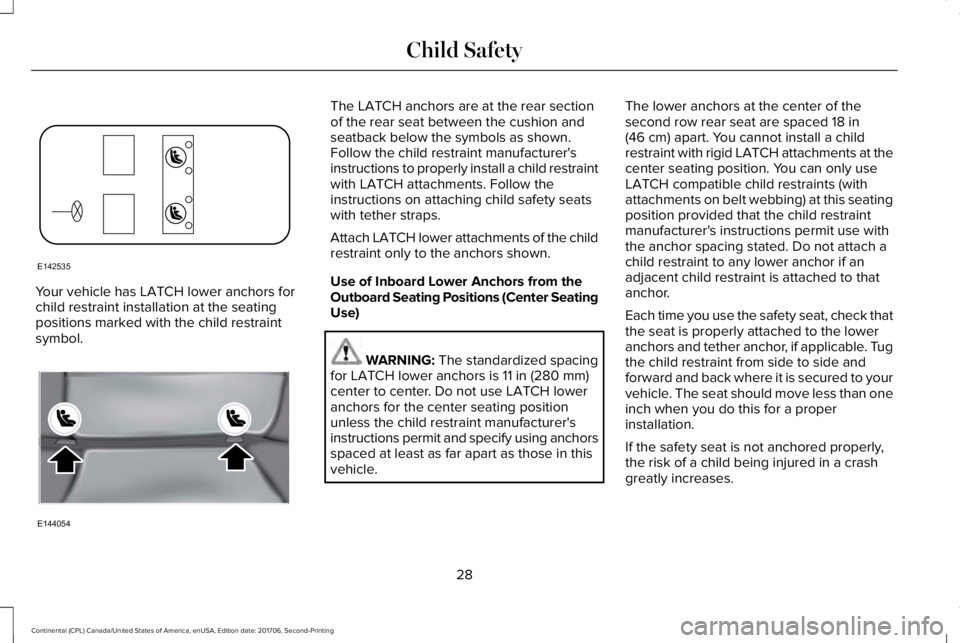
Your vehicle has LATCH lower anchors forchild restraint installation at the seatingpositions marked with the child restraintsymbol.
The LATCH anchors are at the rear sectionof the rear seat between the cushion andseatback below the symbols as shown.Follow the child restraint manufacturer'sinstructions to properly install a child restraintwith LATCH attachments. Follow theinstructions on attaching child safety seatswith tether straps.
Attach LATCH lower attachments of the childrestraint only to the anchors shown.
Use of Inboard Lower Anchors from theOutboard Seating Positions (Center SeatingUse)
WARNING: The standardized spacingfor LATCH lower anchors is 11 in (280 mm)center to center. Do not use LATCH loweranchors for the center seating positionunless the child restraint manufacturer'sinstructions permit and specify using anchorsspaced at least as far apart as those in thisvehicle.
The lower anchors at the center of thesecond row rear seat are spaced 18 in(46 cm) apart. You cannot install a childrestraint with rigid LATCH attachments at thecenter seating position. You can only useLATCH compatible child restraints (withattachments on belt webbing) at this seatingposition provided that the child restraintmanufacturer's instructions permit use withthe anchor spacing stated. Do not attach achild restraint to any lower anchor if anadjacent child restraint is attached to thatanchor.
Each time you use the safety seat, check thatthe seat is properly attached to the loweranchors and tether anchor, if applicable. Tugthe child restraint from side to side andforward and back where it is secured to yourvehicle. The seat should move less than oneinch when you do this for a properinstallation.
If the safety seat is not anchored properly,the risk of a child being injured in a crashgreatly increases.
28
Continental (CPL) Canada/United States of America, enUSA, Edition date: 201706, Second-Printing
Child SafetyE142535 E144054
Page 36 of 615

If the booster seat slides on the vehicle seatupon which it is being used, placing arubberized mesh sold as shelf or carpet linerunder the booster seat may improve thiscondition. Do not introduce any item thickerthan this under the booster seat. Check withthe booster seat manufacturer's instructions.
CHILD RESTRAINT POSITIONING
WARNING: Do not place a rearwardfacing child restraint in front of an activeairbag. Failure to follow this instruction couldresult in personal injury or death.
WARNING: Properly secure children12 years old and under in a rear seatingposition whenever possible. If you are unableto properly secure all children in a rearseating position, properly secure the largestchild on the front seat. If you must use aforward facing child restraint on the frontseat, move the seat as far back as possible.Failure to follow these instructions couldresult in personal injury or death.
WARNING: Always carefully follow theinstructions and warnings provided by themanufacturer of any child restraint todetermine if the restraint device isappropriate for your child's size, height,weight, or age. Follow the child restraintmanufacturer's instructions and warningsprovided for installation and use inconjunction with the instructions andwarnings provided by your vehiclemanufacturer. A safety seat that is improperlyinstalled or utilized, is inappropriate for yourchild's height, age, or weight or does notproperly fit the child may increase the risk ofserious injury or death.
WARNING: Do not allow a passengerto hold a child on their lap when your vehicleis moving. Failure to follow this instructioncould result in personal injury or death in theevent of a sudden stop or crash.
WARNING: Do not use pillows, booksor towels to boost your child's height. Failureto follow this instruction could result inpersonal injury or death.
WARNING: Properly secure childrestraints or booster seats when they are notin use. They could become projectiles in asudden stop or crash. Failure to follow thisinstruction could result in personal injury ordeath.
WARNING: Do not put the shouldersection of the seatbelt or allow the child toput the shoulder section of the seatbeltunder their arm or behind their back. Failureto follow this instruction could reduce theeffectiveness of the seatbelt and increasethe risk of injury or death in a crash.
WARNING: Do not leave children orpets unattended in your vehicle. Failure tofollow this instruction could result in personalinjury or death.
33
Continental (CPL) Canada/United States of America, enUSA, Edition date: 201706, Second-Printing
Child Safety
Page 40 of 615

The safety belt system consists of:
•Lap and shoulder safety belts.
•Shoulder safety belt with automaticlocking mode, (except driver safety belt).
•Height adjuster at the front outboardseating positions.
•Safety belt pretensioner at the frontoutboard seating positions.
•Belt tension sensor at the front outboardpassenger seating position.
· Safety belt warning light andchime.
· Crash sensors and monitoringsystem with readiness indicator.
The safety belt pretensioners at the frontseating positions are designed to tighten thesafety belts when activated. In frontal andnear-frontal crashes, the safety beltpretensioners may be activated alone or, ifthe crash is of sufficient severity, togetherwith the front airbags. The pretensioners mayalso activate when a side curtain airbag isdeployed.
FASTENING THE SEATBELTS
Standard belts shown, inflatable belts similar
The front outermost and rear safety restraintsin the vehicle are combination lap andshoulder belts.
1. Insert the belt tongue into the properbuckle (the buckle closest to the directionthe tongue is coming from) until you heara snap and feel it latch. Make sure yousecurely fasten the tongue in the buckle.
2. To unfasten, press the release buttonand remove the tongue from the buckle.
Using Seatbelts During Pregnancy
WARNING: Always ride and drive withyour seatback upright and properly fastenyour seatbelt. Fit the lap portion of theseatbelt snugly and low across the hips.Position the shoulder portion of the seatbeltacross your chest. Pregnant women mustfollow this practice. See the following figure.
37
Continental (CPL) Canada/United States of America, enUSA, Edition date: 201706, Second-Printing
SeatbeltsE71880 E67017 E142587 E142588
Page 61 of 615

REMOTE CONTROL
Intelligent Access Key
Note:You may not be able to shift out ofpark (P) unless the intelligent access key isinside your vehicle.
The intelligent access keys operate thepower locks and the remote start system. The key must be in your vehicle to use thepush button start.
Note: Your vehicle keys came with asecurity label that provides important keycut information. Keep the label in a safeplace for future reference.
Removable Key Blade
The intelligent access key also contains aremovable key blade that you can use tounlock your vehicle.
Push the release button and pull the keyblade out.
Replacing the Battery
Note:Refer to local regulations whendisposing of transmitter batteries.
Note:Do not wipe off any grease on thebattery terminals or on the back surface ofthe circuit board.
58
Continental (CPL) Canada/United States of America, enUSA, Edition date: 201706, Second-Printing
Keys and Remote ControlsE218688 E151795 E218689
Page 68 of 615

Number of Admin Keys
Indicates how many admin keys areprogrammed to your vehicle. Use this featureto determine how many admin keys you havefor your vehicle, and detect if an additionalMyKey has been programmed.
USING MYKEY WITH REMOTE
START SYSTEMS
MyKey is not compatible with nonFord-approved, aftermarket remote startsystems. If you choose to install a remotestart system, see an authorized dealer for aFord-approved remote start system.
MYKEY TROUBLESHOOTING
Potential causesCondition
· The key or transmitter used to start the vehicle does not have adminprivileges.I cannot create a MyKey.
· Vehicles with keyless start: Make sure you place the transmitter intothe backup slot. See Passive Anti-Theft System (page 82).· The key or transmitter used to start the vehicle is the only admin key.There always has to be at least one admin key.· SecuriLock passive anti-theft system is disabled or in unlimited mode.
· The key or transmitter used to start the vehicle does not have adminprivileges.I cannot program the configurable settings.
65
Continental (CPL) Canada/United States of America, enUSA, Edition date: 201706, Second-Printing
MyKey™
Page 70 of 615

LOCKING AND UNLOCKING
Your vehicle has an intelligent electronicallycontrolled door system that is in constantcommunication with overall vehicle systems.
When you lock your vehicle using the lockswitch on each door interior trim panel, orby using the keyless entry keypad or the locksensor on each door exterior trim panel, theexterior door handle switches do not releasethe doors. This helps to secure your vehicleand prevent unauthorized entry. Also, whenyour vehicle reaches a speed greater than12 mph (20 km/h) the exterior door handleswitches do not release the doors.
If the airbags deploy or the fuel pump shutoffswitch activates, all interior and exteriorunlock switches do not unlock your door forsix seconds. This helps to secure the doorsin the event of a crash. After six seconds, allswitches reset and you can open the doorsusing the interior and exterior unlatchswitches.
Door Lock Indicator
An LED on each front door window trimilluminates when you lock the doors. Itremains on for 2 to 5 seconds after youswitch the ignition off.
Door Lock Switch Inhibitor
When you electronically lock your vehicle,the door lock switches and the interiorluggage compartment release switch do notoperate after 20 seconds. You must unlockyour vehicle with the remote control orkeyless entry keypad, or switch the ignitionon, to restore function to these switches. You can switch this feature on or off in theinformation display. See GeneralInformation (page 115).
Activating Intelligent Access
The intelligent access key must be within 3 ft(1 m) of the door or luggage compartmentyou intend to lock or unlock.
At a Door
67
Continental (CPL) Canada/United States of America, enUSA, Edition date: 201706, Second-Printing
Doors and LocksE222428
Page 73 of 615

Locking and Unlocking the Doors FromInside
Unlock.A
Lock.B
Locking the Doors
Press the lock switch on the door interior trimpanel. The doors can no longer be releasedusing the exterior door handle switches andthe luggage compartment locks.
Unlocking the Doors
Press the unlock switch on the door interiortrim panel. The doors can then be releasedusing the exterior door handle switches.
Emergency Locking
Each door has a backup power system whichallows the door to function if your vehiclehas no power. The system has a limitednumber of operations before the power isdepleted and turns off. When the systemturns off, the door remains open andunlatched and does not close.
If your vehicle has no power and the backuppower system is turned off, you can closeand secure your vehicle by manuallyresetting each door latch using a key in theposition shown.Left-Hand Side
Turn clockwise to reset the latch.
Right-Hand Side
Turn counterclockwise to reset the latch.
When you have reset the latch, you are thenable to fully close and latch the door.
70
Continental (CPL) Canada/United States of America, enUSA, Edition date: 201706, Second-Printing
Doors and LocksE196954 E112203