Page 543 of 628

5437-2. Steps to take in an emergency
LX570_OM_OM60Q78U_(U) 7
When trouble arises Raise the tire. While raising, secure the tire, taking
care that the tire goes straight up with-
out catching on any surrounding part, to
prevent it from flying forward during a
collision or sudden braking.
After the tire goes half way up, check
that the suspended chain is able to enter
the tire hole, for proper storage.
Tightening torque:
33.2 ft•lbf (45 N•m, 4.6 kgf•m)
Confirm that the tire is not loose
after tightening:
Push and pull the tire
Try rotating Visually check to ensure the tire is
not hung on surrounding parts.
If looseness or misassembly exis ts, repeat step and step .
Repeat step , any time the tire is lowered or disturbed.
Stow the tools and jack securely. ■
After completing the tire change
The tire pressure warning system must be reset. ( → P. 487)3
4
1
2
NOTICE ■
When stowing the flat tire
Ensure that there is no object caught between the tire and the vehicle underbody. ■
When replacing the tires ●
When removing or fitting the wheels, tire s or the tire pressure warning valve and
transmitter, contact your Lexus dealer as the tire pressure wa rning valve and trans-
mitter may be damaged if not handled correctly. ●
Replace the grommets for the tire pressure warning valves and transmitters as well.■
To avoid damage to the tire pressu re warning valves and transmitters
When a tire is repaired with liquid sealants, the tire pressure warning valve and trans-
mitter may not operate properly. If a liquid sealant is used, contact your Lexus dealer or
other qualified service shop as soon as possi ble. Make sure to replace the tire pressure
warning valve and transmitter when replacing the tire. ( → P. 487) 3 4
5 4
6
Page 555 of 628
555
LX570_OM_OM60Q78U_(U) 7
When trouble arises 7-2. Steps to take in an emergency
If the vehicle becomes stuck Stop the engine. Set the parking br ake and shift the shift lever to P.
Remove the mud, snow or sand from around the rear wheels.
Place wood, stones or some other materi al under the rear wheels to help pro-
vide traction.
Restart the engine.
Shift the shift lever to the D or R positi on and release the parking brake. Then,
while exercising caution, depress the accelerator pedal. ■
When it is difficult to free the vehicle
■
Extra high mode
→ P. 299Carry out the following procedures if the tires spin or the vehicle becomes
stuck in mud, dirt, or snow:
Press to turn off Active TRAC. 1
2
3
4
5
Page 558 of 628
558
LX570_OM_OM60Q78U_(U) 8-1. Specifications
Maintenance data (fuel, oil level, etc.)
* 1
: Unladen vehicles
* 2
: Vehicles with roof antenna
* 3
: Vehicles with 20-inch tires
* 4
: Vehicles with 21-inch tiresDimensions and weights Overall length 200.0 in. (5080 mm)
Overall width 78.0 in. (1980 mm)
Overall height
* 1
73.4 in. (1865 mm)
75.2 in. (1910 mm)
* 2
Wheelbase 112.2 in. (2850 mm)
Tread Front 64.8 in. (1645 mm)
* 3
65.0 in. (1650 mm)
* 4
Rear 64.6 in. (1640 mm)
* 3
65.0 in. (1650 mm)
* 4
Vehicle capacity weight
(Occupants + luggage) 1285 lb. (580 kg)
TWR
(trailer weight +
cargo weight) With brake 7000 lb. (3175 kg)
Without
brake 1000 lb. (454 kg)
Page 565 of 628
LX570_OM_OM60Q78U_(U) 5658-1. Specifications
8
Vehicle specifications
20-inch tires
21-inch tiresSuspension Fluid type Suspension fluid AHC
Tires and wheels Tire size 285/50R20 112V
Tire inflation pressure
(Recommended cold tire
inflation pressure) Normal driving
Front:
33 psi (230 kPa, 2.3 kgf/cm 2
or bar)
Rear:
33 psi (230 kPa, 2.3 kgf/cm 2
or bar)
Spare:
33 psi (230 kPa, 2.3 kgf/cm 2
or bar)
Trailer towing
Add 2 psi (10 kPa, 0.1 kgf/cm 2
or bar) to the rear
tires.
Wheel size 20 × 8 1/2J
Wheel nut torque 97 ft•lbf (131 N•m, 13.4 kgf•m)
Tire size 275/50R21 113V XL
Tire inflation pressure
(Recommended cold tire
inflation pressure) Normal driving
Front:
33 psi (230 kPa, 2.3 kgf/cm 2
or bar)
Rear:
33 psi (230 kPa, 2.3 kgf/cm 2
or bar)
Spare:
33 psi (230 kPa, 2.3 kgf/cm 2
or bar)
Trailer towing
Add 6 psi (40 kPa, 0.4 kgf/cm 2
or bar) to the
rear tires.
Wheel size 21 X 8 1/2J
Wheel nut torque 97 ft•lbf (131 N•m, 13.4 kgf•m)
Page 569 of 628

569
LX570_OM_OM60Q78U_(U) 8-1. Specifications
8
Vehicle specifications
Tire information
Tire size ( → P. 571)
DOT and Tire Identification Number (TIN) ( → P. 570)
Location of trea dwear indicators ( → P. 486)
Tire ply composition and materials Plies are layers of rubber-c oated parallel cords. Cords are the strands which form the
plies in a tire.
Radial tires or bias-ply tires A radial tire has “RADIAL” on the sidewall. A tire not marked “RADIAL” is a bias-ply
tire.
TUBELESS or TUBE TYPE A tubeless tire does not have a tube and air is directly put into the tire. A tube type tire
has a tube inside the tire and the tube maintains the air pressure.
Load limit at maximum cold tire inflation pressure ( → P. 575)
Maximum cold tire inflation pressure ( → P. 575)This means the pressure to which a tire may be inflated.
Uniform tire quality grading For details, see “Uniform Tire Quality Grading” that follows.
Summer tires or all season tires ( → P. 490)An all season tire has “M+S” on the side wall. A tire not marked “M+S” is a summer
tire.Typical tire symbols
1
2
3
4
5
6
7
8
9
10
Page 573 of 628

LX570_OM_OM60Q78U_(U) 5738-1. Specifications
8
Vehicle specifications This information has been prepared in acco rdance with regulations issued by the
National Highway Traffic Safety Administra tion of the U.S. Department of Trans-
portation.
It provides the purchasers and/or prospe ctive purchasers of Lexus vehicles with
information on uniform tire quality grading.Your Lexus dealer will help answer any ques tions you may have as you read this infor-
mation.■
DOT quality grades
All passenger vehicle tires must conform to Federal Safety Requirements in
addition to these grades. Quality grad es can be found where applicable on
the tire sidewall between tread shoulder and maximum section width. For example: Treadwear 200 Traction AA Temperature A■
Treadwear
The treadwear grade is a comparative rati ng based on the wear rate of the tire
when tested under controlled conditio ns on a specified government test
course. For example, a tire graded 150 would wear one and a half (1 - 1/2) times as well on
the government course as a tire graded 100.
The relative performance of tires depends upon the actua l conditions of their use.
Performance may differ significantly from the norm due to variations in driving
habits, service practices and difference s in road characteristics and climate.■
Traction AA, A, B, C
The traction grades, from highest to lo west, are AA, A, B and C, and they rep-
resent the tire’s ability to stop on wet pavement as measured under controlled
conditions on specified government test surfaces of asphalt and concrete. A tire marked C may have poor traction performance.
Warning: The traction grade assigned to this tire is based on braking (straight
ahead) traction tests and does not include cornering (turning) traction.Uniform Tire Quality Grading
Page 574 of 628
574
LX570_OM_OM60Q78U_(U) 8-1. Specifications■
Temperature A, B, C
The temperature grades are A (the highes t), B, and C, representing the tire’s
resistance to the generation of heat and its ability to dissipate heat when
tested under controlled conditions on a specified indoor laboratory test
wheel. Sustained high temperature can cause the ma terial of the tire to degenerate and
reduce tire life, and excessive temperature can lead to sudden tire failure.
Grade C corresponds to a level of perfor mance which all passenger car tires must
meet under the Federa l Motor Vehicle Safety Standard No. 109.
Grades B and A represent higher levels of performance on the laboratory test
wheel than the minimum required by law.
Warning: The temperature grades of a tire assume that it is properly inflated and
not overloaded.
Excessive speed, underi nflation, or excessive loading, either separately or in com-
bination, can cause heat buildup and possible tire failure.
Page 593 of 628
593
LX570_OM_OM60Q78U_(U) 8-3. Initialization
8
Vehicle specifications
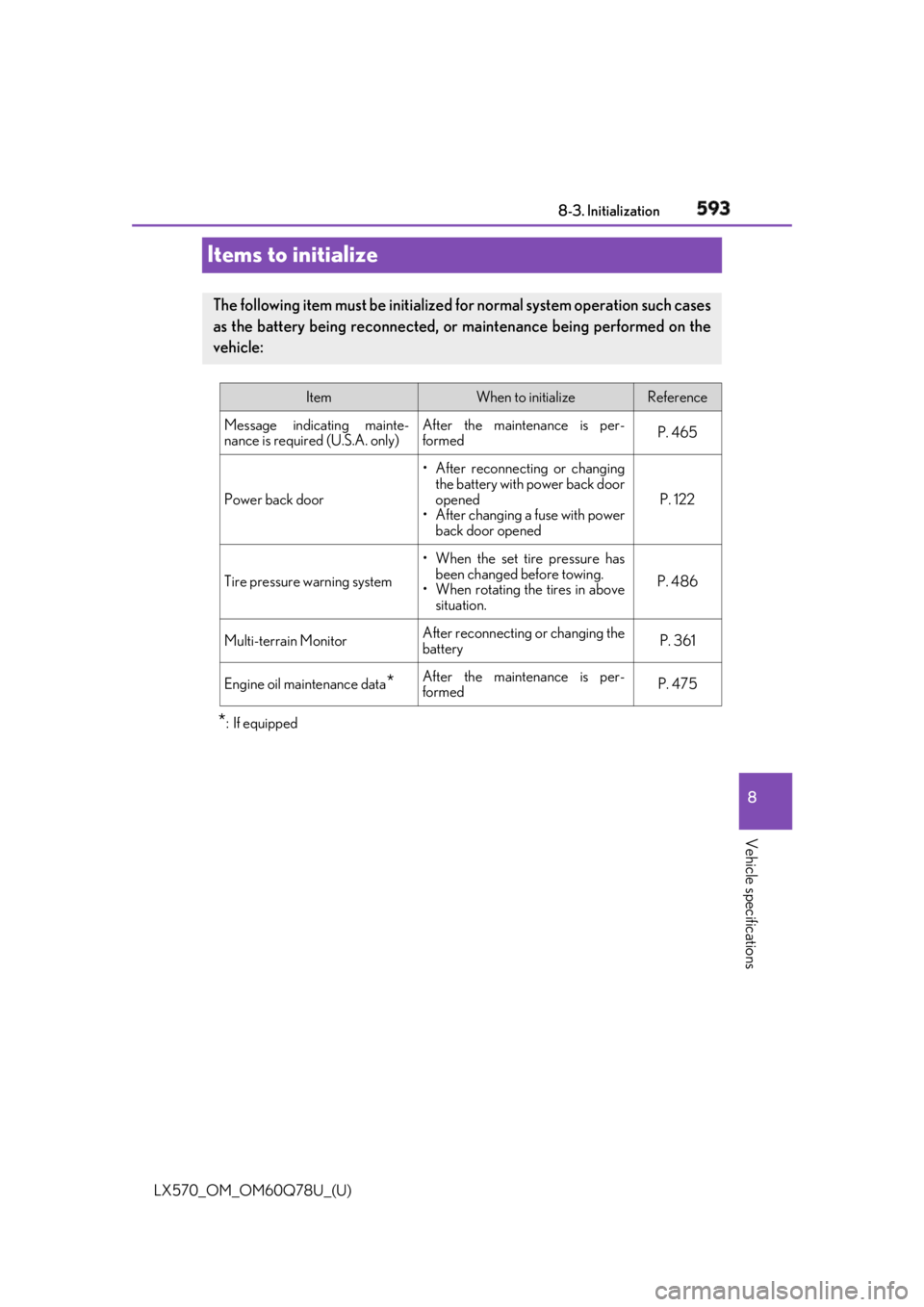
Items to initialize
* : If equippedThe following item must be initialized for normal system operation such cases
as the battery being reconnected, or maintenance being performed on the
vehicle: Item When to initialize Reference
Message indicating mainte-
nance is required (U.S.A. only) After the maintenance is per-
formed P. 465
Power back door • After reconnecting or changing
the battery with power back door
opened
• After changing a fuse with power
back door opened P. 122
Tire pressure warning system • When the set tire pressure has
been changed before towing.
• When rotating the tires in above
situation. P. 486
Multi-terrain Monitor After reconnecting or changing the
battery P. 361
Engine oil maintenance data
* After the maintenance is per-
formed P. 475