2018 LEXUS LS500 park
[x] Cancel search: parkPage 385 of 514
3856-3. Do-it-yourself maintenance
LS500_OM_OM50F54U_(U) 6
Maintenance and care battery was disconnect ed. Make sure to
turn off the engine before disconnecting
the battery. Take extra care when con-
necting the battery if the engine switch
mode prior to discharge is unknown.
If the system will not st art even after multiple
attempts, contact your Lexus dealer.
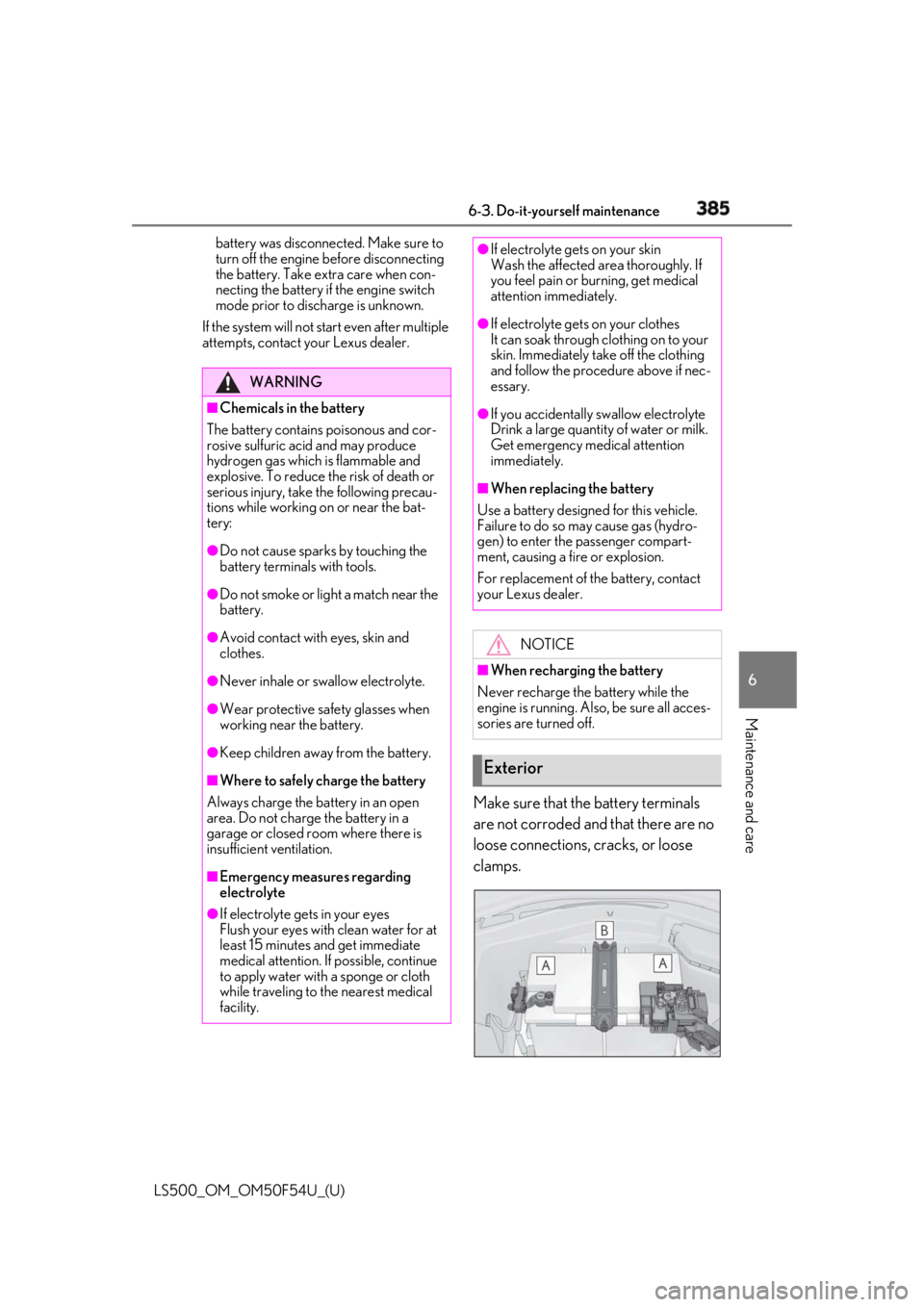
Make sure that the battery terminals
are not corroded and that there are no
loose connections, cracks, or loose
clamps.WARNING■
Chemicals in the battery
The battery contains poisonous and cor-
rosive sulfuric acid and may produce
hydrogen gas which is flammable and
explosive. To reduce the risk of death or
serious injury, take the following precau-
tions while working on or near the bat-
tery: ●
Do not cause sparks by touching the
battery terminals with tools.●
Do not smoke or light a match near the
battery.●
Avoid contact with eyes, skin and
clothes.●
Never inhale or swallow electrolyte.●
Wear protective safety glasses when
working near the battery.
●
Keep children away from the battery.
■
Where to safely charge the battery
Always charge the battery in an open
area. Do not charge the battery in a
garage or closed room where there is
insufficient ventilation.
■
Emergency measures regarding
electrolyte
●
If electrolyte gets in your eyes
Flush your eyes with clean water for at
least 15 minutes and get immediate
medical attention. If possible, continue
to apply water with a sponge or cloth
while traveling to the nearest medical
facility. ●
If electrolyte gets on your skin
Wash the affected area thoroughly. If
you feel pain or burning, get medical
attention immediately. ●
If electrolyte gets on your clothes
It can soak through clothing on to your
skin. Immediately take off the clothing
and follow the procedure above if nec-
essary. ●
If you accidentally swallow electrolyte
Drink a large quantity of water or milk.
Get emergency medical attention
immediately. ■
When replacing the battery
Use a battery designed for this vehicle.
Failure to do so may cause gas (hydro-
gen) to enter the passenger compart-
ment, causing a fire or explosion.
For replacement of the battery, contact
your Lexus dealer.
NOTICE■
When recharging the battery
Never recharge the battery while the
engine is running. Also, be sure all acces-
sories are turned off.
Exterior
Page 392 of 514
392 6-3. Do-it-yourself maintenance
LS500_OM_OM50F54U_(U) When replacing the tires or wheels, the
tire pressure warning valve and trans-
mitters must be installed to the wheels
which will be installed to the vehicle.
When new tire pressure warning
valves and transmitte rs are installed,
new ID codes must be registered in the
tire pressure warning computer and
the tire pressure warning system must
be initialized. ( → P.394)■
Replacing tires and wheels
If the ID codes of the tire pressure warning
valve and transmitters are not registered,
the tire pressure warning system will not
work properly. In this case, after driving for
about 20 minutes, the tire pressure warning
light will blink for ap proximately 1 minute
and then illuminate to indicate a system
malfunction. ■
The tire pressure warning system
must be initialized in the following
circumstances:
When the tire inflation pressure is
changed such as when changing
traveling speed or load weight.
When the tire inflation pressure is
changed such as when the tire size
is changed.
When rotating the tires.
After performing the transmitter ID
code registration procedure.
( → P.394)
When the tire pressure warning system
is initialized, the current tire inflation
pressure is set as the benchmark pres-
sure. ■
How to initialize the tire pressure
warning system
1 Park the vehicle in a safe place and
turn the engine switch off. The initialization pr ocedure cannot be
started while the vehicle is moving.
2 Adjust the tire inflation pressure to
the specified cold tire inflation pres-
sure level. Make sure to adjust the tire pressure to the
specified cold tire infl ation pressure level.
The tire pressure warning system will oper-
ate based on this pressure level.
3 Turn the engine switch to IGNI-
TION ON mode.
4 Press or of the meter con-
trol switch to select .Installing tire pressure warning
valves and transmitters
NOTICE■
Repairing or replacing tires, wheels,
tire pressure warning valves, trans-
mitters and tire valve caps●
When removing or fitting the wheels,
tires or the tire pressure warning
valves and transmitters, contact your
Lexus dealer as the tire pressure warn-
ing valves and transmitters may be
damaged if not handled correctly.
●
Make sure to install the tire valve caps.
If the tire valve caps are not installed,
water may enter the valves of the tire
pressure warning valve and transmit-
ters and the valves may become stuck.
●
When replacing tire valve caps, do not
use tire valve caps other than those
specified. The cap may become stuck. Initializing the tire pressure
warning system
Page 393 of 514

3936-3. Do-it-yourself maintenance
LS500_OM_OM50F54U_(U) 6
Maintenance and care 5 Press or to select “Vehicle
Settings” and then press .
6 Press or to select “TPWS”
and then press .
7 Press or to select “Set
Pressure”. Then press and hold
until the tire pressure warning light
blinks 3 times.Then a message will be displayed on the
multi-information display.
“--” will be displayed on the multiinforma-
tion display for the inflation pressure of
each tire while initia lization is being per-
formed.
8 Drive straight (with occasional left
and right turns) at approximately
25 mph (40 km/h) or more for
approximately 10 to 30 minutes.Initialization is complete when the position
of each tire is determined and the inflation
pressure of each tire is displayed on the
multi-information display.
Initialization may take longer than approxi-
mately 1 hour in certain situations, such as
when the vehicle is stopped for a long time
at traffic lights, etc. ( → P.393)
■
Initialization procedure
●
Make sure to perform the initialization
procedure after adjusting the tire inflation
pressure.
Also, make sure the tires are cold before performing the initia lization procedure or
adjusting the tire inflation pressure. ●
If the engine switch is turned off during
initialization, it is no t necessary to restart
the initialization procedure from the
beginning as it will begin automatically
when the engine switch is turned back to
IGNITION ON mode. ●
If initialization has accidentally been
started when it is not necessary, adjust
the tire inflation pressure to the specified
level when the tires are cold and then
perform the initiali zation procedure
again. ●
While the position of each tire is being
determined and the inflation pressures
are not being displayed on the
multi-information display, if the inflation
pressure of a tire drops, the tire pressure
warning light will come on. ■
If the tire pressure warning system is not
initialized properly ●
In the following situations, initialization
may take longer than usual to be com-
pleted or may not be possible. (Usually,
the vehicle will need to be driven for
approximately 10 to 30 minutes to com-
plete initialization.) If initialization is not
complete after drivin g approximately 30
minutes, continue driving for a while.
• If the vehicle is driven on an unpaved
road, it may take longer to complete ini-
tialization.
• If the vehicle is backed up while perform-
ing initialization, data collected during ini-
tialization will be cleared and it will take
longer than normal to complete.
• If the vehicle is driven in heavy traffic or
another situation where other vehicles
are driven close by, it may take time for
the system to recognize the tire pressure
warning valve and transmitters of your
vehicle over those of other vehicles.
If initialization is not complete after driving
for approximately 1 hour, park the vehicle in
a safe place for approximately 20 minutes
and then drive the vehicle again.
●
In the following situations, initialization
will not be started or was not completed
properly and the system will not operate
properly. Perform the initialization proce-
Page 395 of 514

3956-3. Do-it-yourself maintenance
LS500_OM_OM50F54U_(U) 6
Maintenance and care codes. If the system is initialized before
registering the ID co des, the initialized
values will be invalid.●
As the tires will be warm when registra-
tion is completed, ma ke sure to allow the
tires to cool before performing initializa-
tion.■
Canceling ID code registration●
To cancel ID code registration after it has
been started, turn th e engine switch off
before driving the vehicle.
If the vehicle is driven after ID code regis-
tration is started, to cancel registration,
perform the ID code registration start
procedure again and turn the engine
switch off before driving.●
If ID code registration has been canceled,
the tire pressure warning light will blink
for approximately 1 minute when the
engine switch is turned to IGNITION
ON mode and then illuminate. The tire
pressure warning system will be opera-
tional when the tire pressure warning
light turns off.●
If the warning light does not turn off even
after several minutes have elapsed, ID
code registration may not have been can-
celled correctly. To ca ncel registration,
perform the ID code registration start
procedure again and th en turn the engine
switch off before driving.■
If ID codes are not registered properly●
In the following situat ions, ID code regis-
tration may take longer than usual to be
completed or may not be possible. (Usu-
ally, the vehicle will need to be driven for
approximately 10 to 30 minutes to com-
plete ID code registration.)
If ID code registration is not complete
after driving for approximately 30 min-
utes, continue driving for a while.
• If the vehicle is driven on an unpaved
road, it may take longer than normal to
complete registration.
• If the vehicle is backed up while perform-
ing registration, data collected during
registration will be cleared, and it will take
longer than normal to complete.
• If the vehicle is driven in heavy traffic or
another situation where other vehicles
are driven close by, it may take time for the system to recognize the tire pressure
warning valve and transmitters of your
vehicle over those of other vehicles.
•If a wheel with a ti re pressure warning
valve and transmitter in stalled is inside or
near the vehicle, registration of the ID
codes for the installed wheels may not be
possible.
If ID registration is not complete after driv-
ing for approximately 1 hour, park the vehi-
cle in a safe place for approximately 20
minutes and then perform the ID code reg-
istration procedure again. ●
In the following situations, ID code regis-
tration will not be started or was not com-
pleted properly and the system will not
operate properly. Pe rform the ID code
registration procedure again.
• If, when attempting to start ID code regis-
tration, the tire pressure warning light
does not blink slowly 3 times.
• If, when the vehicle has been driven for
about 20 minutes after performing ID
code registration, the tire pressure warn-
ing light blinks for approximately 1 minute
and then illuminates. ●
If ID code registration cannot be com-
pleted after performing the above proce-
dure, contact your Lexus dealer.
Page 396 of 514

396 6-3. Do-it-yourself maintenance
LS500_OM_OM50F54U_(U) Stop the vehicle in a safe place on a
hard, flat surface.
Set the parking brake.
Shift the shift position to P.
Disabling the height control. (if
equipped) ( → P.293)
Stop the engine. ■
Jack and tools
As your vehicle is equipped with run-flat
tires, the following tools for replacing a tire
are not included with your vehicle. They can
be purchased at your Lexus dealer. ●
Wheel nut wrench●
Jack●
Jack handleReplacing the tire When raising your vehicle with a
jack, position the jack correctly.
Improper placement may damage
your vehicle or cause injury.
If necessary tire replacement
seems difficult to perform, contact
your Lexus dealer.
Before jacking up the vehicle WARNING■
Using the tire jack
Observe the following precautions.
Improper use of the tire jack may cause
the vehicle to suddenly fall off the jack,
leading to death or serious injury. ●
Do not use the tire jack for any pur-
pose other than replacing tires or
installing and removing tire chains. ●
Do not use other tire jacks for replac-
ing tires on this vehicle. ●
Put the jack properly in its jack point. ●
Do not put any part of your body under
the vehicle while it is supported by the
jack. ●
Do not start the engine or drive the
vehicle while the vehicle is supported
by the jack. ●
Do not raise the vehicle while some-
one is inside. ●
When raising the vehicle, do not put an
object on or under the jack. ●
Do not raise the vehicle to a height
greater than that required to replace
the tire. ●
Use a jack stand if it is necessary to get
under the vehicle. ●
Make sure to disable all functions of
the vehicle height control of the elec-
tronically modulated air suspension
and then stopping the engine.
( → P.293)●
When lowering the vehicle, make sure
that there is no-one near the vehicle. If
there are people nearby, warn them
vocally before lowering.
Page 400 of 514
400 6-3. Do-it-yourself maintenance
LS500_OM_OM50F54U_(U) 1 Remove the tire valve cap.
2 Press the tip of the tire pressure
gauge onto the tire valve.
3 Read the pressure using the gauge
gradations.
4 If the tire inflation pressure is not at
the recommended level, adjust the
pressure.
If you add too much air, press the
center of the valve to deflate.
5 After completing the tire inflation
pressure measurem ent and adjust-
ment, apply soapy water to the
valve and check for leakage.
6 Put the tire valve cap back on. ■
Tire inflation pressure check interval
You should check tire inflation pressure
every two weeks, or at least once a month.
Do not forget to check the spare. ■
Effects of incorrect tire inflation pres-
sure
Driving with incorrect ti re inflation pressure
may result in the following: ●
Reduced fuel economy●
Reduced driving comfort and poor han-
dling●
Reduced tire life due to wear●
Reduced safety●
Damage to the drive train
If a tire needs frequent inflating, have it
checked by your Lexus dealer.
■
Instructions for checking tire inflation
pressure
When checking tire inflation pressure,
observe the following:
●
Check only when the tires are cold.
If your vehicle has been parked for at
least 3 hours or has not been driven for
more than 1 mile or 1.5 km, you will get an
accurate cold tire in flation pressure read- ing. ●
Always use a tire pressure gauge.
It is difficult to judge if a tire is properly
inflated based only on its appearance. ●
It is normal for the ti re inflation pressure
to be higher after driving as heat is gen-
erated in the tire. Do not reduce tire infla-
tion pressure after driving. ●
Never exceed the vehicle capacity
weight.
Passengers and luggage weight should
be placed so that the vehicle is balanced.
WARNING■
Proper inflation is critical to save tire
performance
Keep your tires properly inflated.
If the tires are not properly inflated, the
following conditions may occur which
could lead to an accident resulting in
death or serious injury: ●
Excessive wear ●
Uneven wear ●
Poor handling ●
Possibility of blowouts resulting from
overheated tires
●
Air leaking from between tire and
wheel
●
Wheel deformation and/or tire dam-
age
●
Greater possibility of tire damage
while driving (due to road hazards,
expansion joints, sharp edges on the
road, etc.)
NOTICE
■
When inspecting and adjusting tire
inflation pressure
Be sure to put the tire valve caps back on.
If a valve cap is not installed, dirt or mois-
ture may get into the valve and cause an
air leak, resulting in decreased tire infla-
tion pressure.
Page 412 of 514
412 7-2. Steps to take in an emergency
LS500_OM_OM50F54U_(U) 7-2.Steps to take in an emergency
If your vehicle needs to be
towed If towing is ne cessary, we recom-
mend having your vehicle towed by
your Lexus dealer or commercial
towing service, using a wheel-lift
type truck or flatbed truck.
Use a safety chain system for all
towing, and abide by all state/pro-
vincial and local laws. WARNING
Observe the following precautions.
Failure to do so may result in death or
serious injury. ■
When towing the vehicle
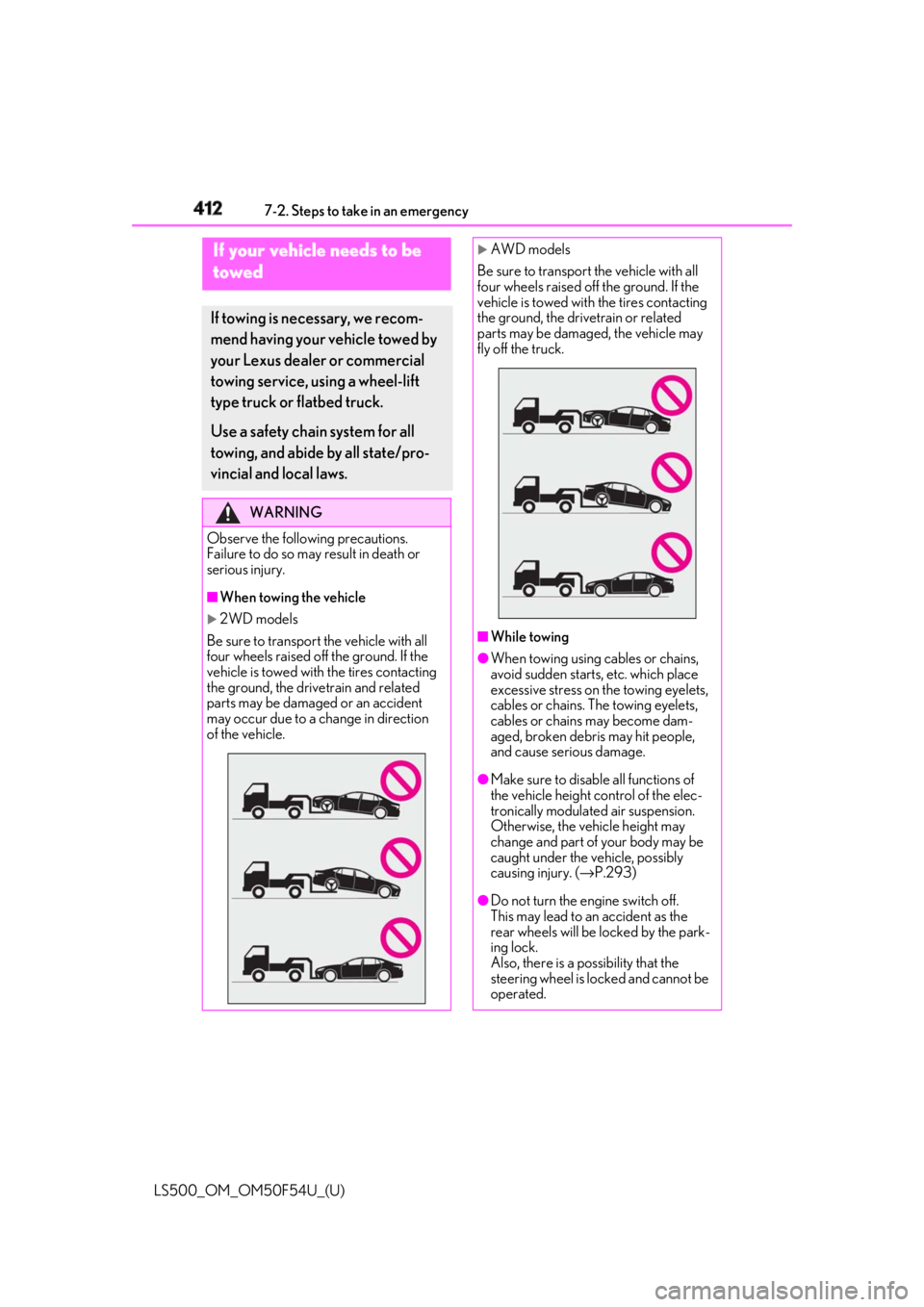
2WD models
Be sure to transport the vehicle with all
four wheels raised off the ground. If the
vehicle is towed with the tires contacting
the ground, the driv etrain and related
parts may be damaged or an accident
may occur due to a change in direction
of the vehicle.
AWD models
Be sure to transport the vehicle with all
four wheels raised off the ground. If the
vehicle is towed with the tires contacting
the ground, the driv etrain or related
parts may be damaged, the vehicle may
fly off the truck.
■
While towing ●
When towing using cables or chains,
avoid sudden starts, etc. which place
excessive stress on the towing eyelets,
cables or chains. The towing eyelets,
cables or chains may become dam-
aged, broken debris may hit people,
and cause serious damage.
●
Make sure to disable all functions of
the vehicle height control of the elec-
tronically modulated air suspension.
Otherwise, the vehicle height may
change and part of your body may be
caught under the vehicle, possibly
causing injury. ( → P.293)
●
Do not turn the engine switch off.
This may lead to an accident as the
rear wheels will be locked by the park-
ing lock.
Also, there is a possibility that the
steering wheel is locked and cannot be
operated.
Page 413 of 514
4137-2. Steps to take in an emergency
LS500_OM_OM50F54U_(U) 7
When trouble arises
In the following situations, it is not pos-
sible to be towed by another vehicle
using cables or chains, as the rear
wheels may be locked due to the park-
ing lock. Contact your Lexus dealer or
commercial towing service.
There is a malfunction in the shift control system. ( → P.163, 428)
There is a malfunction in the engine
immobilizer system. ( → P.58)
There is a malfunction in the smart
access system with push-button
start. ( → P.436)
The battery is discharged.
( → P.438)
The following may indicate a problem
with your transmission. Contact your
Lexus dealer or commercial towing
service before towing.
The engine is running but the vehi-
cle does not move.
The vehicle makes an abnormal
sound.
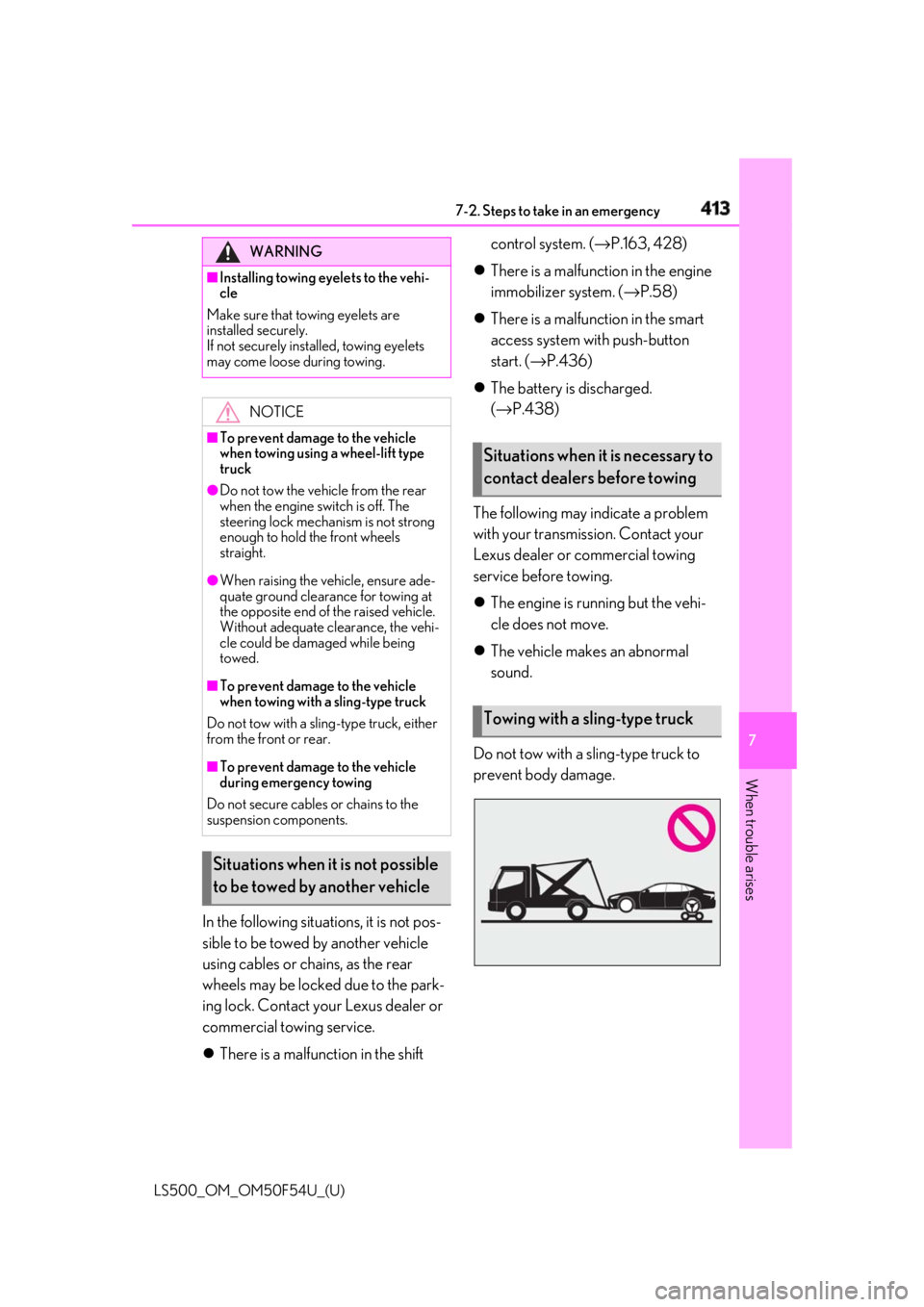
Do not tow with a sling-type truck to
prevent body damage.WARNING■
Installing towing eyelets to the vehi-
cle
Make sure that towing eyelets are
installed securely.
If not securely installed, towing eyelets
may come loose during towing.
NOTICE■
To prevent damage to the vehicle
when towing using a wheel-lift type
truck●
Do not tow the vehicle from the rear
when the engine switch is off. The
steering lock mechanism is not strong
enough to hold the front wheels
straight.●
When raising the vehicle, ensure ade-
quate ground clearance for towing at
the opposite end of the raised vehicle.
Without adequate clearance, the vehi-
cle could be damaged while being
towed.■
To prevent damage to the vehicle
when towing with a sling-type truck
Do not tow with a sling-type truck, either
from the front or rear.
■
To prevent damage to the vehicle
during emergency towing
Do not secure cables or chains to the
suspension components.
Situations when it is not possible
to be towed by another vehicle Situations when it is necessary to
contact dealers before towing
Towing with a sling-type truck