2018 KIA SPORTAGE start engine
[x] Cancel search: start enginePage 491 of 605
821
Maintenance
EXPLANATION OF SCHEDULED MAINTENANCE ITEMS
Engine oil and filter
The engine oil and filter should be
changed at the intervals specified in
the maintenance schedule. If the
vehicle is being driven in severe con-
ditions, more frequent oil and filter
changes are required.
Drive belts
Inspect all drive belts for evidence of
cuts, cracks, excessive wear or oil
saturation and replace if necessary.
Drive belts should be checked peri-
odically for proper tension and
adjusted as necessary.
Fuel filter (for gasoline)
Kia gasoline vehicle is equipped a
lifetime fuel filter that integrated with
the fuel tank. Regular maintenance
or replacement is not needed but
depends on fuel quality. If there are
some important safety matters like
fuel flow restriction, surging, loss of
power, hard starting problem etc, fuel
filter inspection or replace is needed.
The fuel filter be Inspected or
replaced by an authorized Kia dealer.
Fuel lines, fuel hoses and con-
nections
Check the fuel lines, fuel hoses and
connections for leakage and dam-
age. Have an authorized Kia dealer
replace any damaged or leaking
parts immediately.
Vapor hose and fuel filler cap
The vapor hose and fuel filler cap
should be inspected at those inter-
vals specified in the maintenance
schedule. Make sure that a new
vapor hose or fuel filler cap is cor-
rectly replaced.
Page 494 of 605
Maintenance
24
8
(Continued)
1. Wash the undercarriage of your
vehicle regularly throughout the
winter and do a thorough washing
in the spring to remove road salt
and other de-icing chemicals.
2. Monitor the brake system for signs of corrosion by having regu-
lar professional inspections and
watching for signs of problems,
including loss of brake fluid,
unusual leaks and soft or spongy
feel in the brake pedal.
3. Replace the entire brake pipe assembly if you find severe corro-
sion that causes scaling or flaking
of brake components.
Brake fluid
Check the brake fluid level in the
brake fluid reservoir. The level should
be between “MIN” and “MAX” marks
on the side of the reservoir. Use only
hydraulic brake fluid conforming to
DOT 3 or DOT 4 specification.
Parking brake
Inspect the parking brake system
including the parking brake pedal
and cables.
Brake discs, pads, calipers
and rotors
Check the pads for excessive wear,
discs for run out and wear, and
calipers for fluid leakage.
Exhaust pipe and muffler
Visually inspect the exhaust pipes,
muffler and hangers for cracks, dete-
rioration, or damage. Start the
engine and listen carefully for any
exhaust gas leakage. Tighten con-
nections or replace parts as neces-
sary.
Suspension mounting bolts
Check the suspension connections
for looseness or damage. Retighten
to the specified torque.
Steering gear box, linkage &
boots/lower arm ball joint
With the vehicle stopped and engine
off, check for excessive free-play in
the steering wheel.
Check the linkage for bends or dam-
age. Check the dust boots and ball
joints for deterioration, cracks, or
damage. Replace any damaged
parts.
Drive shafts and boots
Check the drive shafts, boots and
clamps for cracks, deterioration, or
damage. Replace any damaged
parts and, if necessary, repack the
grease.
Air conditioning refrigerant
Check the air conditioning lines and
connections for leakage and dam-
age.
Page 496 of 605
Maintenance
26
8
ENGINE OIL
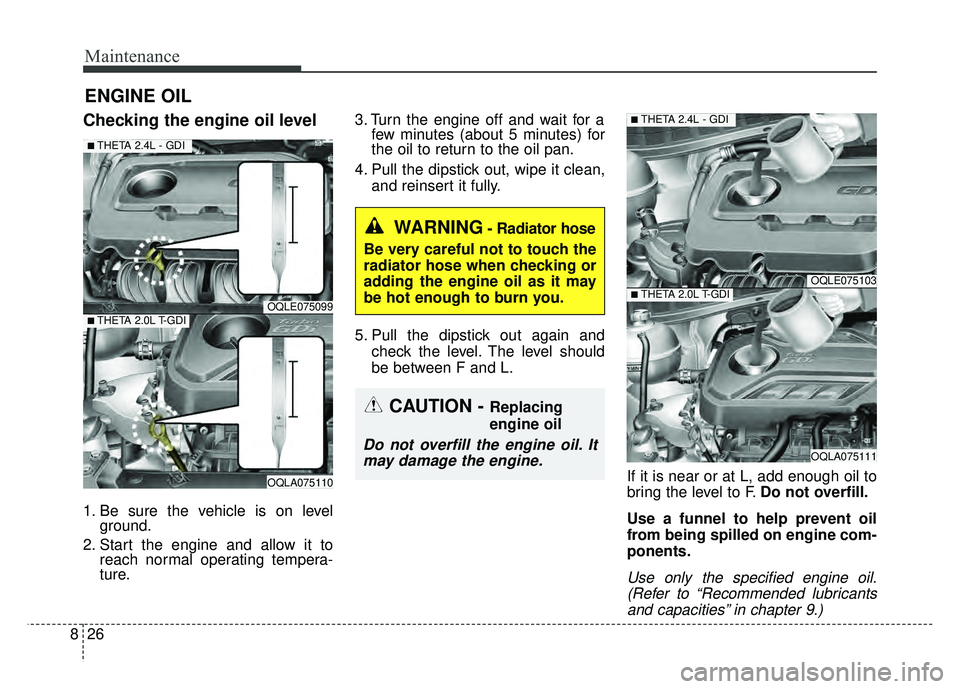
Checking the engine oil level
1. Be sure the vehicle is on level
ground.
2. Start the engine and allow it to reach normal operating tempera-
ture. 3. Turn the engine off and wait for a
few minutes (about 5 minutes) for
the oil to return to the oil pan.
4. Pull the dipstick out, wipe it clean, and reinsert it fully.
5. Pull the dipstick out again and check the level. The level should
be between F and L.
If it is near or at L, add enough oil to
bring the level to F.Do not overfill.
Use a funnel to help prevent oil
from being spilled on engine com-
ponents.
Use only the specified engine oil. (Refer to “Recommended lubricantsand capacities” in chapter 9.)
OQLE075099
OQLA075110
■THETA 2.4L - GDI
■THETA 2.0L T-GDI
CAUTION - Replacing
engine oil
Do not overfill the engine oil. Itmay damage the engine.
WARNING- Radiator hose
Be very careful not to touch the
radiator hose when checking or
adding the engine oil as it may
be hot enough to burn you.
OQLE075103
OQLA075111
■THETA 2.4L - GDI
■THETA 2.0L T-GDI
Page 542 of 605
Maintenance
72
8
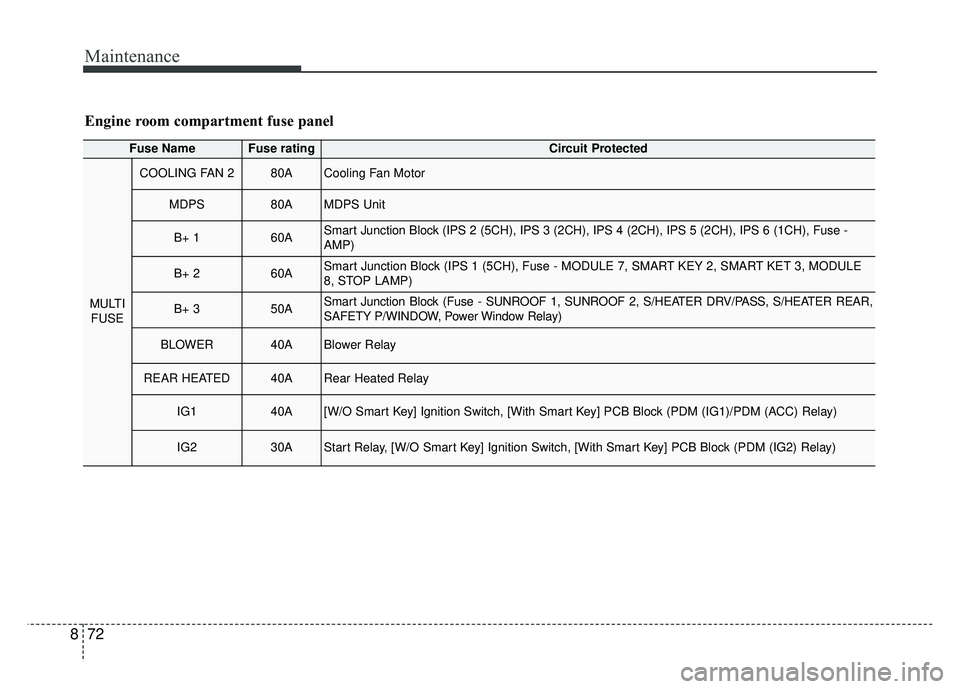
Fuse NameFuse ratingCircuit Protected
MULTI
FUSE
COOLING FAN 280ACooling Fan Motor
MDPS80AMDPS Unit
B+ 160ASmart Junction Block (IPS 2 (5CH), IPS 3 (2CH), IPS 4 (2CH), IPS 5 (2CH), IPS 6 (\
1CH), Fuse -
AMP)
B+ 260ASmart Junction Block (IPS 1 (5CH), Fuse - MODULE 7, SMART KEY 2, SMART KET 3, MODULE
8, STOP LAMP)
B+ 350ASmart Junction Block (Fuse - SUNROOF 1, SUNROOF 2, S/HEATER DRV/PASS, S/HEATER REAR,
SAFETY P/WINDOW, Power Window Relay)
BLOWER40ABlower Relay
REAR HEATED40ARear Heated Relay
IG140A[W/O Smart Key] Ignition Switch, [With Smart Key] PCB Block (PDM (IG1)/PDM (ACC) Relay)
IG230AStart Relay, [W/O Smart Key] Ignition Switch, [With Smart Key] PCB Block (PDM (IG2) Relay)
Engine room compartment fuse panel
Page 573 of 605
8103
Maintenance
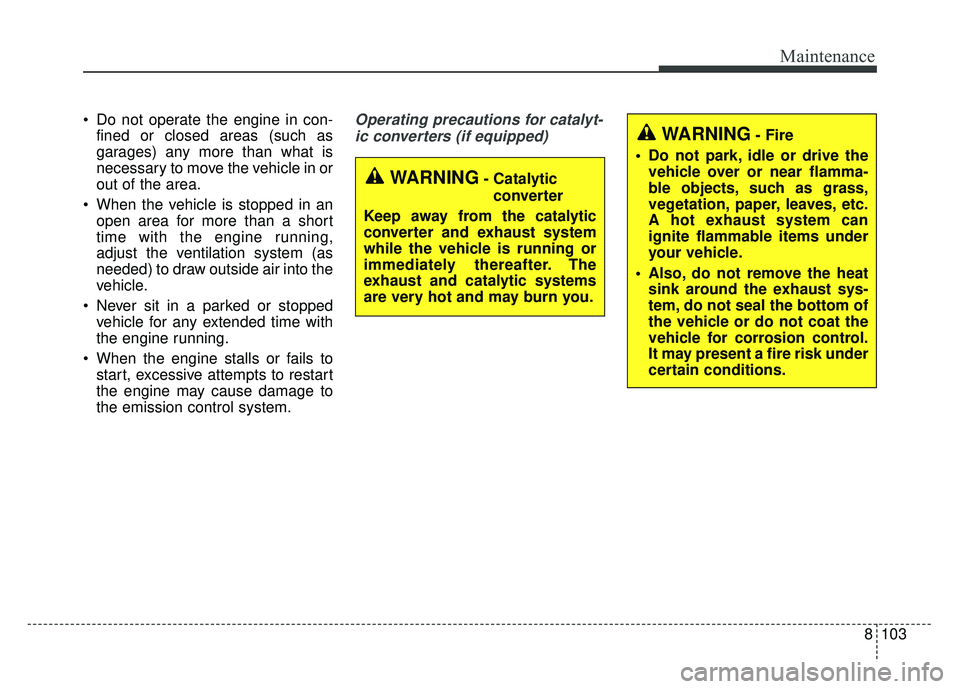
Do not operate the engine in con-fined or closed areas (such as
garages) any more than what is
necessary to move the vehicle in or
out of the area.
When the vehicle is stopped in an open area for more than a short
time with the engine running,
adjust the ventilation system (as
needed) to draw outside air into the
vehicle.
Never sit in a parked or stopped vehicle for any extended time with
the engine running.
When the engine stalls or fails to start, excessive attempts to restart
the engine may cause damage to
the emission control system.Operating precautions for catalyt-
ic converters (if equipped)
WARNING- Catalytic converter
Keep away from the catalytic
converter and exhaust system
while the vehicle is running or
immediately thereafter. The
exhaust and catalytic systems
are very hot and may burn you.
WARNING- Fire
Do not park, idle or drive the vehicle over or near flamma-
ble objects, such as grass,
vegetation, paper, leaves, etc.
A hot exhaust system can
ignite flammable items under
your vehicle.
Also, do not remove the heat sink around the exhaust sys-
tem, do not seal the bottom of
the vehicle or do not coat the
vehicle for corrosion control.
It may present a fire risk under
certain conditions.
Page 583 of 605
99
Specifications, Consumer information, Reporting safety defects
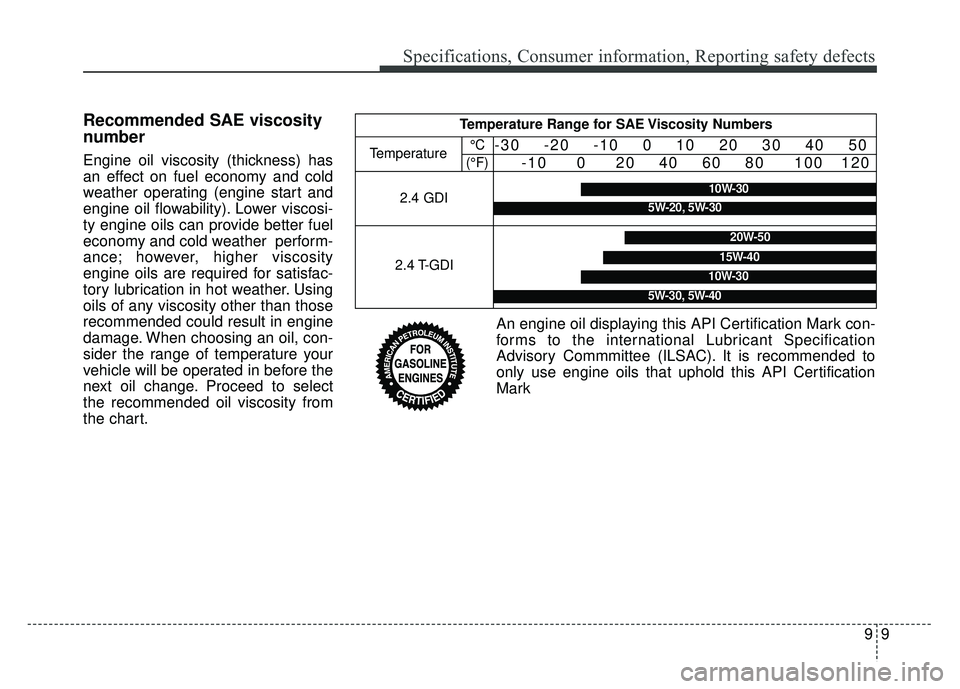
Recommended SAE viscosity
number
Engine oil viscosity (thickness) has
an effect on fuel economy and cold
weather operating (engine start and
engine oil flowability). Lower viscosi-
ty engine oils can provide better fuel
economy and cold weather perform-
ance; however, higher viscosity
engine oils are required for satisfac-
tory lubrication in hot weather. Using
oils of any viscosity other than those
recommended could result in engine
damage. When choosing an oil, con-
sider the range of temperature your
vehicle will be operated in before the
next oil change. Proceed to select
the recommended oil viscosity from
the chart.
Temperature Range for SAE Viscosity Numbers
Temperature°C
(°F)-30 -20 -10 0 10 20 30 40 50 -10 0 20 40 60 80 100 120
2.4 T-GDI
20W-50
10W-30
15W-40
5W-30, 5W-40
2.4 GDI10W-30
5W-20, 5W-30
An engine oil displaying this API Certification Mark con-
forms to the international Lubricant Specification
Advisory Commmittee (ILSAC). It is recommended to
only use engine oils that uphold this API Certification
Mark
Page 593 of 605
I3
Index
Sensor to detect the distance from the vehiclein front (front radar)..................................................6-56
System malfunction ....................................................6-57
Limitation of the system ............................................6-58
Recognizing pedestrians ............................................6-61
Back-up lamp and Rear turn signal lamp bulb replacement..........................................................8-87
Battery........................................................................\
....8-42 For best battery service ..............................................8-42
Recharging the battery ................................................8-43
Reset items ..................................................................8-44
Battery replacement (folding key) ..................................4-8
Battery replacement (smart key)....................................4-17
Battery saver function ..................................................4-118
Before driving ..................................................................6-4
Blind Spot Detection System (BSD) ............................6-72 BSD (Blind Spot Detection)/LCA (Lane Change Assist)......................................6-73
RCTA (Rear cross traffic alert) ..................................6-76
Bonnet see the hood ......................................................4-43
Brake system..................................................................6-28 Power brakes ..............................................................6-28
Parking brake ..............................................................6-30
Electric parking brake (EPB) ......................................6-31
Auto hold ....................................................................6-38\
Anti-lock brake system (ABS)....................................6-42
Electronic stability control (ESC) ..............................6-44
Vehicle stability management (VSM) ........................6-48
Hill-start assist control (HAC) ....................................6-49
Brakes fluid....................................................................8-32\
Checking the brake fluid level ....................................8-32
Bulb replacement ..........................................................8-78
Bulb wattage ....................................................................9-3
Button start/stop, see engine start/stop button ................6-9
California Perchlorate notice ......................................8-103
Camera (Rear view) ....................................................4-117
Capacities (Lubricants) ....................................................9-7
Care Care of seat belts ........................................................3-31
SRS Care ....................................................................3-68\
Tire care ......................................................................8-\
44
Exterior care ................................................................8-93
Interior care ................................................................8-98
Care of seat belts ..........................................................3-31
Center console storage ................................................4-161
Central door lock switch................................................4-24
Chains - Tire ..................................................................6-91
Checking fluid levels ....................................................8-25
Checking tire inflation pressure ....................................8-46
Child restraint system ....................................................3-32
B
C
Page 595 of 605

I5
Index
Door locks......................................................................4-\
22From outside the vehicle ............................................4-22
From inside the vehicle ..............................................4-23
Central door lock switch ............................................4-24
Child-protector rear door lock ....................................4-26
Downhill Brake Control (DBC) ....................................6-62 DBC operation ............................................................6-63
Drinks holders, see cup holders ..................................4-164
DRIVE mode (Drive mode integrated control system) ..6-70
Drive mode integrated control system ..........................6-70 DRIVE mode ..............................................................6-70
ECO mode ..................................................................6-70
SPORT mode ..............................................................6-71
Driver's and passenger's front air bag ............................3-58
Driving at night ..............................................................6-87
Driving in flooded areas ................................................6-89
Driving in the rain..........................................................6-88
Driving off-road ............................................................6-89
ECO mode (Drive mode integrated control system) ....6-70
Economical operation ....................................................6-84
Electric parking brake (EPB) ........................................6-31
Electrical Equipment (U.S. only) ..................................9-15 Installation of a mobile two-way radio system ..........9-15
Electrochromic mirror (ECM) ......................................4-59
Electrochromic mirror with HomeLink system ............4-60 Electronic power steering ..............................................4-54
Electronic stability control (ESC) ................................6-44
Emergency liftgate safety release ..................................4-28
Emergency roadside assistance......................................9-12
Emergency starting ..........................................................7-5
Jump starting ................................................................7-5
Emergency while driving ................................................7-3
Emission control system ..............................................8-101 Crankcase emission control system ..........................8-101
Evaporative emission control System ......................8-101
Exhaust emission control system ..............................8-102
Engine ........................................................................\
......9-2
Engine compartment ........................................................2-6
Engine compartment ........................................................8-3
Engine coolant ..............................................................8-28 Checking the coolant level..........................................8-28
Changing the coolant ..................................................8-31
Engine Coolant Temperature Gauge..............................4-70
Engine number ..............................................................9-11
Engine oil ......................................................................8-\
26 Checking the engine oil level ....................................8-26
Changing the engine oil and filter ..............................8-27
Engine overheats ..............................................................7-7
Engine start/stop button ..................................................6-9 Illuminated engine start/stop button ............................6-9
Engine start/stop button position ..................................6-9
Starting the engine with a smart key ..........................6-11
Engine start/stop button illumination ..............................6-9
E