2018 KIA SOUL center console
[x] Cancel search: center consolePage 16 of 620

25
Your vehicle at a glance
INSTRUMENT PANEL OVERVIEW
1. Audio remote control buttons..................5-3
2. Driver’s front air bag .............................3-56
3. Horn ......................................................4-41
4. Cruise control button ............................6-63
5. Instrument cluster .................................4-48
6. Lighting control lever.............................4-89
7.Wiper and washer control lever .............4-93
8. Ignition switch or Engine start/stopbutton...............................................6-6, 6-9
9. Audio ...........................................5-10, 5-46
10. Hazard warning flasher.........................7-2
11. Climate control system ..........4-103, 4-114
12. Front seat warmer/ Seat air ventilation .................4-137, 4-139
13. Power outlet ......................................4-141
14. Center console storage box..............4-133
15. Glove box ..........................................4-134
16. Passenger’s front air bag ....................3-56
17. Parking brake......................................6-37
18. Drive mode button ..............................6-84
OPS013003N
❈The actual shape may differ from the illustration.
Page 24 of 620
Safety features of your vehicle
63
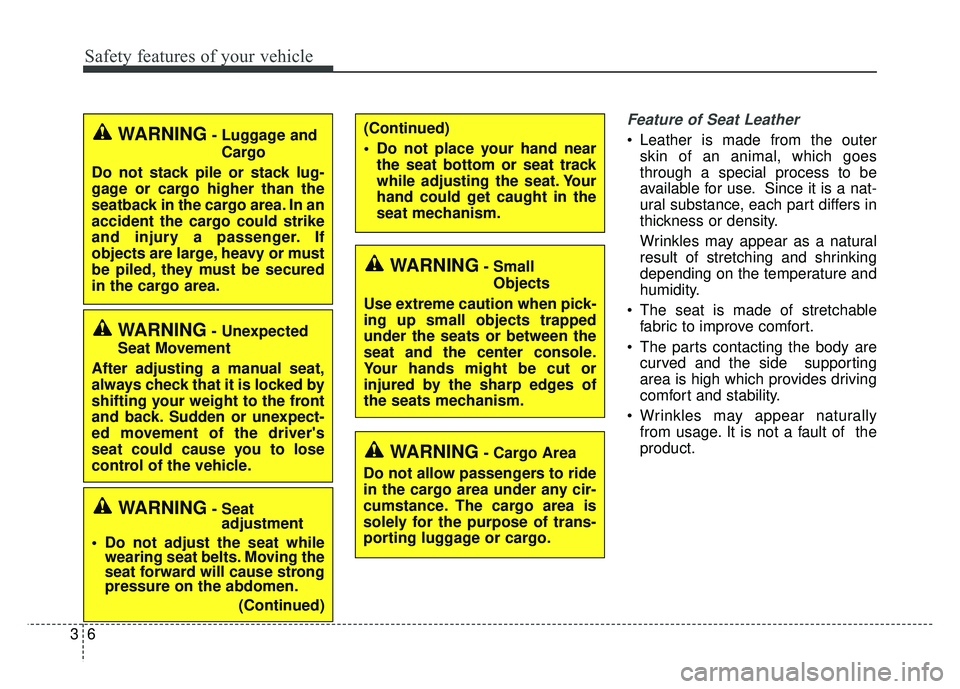
Feature of Seat Leather
Leather is made from the outerskin of an animal, which goes
through a special process to be
available for use. Since it is a nat-
ural substance, each part differs in
thickness or density.
Wrinkles may appear as a natural
result of stretching and shrinking
depending on the temperature and
humidity.
The seat is made of stretchable fabric to improve comfort.
The parts contacting the body are curved and the side supporting
area is high which provides driving
comfort and stability.
Wrinkles may appear naturally from usage. It is not a fault of the
product.
WARNING- Unexpected
Seat Movement
After adjusting a manual seat,
always check that it is locked by
shifting your weight to the front
and back. Sudden or unexpect-
ed movement of the driver's
seat could cause you to lose
control of the vehicle.
WARNING- Luggage and Cargo
Do not stack pile or stack lug-
gage or cargo higher than the
seatback in the cargo area. In an
accident the cargo could strike
and injury a passenger. If
objects are large, heavy or must
be piled, they must be secured
in the cargo area.(Continued)
Do not place your hand near the seat bottom or seat track
while adjusting the seat. Your
hand could get caught in the
seat mechanism.
WARNING- Small
Objects
Use extreme caution when pick-
ing up small objects trapped
under the seats or between the
seat and the center console.
Your hands might be cut or
injured by the sharp edges of
the seats mechanism.
WARNING- Cargo Area
Do not allow passengers to ride
in the cargo area under any cir-
cumstance. The cargo area is
solely for the purpose of trans-
porting luggage or cargo.
WARNING- Seat adjustment
Do not adjust the seat while wearing seat belts. Moving the
seat forward will cause strong
pressure on the abdomen.
(Continued)
Page 68 of 620

Safety features of your vehicle
50
3
Main components of the occu-
pant detection system
A detection device located within the front passenger seat cushion.
An electronic system which deter- mines whether the passenger air
bag systems should be activated
or deactivated.
A indicator light located on the instrument panel which illuminates
the words PASSENGER AIR BAG
“OFF” indicating the front passen-
ger air bag system is deactivated.
The instrument panel air bag warn- ing light is interconnected with the
occupant detection system. If the front passenger seat is occupied
by a person that the system deter-
mines to be of appropriate size, and
he/she sits properly (sitting upright
with the seatback in an upright posi-
tion, centered on the seat cushion with
their seat belt on, legs comfortably
extended and their feet on the floor),
the PASSENGER AIR BAG “OFF”
indicator will turn off and the front pas-
senger's air bag will be able to inflate,
if necessary, in frontal crashes.
You will find the PASSENGER AIR
BAG “OFF” indicator on the center
facia panel. This system detects the
conditions 1~4 in the following table
and activates or deactivates the front
passenger air bag based on these
conditions.
Always be sure that you and all vehicle
occupants are seated and restrained
properly (sitting upright with the seat in
an upright position, centered on the
seat cushion, with the person’s legs
comfortably extended, feet on the floor,
and wearing the safety belt properly)
for the most effective protection by the
air bag and the safety belt. The ODS (Occupant Detection
System) may not function properly if
the passenger takes actions which
can defeat the detection system.
These include:
(1) Failing to sit in an upright position.
(2) Leaning against the door or cen- ter console.
(3) Sitting towards the sides or the front of the seat.
(4) Putting legs on the dashboard or resting them on other locations
which reduce the passenger
weight on the front seat.
(5) Improperly wear ing the safety
belt.
(6) Reclining the seat back.
(7) Wearing a thick cloth like ski wear or hip protection wear.
(8) Put on the seat an additional thick cushion.
Page 219 of 620
4133
Features of your vehicle
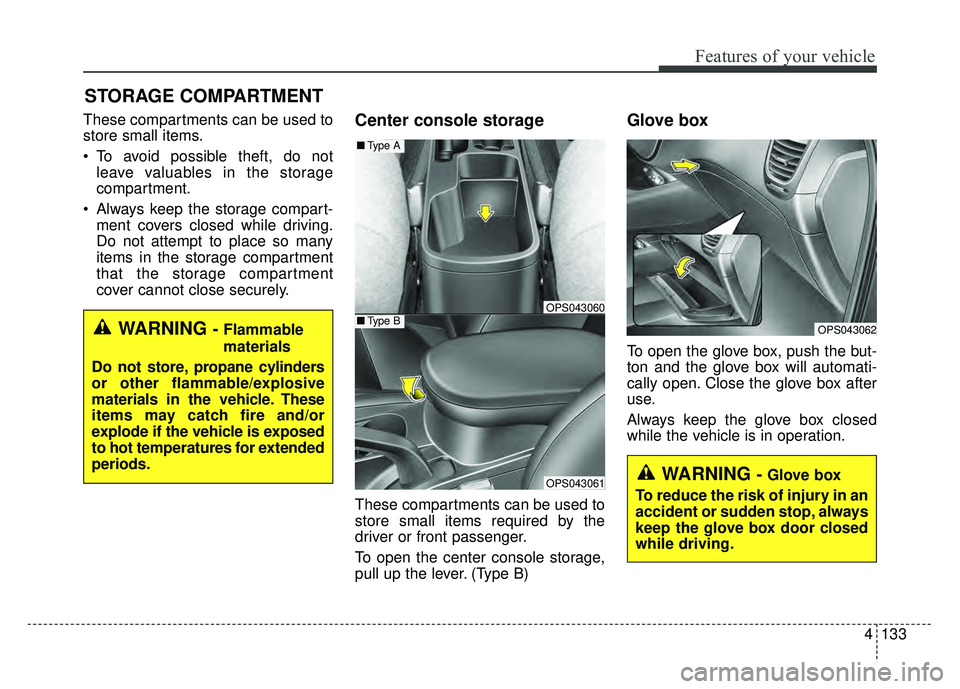
These compartments can be used to
store small items.
To avoid possible theft, do notleave valuables in the storage
compartment.
Always keep the storage compart- ment covers closed while driving.
Do not attempt to place so many
items in the storage compartment
that the storage compartment
cover cannot close securely.Center console storage
These compartments can be used to
store small items required by the
driver or front passenger.
To open the center console storage,
pull up the lever. (Type B)
Glove box
To open the glove box, push the but-
ton and the glove box will automati-
cally open. Close the glove box after
use.
Always keep the glove box closed
while the vehicle is in operation.
STORAGE COMPARTMENT
OPS043062WARNING - Flammable
materials
Do not store, propane cylinders
or other flammable/explosive
materials in the vehicle. These
items may catch fire and/or
explode if the vehicle is exposed
to hot temperatures for extended
periods.
OPS043060
OPS043061
■ Type B
■Type A
WARNING - Glove box
To reduce the risk of injury in an
accident or sudden stop, always
keep the glove box door closed
while driving.
Page 441 of 620
What to do in an emergency
27
ROAD WARNING
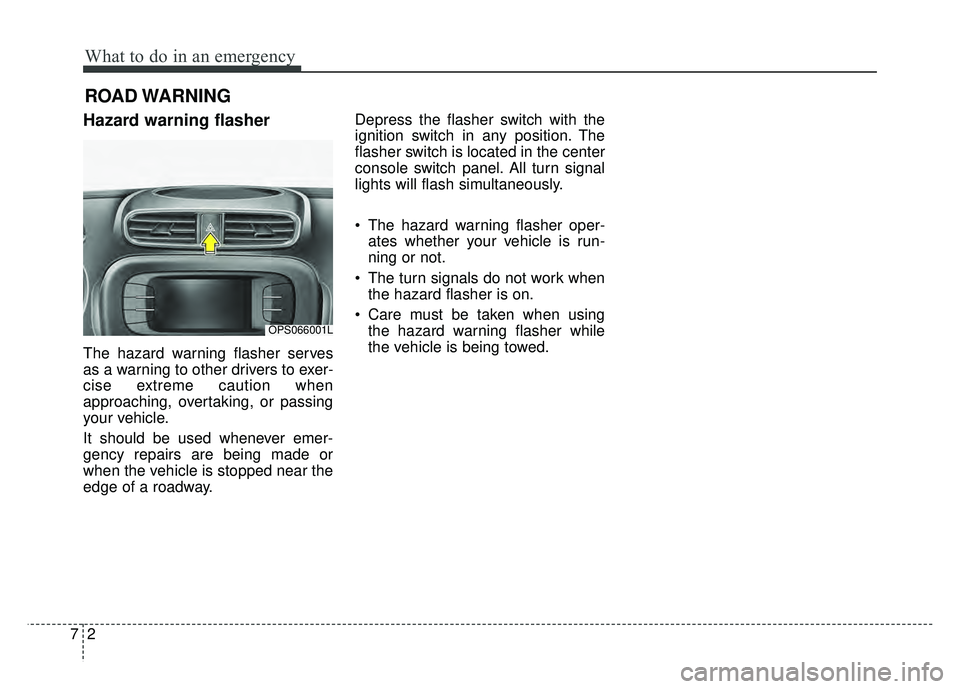
Hazard warning flasher
The hazard warning flasher serves
as a warning to other drivers to exer-
cise extreme caution when
approaching, overtaking, or passing
your vehicle.
It should be used whenever emer-
gency repairs are being made or
when the vehicle is stopped near the
edge of a roadway.Depress the flasher switch with the
ignition switch in any position. The
flasher switch is located in the center
console switch panel. All turn signal
lights will flash simultaneously.
• The hazard warning flasher oper-
ates whether your vehicle is run-
ning or not.
The turn signals do not work when the hazard flasher is on.
Care must be taken when using the hazard warning flasher while
the vehicle is being towed.
OPS066001L
Page 617 of 620
I9
Index
Special driving conditions . . . . . . . . . . . . . . . . . . . . . 6-105Driving at night . . . . . . . . . . . . . . . . . . . . . . . . . . . 6-107
Driving in flooded areas. . . . . . . . . . . . . . . . . . . . . 6-108
Driving in the rain . . . . . . . . . . . . . . . . . . . . . . . . . 6-108
Driving off-road . . . . . . . . . . . . . . . . . . . . . . . . . . . 6-109
Hazardous driving conditions . . . . . . . . . . . . . . . . 6-105
Highway driving . . . . . . . . . . . . . . . . . . . . . . . . . . . 6-109
Reducing the risk of a rollover. . . . . . . . . . . . . . . . 6-105
Rocking the vehicle . . . . . . . . . . . . . . . . . . . . . . . . 6-106
Smooth cornering . . . . . . . . . . . . . . . . . . . . . . . . . . 6-107
Steering wheel . . . . . . . . . . . . . . . . . . . . . . . . . . . . . . . 4-39 Electric power steering (EPS) . . . . . . . . . . . . . . . . . 4-39
Flex steer . . . . . . . . . . . . . . . . . . . . . . . . . . . . . . . . . 4-42
Heated steering wheel . . . . . . . . . . . . . . . . . . . . . . . 4-41
Horn . . . . . . . . . . . . . . . . . . . . . . . . . . . . . . . . . . . . \
. 4-41
Tilt and telescopic steering. . . . . . . . . . . . . . . . . . . . 4-40
Storage compartment . . . . . . . . . . . . . . . . . . . . . . . . . 4-133 Center console storage . . . . . . . . . . . . . . . . . . . . . . 4-133
Cool box . . . . . . . . . . . . . . . . . . . . . . . . . . . . . . . . . 4-134
Glove box . . . . . . . . . . . . . . . . . . . . . . . . . . . . . . . . 4-133
Luggage box . . . . . . . . . . . . . . . . . . . . . . . . . . . . . . 4-135
Sunglass holder . . . . . . . . . . . . . . . . . . . . . . . . . . . 4-134
Tire Pressure Monitoring System (TPMS) . . . . . . . . . . . 7-9 Changing a tire with TPMS . . . . . . . . . . . . . . . . . . . 7-12
This device complies with Part 15 of the FCC rules. 7-14 Tire specification and pressure label . . . . . . . . . . . . . . 9-11
Tires and wheels . . . . . . . . . . . . . . . . . . . . . . . . . . . . . . 8-59
All season tires . . . . . . . . . . . . . . . . . . . . . . . . . . . . . 8-71
Checking tire inflation pressure . . . . . . . . . . . . . . . . 8-60
Low aspect ratio tire. . . . . . . . . . . . . . . . . . . . . . . . . 8-73
Radial-ply tires . . . . . . . . . . . . . . . . . . . . . . . . . . . . . 8-72
Recommended cold tire inflation pressures . . . . . . . 8-59
Snow tires . . . . . . . . . . . . . . . . . . . . . . . . . . . . . . . . . 8-71
Summer tires . . . . . . . . . . . . . . . . . . . . . . . . . . . . . . 8-71
Tire care . . . . . . . . . . . . . . . . . . . . . . . . . . . . . . . . . . 8-59\
Tire chains . . . . . . . . . . . . . . . . . . . . . . . . . . . . . . . . 8-71
Tire maintenance . . . . . . . . . . . . . . . . . . . . . . . . . . . 8-64
Tire replacement . . . . . . . . . . . . . . . . . . . . . . . . . . . . 8-63
Tire rotation . . . . . . . . . . . . . . . . . . . . . . . . . . . . . . . 8-61
Tire sidewall labeling . . . . . . . . . . . . . . . . . . . . . . . . 8-64
Tire traction . . . . . . . . . . . . . . . . . . . . . . . . . . . . . . . 8-64
Wheel alignment and tire balance . . . . . . . . . . . . . . 8-62
Wheel replacement . . . . . . . . . . . . . . . . . . . . . . . . . . 8-64
Tires and wheels . . . . . . . . . . . . . . . . . . . . . . . . . . . . . . . 9-5
Towing . . . . . . . . . . . . . . . . . . . . . . . . . . . . . . . . . . . . \
. 7-32 Emergency towing . . . . . . . . . . . . . . . . . . . . . . . . . . 7-34
Removable towing hook (front) . . . . . . . . . . . . . . . . 7-33
Towing service . . . . . . . . . . . . . . . . . . . . . . . . . . . . . 7-32
Trip computer . . . . . . . . . . . . . . . . . . . . . . . . . . . . . . . . 4-68 Accumulated info display (for Type B cluster) . . . . 4-71
Drive info display (for Type B cluster) . . . . . . . . . . 4-72
Fuel economy . . . . . . . . . . . . . . . . . . . . . . . . . . . . . . 4-70
T