Page 373 of 496
67
What to do in an emergency
5. Start the vehicle with the boosterbattery and the auxiliary battery
begins to charge when EV ready
light glows, then start the vehicle
with the discharged battery. If the
first starting attempt is not suc-
cessful, wait a few minutes before
making another attempt in order to
allow the discharged battery to
recharge.
If the cause of your battery discharg-ing is not apparent, you should haveyour vehicle checked by an author-ized Kia dealer.
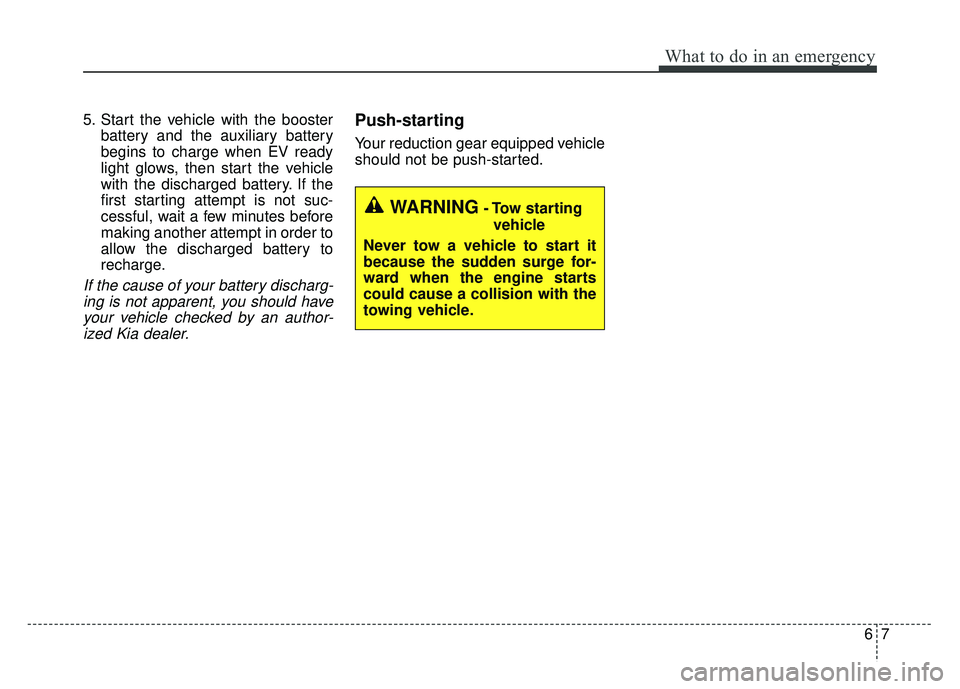
Push-starting
Your reduction gear equipped vehicle
should not be push-started.
WARNING- Tow starting
vehicle
Never tow a vehicle to start it
because the sudden surge for-
ward when the engine starts
could cause a collision with the
towing vehicle.
Page 381 of 496
615
What to do in an emergency
It is possible that some tires, espe-
cially with larger punctures or dam-
age to the sidewall, cannot be sealed
completely.
Air pressure loss in the tire may
adversely affect tire performance.
For this reason, you should avoid
abrupt steering or other driving
maneuvers, especially if the vehicle
is heavily loaded or if a trailer is in
use.
The Tire Mobility Kit is not designed
or intended as a permanent tire
repair method and is to be used for
one tire only.
This instruction shows you step by
step how to temporarily seal the
puncture simply and reliably.
Read the section "Notes on the safe
use of the Tire Mobility Kit".Notes on the suggested use of
the Tire Mobility Kit
Park your car at the side of the roadso that you can work with the Tire
Mobility Kit away from moving traf-
fic.
To be sure your vehicle will not move, even when you're on fairly
level ground, always set your park-
ing brake.
Only use the Tire Mobility Kit for sealing/inflation passenger car tires.
Only punctured areas located with-
in the tread region of the tire can be
sealed using the tire mobility kit.
Do not use on motorcycles, bicycles or any other type of tires.
When the tire and wheel are dam- aged, do not use Tire Mobility Kit for
your safety.
Use of the Tire Mobility Kit may not be effective for tire damage larger
than approximately 0.24 in (6 mm).
Please contact the nearest Kia
dealership if the tire cannot be
made roadworthy with the Tire
Mobility Kit. Do not use the Tire Mobility Kit if a
tire is severely damaged by driving
run flat or with insufficient air pres-
sure.
Do not remove any foreign objects such as nails or screws that have
penetrated the tire.
Provided the car is outdoors, leave the vehicle running. Otherwise
operating the compressor may
eventually drain the car battery.
Never leave the Tire Mobility Kit unattended while it is being used.
Do not leave the compressor run- ning for more than 10 min. at a time
or it may overheat.
Do not use the Tire Mobility Kit if the ambient temperature is below -
22°F (-30°C).
Before using the TMK, read the precautionary advice printed on
the sealant bottle!
Page 387 of 496
621
What to do in an emergency
When towing your vehicle in an
emergency without wheel dollies :
1. Set the ignition switch in the ACCposition.
2. Place the transaxle shift lever in N (Neutral).
3. Release the parking brake.
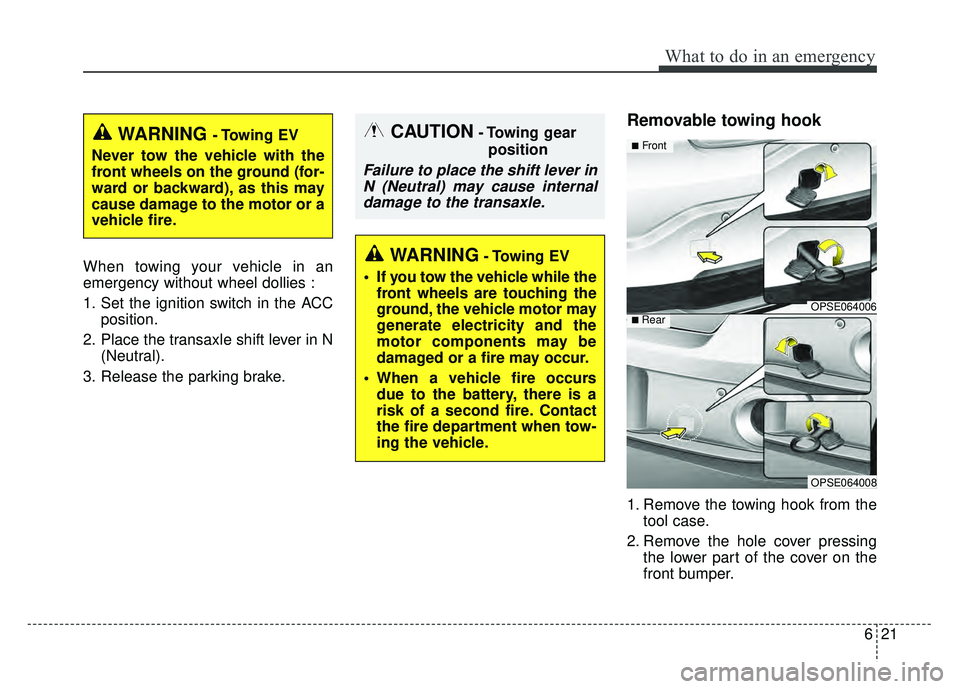
Removable towing hook
1. Remove the towing hook from the tool case.
2. Remove the hole cover pressing the lower part of the cover on the
front bumper.
WARNING - Towing EV
Never tow the vehicle with the
front wheels on the ground (for-
ward or backward), as this may
cause damage to the motor or a
vehicle fire.CAUTION- Towing gear position
Failure to place the shift lever inN (Neutral) may cause internaldamage to the transaxle.
WARNING- Towing EV
If you tow the vehicle while the front wheels are touching the
ground, the vehicle motor may
generate electricity and the
motor components may be
damaged or a fire may occur.
When a vehicle fire occurs due to the battery, there is a
risk of a second fire. Contact
the fire department when tow-
ing the vehicle.
OPSE064006
OPSE064008
■Front
■Rear
Page 391 of 496
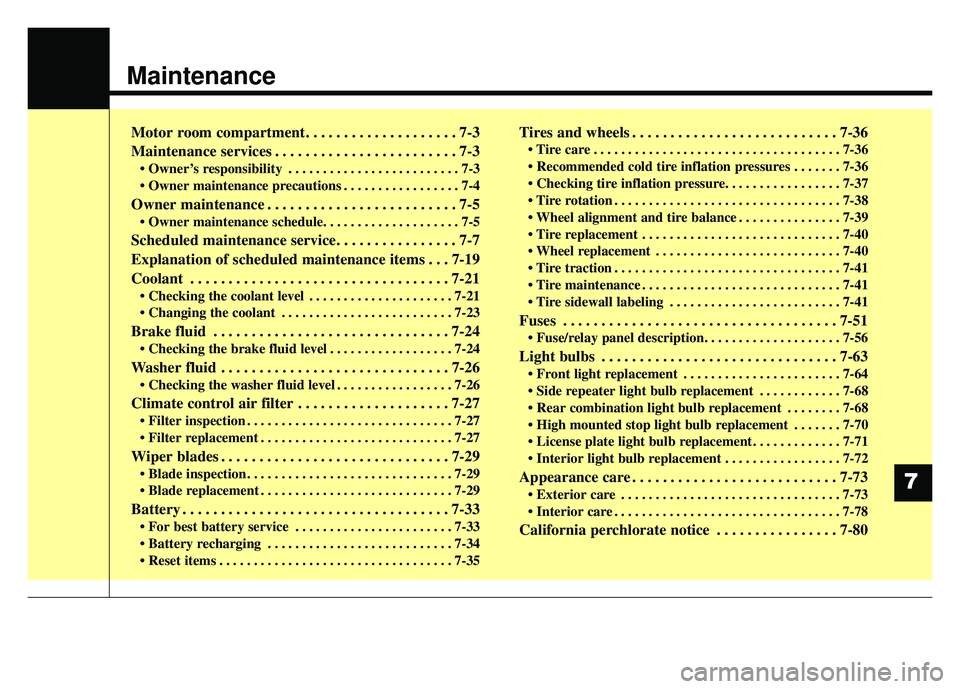
Maintenance
Motor room compartment. . . . . . . . . . . . . . . . . . . . 7-3
Maintenance services . . . . . . . . . . . . . . . . . . . . . . . . 7-3
• Owner’s responsibility . . . . . . . . . . . . . . . . . . . . . . . . . 7-3
. . . . . . . . . . . . . . . . . 7-4
Owner maintenance . . . . . . . . . . . . . . . . . . . . . . . . . 7-5
Scheduled maintenance service. . . . . . . . . . . . . . . . 7-7
Explanation of scheduled maintenance items . . . 7-19
Coolant . . . . . . . . . . . . . . . . . . . . . . . . . . . . . . . . . . 7-21\
. . . . . . . . . . . . . . . . . . . . . 7-21
. . . . . . . . . . . . . . . . . . . . . . . . . 7-23
Brake fluid . . . . . . . . . . . . . . . . . . . . . . . . . . . . . . . 7-24
. . . . . . . . . . . . . . . . . . 7-24
Washer fluid . . . . . . . . . . . . . . . . . . . . . . . . . . . . . . 7-26
. . . . . . . . . . . . . . . . . 7-26
Climate control air filter . . . . . . . . . . . . . . . . . . . . 7-27
. . . . . . . . . . . . . . . . . . . . . . . . . . . . . . 7-27
. . . . . . . . . . . . . . . . . . . . . . . . . . . . 7-27
Wiper blades . . . . . . . . . . . . . . . . . . . . . . . . . . . . . . 7-29
. . . . . . . . . . . . . . . . . . . . . . . . . . . . . . 7-29
. . . . . . . . . . . . . . . . . . . . . . . . . . . . 7-29
Battery . . . . . . . . . . . . . . . . . . . . . . . . . . . . . . . . . . . 7-\
33
. . . . . . . . . . . . . . . . . . . . . . . 7-33
. . . . . . . . . . . . . . . . . . . . . . . . . . . 7-34
. . . . . . . . . . . . . . . . . . . . . . . . . . . . . . . . . . 7-35\
Tires and wheels . . . . . . . . . . . . . . . . . . . . . . . . . . . 7-36
. . . . . . . . . . . . . . . . . . . . . . . . . . . . . . . . . . . . \
7-36
. . . . . . . 7-36
. . . . . . . . . . . . . . . . . . . . . . . . . . . . . . . . . 7-38
. . . . . . . . . . . . . . . 7-39
. . . . . . . . . . . . . . . . . . . . . . . . . . . . . 7-40
. . . . . . . . . . . . . . . . . . . . . . . . . . . 7-40
. . . . . . . . . . . . . . . . . . . . . . . . . . . . . . . . . 7-41
. . . . . . . . . . . . . . . . . . . . . . . . . . . . . 7-41
. . . . . . . . . . . . . . . . . . . . . . . . . 7-41
Fuses . . . . . . . . . . . . . . . . . . . . . . . . . . . . . . . . . . . . \
7-51
Light bulbs . . . . . . . . . . . . . . . . . . . . . . . . . . . . . . . 7-63
. . . . . . . . . . . . . . . . . . . . . . . 7-64
. . . . . . . . . . . . 7-68
. . . . . . . . 7-68
. . . . . . . 7-70
. . . . . . . . . . . . . 7-71
. . . . . . . . . . . . . . . . . 7-72
Appearance care . . . . . . . . . . . . . . . . . . . . . . . . . . . 7-73
. . . . . . . . . . . . . . . . . . . . . . . . . . . . . . . . 7-73
. . . . . . . . . . . . . . . . . . . . . . . . . . . . . . . . . 7-78
California perchlorate notice . . . . . . . . . . . . . . . . 7-80
7
Page 392 of 496
Maintenance
27
MOTOR ROOM COMPARTMENT
OPSE075001
1. Coolant reservoir
2. Brake fluid reservoir
3. Fuse box
4. Positive battery terminal
5. Negative battery terminal
6. Radiator cap
7. Windshield washer fluid reservoir
❈ The actual motor compartment in the vehicle may differ from the illustration.
Page 396 of 496
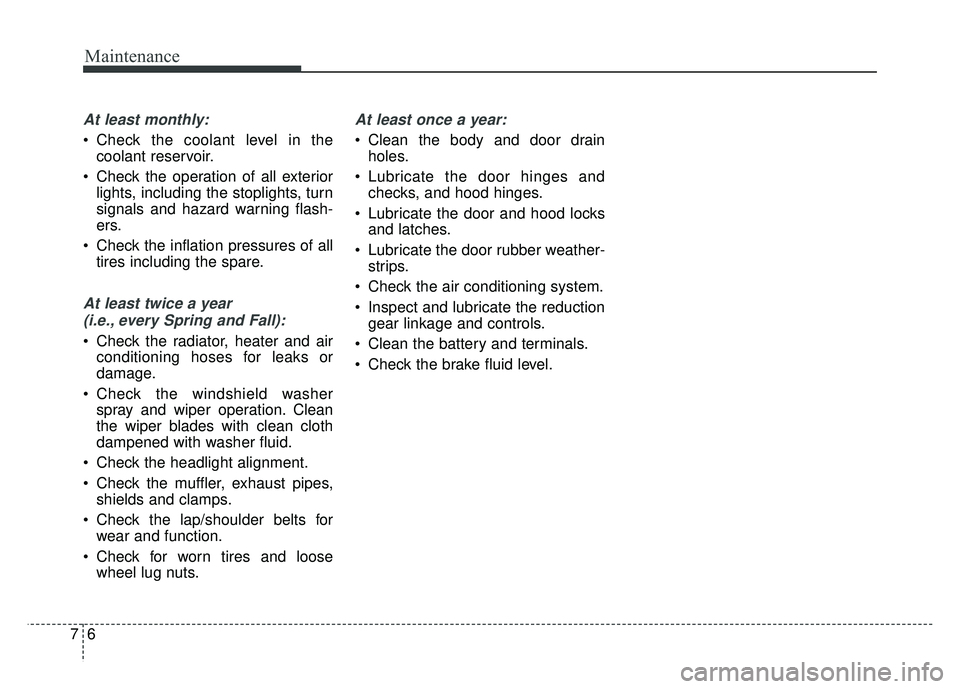
Maintenance
67
At least monthly:
Check the coolant level in thecoolant reservoir.
Check the operation of all exterior lights, including the stoplights, turn
signals and hazard warning flash-
ers.
Check the inflation pressures of all tires including the spare.
At least twice a year
(i.e., every Spring and Fall):
Check the radiator, heater and air conditioning hoses for leaks or
damage.
Check the windshield washer spray and wiper operation. Clean
the wiper blades with clean cloth
dampened with washer fluid.
Check the headlight alignment.
Check the muffler, exhaust pipes, shields and clamps.
Check the lap/shoulder belts for wear and function.
Check for worn tires and loose wheel lug nuts.
At least once a year:
Clean the body and door drainholes.
Lubricate the door hinges and checks, and hood hinges.
Lubricate the door and hood locks and latches.
Lubricate the door rubber weather- strips.
Check the air conditioning system.
Inspect and lubricate the reduction gear linkage and controls.
Clean the battery and terminals.
Check the brake fluid level.
Page 399 of 496
79
Maintenance
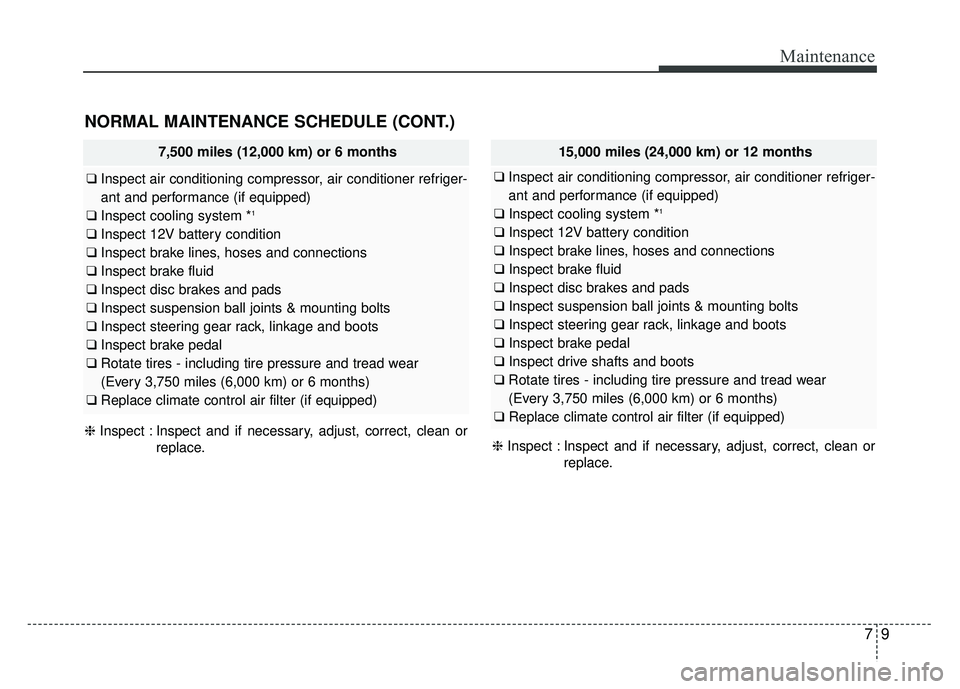
NORMAL MAINTENANCE SCHEDULE (CONT.)
❈Inspect : Inspect and if necessary, adjust, correct, clean or
replace. ❈
Inspect : Inspect and if necessary, adjust, correct, clean or
replace.
7,500 miles (12,000 km) or 6 months
❑Inspect air conditioning compressor, air conditioner refriger-
ant and performance (if equipped)
❑ Inspect cooling system *
1
❑Inspect 12V battery condition
❑ Inspect brake lines, hoses and connections
❑ Inspect brake fluid
❑ Inspect disc brakes and pads
❑ Inspect suspension ball joints & mounting bolts
❑ Inspect steering gear rack, linkage and boots
❑ Inspect brake pedal
❑ Rotate tires - including tire pressure and tread wear
(Every 3,750 miles (6,000 km) or 6 months)
❑ Replace climate control air filter (if equipped)
15,000 miles (24,000 km) or 12 months
❑Inspect air conditioning compressor, air conditioner refriger-
ant and performance (if equipped)
❑ Inspect cooling system *
1
❑Inspect 12V battery condition
❑ Inspect brake lines, hoses and connections
❑ Inspect brake fluid
❑ Inspect disc brakes and pads
❑ Inspect suspension ball joints & mounting bolts
❑ Inspect steering gear rack, linkage and boots
❑ Inspect brake pedal
❑ Inspect drive shafts and boots
❑ Rotate tires - including tire pressure and tread wear
(Every 3,750 miles (6,000 km) or 6 months)
❑ Replace climate control air filter (if equipped)
Page 400 of 496
Maintenance
10
7
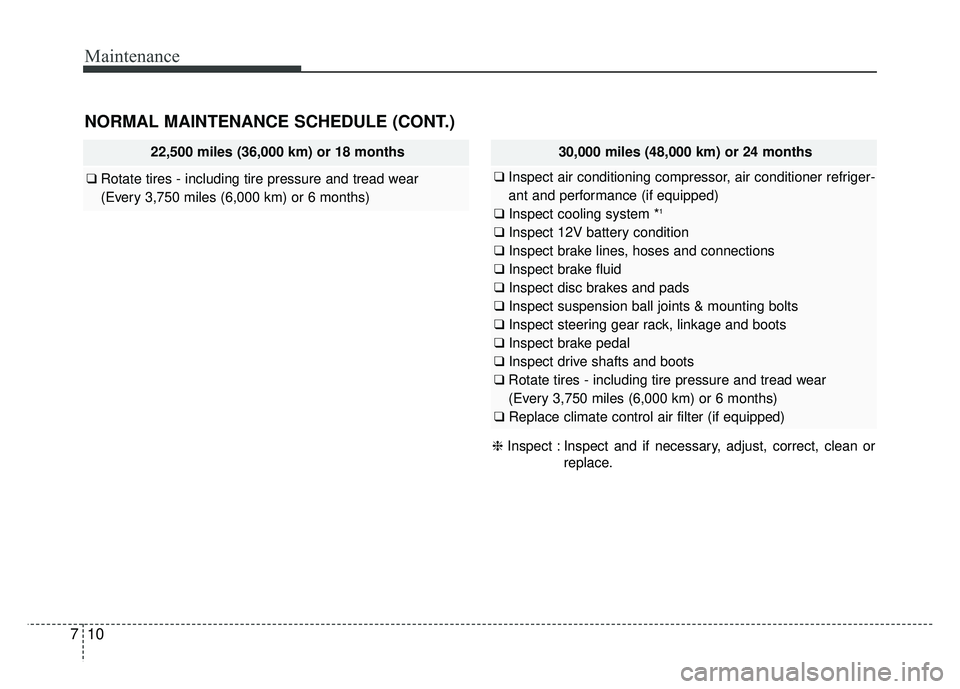
NORMAL MAINTENANCE SCHEDULE (CONT.)
❈ Inspect : Inspect and if necessary, adjust, correct, clean or
replace.
22,500 miles (36,000 km) or 18 months
❑Rotate tires - including tire pressure and tread wear
(Every 3,750 miles (6,000 km) or 6 months)
30,000 miles (48,000 km) or 24 months
❑Inspect air conditioning compressor, air conditioner refriger-
ant and performance (if equipped)
❑ Inspect cooling system *
1
❑Inspect 12V battery condition
❑ Inspect brake lines, hoses and connections
❑ Inspect brake fluid
❑ Inspect disc brakes and pads
❑ Inspect suspension ball joints & mounting bolts
❑ Inspect steering gear rack, linkage and boots
❑ Inspect brake pedal
❑ Inspect drive shafts and boots
❑ Rotate tires - including tire pressure and tread wear
(Every 3,750 miles (6,000 km) or 6 months)
❑ Replace climate control air filter (if equipped)