2018 KIA SORENTO brake
[x] Cancel search: brakePage 387 of 536
5117
Driving your vehicle
Vehicle capacity weight:
5 persons : 420kg (930 lbs.)
7 persons : 506kg (1,120 lbs.)
Vehicle capacity weight is the maxi-
mum combined weight of occupants
and cargo. If your vehicle is equipped
with a trailer, the combined weight
includes the tongue load.
Seating capacity:
Total - 5 persons (Front seat : 2 persons,
Rear seat : 3 persons)
- 7 persons (Front seat : 2 persons,
Rear seat : 5 persons) Seating capacity is the maximum
number of occupants including a
driver, your vehicle may carry.
However, the seating capacity may
be reduced based upon the weight of
all of the occupants, and the weight
of the cargo being carried or towed.
Do not overload the vehicle as there
is a limit to the total weight, or load
limit including occupants and cargo,
the vehicle can carry.
Towing capacity:
* 2.0L Engine
Without trailer brakes
: 750 kg (1,650 lbs)
With trailer brakes
: 907 kg (2,000 lbs)
With trailer package
: 1,587 kg (3,500 lbs) * 2.4L Engine
Without trailer brakes
: 750 kg (1,650 lbs)
With trailer brakes
: 907 kg (2,000 lbs)
With trailer package
: N/A
* 3.3L Engine
Without trailer brakes
: 750 kg (1,650 lbs)
With trailer brakes
: 907 kg (2,000 lbs)
With trailer package
: 2WD : 1,587 (3,500)
4WD : 2,267 (5,000)
Page 395 of 536

63
What to do in an emergency
If the engine stalls at a cross-
road or crossing
If the engine stalls at a crossroad or
crossing, set the shift lever in the N
(Neutral) position and then push the
vehicle to a safe place.
If you have a flat tire while
driving
If a tire goes flat while you are driv-
ing:
1.Take your foot off the acceleratorpedal and let the vehicle slow
down while driving straight ahead.
Do not apply the brakes immedi-
ately or attempt to pull off the road
as this may cause a loss of control.
When the vehicle has slowed to
such a speed that it is safe to do
so, brake carefully and pull off the
road. Drive off the road as far as
possible and park on a firm level
ground. If you are on a divided
highway, do not park in the median
area between the two traffic lanes. 2.When the vehicle is stopped, turn
on your emergency hazard flash-
ers, set the parking brake and put
the transaxle in P (Park, automatic
transaxle).
3.Have all passengers get out of the vehicle. Be sure they all get out on
the side of the vehicle that is away
from traffic.
4.When changing a flat tire, follow the instruction provided later in this
section.
If the engine stalls while driv-
ing
1.Reduce your speed gradually,keeping a straight line. Move cau-
tiously off the road to a safe place.
2.Turn on your emergency flashers.
3.Try to start the engine again. If your vehicle will not start, contact an
authorized Kia dealer or seek other
qualified assistance.
✽ ✽ NOTICE
If there was a check engine light and
loss of power or stall and if safe to do
so, wait at least 10 seconds to restart
the vehicle after it stalls. This may
reset the car so it will no longer run
at low power condition.
IN CASE OF AN EMERGENCY WHILE DRIVING
Page 396 of 536

What to do in an emergency
46
IF THE ENGINE WILL NOT START
If engine doesn't turn over or
turns over slowly
1.If your vehicle has an automatictransaxle, be sure the shift lever is
in N (Neutral) or P (Park) and the
emergency brake is set.
2.Check the battery connections to be sure they are clean and tight.
3.Turn on the interior light. If the light dims or goes out when you operate
the starter, the battery is dis-
charged.
4.Check the starter connections to be sure they are securely tight-
ened.
5.Do not push or pull the vehicle to start it. See instructions for "Jump
starting".
If engine turns over normally
but does not start
1.Check the fuel level.
2.With the ignition switch in theLOCK position, check all connec-
tors at the ignition coils and spark
plugs. Reconnect any that may be
disconnected or loose.
3.Check the fuel line in the engine compartment.
4.If the engine still does not start, call an authorized Kia dealer or seek
other qualified assistance.
WARNING - Push/
pull start
Do not push or pull the vehicle
to start it. Push or pull starting
may cause the catalytic con-
verter to overload and create a
fire hazard.
Page 399 of 536

67
What to do in an emergency
IF THE ENGINE OVERHEATS
If your temperature gauge indicates
overheating, you experience a loss
of power, or hear loud pinging or
knocking, the engine will probably be
too hot. If this happens, you should:
1.Pull off the road and stop as soonas it is safe to do so.
2.Place the shift lever in P (Park, automatic transaxle) and set the
parking brake. If the air condition-
ing is on, turn it off.
3.If engine coolant is running out under the vehicle or steam is com-
ing out from underneath the hood,
stop the engine. Do not open the
hood until the coolant has stopped
running or the steaming has
stopped. If there is no visible loss
of engine coolant and no steam,
leave the engine running and
check to be sure the engine cool-
ing fan is operating. If the fan is not
running, turn the engine off. 4.Check to see if the water pump
drive belt is missing. If it is not
missing, check to see that it is
tight. If the drive belt seems to be
satisfactory, check for coolant leak-
ing from the radiator, hoses or
under the vehicle. (If the air condi-
tioning had been in use, it is nor-
mal for cold water to be draining
from it when you stop).
5.If the water pump drive belt is bro- ken or engine coolant is leaking
out, stop the engine immediately
and call the nearest authorized Kia
dealer for assistance. 6.If you cannot find the cause of the
overheating, wait until the engine
temperature has returned to nor-
mal. Then, if coolant has been lost,
carefully add coolant to the reser-
voir to bring the fluid level in the
reservoir up to the halfway mark.
7.Proceed with caution, keeping alert for further signs of overheat-
ing. If overheating happens again,
call an authorized Kia dealer for
assistance.
Serious loss of coolant indicates
there is a leak in the cooling system
and this should be checked as soon
as possible by an authorized Kia
dealer.
WARNING - Under the hood
While the engine is running,
keep hair, hands and clothing
away from moving parts such
as the fan and drive belts to pre-
vent injury.
WARNING - Radiator cap
Do not remove the radiator cap
when the engine is hot. This
may result in coolant being
blown out of the opening and
cause serious burns.
Page 403 of 536
611
What to do in an emergency
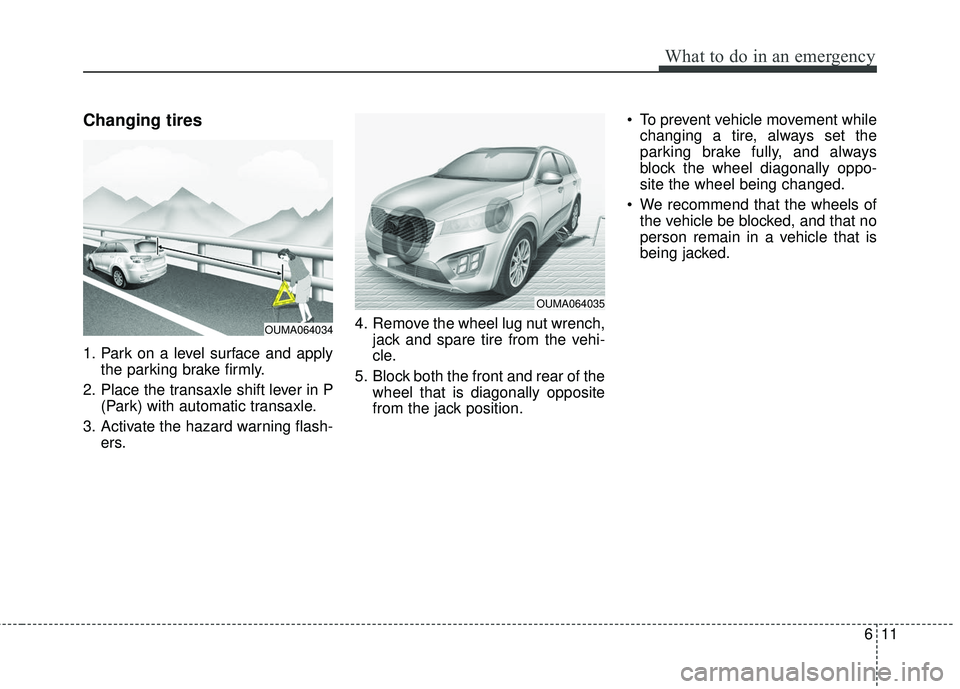
Changing tires
1. Park on a level surface and applythe parking brake firmly.
2. Place the transaxle shift lever in P (Park) with automatic transaxle.
3. Activate the hazard warning flash- ers. 4. Remove the wheel lug nut wrench,
jack and spare tire from the vehi-
cle.
5. Block both the front and rear of the wheel that is diagonally opposite
from the jack position. To prevent vehicle movement while
changing a tire, always set the
parking brake fully, and always
block the wheel diagonally oppo-
site the wheel being changed.
We recommend that the wheels of the vehicle be blocked, and that no
person remain in a vehicle that is
being jacked.
OUMA064035
OUMA064034
Page 409 of 536
617
What to do in an emergency
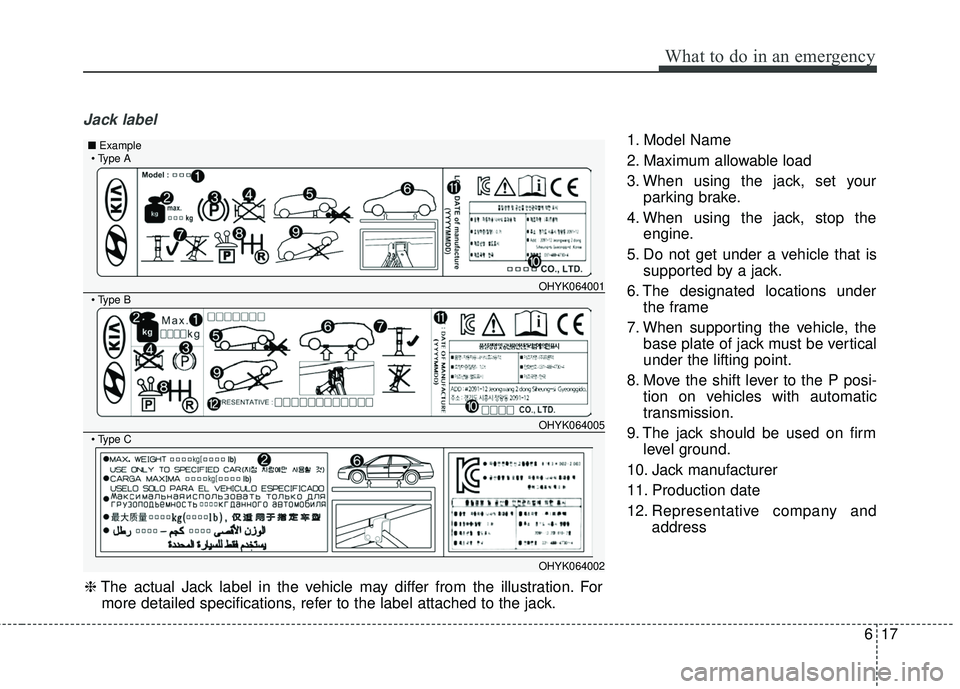
Jack label
1. Model Name
2. Maximum allowable load
3. When using the jack, set yourparking brake.
4. When using the jack, stop the engine.
5. Do not get under a vehicle that is supported by a jack.
6. The designated locations under the frame
7. When supporting the vehicle, the base plate of jack must be vertical
under the lifting point.
8. Move the shift lever to the P posi- tion on vehicles with automatic
transmission.
9. The jack should be used on firm level ground.
10. Jack manufacturer
11. Production date
12. Representative company and address
OHYK064001
OHYK064005
OHYK064002
■Example
❈The actual Jack label in the vehicle may differ from the illustration. For
more detailed specifications, refer to the label attached to the jack.
Page 411 of 536
619
What to do in an emergency
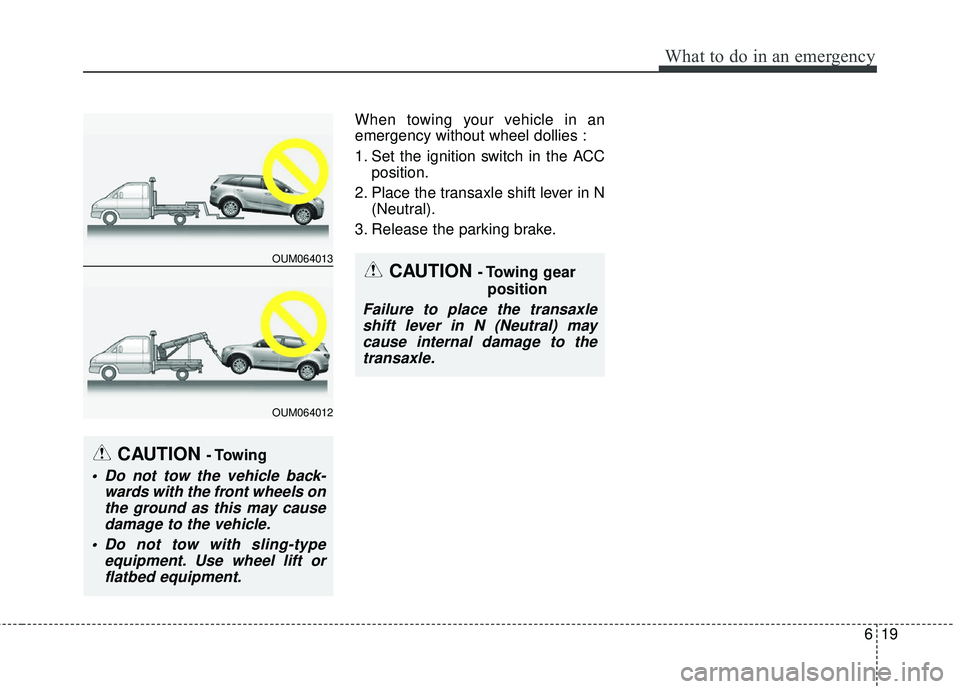
When towing your vehicle in an
emergency without wheel dollies :
1. Set the ignition switch in the ACCposition.
2. Place the transaxle shift lever in N (Neutral).
3. Release the parking brake.
CAUTION - Towing
Do not tow the vehicle back- wards with the front wheels onthe ground as this may causedamage to the vehicle.
Do not tow with sling-type equipment. Use wheel lift orflatbed equipment.
CAUTION - Towing gear
position
Failure to place the transaxleshift lever in N (Neutral) maycause internal damage to thetransaxle.
OUM064013
OUM064012
Page 412 of 536

Maintenance
Engine compartment . . . . . . . . . . . . . . . . . . . . . . . . 7-3
Maintenance services . . . . . . . . . . . . . . . . . . . . . . . . 7-6
• Owner’s responsibility . . . . . . . . . . . . . . . . . . . . . . . . . 7-6
• Owner maintenance precautions . . . . . . . . . . . . . . . . . 7-7
Owner maintenance . . . . . . . . . . . . . . . . . . . . . . . . . 7-8
• Owner maintenance schedule. . . . . . . . . . . . . . . . . . . . 7-8
Scheduled maintenance service. . . . . . . . . . . . . . . 7-10
Explanation of scheduled maintenance items . . . 7-29
Engine oil. . . . . . . . . . . . . . . . . . . . . . . . . . . . . . . . . 7-33
• Checking the engine oil level . . . . . . . . . . . . . . . . . . . 7-34
• Changing the engine oil and filter . . . . . . . . . . . . . . . 7-35
Engine coolant . . . . . . . . . . . . . . . . . . . . . . . . . . . . 7-36
• Checking the coolant level . . . . . . . . . . . . . . . . . . . . . 7-36
• Changing the coolant . . . . . . . . . . . . . . . . . . . . . . . . . 7-38
Brake fluid . . . . . . . . . . . . . . . . . . . . . . . . . . . . . . . 7-39
• Checking the brake fluid level . . . . . . . . . . . . . . . . . . 7-39
Washer fluid . . . . . . . . . . . . . . . . . . . . . . . . . . . . . . 7-40
• Checking the washer fluid level . . . . . . . . . . . . . . . . . 7-40
Parking brake . . . . . . . . . . . . . . . . . . . . . . . . . . . . . 7-41
• Checking the parking brake. . . . . . . . . . . . . . . . . . . . 7-41
Air cleaner. . . . . . . . . . . . . . . . . . . . . . . . . . . . . . . . 7-42
• Filter replacement . . . . . . . . . . . . . . . . . . . . . . . . . . . . 7-42
Climate control air filter . . . . . . . . . . . . . . . . . . . . 7-44
• Filter inspection . . . . . . . . . . . . . . . . . . . . . . . . . . . . . . 7-44
Wiper blades . . . . . . . . . . . . . . . . . . . . . . . . . . . . . . 7-46
• Blade inspection . . . . . . . . . . . . . . . . . . . . . . . . . . . . . . 7-46
• Blade replacement . . . . . . . . . . . . . . . . . . . . . . . . . . . . 7-46
Battery . . . . . . . . . . . . . . . . . . . . . . . . . . . . . . . . . . . 7-\
49
• For best battery service . . . . . . . . . . . . . . . . . . . . . . . 7-49
• Battery recharging . . . . . . . . . . . . . . . . . . . . . . . . . . . 7-50
• Recharging battery . . . . . . . . . . . . . . . . . . . . . . . . . . . 7-51
• Reset items . . . . . . . . . . . . . . . . . . . . . . . . . . . . . . . . . . 7-51\
Tires and wheels . . . . . . . . . . . . . . . . . . . . . . . . . . . 7-52
• Tire care . . . . . . . . . . . . . . . . . . . . . . . . . . . . . . . . . . . . \
7-52
• Recommended cold tire inflation pressures . . . . . . . 7-52
• Tire pressure . . . . . . . . . . . . . . . . . . . . . . . . . . . . . . . . 7-53
• Checking tire inflation pressure. . . . . . . . . . . . . . . . . 7-53
• Tire rotation . . . . . . . . . . . . . . . . . . . . . . . . . . . . . . . . . 7-54
• Wheel alignment and tire balance . . . . . . . . . . . . . . . 7-55
• Tire replacement . . . . . . . . . . . . . . . . . . . . . . . . . . . . . 7-56
• Wheel replacement . . . . . . . . . . . . . . . . . . . . . . . . . . . 7-57
• Tire traction . . . . . . . . . . . . . . . . . . . . . . . . . . . . . . . . . 7-57
• Tire maintenance . . . . . . . . . . . . . . . . . . . . . . . . . . . . . 7-57
• Tire sidewall labeling . . . . . . . . . . . . . . . . . . . . . . . . . 7-57
• All season tires . . . . . . . . . . . . . . . . . . . . . . . . . . . . . . . 7-64
• Summer tires . . . . . . . . . . . . . . . . . . . . . . . . . . . . . . . . 7-64
• Snow tires . . . . . . . . . . . . . . . . . . . . . . . . . . . . . . . . . . . 7-\
64
• Radial-ply tires . . . . . . . . . . . . . . . . . . . . . . . . . . . . . . 7-64
• Low aspect ratio tire . . . . . . . . . . . . . . . . . . . . . . . . . . 7-65
7