2018 KIA RIO HATCHBACK warning lights
[x] Cancel search: warning lightsPage 306 of 492
Driving your vehicle
58
6
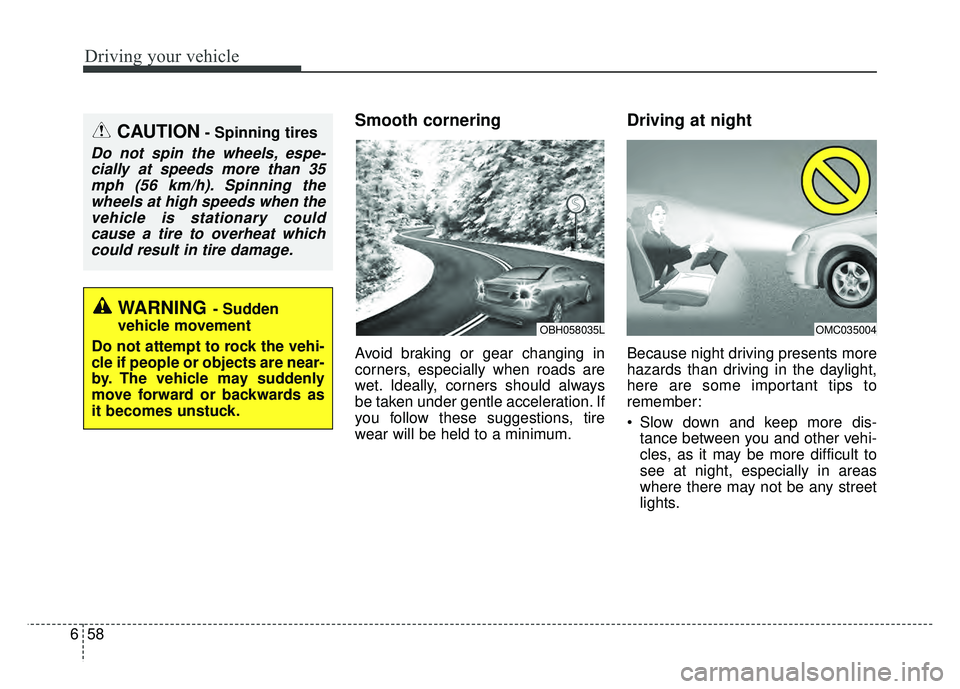
Smooth cornering
Avoid braking or gear changing in
corners, especially when roads are
wet. Ideally, corners should always
be taken under gentle acceleration. If
you follow these suggestions, tire
wear will be held to a minimum.
Driving at night
Because night driving presents more
hazards than driving in the daylight,
here are some important tips to
remember:
Slow down and keep more dis-
tance between you and other vehi-
cles, as it may be more difficult to
see at night, especially in areas
where there may not be any street
lights.
OBH058035LOMC035004
WARNING- Sudden
vehicle movement
Do not attempt to rock the vehi-
cle if people or objects are near-
by. The vehicle may suddenly
move forward or backwards as
it becomes unstuck.
CAUTION- Spinning tires
Do not spin the wheels, espe- cially at speeds more than 35mph (56 km/h). Spinning thewheels at high speeds when thevehicle is stationary couldcause a tire to overheat whichcould result in tire damage.
Page 321 of 492
What to do in an emergency
27
ROAD WARNING
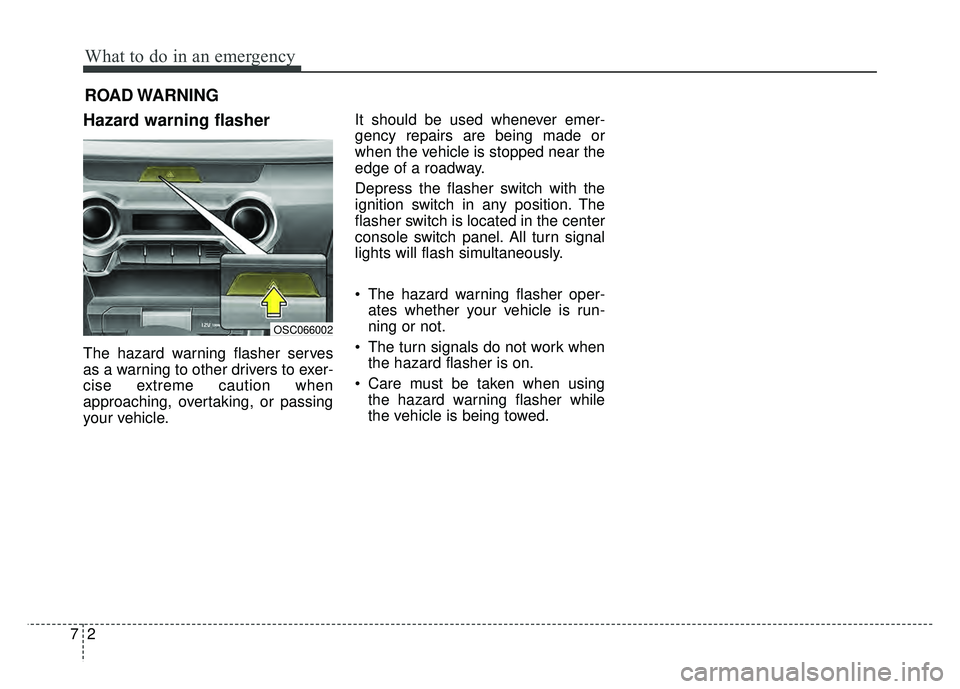
Hazard warning flasher
The hazard warning flasher serves
as a warning to other drivers to exer-
cise extreme caution when
approaching, overtaking, or passing
your vehicle. It should be used whenever emer-
gency repairs are being made or
when the vehicle is stopped near the
edge of a roadway.
Depress the flasher switch with the
ignition switch in any position. The
flasher switch is located in the center
console switch panel. All turn signal
lights will flash simultaneously.
• The hazard warning flasher oper-
ates whether your vehicle is run-
ning or not.
The turn signals do not work when the hazard flasher is on.
Care must be taken when using the hazard warning flasher while
the vehicle is being towed.
OSC066002
Page 358 of 492

Maintenance
88
At least monthly:
Check the coolant level in theengine coolant reservoir.
Check the operation of all exterior lights, including the stoplights, turn
signals and hazard warning flash-
ers.
Check the inflation pressures of all tires including the spare.
At least twice a year
(i.e., every Spring and Fall) :
Check the radiator, heater and air conditioning hoses for leaks or
damage.
Check the windshield washer spray and wiper operation. Clean
the wiper blades with clean cloth
dampened with washer fluid.
Check the headlight alignment.
Check the muffler, exhaust pipes, shields and clamps.
Check the lap/shoulder belts for wear and function.
Check for worn tires and loose wheel lug nuts.
At least once a year :
Clean the body and door drainholes.
Lubricate the door hinges and check the hood hinges.
Lubricate the door and hood locks and latches.
Lubricate the door rubber weather- strips.
Check the air conditioning system.
Inspect and lubricate automatic transaxle linkage and controls.
Clean the battery and terminals.
Check the brake fluid level.
Page 410 of 492

Maintenance
60
8
FUSES
❈ Left side : Normal , Right side : Blown
A vehicle’s electrical system is pro-
tected from electrical overload dam-
age by fuses.
This vehicle has 2 (or 3) fuse panels,
one located in the driver’s side panel
bolster, the other in the engine com-
partment near the battery.
If any of your vehicle’s lights, acces-
sories, or controls do not work, check
the appropriate circuit fuse. If a fuse
has blown, the element inside the
fuse will melt.
If the electrical system does not
work, first check the driver’s side
fuse panel.
Always replace a blown fuse with
one of the same rating.
If the replacement fuse blows, this
indicates an electrical problem. Avoid
using the system involved and imme-
diately consult an authorized Kia
dealer.
Three kinds of fuses are used: blade
type for lower amperage rating, car-tridge type, and multi fuse for higheramperage ratings.
Do not arbitrarily modify or add-on electric wiring to the vehicle.
WARNING- Fuse replace-
ment
Never replace a fuse with any- thing but another fuse of the
same rating.
A higher capacity fuse could cause damage and possibly a
fire.
Never install a wire or alu- minum foil instead of the
proper fuse - even as a tem-
porary repair. It may cause
extensive wiring damage and
a possible fire.
CAUTION
Do not use a screwdriver or anyother metal object to removefuses because it may cause ashort circuit and damage thesystem.
OJF075021
■
Blade type
■ Cartridge type
■ Multi fuse
■ BFT
Page 413 of 492

863
Maintenance
✽
✽NOTICE
• Set all switches to ON before driv-
ing.
• If the vehicle is going to be unused for over 1 month, set all switches
to OFF to prevent the batteries
from draining.
Memory fuse
Your vehicle is equipped with the
memory fuse to prevent battery dis-
charge if your vehicle is parked with-
out being operated for prolonged
periods. Use the following proce-
dures before parking the vehicle for
prolonged periods.
1. Turn off the engine.
2. Turn off the headlights and tail
lights.
3. Open the driver’s side panel cover and pull up the memory fuse. If the memory fuse is pulled up from
the fuse panel, the warning chime,
audio, clock and interior lamps, etc.,
will not operate. Some items must be
reset after replacement. Refer to
“Battery” in this section.
Even though the memory fuse is
pulled up, the battery can still be dis-
charged by operation of the head-
lights or other electrical devices.
CAUTION - Fuse Panel
Covers
The contact points of the
switches may wear out withexcessive use. Please refrainfrom excessive use of theswitches (except for long-termparking for over 1 month).
OYB076037
Page 425 of 492

875
Maintenance
LIGHT BULBS
Bulb replacement precaution
Please keep extra bulbs on hand
with appropriate wattage ratings in
case of emergencies.
Refer to “Bulb Wattage” in chapter 9.
When changing lamps, first turn off
the engine at a safe place, firmly
apply the parking brake and detach
the battery’s negative (-) terminal.
Use only bulbs of the specifiedwattage. net-work failure
The headlamp, taillight, and fog light
may light up when the head lamp
switch is turned ON, and not light up
when the taillight or for light switch is
turned ON. This may be cause by
network failure or vehicle electrical
control system malfunction. If there is
a problem, we recommend the sys-
tem be serviced by an authorized Kia
dealer.
trical control system stabilization
A normally functioning lamp may
flicker momentarily. This momentary
occurrence is due to stabilization
function of the vehicle's electrical on
control system. If the lamp soon
returns to normal, the vehicle does
not require service.
However, if the lamp goes out after
the momentary flickering, or the flick-
ering continues, we recommend the
system be serviced by an authorized
Kia dealer.
WARNING- Working on the lights
Prior to working on the light,
firmly apply the parking brake,
ensure that the ignition switch
is turned to the LOCK position
and turn off the lights to avoid
sudden movement of the vehi-
cle and burning your fingers or
receiving an electric shock.
CAUTION -Light replace-
ment
Be sure to replace the burned- out bulb with one of the samewattage rating. Otherwise, itmay cause damage to the fuseor electric wiring system.
CAUTION -Headlamp
Lens
To prevent damage, do notclean the headlamp lens withchemical solvents or strongdetergents.
Page 484 of 492

Index
6I
Fuel filler lid ..................................................................4-38Opening the fuel filler lid ..........................................4-38
Closing the fuel filler lid ............................................4-38
Fuel gauge......................................................................4-\
55
Fuses ........................................................................\
......8-60 Inner panel fuse replacement ......................................8-62
Memory fuse ..............................................................8-63
Engine compartment fuse replacement ......................8-64
Fuse/relay panel description ......................................8-66
Gauges ........................................................................\
..4-54
Glove box ....................................................................4-12\
8
Glove box lamp............................................................4-101
Glove box lamp bulb replacement ................................8-99
Hazard warning flasher ....................................................7-2
Hazardous driving conditions ........................................6-57
Headlamp (Low/High beam) bulb replacement (Headlamp type B) ......................................................8-82
Headlamp (Low/High beam) bulb replacement (Headlamp Type A) ....................................................8-80
Headlight escort function ..............................................4-87
Headlight position..........................................................4-89
Headlight welcome function..........................................4-87 Headrest (Front) ..............................................................3-6
Heated steering wheel....................................................4-48
High - beam operation ..................................................4-90
High mounted stop lamp bulb replacement (4 door) ....8-96
High mounted stop lamp bulb replacement (5 door) ....8-91
Highway driving ............................................................6-60
Hill-start assist control (HAC) ......................................6-33
Hood ........................................................................\
......4-36
Opening the hood ........................................................4-36
Closing the hood ........................................................4-37
Hood open warning ....................................................4-37
Horn ........................................................................\
......4-47
Ignition switch position ..................................................6-6
Indicator lights ..............................................................4-82
Inside rearview mirror ..................................................4-49
Instrument cluster ..........................................................4-52 Instrument cluster control ..........................................4-53
LCD window control ..................................................4-53
Gauges ........................................................................\
4-54
Warning lights ............................................................4-74
Indicator lights ............................................................4-82
Interior care..................................................................8-106
Interior features............................................................4-131 Cup holder ................................................................4-131
Sunvisor ....................................................................4-13\
1
G
H
I
Page 491 of 492
I13
Index
Trunk lamp bulb replacement (4 door) ..........................8-97
Trunk (4 door)................................................................4-21Opening the trunk ......................................................4-21
Closing the trunk ........................................................4-21
Emergency trunk safety release ..................................4-22
Turn signals....................................................................4-91\
USB charger ................................................................4-134
User settings mode(for Type B cluster) ........................4-65
Vanity mirror lamp ......................................................4-102
Vanity mirror lamp bulb replacement ............................8-98
Vehicel load limit ..........................................................6-66
Vehicle certification label ..............................................9-10
Vehicle identification number (VIN) ............................9-10
Vehicle stability management (VSM) ..........................6-34
Vehicle weight ..............................................................6-71
Warning and Indicator lights ........................................4-74
Warning lights ................................................................4-74
Warning messages..........................................................4-69 Washer fluid ..................................................................8-32
Checking the washer fluid level..................................8-32
Weight/Volume ................................................................9-6
Wheel alignment and tire balance ................................8-48
Wheel replacement ........................................................8-50
Windows ........................................................................\
4-30 Power window lock button ........................................4-34
Windshield defrosting and defogging..........................4-123 Manual climate control system ................................4-123
Automatic climate control system ............................4-124
Defogging logic ........................................................4-125
Auto defogging system ............................................4-126
Windshield washers ......................................................4-95
Windshield wipers ........................................................4-94
Winter driving ................................................................6-61 Snow tires....................................................................6-61\
Tire chains ..................................................................6-62
Wiper blades ..................................................................8-38 Blade inspection ..........................................................8-38
Blade replacement ......................................................8-38
Wipers and washers ......................................................4-93 Windshield wipers ......................................................4-94
Windshield washers ....................................................4-95
Rear window wiper and washer switch ......................4-96
U
V
W