2018 JEEP PATRIOT service
[x] Cancel search: servicePage 128 of 332

Brake Warning Light
Red Telltale Light What It Means
Brake Warning Light
This light monitors various brake functions, including brake fluid level and parking brake application. If the brake light turns
on it may indicate that the parking brake is applied, that the brake fluid level is low, or that there is a problem with the
anti-lock brake system reservoir.
If the light remains on when the parking brake has been disengaged, and the fluid level is at the full mark on the master
cylinder reservoir, it indicates a possible brake hydraulic system malfunction or that a problem with the Brake Booster has
been detected by the Anti-Lock Brake System (ABS) / Electronic Stability Control (ESC) system. In this case, the light will
remain on until the condition has been corrected. If the problem is related to the brake booster, the ABS pump will run
when applying the brake, and a brake pedal pulsation may be felt during each stop.
The dual brake system provides a reserve braking capacity in the event of a failure to a portion of the hydraulic system. A
leak in either half of the dual brake system is indicated by the Brake Warning Light, which will turn on when the brake
fluid level in the master cylinder has dropped below a specified level.
The light will remain on until the cause is corrected.
NOTE:
The light may flash momentarily during sharp cornering maneuvers, which change fluid level conditions. The vehicle
should have service performed, and the brake fluid level checked.
If brake failure is indicated, immediate repair is necessary.
124
Page 130 of 332

Oil Pressure Warning Light
Red Telltale Light What It Means
Oil Pressure Warning Light
This light indicates low engine oil pressure. If the light turns on while driving, stop the vehicle and shut off the engine as
soon as possible. A chime will sound when this light turns on.
Do not operate the vehicle until the cause is corrected. This light does not indicate how much oil is in the engine. The en-
gine oil level must be checked under the hood.
Engine Temperature Warning Light
Red Warning Light What It Means
Engine Temperature Warning Light
This light warns of an overheated engine condition. As engine coolant temperatures rise and the gauge approachesH, this
indicator will illuminate and a single chime will sound after reaching a set threshold. Further overheating will cause a con-
tinuous chime sound for 4 minutes, or until the engine is allowed to cool, whichever comes first.
If the light turns on while driving, safely pull over and stop the vehicle. If the A/C system is on, turn it off. Also, shift the
transmission into NEUTRAL and idle the vehicle. If the temperature reading does not return to normal, turn the engine off
immediately and call for service. Refer to “If Your Engine Overheats” in “What To Do In Emergencies” for further informa-
tion.
126
Page 132 of 332

Electronic Throttle Control (ETC) Warning Light
Red Telltale Light What It Means
Electronic Throttle Control (ETC) Warning Light
This light informs you of a problem with the Electronic Throttle Control (ETC) system. If a problem is detected while the
engine is running, the light will either stay on or flash depending on the nature of the problem. Cycle the ignition key when
the vehicle is safely and completely stopped and the transmission is placed in the PARK position. The light should turn off.
If the light remains on with the engine running, your vehicle will usually be drivable; however, see an authorized dealer for
service as soon as possible.
If the light continues to flash when the engine is running, immediate service is required and you may experience reduced
performance, an elevated/rough idle, or engine stall and your vehicle may require towing. The light will come on when the
ignition is first turned to ON/RUN and remain on briefly as a bulb check. If the light does not come on during starting, have
the system checked by an authorized dealer.
128
Page 133 of 332

Yellow Telltale Indicator Lights
Engine Check/Malfunction Indicator Light (MIL)
Yellow Telltale Light What It Means
Engine Check/Malfunction Indicator Light (MIL)The Engine Check/Malfunction Indicator Light (MIL) is a part of an Onboard Diagnostic System called OBD II that monitors en-
gine and automatic transmission control systems. The light will illuminate when the ignition is in the ON position before engine
start. If the bulb does not come on when turning the key from OFF to ON/RUN, have the condition checked promptly.
Certain conditions, such as a loose or missing gas cap, poor quality fuel, etc., may illuminate the light after engine start.
The vehicle should be serviced if the light stays on through several typical driving styles. In most situations, the vehicle will
drive normally and will not require towing.
When the engine is running, the MIL may flash to alert serious conditions that could lead to immediate loss of power or
severe catalytic converter damage. The vehicle should be serviced as soon as possible if this occurs.
CAUTION!
Prolonged driving with the Malfunction Indicator
Light (MIL) on could cause damage to the engine
control system. It also could affect fuel economy
and driveability. If the MIL is flashing, severe
catalytic converter damage and power loss will
soon occur. Immediate service is required.
WARNING!
A malfunctioning catalytic converter, as ref-
erenced above, can reach higher tempera-
tures than in normal operating conditions.
This can cause a fire if you drive slowly or
(Continued)
WARNING!(Continued)
park over flammable substances such as dry
plants, wood, cardboard, etc. This could re-
sult in death or serious injury to the driver,
occupants or others.
129
Page 137 of 332

Anti-Lock Brake (ABS) Indicator Light
Yellow Telltale Light What It Means
Anti-Lock Brake (ABS) Indicator Light
This light monitors the Anti-Lock Brake System (ABS). The light will turn on when the ignition is placed in the ON/RUN po-
sition and may stay on for as long as four seconds.
If the ABS light remains on or turns on while driving, then the Anti-Lock portion of the brake system is not functioning and
service is required. However, the conventional brake system will continue to operate normally if the brake warning light is
not on.
If the ABS light is on, the brake system should be serviced as soon as possible to restore the benefits of Anti-Lock Brakes.
If the ABS light does not turn on when the ignition is placed in the ON/RUN position, have the light inspected by an autho-
rized dealer.
Low Fuel Warning Indicator Light
Yellow Telltale Light What It Means
Low Fuel Warning Indicator Light
When the fuel level reaches approximately 2.8 gal (10.6 L), this light will turn on and a single chime will sound.
133
Page 138 of 332
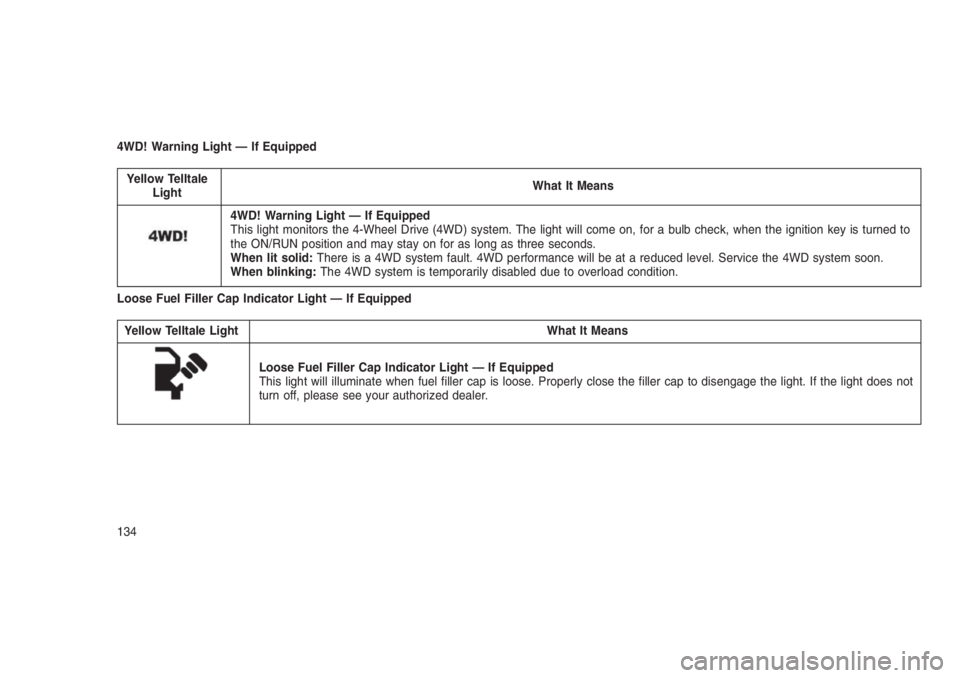
4WD! Warning Light — If Equipped
Yellow Telltale
LightWhat It Means
4WD! Warning Light — If Equipped
This light monitors the 4-Wheel Drive (4WD) system. The light will come on, for a bulb check, when the ignition key is turned to
the ON/RUN position and may stay on for as long as three seconds.
When lit solid:There is a 4WD system fault. 4WD performance will be at a reduced level. Service the 4WD system soon.
When blinking:The 4WD system is temporarily disabled due to overload condition.
Loose Fuel Filler Cap Indicator Light — If Equipped
Yellow Telltale Light What It Means
Loose Fuel Filler Cap Indicator Light — If Equipped
This light will illuminate when fuel filler cap is loose. Properly close the filler cap to disengage the light. If the light does not
turn off, please see your authorized dealer.
134
Page 154 of 332

If you push the switch up or down twice, it plays
the second track; three times, it will play the
third, etc.
The center button on the left side rocker switch
has no function for a single-disc CD player.
However, when a multiple-disc CD player is
equipped on the vehicle, the center button will
select the next available CD in the player.
CD/DVD DISC MAINTENANCE
To keep a CD/DVD in good condition, take the
following precautions:
1. Handle the disc by its edge; avoid touching
the surface.
2. If the disc is stained, clean the surface with a
soft cloth, wiping from center to edge.
3. Do not apply paper or tape to the disc; avoid
scratching the disc.
4. Do not use solvents such as benzene, thin-
ner, cleaners, or anti-static sprays.
5. Store the disc in its case after playing.
6. Do not expose the disc to direct sunlight.7. Do not store the disc where temperatures
may become too high.
NOTE:
If you experience difficulty in playing a par-
ticular disc, it may be damaged (e.g.,
scratched, reflective coating removed, a
hair, moisture or dew on the disc) oversized,
or have protection encoding. Try a known
good disc before considering disc player
service.
RADIO OPERATION AND
MOBILE DEVICES
Under certain conditions, an “on” mobile device
in your vehicle can cause erratic or noisy per-
formance from your radio. This condition may
be lessened or eliminated by relocating the
mobile device antenna. This condition is not
harmful to the radio. If your radio performance
does not satisfactorily “clear” by the reposition-
ing of the antenna, it is recommended that the
radio volume be turned down or off during
mobile device operation when not using
Uconnect (if equipped).
CLIMATE CONTROLS
The air conditioning and heating system is
designed to make you comfortable in all types
of weather.
Manual Heating And Air
Conditioning
The Manual Temperature Controls consist of a
series of outer rotary dials and inner push
knobs.
Manual Temperature Controls
150
Page 162 of 332

Summer Operation
The engine cooling system must be protected
with a high-quality antifreeze coolant to provide
proper corrosion protection and to protect
against engine overheating. A solution of 50%
OAT (Organic Additive Technology) coolant that
meets the requirements of FCA Material Stan-
dard MS.90032 and 50% water is recom-
mended. Refer to “Maintenance Procedures” in
“Maintaining Your Vehicle” for proper coolant
selection.
Winter Operation
Use of the air Recirculation Mode during winter
months is not recommended because it may
cause window fogging.
Vacation Storage
Anytime you store your vehicle, or keep it out of
service (i.e., vacation) for two weeks or more,
run the air conditioning system at idle for about
five minutes in the fresh air and high blower
settings. This will ensure adequate system lu-
brication to minimize the possibility of compres-
sor damage when the system is started again.Window Fogging
Interior fogging on the windshield can be quickly
removed by turning the mode selector to De-
frost. The Defrost/Floor mode can be used to
maintain a clear windshield and provide suffi-
cient heating. If side window fogging becomes a
problem, increase blower speed. Vehicle win-
dows tend to fog on the inside in mild but rainy
or humid weather.
NOTE:
Recirculate without A/C should not be used
for long periods as fogging may occur.
Side Window Demisters
A side window demister outlet is located at each
end of the instrument panel. These non-
adjustable outlets direct air toward the side
windows when the system is in the FLOOR,
MIX, or DEFROST mode. The air is directed at
the area of the windows through which you view
the outside mirrors.Outside Air Intake
Make sure the air intake, located directly in front
of the windshield, is free of obstructions such as
leaves. Leaves collected in the air intake may
reduce airflow, and if they enter the plenum,
they could plug the water drains. In winter
months, make sure the air intake is clear of ice,
slush, and snow.
A/C Air Filter — If Equipped
The A/C Filter prevents most dust and pollen
from entering the cabin. The filter acts on air
coming from outside the vehicle and recircu-
lated air within the passenger compartment.
Refer to “Maintenance Procedures” in “Main-
taining Your Vehicle” for A/C Air Filter service
information or see your authorized dealer for
service. Refer to “Maintenance Schedules” in
“Maintaining Your Vehicle” for filter service inter-
vals.
158