Page 429 of 522
7
Maintenance
7-19
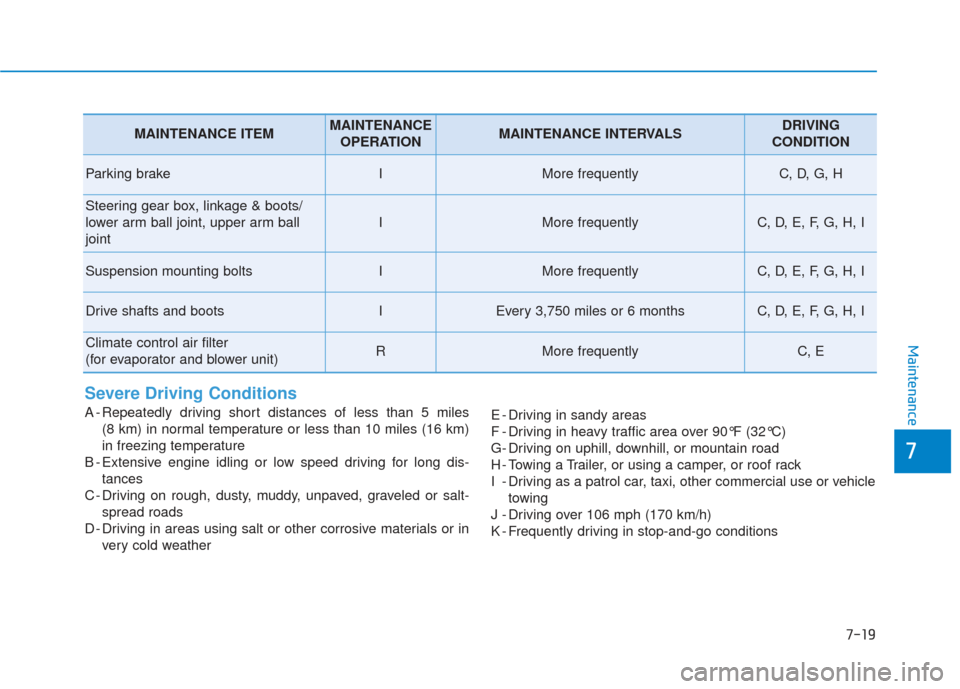
Severe Driving Conditions
A - Repeatedly driving short distances of less than 5 miles (8 km) in normal temperature or less than 10 miles (16 km)
in freezing temperature
B - Extensive engine idling or low speed driving for long dis- tances
C - Driving on rough, dusty, muddy, unpaved, graveled or salt- spread roads
D - Driving in areas using salt or other corrosive materials or in very cold weather E - Driving in sandy areas
F - Driving in heavy traffic area over 90°F (32°C)
G- Driving on uphill, downhill, or mountain road
H - Towing a Trailer, or using a camper, or roof rack
I - Driving as a patrol car, taxi, other commercial use or vehicle
towing
J - Driving over 106 mph (170 km/h)
K - Frequently driving in stop-and-go conditions
MAINTENANCE ITEMMAINTENANCE OPERATIONMAINTENANCE INTERVALSDRIVING
CONDITION
Parking brakeIMore frequentlyC, D, G, H
Steering gear box, linkage & boots/
lower arm ball joint, upper arm ball
joint
IMore frequentlyC, D, E, F, G, H, I
Suspension mounting boltsIMore frequentlyC, D, E, F, G, H, I
Drive shafts and bootsIEvery 3,750 miles or 6 monthsC, D, E, F, G, H, I
Climate control air filter
(for evaporator and blower unit)RMore frequentlyC, E
Page 431 of 522

7-21
7
Maintenance
Valve Clearance (if equipped)
Inspect for excessive valve noise
and/or engine vibration and adjust if
necessary. Have an authorized
HYUNDAI dealer perform the opera-
tion.
Cooling System
Check cooling system components,
such as radiator, coolant reservoir,
hoses and connections for leakage
and damage. Replace any damaged
parts.
Engine Coolant
The coolant should be changed at
the intervals specified in the mainte-
nance schedule.
Automatic Transmission Fluid
Automatic transmission fluid should
not be checked under normal usage
conditions. But in severe conditions,
the fluid should be changed at an
authorized HYUNDAI dealer in accor-
dance to the scheduled maintenance
at the beginning of this chapter.
Automatic transmission fluid
color is basically red.
As the vehicle is driven, the auto-
matic transmission fluid will begin
to look darker. This is a normal
condition and you should not
judge the need to replace the fluid
based upon the changed color.
Ecoshift dual clutch transmis-
sion Fluid
Inspect the Ecoshift dual clutch
transmission fluid according to the
maintenance schedule.
NOTICE
The use of a non-specified fluid
could result in transmission
malfunction and failure. Use
only the specified automatic
transmission fluid (refer to
"Recommended Lubricants and
Capacities" in chapter 8).
CAUTION
Page 453 of 522

7-43
7
Maintenance
Tire Rotation
To equalize tread wear, HYUNDAI
recommends that the tires be rotated
every 7,500 miles (12,000 km) or
sooner if irregular wear develops.
During rotation, check the tires for
correct balance.
When rotating tires, check for uneven
wear and damage. Abnormal wear is
usually caused by incorrect tire pres-
sure, improper wheel alignment, out-
of-balance wheels, severe braking or
severe cornering. Look for bumps or
bulges in the tread or side of tire.
Replace the tire if you find either of
these conditions. Replace the tire if
fabric or cord is visible. After rotation,
be sure to bring the front and rear tire
pressures to specification and check
lug nut tightness (proper torque is
79-94 lb.ft [11-13 kg.m]).Disc brake pads should be inspected
for wear whenever tires are rotated.
Information
The outside and inside of the unsym-
metrical tire is distinguishable. When
installing an unsymmetrical tire, be
sure to install the side marked "out-
side" face the outside. If the side
marked "inside" is installed on the
outside, it will have a bad effect on
vehicle performance.
i
Do not use the compact spare
tire for tire rotation.
Do not mix bias ply and radial
ply tires under any circum-
stances. This may cause
unusual handling characteris-
tics that may cause loss of
vehicle control resulting in an
accident.
WARNING ODH073802
■
Without a spare tire
Page 463 of 522

7-53
7
Maintenance
Vehicle Maximum Load on theTire
Load on an individual tire due to curb
and accessory weight plus maximum
occupant and cargo weight.
Vehicle Normal Load on the Tire
Load on an individual tire that is
determined by distributing to each
axle its share of the curb weight,
accessory weight, and normal occu-
pant weight and dividing by 2.
Vehicle Placard
A label permanently attached to a
vehicle showing the original equip-
ment tire size and recommended
inflation pressure.
All Season Tires
HYUNDAI specifies all season tires
on some models to provide good
performance for use all year round,
including snowy and icy road condi-
tions. All season tires are identified
by ALL SEASON and/or M+S (Mud
and Snow) on the tire sidewall. Snow
tires have better snow traction than
all season tires and may be more
appropriate in some areas.
Summer Tires
HYUNDAI specifies summer tires on
some models to provide superior
performance on dry roads. Summer
tire performance is substantially
reduced in snow and ice. Summer
tires do not have the tire traction rat-
ing M+S (Mud and Snow) on the tire
side wall. If you plan to operate your
vehicle in snowy or icy conditions,
HYUNDAI recommends the use of
snow tires or all season tires on all
four wheels.
Snow Tires
If you equip your car with snow tires,
they should be the same size and
have the same load capacity as the
original tires. Snow tires should be
installed on all four wheels; other-
wise, poor handling may result. Snow
tires should carry 4 psi (28 kPa)
more air pressure than the pressure
recommended for the standard tires
on the tire label on the driver’s side of
the center pillar, or up to the maxi-
mum pressure shown on the tire
sidewall, whichever is less. Do not
drive faster than 75 mph (120 km/h)
when your vehicle is equipped with
snow tires.
Page 519 of 522

I-7
Owner Maintenance ..........................................................7-7Owner Maintenance Schedule......................................7-8
Parking Brake .................................................................7-30 Checking the Parking Brake ......................................7-30
Recommended Lubricants and Capacities ........................8-7 Recommended SAE Viscosity Number .......................8-9
Refrigerant Label ............................................................8-11
Reporting Safety Defects ................................................8-13 Scheduled Maintenance Services .....................................7-9
Maintenance Under Severe Usage Conditions (Gamma 1.6 T-GDI/Theta 2.0 T-GDI) ....................7-13
Maintenance Under Severe Usage Conditions (Theta 2.4 GDI).......................................................7-18
Normal Maintenance Schedule (Gamma 1.6 T-GDI/Theta 2.0 T-GDI) ....................7-10
Normal Maintenance Schedule (Theta 2.4 GDI) .......7-15
Seat Belts ........................................................................\
2-22 Additional Seat Belt Safety Precautions ....................2-30
Care of Seat Belts .......................................................2-33
Seat Belt Restraint System .........................................2-24
Seat Belt Safety Precautions ......................................2-22
Seat Belt Warning Light .............................................2-23
Seats ........................................................................\
..........2-4 Front Seats ....................................................................2-6
Head Restraints ..........................................................2-15
Rear Seats ...................................................................2-12
Safety Precautions ........................................................2-5
Seat Warmers and Air Ventilation Seats.....................2-19
I
Index
O
P
S
R