2018 Hyundai Ioniq Electric regenerative braking
[x] Cancel search: regenerative brakingPage 142 of 541
3-57
Convenient features of your vehicle
3
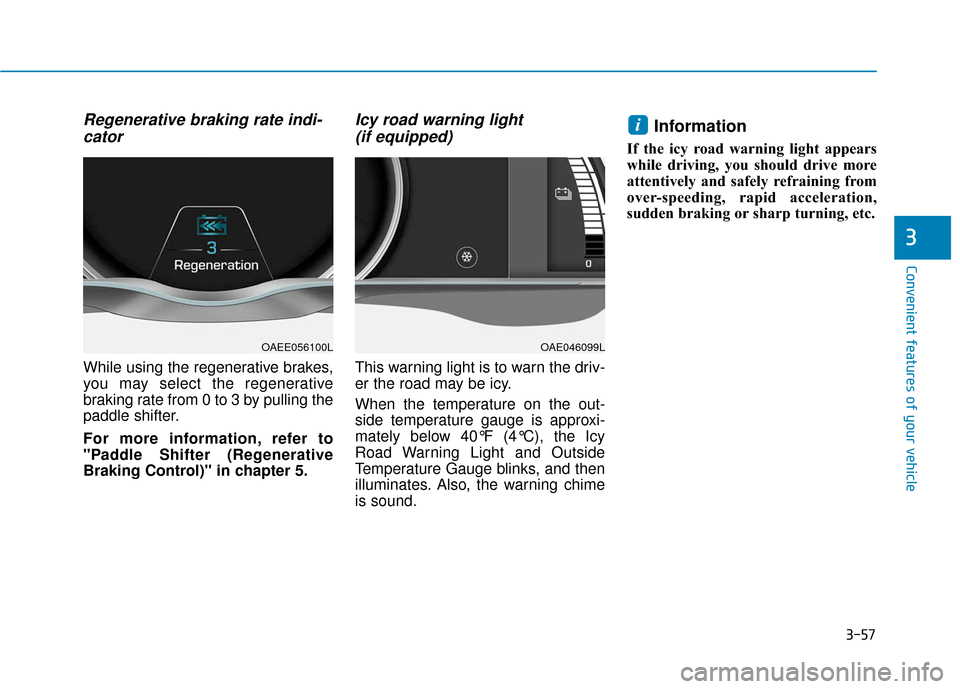
Regenerative braking rate indi-cator
While using the regenerative brakes,
you may select the regenerative
braking rate from 0 to 3 by pulling the
paddle shifter.
For more information, refer to
"Paddle Shifter (Regenerative
Braking Control)" in chapter 5.
Icy road warning light (if equipped)
This warning light is to warn the driv-
er the road may be icy.
When the temperature on the out-
side temperature gauge is approxi-
mately below 40°F (4°C), the Icy
Road Warning Light and Outside
Temperature Gauge blinks, and then
illuminates. Also, the warning chime
is sound.
Information
If the icy road warning light appears
while driving, you should drive more
attentively and safely refraining from
over-speeding, rapid acceleration,
sudden braking or sharp turning, etc.
i
OAEE056100LOAE046099L
Page 144 of 541
![Hyundai Ioniq Electric 2018 Owners Manual 3-59
Convenient features of your vehicle
Charging IndicatorLight
This warning light illuminates :
[Red] When charging the high volt-
age battery.
High Voltage BatteryLow Level WarningLight
This warn](/manual-img/35/14904/w960_14904-143.png "Hyundai Ioniq Electric 2018 Owners Manual 3-59
Convenient features of your vehicle
Charging IndicatorLight
This warning light illuminates :
[Red] When charging the high volt-
age battery.
High Voltage BatteryLow Level WarningLight
This warn")
3-59
Convenient features of your vehicle
Charging IndicatorLight
This warning light illuminates :
[Red] When charging the high volt-
age battery.
High Voltage BatteryLow Level WarningLight
This warning light illuminates :
When the high voltage battery level
is low.
When the warning light turns ON,
charge the battery immediately.
Supplemental RestraintSystem Warning Light
This warning light illuminates:
When the POWER button is in the
ON position.
- It illuminates for approximately 6seconds and then goes off.
When there is a malfunction with the SRS.
In this case, have your vehicle
inspected by an authorized HYUNDAI
dealer.
Seat Belt Warning Light
This warning light informs the driver
that the seat belt is not fastened.
For more information, refer to the
"Seat Belts" in chapter 2.
Regenerative BrakeWarning Light
This warning light illuminates :
When the regenerative brake does
not operate and the brake does not
perform well. This causes the Brake
Warning light (red) and Regenerative
Brake Warning Light (yellow) to illu-
minate simultaneously.
In this case, drive safely and have
your vehicle inspected by an author-
ized HYUNDAI dealer.
The operation of the brake pedal may
be more difficult than normal and the
braking distance can increase.
3
(yellow)
Page 262 of 541
Driving your vehicle
Before Driving ........................................................5-3
Before Entering the Vehicle ...........................................5-3
Before Starting ..................................................................5-3
Power Button..........................................................5-5
POWER Button Positions.................................................5-6
Starting the Vehicle ..........................................................5-8
Turning Off the Vehicle ...................................................5-9
Reduction Gear.....................................................5-10
Reduction Gear Operation ............................................5-10
Parking ........................................................................\
.......5-12
LCD Display Messages ...................................................5-12
Good Driving Practices ..................................................5-15
Paddle Shifter (Regenerative Braking
Control)..................................................................5-16
Braking System ....................................................5-17
Power Brakes ...................................................................5-17
Disc Brake Wear Indicator ............................................5-18
Electronic Parking Brake (EPB)...................................5-18
Auto Hold ........................................................................\
..5-23
Anti-lock Brake System (ABS) ....................................5-27
Electronic Stability Control (ESC)................................5-29
Vehicle Stability Management (VSM).........................5-33
Hill-Start Assist Control (HAC) ....................................5-34
Good Braking Practices .................................................5-35
Drive Mode Integrated Control System ............5-36
Blind Spot Detection System (BSD) ..................5-38
BSD (Blind Spot Detection) /
LCA (Lane Change Assist) .............................................5-39
RCTA (Rear Cross Traffic Alert) ..................................5-41
Detecting Sensor .............................................................5-43
Limitations of the System .............................................5-44
Autonomous (Automatic) Emergency Braking
(AEB)......................................................................5-\
46
System Setting and Activation.....................................5-46
AEB Warning Message and System Control ............5-48
AEB Sensor .......................................................................5\
-50
System Malfunction .......................................................5-52
Limitations of the System .............................................5-54
Lane Keeping Assist System (LKAS) .................5-59
LKAS Operation ...............................................................5-60
Warning Light and Message.........................................5-64
Limitations of the System .............................................5-65
LKAS Function Change ..................................................5-66
Cruise control .......................................................5-67
Cruise Control Operation...............................................5-67
5
Page 277 of 541
5-16
Driving your vehicle
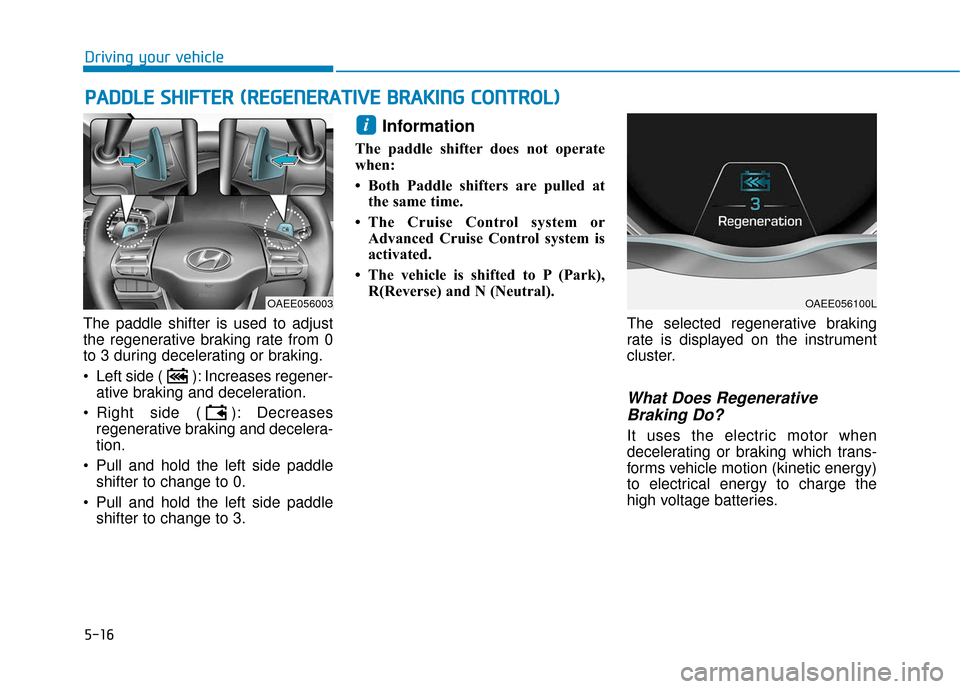
The paddle shifter is used to adjust
the regenerative braking rate from 0
to 3 during decelerating or braking.
Left side ( ): Increases regener- ative braking and deceleration.
Right side ( ): Decreases regenerative braking and decelera-
tion.
Pull and hold the left side paddle shifter to change to 0.
Pull and hold the left side paddle shifter to change to 3.
Information
The paddle shifter does not operate
when:
• Both Paddle shifters are pulled atthe same time.
• The Cruise Control system or Advanced Cruise Control system is
activated.
• The vehicle is shifted to P (Park), R(Reverse) and N (Neutral).
The selected regenerative braking
rate is displayed on the instrument
cluster.
What Does RegenerativeBraking Do?
It uses the electric motor when
decelerating or braking which trans-
forms vehicle motion (kinetic energy)
to electrical energy to charge the
high voltage batteries.
i
P
P A
A D
DD
DL
LE
E
S
S H
H I
IF
F T
T E
ER
R
(
( R
R E
EG
G E
EN
N E
ER
R A
A T
TI
IV
V E
E
B
B R
RA
A K
KI
IN
N G
G
C
C O
O N
NT
TR
R O
O L
L)
)
OAEE056100LOAEE056003
Page 278 of 541

5-17
Driving your vehicle
5
Power Brakes
Your vehicle has power-assisted
brakes that adjust automatically
through normal usage.
If the vehicle is not in the ready
( ) mode or the vehicle is turned
off while driving, the power assist for
the brakes will not work. You can still
stop your vehicle by applying greater
force to the brake pedal than typical.
The stopping distance, however, will
be longer than with power brakes.
When the vehicle is not in the ready
( ) mode, the reserve brake
power is partially depleted each time
the brake pedal is applied. Do not
pump the brake pedal when the
power assist has been interrupted.
Pump the brake pedal only when
necessary to maintain steering con-
trol on slippery surfaces.
B
BR
RA
A K
KI
IN
N G
G
S
S Y
Y S
ST
T E
EM
M
Take the following precautions:
Do not drive with your foot
resting on the brake pedal.
This will create abnormal high
brake temperatures, exces-
sive brake lining and pad
wear, and increased stopping
distances.
When descending down a
long or steep hill, use the pad-
dle shifter (left side lever) to
increase regenerative braking
control in order to control
your speed without using the
brake pedal excessively.
Applying the brakes continu-
ously will cause the brakes to
overheat and could result in a
temporary loss of braking per-
formance.
(Continued)
(Continued)
Wet brakes may impair the
vehicle's ability to safely slow
down; the vehicle may also
pull to one side when the
brakes are applied. Applying
the brakes lightly will indicate
whether they have been
affected in this way. Always
test your brakes in this fash-
ion after driving through deep
water. To dry the brakes, light-
ly tap the brake pedal to heat
up the brakes while maintain-
ing a safe forward speed until
brake performance returns to
normal. Avoid driving at high
speeds until the brakes func-
tion correctly.
WARNING
Page 364 of 541
6-3
What to do in an emergency
If you Have a Flat Tire While
Driving
If a tire goes flat while you are driving:
Take your foot off the acceleratorpedal and let the vehicle slow down
while driving straight ahead. Do not
apply the brakes immediately to
slow down the vehicle, but use the
paddle shifter (left side lever) to
increase regenerative braking con-
trol. Also, do not or attempt to pull
off the road as this may cause loss
of vehicle control resulting in an
accident. When the vehicle has
slowed to such a speed that it is
safe to do so, brake carefully and
pull off the road. Drive off the road
as far as possible and park on firm,
level ground. If you are on a divided
highway, do not park in the median
area between the two traffic lanes.
When the vehicle is stopped, press the hazard warning flasher button,
shift to P(Park), apply the parking
brake, and place the POWER but-
ton in the OFF position. Have all passengers get out of the
vehicle. Be sure they all get out on
the side of the vehicle that is away
from traffic.
When changing a flat tire, follow the instructions provided later in
this chapter.
Confirm the EV Battery Is Not
Low on the Charge Gauge
Be sure the gear is in P (Park). The
vehicle starts only when the gear is
in P (Park).
Check the 12-volt battery connec- tions to be sure they are clean and
tight.
Turn on the interior light. If the light dims or goes out when you operate
the starter, the battery is drained.
Do not push or pull the vehicle to
start it. This could cause damage to
your vehicle. See instructions for
"Jump Starting" provided in this
chapter.
6
I I F
F
T
T H
H E
E
V
V E
EH
H I
IC
C L
LE
E
W
W I
IL
L L
L
N
N O
O T
T
S
S T
T A
A R
RT
T
Page 475 of 541
I-7
Instrument panel illumination ....................................3-52
LCD display control ...................................................3-80
LCD display messages ...............................................3-68
LCD display modes ....................................................3-81
Regenerative braking rate indicator ...........................3-57
Shift indicator pop-up ................................................3-56
Trip computer .............................................................3-90
User settings mode .....................................................3-84
Warning and indicator lights ......................................3-58
Instrument panel fuse replacement .................................7-43
Instrument panel overview ...............................................1-5
Interior care .....................................................................7-7\
0
Interior features Bottle holder .............................................................3-125
Cargo security screen ...............................................3-131
Clock ........................................................................\
3-129
Clothes hanger ..........................................................3-130
Cup holder ................................................................3-125
Floor mat anchor(s) ..................................................3-130
Mobile phone holder ................................................3-128
Power outlet..............................................................3-127
Sunvisor ....................................................................3-12\
6
Wireless cellular phone charging system .................3-128
Interior lamp AUTO cut..................................................3-99 Interior lights...................................................................3-99
Door lamp...................................................................3-99
Interior lamp AUTO cut .............................................3-99
Luggage room lamp .................................................3-100
Map lamp....................................................................3-99\
Rear lamps ................................................................3-100
Room lamp .................................................................3-99
Vanity mirror lamp ...................................................3-101
Puddle lamp ..............................................................3-101
Interior overview...............................................................1-4
Jump starting .....................................................................6-4\
Label Air bag warning labels ...............................................2-70
Refrigerent label ...........................................................8-8
Tire sidewall labeling .................................................7-31
Tire specification and pressure label ............................8-8
Vehicle certification label .............................................8-8
Lane change signals ........................................................3-96
Lane Keeping Assist System (LKAS) ............................5-59
Lap/shoulder belt ............................................................2-26
I
Index
J
L
Page 478 of 541
I-10
Paddle shifter (Regenerative braking control) ................5-16
Parking lamp position .....................................................3-95
Passenger's front air bag .................................................2-49
Power brakes ...................................................................5-17
Power button .....................................................................5-5\
POWER button positions .............................................5-6
Starting the vehicle .......................................................5-8
Turning off the vehicle .................................................5-9
Power outlet ..................................................................3-127
Power steering.................................................................3-16
Power window lock switch .............................................3-41
Pre-tensioner seat belt .....................................................2-29
Puddle lamp ..................................................................3-101
Rear center seatbelt .........................................................2-32
Rear seat adjustment .......................................................2-12 Armrest .......................................................................2\
-15
Folding the rear seat ...................................................2-12
Rear seat head restraints .................................................2-19 Adjusting the height up and down .............................2-19
Removal/Reinstall ......................................................2-20
Rear seat warmers ...........................................................2-22
Rear view camera .........................................................3-105
Recommended cold tire inflation pressures ...................7-27 Recommended lubricants and capacities ..........................8-6
Reduction gear ................................................................5-10
Gear position ..............................................................5-10
Good driving practices ...............................................5-15
LCD display messages ...............................................5-12
Shift-lock system ........................................................5-12
When the battery (12 V) is discharged ......................5-12
Refrigerent label ...............................................................8-8
Regenerative braking rate indicator ................................3-57
Removable towing hook .................................................6-22
Replacement light bulb ...................................................7-55
Reporting safety defects .................................................8-10
Rocking the vehicle ........................................................5-89
Rotation (Tire) ................................................................7-29
Safety messages ................................................................F-6
Scheduled maintenance services.......................................7-7
Seat belt warning light Driver's seat ................................................................2-24
Front passenger's seat .................................................2-25
Seat belts ........................................................................\
.2-23 Additional seat belt safety precautions ......................2-32
Care of seat belts ........................................................2-35
Do not lie down ..........................................................2-34
Height adjustment ......................................................2-27
Keep belts clean and dry ............................................2-35
Lap/shoulder belt ........................................................2-26
Index
S
P
R