2018 HYUNDAI I10 spark
[x] Cancel search: sparkPage 8 of 343

13
Introduction
Unleaded
Your new vehicle is designed to use only
unleaded fuel having an Octane Rating
of RON (Research Octane Number) 91 /
AKI (Anti-Knock Index) 87 or higher.
Your new vehicle is designed to obtain
maximum performance with UNLEADED
FUEL, as well as minimize exhaust emis-
sions and spark plug fouling.
Leaded (if equipped)
For some countries, your vehicle is
designed to use leaded gasoline. When
you are going to use leaded gasoline, we
recommend that you ask an authorzied
HYUNDAI dealer whether leaded gaso-
line in your vehicle is available or not.
Octane Rating of leaded gasoline is
same with unleaded one.
FUEL REQUIREMENTS
CAUTION
NEVER USE LEADED FUEL. The
use of leaded fuel is detrimental to
the catalytic converter and will
damage the engine control sys-
tem’s oxygen sensor and affect
emission control.
Never add any fuel system cleaning
agents to the fuel tank other than
what has been specified. (We rec-
ommend that you contact an
authorized HYUNDAI dealer for
details)
WARNING
• Do not "top off" after the nozzle
automatically shuts off when
refueling.
• Always check that the fuel cap is
installed securely to prevent fuel
spillage in the event of an acci-
dent.
Page 95 of 343

Features of your vehicle
34 4
(Continued)
Use only approved portable plas-
tic fuel containers designed to
carry and store gasoline.
• Do not use cellular phones while
refueling. Electric current and/or
electronic interference from cel-
lular phones can potentially
ignite fuel vapors causing a fire.
• When refueling, always shut the
engine off. Sparks produced by
electrical components related to
the engine can ignite fuel vapors
causing a fire. Once refueling is
complete, check to make sure the
filler cap and filler door are
securely closed, before starting
the engine.
• DO NOT use matches or a lighter
and DO NOT SMOKE or leave a lit
cigarette in your vehicle while at
a gas station especially during
refueling. Automotive fuel is
highly flammable and can, when
ignited, result in fire.
(Continued)(Continued)
• If a fire breaks out during refuel-
ing, leave the vicinity of the vehi-
cle, and immediately contact the
manager of the gas station and
then contact the local fire depart-
ment. Follow any safety instruc-
tions they provide.CAUTION
• Make sure to refuel with unleaded
(or leaded for some countries)
fuel only. (Gasoline engine only)
• If the fuel filler cap requires
replacement, we recommend that
you use parts for replacement
from an authorized HYUNDAI
dealer. An incorrect fuel filler cap
can result in a serious malfunc-
tion of the fuel system or emis-
sion control system.
• Do not spill fuel on the exterior
surfaces of the vehicle. Any type
of fuel spilled on painted surfaces
may damage the paint.
• After refueling, make sure the fuel
cap is installed securely to pre-
vent fuel spillage in the event of
an accident.
Page 236 of 343

63
What to do in an emergency
2. When the vehicle is stopped, turn on
your hazard warning flasher, set the
parking brake and put the transaxle in
P (automatic transaxle) or reverse
(manual transaxle).
3. Have all passengers get out of the
vehicle. Be sure they all get out on the
side of the vehicle that is away from
traffic.
4. When changing a flat tire, follow the
instruction provided later in this chap-
ter.
If the engine stalls while driving
1. Reduce your speed gradually, keeping
a straight line. Move cautiously off the
road to a safe place.
2. Turn on your hazard warning flasher.
3. Try to start the engine again. Try to
start the engine again. If your vehicle
will not start, we recommend that you
consult an authorized HYUNDAI deal-
er.
If the engine doesn't turn over or
turns over slowly
1. If your vehicle has an automatic
transaxle, be sure the shift lever is in N
(Neutral) or P (Park) and the emer-
gency brake is set.
2. Check the battery connections to be
sure they are clean and tight.
3. Turn on the interior light. If the light
dims or goes out when you operate the
starter, the battery is discharged.
4. Check the starter connections to be
sure they are securely tightened.
5. Do not push or pull the vehicle to start
it. See instructions for "Jump starting".
If the engine turns over normally
but does not start
1. Check the fuel level.
2. With the ignition switch in the LOCK/
OFF position, check all connectors at
the ignition coils and spark plugs.
Reconnect any that may be discon-
nected or loose.
3. Check the fuel line in the engine com-
partment.
4. If the engine still does not start, we rec-
ommend that you call an authorized
HYUNDAI dealer.
IF THE ENGINE DOES NOT START
WARNING
If the engine will not start, do not
push or pull the vehicle to start it.
This could result in a collision or
cause other damage. In addition,
push or pull starting may cause the
catalytic converter to overload and
create a fire.
Page 237 of 343
What to do in an emergency
4 6
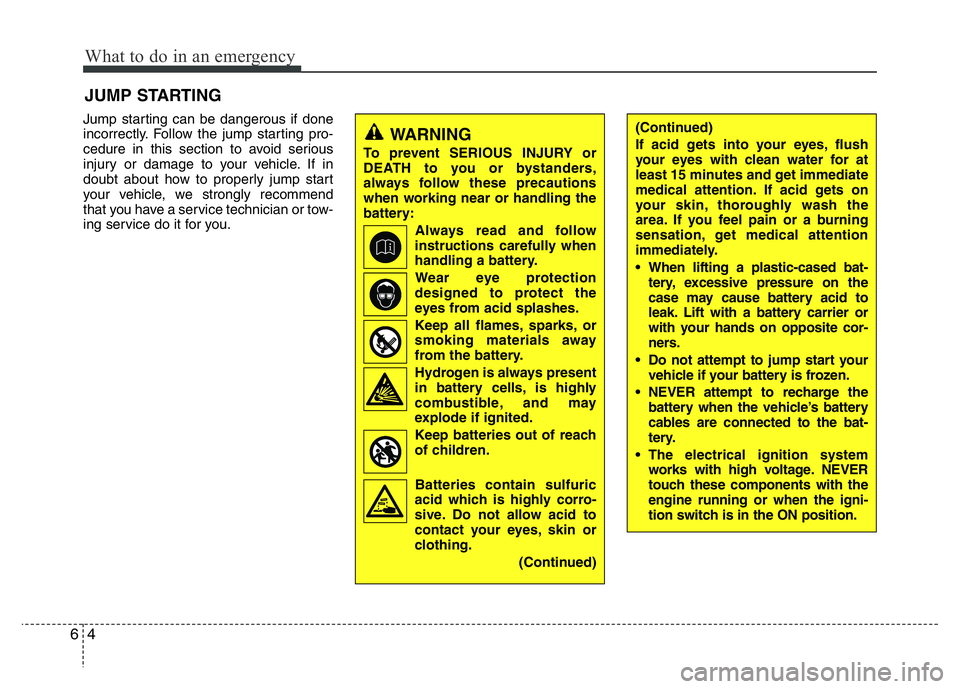
JUMP STARTING
Jump starting can be dangerous if done
incorrectly. Follow the jump starting pro-
cedure in this section to avoid serious
injury or damage to your vehicle. If in
doubt about how to properly jump start
your vehicle, we strongly recommend
that you have a service technician or tow-
ing service do it for you.
WARNING
To prevent SERIOUS INJURY or
DEATH to you or bystanders,
always follow these precautions
when working near or handling the
battery:
Always read and follow
instructions carefully when
handling a battery.
Wear eye protection
designed to protect the
eyes from acid splashes.
Keep all flames, sparks, or
smoking materials away
from the battery.
Hydrogen is always present
in battery cells, is highly
combustible, and may
explode if ignited.
Keep batteries out of reach
of children.
Batteries contain sulfuric
acid which is highly corro-
sive. Do not allow acid to
contact your eyes, skin or
clothing.
(Continued)
(Continued)
If acid gets into your eyes, flush
your eyes with clean water for at
least 15 minutes and get immediate
medical attention. If acid gets on
your skin, thoroughly wash the
area. If you feel pain or a burning
sensation, get medical attention
immediately.
• When lifting a plastic-cased bat-
tery, excessive pressure on the
case may cause battery acid to
leak. Lift with a battery carrier or
with your hands on opposite cor-
ners.
• Do not attempt to jump start your
vehicle if your battery is frozen.
• NEVER attempt to recharge the
battery when the vehicle’s battery
cables are connected to the bat-
tery.
• The electrical ignition system
works with high voltage. NEVER
touch these components with the
engine running or when the igni-
tion switch is in the ON position.
Page 261 of 343

79
Maintenance
I : Inspect and if necessary, adjust, correct, clean or replace.
R : Replace or change.
*
1: Adjust alternator and power steering (and water pump drive belt) and air conditioner drive belt (if equipped).
Inspect and if necessary correct or replace.
*
2: Check the engine oil level and leak every 500 km (350 miles) or before starting a long trip.
*3: For your convenience, it can be replaced prior to it's interval when you do maintenance of other items.
NORMAL MAINTENANCE SCHEDULE (FOR MEXICO)
Number of months or driving distance, whichever comes first
Months612182430364248
Miles×1,0006.51319.52632.53945.552
Km×1,0001020304050607080
Drive belts *1IIIIIIII
Engine oil and engine oil filter *2RRRRRRRR
Air cleaner filterIIRIIRII
Spark plugsReplace every 160,000 km (100,000 miles) *3
MAINTENANCE
INTERVALS
MAINTENANCE
ITEM
Page 265 of 343

713
Maintenance
NORMAL MAINTENANCE SCHEDULE (EXCEPT MEXICO)
MAINTENANCE
INTERVALS
MAINTENANCE
ITEMNumber of months or driving distance, whichever comes first
Months 12 24 36 48 60 72 84 96
Miles×1,000 10 20 30 40 50 60 70 80
Km×1,000 15 30 45 60 75 90 105 120
Drive belts *
1III IIIII
Engine oil and engine oil filter
*2
Air cleaner filterIIRIIRII
RRR RRRRR
Spark plugs
Replace every 160,000 km (100,000 miles) *3
Replace every 10,000 km (6,000 miles) or 12 months
Replace every 15,000 km (10,000 miles) or 12 months
Middle EastExcept
Middle East
Middle EastExcept
Middle East
I : Inspect and if necessary, adjust, correct, clean or replace.
R : Replace or change.
*
1: Adjust alternator and power steering (and water pump drive belt) and air conditioner drive belt (if equipped).
Inspect and if necessary correct or replace.
*
2: Check the engine oil level and leak every 500 km (350 miles) or before starting a long trip.
*3: For your convenience, it can be replaced prior to it's interval when you do maintenance of other items.
Page 269 of 343

717
Maintenance
MAINTENANCE UNDER SEVERE USAGE CONDITIONS
The following items must be serviced more frequently on cars mainly used under severe driving conditions.
Refer to the chart below for the appropriate maintenance intervals.
I : Inspect and if necessary, adjust, correct, clean or replace R : Replace or change
Maintenance itemMaintenance
operationMaintenance intervalsDriving condition
Engine oil and engine
oil filterExcept Middle EastREvery 7,500 km (4,600 miles) or 6 months A, B, C, D, E,
F, G, H, I, J
For Middle EastREvery 5,000 km (3,100 miles) or 6 months
Air cleaner filterRReplace more frequently
depending on the conditionC, E
Spark plugsRReplace more frequently
depending on the conditionB, H
Manual transaxle fluid (if equipped)REvery 120,000 km (80,000 miles)C, D, E, F, G,
H, I, J
Automatic transaxle fluid (if equipped)REvery 100,000 km (62,500 miles)A, C, D, E, F,
G, H, I, J
Steering gear rack, linkage and bootsIInspect more frequently
depending on the conditionC, D, E, F, G
Page 272 of 343

Maintenance
20 7
Air cleaner filter
When replacing the air cleaner filter, we
recommend that you use HYUNDAI gen-
uine parts.
Spark plugs
Make sure to install new spark plugs of
the correct heat range.
Valve clearance (if equipped)
Inspect for excessive valve noise and/or
engine vibration and adjust if necessary.
We recommend that the system be serv-
iced by an authorized HYUNDAI dealer.
Cooling system
Check the cooling system components,
such as the radiator, coolant reservoir,
hoses and connections for leakage and
damage. Replace any damaged parts.
Coolant
The coolant should be changed at the
intervals specified in the maintenance
schedule.
Manual transaxle fluid
(if equipped)
Inspect the manual transaxle fluid
according to the maintenance schedule.
Automatic transaxle fluid
(if equipped)
Inspect the automatic transaxle fluid
according to the maintenance schedule.
Brake hoses and lines
Visually check for proper installation,
chafing, cracks, deterioration and any
leakage. Replace any deteriorated or
damaged parts immediately.
Brake fluid
Check the brake fluid level in the brake
fluid reservoir. The level should be
between “MIN” and “MAX” marks on the
side of the reservoir. Use only hydraulic
brake fluid conforming to DOT 3 or DOT
4 specification.
Parking brake
Inspect the parking brake system includ-
ing the parking brake lever and cables.