2018 Hyundai Elantra 7-4
[x] Cancel search: 7-4Page 15 of 526

1-4
Your vehicle at a glance
I
IN
N T
TE
ER
R I
IO
O R
R
O
O V
VE
ER
R V
V I
IE
E W
W
1. Door lock/unlock button ........................3-12
2. Side view mirror control switch ..............3-35
3. Central door lock switch ........................3-13
4. Power window switches ........................3-37
5. Power window lock switch......................3-40
6. Fuel filler door release lever ..................3-51
7. Instrument panel illumination control
switch ....................................................3-56
8. Blind spot detection(BSD) system button* ....................................................5-45
9. Lane keeping assist system (LKAS) button * ..................................................5-62
10. ESC (Electronic Stability Control) OFF button ..........................................5-38
11. Trunk lid release lever ..........................3-47
12. Fuse panel ..........................................7-49
13. Steering wheel ....................................3-18
14. Steering wheel tilt/telescope lever ......3-19
15. Light control/Turn signals ....................3-98
16. Wiper/Washer ....................................3-108
17. Seat........................................................2-3
18. Hood release lever ..............................3-45
19. Brake pedal ..........................................5-33
20. Accelerator pedal
* : if equipped
OAD015003N
The actual shape may differ from the illustration.
Page 17 of 526
1-6
Your vehicle at a glance
E
EN
N G
GI
IN
N E
E
C
C O
O M
M P
PA
A R
RT
TM
M E
EN
N T
T
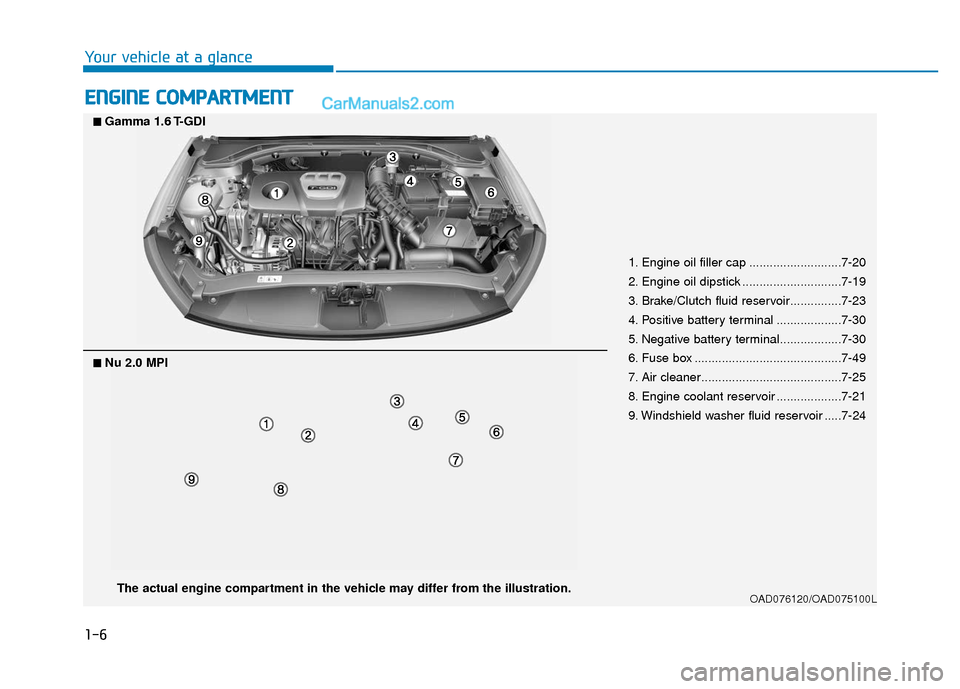
1. Engine oil filler cap ...........................7-20
2. Engine oil dipstick .............................7-19
3. Brake/Clutch fluid reservoir...............7-23
4. Positive battery terminal ...................7-30
5. Negative battery terminal..................7-30
6. Fuse box ...........................................7-49
7. Air cleaner.........................................7-25
8. Engine coolant reservoir ...................7-21
9. Windshield washer fluid reservoir .....7-24
OAD076120/OAD075100LThe actual engine compartment in the vehicle may differ from the illustration.
■
■Nu 2.0 MPI
■
■Gamma 1.6 T-GDI
Page 419 of 526

7
Maintenance
7
Maintenance
Engine Compartment .............................................7-3
Maintenance Services ...........................................7-4
Owner's Responsibility .....................................................7-4
Owner Maintenance Precautions..................................7-4
Owner Maintenance ..............................................7-4
Owner Maintenance Schedule .......................................7-5
Scheduled Maintenance Services........................7-6
Normal Maintenance Schedule (Nu 2.0 MPI) .............7-7
Maintenance Under Severe Usage Conditions
(Nu 2.0 MPI)......................................................................7-\
10
Severe Driving Conditions .............................................7-11
Normal Maintenance Schedule (Gamma 1.6 T-GDI) ..7-12
Maintenance Under Severe Usage Conditions
(Gamma 1.6 T-GDI) .........................................................7-15
Severe Driving Conditions .............................................7-16
Explanation of Scheduled Maintenance Items.. 7-17
Engine Oil ..............................................................7-19
Checking the Engine Oil Level .....................................7-19
Checking the Engine Oil and Filter .............................7-20
Engine Coolant .....................................................7-21
Checking the Engine Coolant Level ............................7-21
Changing Engine Coolant ..............................................7-23
Brake/Clutch Fluid ...............................................7-23
Checking the Brake/Clutch Fluid Level .....................7-23
Washer Fluid .........................................................7-24
Checking the Washer Fluid Level................................7-24
Parking Brake .......................................................7-25
Checking the Parking Brake .........................................7-25
Air Cleaner ............................................................7-25
Filter Replacement ..........................................................7-25
Climate Control Air Filter ....................................7-26
Filter Inspection ...............................................................7-26
Wiper Blades.........................................................7-28
Blade Inspection ..............................................................7-28
Blade Replacement .........................................................7-28
Battery...................................................................7-30
For Best Battery Service ..............................................7-31
Battery Recharging ........................................................7-31
Reset Features.................................................................7-32
7
Page 420 of 526

7
Tires and Wheels .................................................7-33
Tire Care ........................................................................\
....7-33
Recommended Cold Tire Inflation Pressures ...........7-34
Check Tire Inflation Pressure ......................................7-35
Tire Rotation...................................................................\
..7-36
Wheel Alignment and Tire Balance ............................7-37
Tire Replacement ............................................................7-37
Wheel Replacement ........................................................7-38
Tire Traction .....................................................................7-3\
8
Tire Maintenance ............................................................7-39
Tire Sidewall Labeling ....................................................7-39
Tire Terminology and Definitions................................7-43
All Season Tires ...............................................................7-46
Summer Tires ...................................................................7-46
Snow Tires ........................................................................\
7-46
Radial-Ply Tires ...............................................................7-46
Low Aspect Ratio Tires..................................................7-47
Fuses ......................................................................7-\
48
Instrument Panel Fuse Replacement..........................7-49
Engine Compartment Panel Fuse Replacement.......7-50
Fuse/Relay Panel Description ......................................7-53
Light Bulbs ............................................................7-59
Headlamp, Parking Lamp,
Turn Signal Lamp and Side Marker ............................7-59
Side Repeater Lamp Replacement ..............................7-70
Rear Combination Light Bulb Replacement ..............7-70
High Mounted Stop Light Replacement ....................7-74
License Plate Light Bulb Replacement ......................7-74
Interior Light Bulb Replacement .................................7-75
Appearance Care..................................................7-76
Exterior Care ....................................................................7-76\
Interior Care .....................................................................7-8\
0
Emission Control System ....................................7-83
Crankcase Emission Control System ..........................7-83
Evaporative Emission Control System Including
Onboard Refueling Vapor Recovery (ORVR)............7-83
Exhaust Emission Control System ..............................7-84
California Perchlorate Notice.............................7-86
Page 422 of 526

7-4
Maintenance
M
MA
AI
IN
N T
TE
EN
N A
AN
N C
CE
E
S
S E
E R
R V
V I
IC
C E
E S
S
You should exercise the utmost care to
prevent damage to your vehicle and
injury to yourself whenever performing
any maintenance or inspection proce-
dures.
We recommend you have your vehicle
maintained and repaired by an author-
ized HYUNDAI dealer. An authorized
HYUNDAI dealer meets HYUNDAI’s high
service quality standards and receives
technical support from HYUNDAI in
order to provide you with a high level of
service satisfaction.
Owner's Responsibility
Maintenance service and record reten-
tion are the owner's responsibility.
You should retain documents that show
proper maintenance has been performed
on your vehicle in accordance with the
scheduled maintenance service charts
shown on the following pages. You need
this information to establish your compli-
ance with the servicing and maintenance
requirements of your vehicle warranties.
Detailed warranty information is provided
in your Owner's Handbook & Warranty
Information booklet.
Repairs and adjustments required as a
result of improper maintenance or a lack
of required maintenance are not covered.
Owner Maintenance
Precautions
Inadequate, incomplete or insufficient
servicing may result in operational prob-
lems with your vehicle that could lead to
vehicle damage, an accident, or person-
al injury. This chapter provides instruc-
tions only for the maintenance items that
are easy to perform. Several procedures
can be done only by an authorized
HYUNDAI dealer with special tools.
Your vehicle should not be modified in
any way. Such modifications may
adversely affect the performance, safety
or durability of your vehicle and may, in
addition, violate conditions of the limited
warranties covering the vehicle.
Certain modifications may also be in vio-
lation of regulations established by the
U.S. Department of Transportation and
other federal or state agencies.
Improper owner maintenance during
the warranty period may affect war-
ranty coverage. For details, read the
separate Owner's Handbook &
Warranty Information booklet provid-
ed with the vehicle. If you're unsure
about any service or maintenance
procedure, have it done by an author-
ized HYUNDAI dealer.
NOTICE
O O W
W N
NE
ER
R
M
M A
AI
IN
N T
TE
EN
N A
AN
N C
CE
E
Performing maintenance work on a
vehicle can be dangerous. If you
lack sufficient knowledge and
experience or the proper tools and
equipment to do the work, have it
done by an authorized HYUNDAI
dealer.
ALWAYS follow these precautions
for performing maintenance work:
•Park your vehicle on level
ground, move the shift lever into
the P (Park, for automatic trans-
mission vehicle) position or neu-
tral (for manual transmission
vehicle), apply the parking brake,
place the ignition switch in the
LOCK/OFF position.
Block the tires (front and back) to
prevent the vehicle from moving.
Remove loose clothing or jewelry
that can become entangled in
moving parts.
If you must run the engine during
maintenance, do so out doors or
in an area with plenty of ventila-
tion.
Keep flames, sparks, or smoking
materials away from the battery
and fuel-related parts.
WARNING
Page 458 of 526

7-40
Maintenance
Wheel size designation
Wheels are also marked with impor-
tant information that you need if you
ever have to replace one. The follow-
ing explains what the letters and
numbers in the wheel size designa-
tion mean.
Example wheel size designation:
6.5J X 16
6.5 - Rim width in inches.
J - Rim contour designation.
16 - Rim diameter in inches.
Tire speed ratings
The chart below lists many of the dif-
ferent speed ratings currently being
used for passenger car tires. The
speed rating is part of the tire size
designation on the sidewall of the
tire. This symbol corresponds to that
tire’s designed maximum safe oper-
ating speed.
3. Checking tire life (TIN : TireIdentification Number)
Any tires that are over six years old,
based on the manufacturing date,
(including the spare tire) should be
replaced by new ones. You can find
the manufacturing date on the tire
sidewall (possibly on the inside of the
wheel), displaying the DOT Code.
The DOT Code is a series of num-
bers on a tire consisting of numbers
and English letters. The manufactur-
ing date is designated by the last four
digits (characters) of the DOT code.
DOT : XXXX XXXX OOOO
The front part of the DOT means a
plant code number, tire size and
tread pattern and the last four num-
bers indicate week and year manu-
factured.
For example:
DOT XXXX XXXX 1418 represents
that the tire was produced in the 14th
week of 2018.
Speed
Rating
Symbol Maximum Speed
S 112 mph (180 km/h) T 118 mph (190 km/h)
H 130 mph (210 km/h) V 149 mph (240 km/h)
W 168 mph (270 km/h)
Y186 mph (300 km/h)
Page 459 of 526

7-41
7
Maintenance
4. Tire ply composition andmaterial
The number of layers or plies of rub-
ber-coated fabric in the tire. Tire
manufacturers also must indicate the
materials in the tire, which include
steel, nylon, polyester, and others.
The letter "R" means radial ply con-
struction; the letter "D" means diago-
nal or bias ply construction; and the
letter "B" means belted-bias ply con-
struction.
5. Maximum permissible infla-tion pressure
This number is the greatest amount
of air pressure that should be put in
the tire. Do not exceed the maximum
permissible inflation pressure. Refer
to the Tire and Loading Information
label for recommended inflation
pressure.
6. Maximum load rating
This number indicates the maximum
load in kilograms and pounds that
can be carried by the tire. When
replacing the tires on the vehicle,
always use a tire that has the same
load rating as the factory installed
tire.
7. Uniform tire quality grading
Quality grades can be found where
applicable on the tire sidewall
between tread shoulder and maxi-
mum section width.
For example:
TREAD WEAR 200
TRACTION AA
TEMPERATURE A
Tread wear
The tread wear grade is a compara-
tive rating based on the wear rate of
the tire when tested under controlled
conditions on a specified govern-
ment test course. For example, a tire
graded 150 would wear one-and-a-
half times (1½) as well on the gov-
ernment course as a tire graded 100.
The relative performance of tires
depends upon the actual conditions
of their use, however, and may
depart significantly from the norm
due to variations in driving habits,
service practices and differences in
road characteristics and climate.
These grades are molded on the
sidewalls of passenger vehicle tires.
The tires available as standard or
optional equipment on your vehicle
may vary with respect to grade.
Page 460 of 526
7-42
Maintenance
Traction - AA, A, B & C
The traction grades, from highest to
lowest, are AA, A, B and C. Those
grades represent the tire's ability to
stop on wet pavement as measured
under controlled conditions on spec-
ified government test surfaces of
asphalt and concrete. A tire marked
C may have poor traction perform-
ance.
Temperature - A, B & C
The temperature grades are A (the
highest), B and C representing the
tire’s resistance to the generation of
heat and its ability to dissipate heat
when tested under controlled condi-
tions on a specified indoor laboratory
test wheel.
Sustained high temperature can
cause the material of the tire to
degenerate and reduce tire life, and
excessive temperature can lead to
sudden tire failure. Grade C
responds to a level of performance
which all passenger car tires must
meet under the Federal Motor
Vehicle Safety Standard No. 109.
Grades B and A represent higher
levels of performance on the labora-
tory test wheel than the minimum
required by law.
The traction grade assigned to
this tire is based on straight-
ahead braking traction tests,
and does not include accelera-
tion, cornering, hydroplaning,
or peak traction characteristics.
WARNING
The temperature grade for this
tire is established for a tire that
is properly inflated and not
overloaded. Excessive speed,
under-inflation, over-inflation,
or excessive loading, either
separately or in combination,
can cause heat build-up and
possible sudden tire failure.
This may cause loss of vehicle
control resulting in an accident.
WARNING