2018 Hyundai Creta coolant
[x] Cancel search: coolantPage 393 of 472
7-36
Maintenance
Recommended engine coolant
Use only soft (distilled) water in the
coolant mixture.
The engine in your vehicle has alu-
minum engine parts and must be
protected by a phosphate-based
ethylene glycol coolant for alu-
minum radiator based coolant to
prevent corrosion and freezing.
DO NOT USE alcohol or methanol
coolant or mix them with the spec-
ified coolant.
Do not use a solution that contains
more than 60% antifreeze or less
than 35% antifreeze, which would
reduce the effectiveness of the
solution.
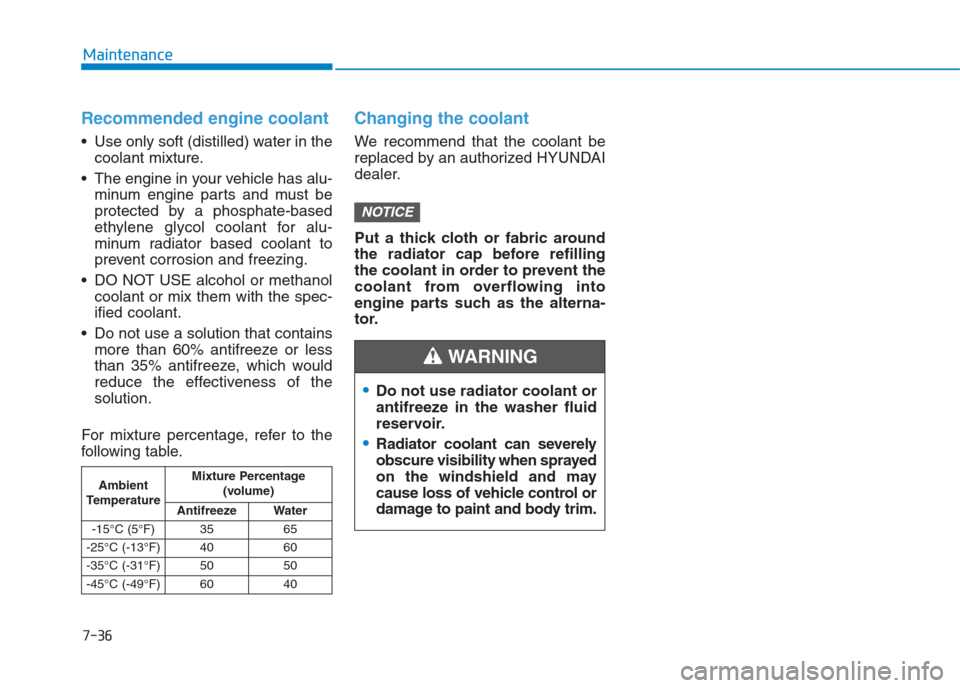
For mixture percentage, refer to the
following table.
Changing the coolant
We recommend that the coolant be
replaced by an authorized HYUNDAI
dealer.
Put a thick cloth or fabric around
the radiator cap before refilling
the coolant in order to prevent the
coolant from overflowing into
engine parts such as the alterna-
tor.
NOTICE
Ambient
TemperatureMixture Percentage
(volume)
Antifreeze Water
-15°C (5°F) 35 65
-25°C (-13°F) 40 60
-35°C (-31°F) 50 50
-45°C (-49°F) 60 40
Do not use radiator coolant or
antifreeze in the washer fluid
reservoir.
Radiator coolant can severely
obscure visibility when sprayed
on the windshield and may
cause loss of vehicle control or
damage to paint and body trim.
WARNING
Page 396 of 472

7-39
7
Maintenance
W WA
AS
SH
HE
ER
R
F
FL
LU
UI
ID
D
Checking the washer fluid
level
Check the fluid level in the washer
fluid reservoir and add fluid if neces-
sary. Plain water may be used if
washer fluid is not available.
However, use washer solvent with
antifreeze characteristics in cold cli-
mates to prevent freezing.Do not use engine coolant or
antifreeze in the washer fluid
reservoir.
Checking the parking brake
Check the stroke of the parking
brake by counting the number of
“clicks’’ heard while fully applying it
from the released position.
Also, the parking brake alone should
securely hold the vehicle on a fairly
steep grade. If the stroke is more or
less than specified, we recommend
that the system be inspected by an
authorized HYUNDAI dealer.
Stroke : 6~8 “clicks’’ at a force of
20 kg (44 lbs, 196 N).
NOTICE
OGS075007
OGS075008
Engine coolant can severely
obscure visibility when
sprayed on the windshield
and may cause loss of vehicle
control or damage to paint
and body trim.
Windshield Washer fluid
agents contain some amounts
of alcohol and can be flamma-
ble under certain circum-
stances. Do not allow sparks
or flame to contact the washer
fluid or the washer fluid reser-
voir. Damage to the vehicle or
occupants could occur.
Windshield washer fluid is
poisonous to humans and
animals. Do not drink and
avoid contacting windshield
washer fluid. Serious injury or
death could occur.
WARNING
P PA
AR
RK
KI
IN
NG
G
B
BR
RA
AK
KE
E
Page 452 of 472

7-95
7
Maintenance
E EM
MI
IS
SS
SI
IO
ON
N
C
CO
ON
NT
TR
RO
OL
L
S
SY
YS
ST
TE
EM
M
The emission control system of your
vehicle is covered by a written limited
warranty. Please see the warranty
information contained in the Service
Passport in your vehicle.
Your vehicle is equipped with an
emission control system to meet all
emission regulations.
There are three emission control
systems which are as follows.
(1) Crankcase emission control sys-
tem
(2) Evaporative emission control sys-
tem
(3) Exhaust emission control system
In order to assure the proper function
of the emission control systems, it is
recommended that you have your
car inspected and maintained by an
authorized HYUNDAI dealer in
accordance with the maintenance
schedule in this manual.1. Crankcase emission control
system
The positive crankcase ventilation
system is employed to prevent air
pollution caused by blow-by gases
being emitted from the crankcase.
This system supplies fresh filtered air
to the crankcase through the air
intake hose. Inside the crankcase,
the fresh air mixes with blow-by
gases, which then pass through the
PCV valve into the induction system.
2. Evaporative emission con-
trol system
The Evaporative Emission Control
System is designed to prevent fuel
vapors from escaping into the atmos-
phere.
Canister
Fuel vapors generated inside the fuel
tank are absorbed and stored in the
onboard canister. When the engine is
running, the fuel vapors absorbed in
the canister are drawn into the surge
tank through the purge control sole-
noid valve.
Purge Control Solenoid Valve
(PCSV)
The purge control solenoid valve is
controlled by the Engine Control
Module (ECM); when the engine
coolant temperature is low during
idling, the PCSV closes so that evap-
orated fuel is not taken into the
engine. After the engine warms up
during ordinary driving, the PCSV
opens to introduce evaporated fuel to
the engine.
Page 460 of 472
8-6
Specifications & Consumer information
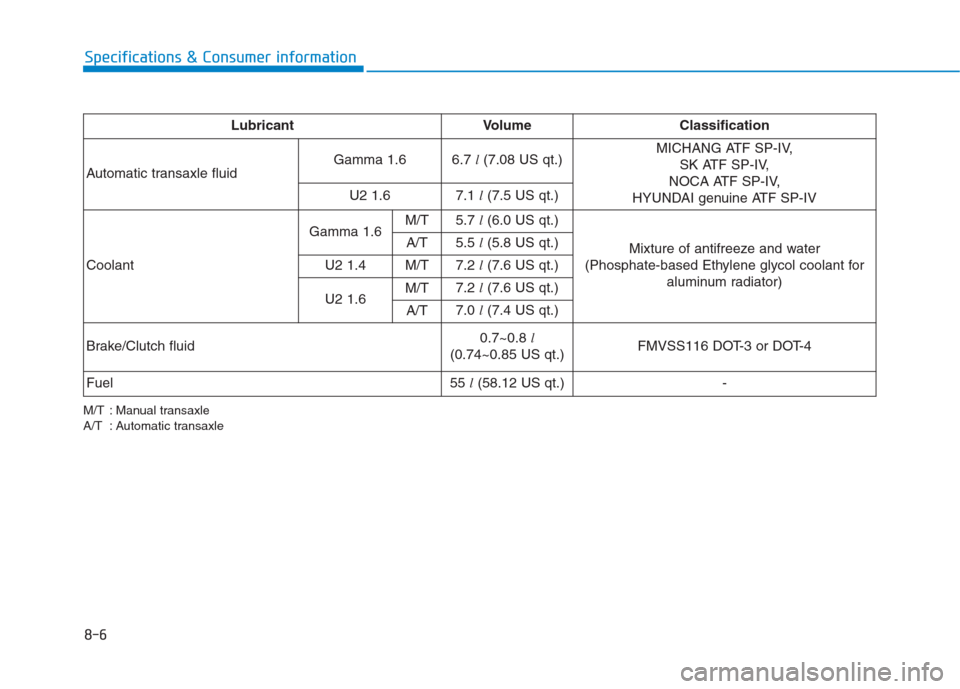
Lubricant Volume Classification
Automatic transaxle fluidGamma 1.66.7 l(7.08 US qt.)MICHANG ATF SP-IV,
SK ATF SP-IV,
NOCA ATF SP-IV,
HYUNDAI genuine ATF SP-IV U2 1.67.1 l(7.5 US qt.)
CoolantGamma 1.6M/T5.7 l(6.0 US qt.)
Mixture of antifreeze and water
(Phosphate-based Ethylene glycol coolant for
aluminum radiator) A/T5.5 l(5.8 US qt.)
U2 1.4 M/T7.2 l(7.6 US qt.)
U2 1.6M/T7.2 l(7.6 US qt.)
A/T7.0 l(7.4 US qt.)
Brake/Clutch fluid0.7~0.8 l
(0.74~0.85 US qt.)FMVSS116 DOT-3 or DOT-4
Fuel55 l(58.12 US qt.)-
M/T : Manual transaxle
A/T : Automatic transaxle
Page 468 of 472

I-4
Door locks.....................................................................3-13
Auto door lock/unlock features .................................3-17
Child-protector rear door locks .................................3-17
Operating door locks from inside the vehicle ...........3-15
Operating door locks from outside the vehicle .........3-13
Driver assist system ......................................................3-91
Rear parking assist system.........................................3-92
Rear view camera ......................................................3-91
Emergency commodity .................................................6-26
Fire extinguisher .......................................................6-26
First aid kit ................................................................6-26
Tire pressure gauge ....................................................6-26
Triangle reflector ......................................................6-26
Emission control system ...............................................7-95
Crankcase emission control system ...........................7-95
Evaporative emission control system ........................7-95
Exhaust emission control system...............................7-96
Engine .............................................................................8-2
Engine compartment .......................................................7-3
Engine compartment (I)..................................................1-8
Engine compartment (II) ................................................1-9
Engine number................................................................8-9
Changing the coolant .................................................7-36
Checking the coolant level ........................................7-34
Recommended engine coolant ...................................7-36Engine oil......................................................................7-32
Changing the engine oil and filter .............................7-33
Checking the engine oil level ..................................7-32
Explanation of scheduled maintenance items ..............7-28
Exterior overview (I) ......................................................1-2
Exterior overview (II) .....................................................1-3
Fuel filler door ..............................................................3-30
Closing the fuel filler door ........................................3-31
Opening the fuel filler door .......................................3-30
Fuel filter (For Diesel)..................................................7-40
Draining water from fuel filter ..................................7-40
Extracting air from the fuel filter ..............................7-40
Fuses .............................................................................7-63
Engine compartment panel fuse replacement ............7-66
Fuse/Relay panel description .....................................7-68
Instrument panel fuse replacement ............................7-64
Hazard warning flasher...................................................6-2
Hood .............................................................................3-28
Closing the hood ........................................................3-29
Opening the hood.......................................................3-28
Index
E
F
H