2018 GMC YUKON XL light
[x] Cancel search: lightPage 255 of 425

GMC Yukon/Yukon XL/Denali Owner Manual (GMNA-Localizing-U.S./
Canada/Mexico-11349262) - 2018 - crc - 6/21/17
254 Driving and Operating .
Sudden lighting changes, such
as when driving through tunnels.
.
Banked roads.
.
Roads with poor lane markings,
such as two-lane roads.
If the LKA system is not functioning
properly when lane markings are
clearly visible, cleaning the
windshield may help.
A system unavailable message may
display if the camera is blocked.
The LKA system does not need
service.
LKA assistance and/or LDW alerts
may occur due to tar marks,
shadows, cracks in the road,
temporary or construction lane
markings, or other road
imperfections. This is normal system
operation; the vehicle does not need
service. Turn LKA off if these
conditions continue. Fuel GM recommends the use of TOP
TIER ®
detergent gasoline to keep
the engine cleaner and reduce
engine deposits. See
www.toptiergas.com for a list of TOP
TIER detergent gasoline marketers
and applicable countries.
If the vehicle has a yellow sticker on
the fuel door, E85 or FlexFuel can
be used. See E85 or FlexFuel
0 256 .
For the L83 5.3L V8 engine, use
regular unleaded gasoline meeting
ASTM specification D4814 with a
posted octane rating of 87 or higher. Do not use gasoline with a posted
octane rating of less than 87, as this
may cause engine knock and will
lower fuel economy.
For the L86 6.2L V8 engine,
premium unleaded gasoline meeting
ASTM specification D4814 with a
posted octane rating of 93 is highly
recommended for best performance
and fuel economy. Unleaded
gasoline with an octane rated as low
as 87 can be used. Using unleaded
gasoline rated below 93 octane,
however, will lead to reduced
acceleration and fuel economy.
If knocking occurs, use a gasoline
rated at 93 octane as soon as
possible, otherwise, the engine
could be damaged. If heavy
knocking is heard when using
gasoline with a 93 octane rating, the
engine needs service.
Page 256 of 425

GMC Yukon/Yukon XL/Denali Owner Manual (GMNA-Localizing-U.S./
Canada/Mexico-11349262) - 2018 - crc - 6/21/17
Driving and Operating 255Prohibited Fuels
CautionDo not use fuels with any of the
following conditions; doing so
may damage the vehicle and void
its warranty:
.
For vehicles which are not
FlexFuel, fuel labeled
greater than 15% ethanol by
volume, such as mid-level
ethanol blends (16 – 50%
ethanol), E85, or FlexFuel.
.
Fuel with any amount of
methanol, methylal, and
aniline. These fuels can
corrode metal fuel system
parts or damage plastic and
rubber parts.
.
Fuel containing metals such
as methylcyclopentadienyl
manganese tricarbonyl
(MMT), which can damage
the emissions control
system and spark plugs.
(Continued) Caution (Continued) .
Fuel with a posted octane
rating of less than the
recommended fuel. Using
this fuel will lower fuel
economy and performance,
and may decrease the life of
the emissions catalyst.
California Fuel
Requirements If the vehicle is certified to meet
California Emissions Standards, it is
designed to operate on fuels that
meet California specifications. See
the underhood emission control
label. If this fuel is not available in
states adopting California Emissions
Standards, the vehicle will operate
satisfactorily on fuels meeting
federal specifications, but emission
control system performance may be
affected. The malfunction indicator
lamp could turn on and the vehicle
may not pass a smog-check test.
See Malfunction Indicator Lamp
(Check Engine Light) 0 143 . If this occurs, return to your authorized
dealer for diagnosis. If it is
determined that the condition is
caused by the type of fuel used,
repairs may not be covered by the
vehicle warranty.
Fuels in Foreign
Countries The U.S., Canada, and Mexico post
fuel octane ratings in anti-knock
index (AKI). For fuel not to use in a
foreign country, see “ Prohibited
Fuels ” in Fuel 0 254 .
Fuel Additives To keep fuel systems clean, TOP
TIER detergent gasoline is
recommended. See Fuel 0 254 .
If TOP TIER detergent gasoline is
not available, one bottle of GM Fuel
System Treatment Cleaner added to
the fuel tank at every engine oil
change, can help. GM Fuel System
Treatment Cleaner is the only
gasoline additive recommended by
General Motors. It is available at
your dealer.
Page 259 of 425

GMC Yukon/Yukon XL/Denali Owner Manual (GMNA-Localizing-U.S./
Canada/Mexico-11349262) - 2018 - crc - 6/21/17
258 Driving and Operating Filling the Tank with a Portable
Gas Can
If the vehicle runs out of fuel and
must be filled from a portable
gas can:
1. Locate the capless funnel
adapter from inside the vehicle.
2. Insert and latch the funnel into
the capless fuel system.
{ Warning
Attempting to refuel without using
the funnel adapter may cause fuel
spillage and damage the capless
fuel system. This could cause a
fire and you or others could be
badly burned and the vehicle
could be damaged. 3. Remove and clean the funnel
adapter and return to the
storage location.
Filling a Portable Fuel
Container
{ WarningFilling a portable fuel container
while it is in the vehicle can cause
fuel vapors that can ignite either
by static electricity or other
means. You or others could be
badly burned and the vehicle
could be damaged. Always:
.
Use approved fuel
containers.
.
Remove the container from
the vehicle, trunk, or pickup
bed before filling.
.
Place the container on the
ground.
.
Place the nozzle inside the
fill opening of the container
before dispensing fuel, and
(Continued) Warning (Continued) keep it in contact with the fill
opening until filling is
complete.
.
Fill the container no more
than 95% full to allow for
expansion.
.
Do not smoke, light
matches, or use lighters
while pumping fuel.
.
Avoid using cell phones or
other electronic devices.
Page 269 of 425
GMC Yukon/Yukon XL/Denali Owner Manual (GMNA-Localizing-U.S./
Canada/Mexico-11349262) - 2018 - crc - 6/21/17
268 Driving and Operating Trailer Brakes A loaded trailer that weighs more
than 900 kg (2,000 lb) must be
equipped with its own brake system,
with brakes working on all axles.
Trailer braking equipment
conforming to Canadian Standards
Association (CSA) requirement
CAN3-D313, or its equivalent, is
recommended.
State and local regulations may also
require the trailer to have its own
braking system if loaded above a
certain threshold. These
requirements vary from state to
state.
Be sure to read and follow the
instructions for the trailer brakes so
they are installed, adjusted, and
maintained properly. These
requirements vary from state to
state.
Do not tap into the vehicle's
hydraulic brake system.
Since the vehicle is equipped with
StabiliTrak, the trailer brakes cannot
tap into the vehicle's hydraulic
system. Trailer Wiring Harness The seven-pin trailer connector is
mounted in the bumper. This
connector can be plugged into a
seven-pin universal heavy-duty
trailer connector available through
your dealer.
Use only a round, seven-wire
connector with flat blade terminals
meeting SAE J2863 specifications
for proper electrical connectivity.
The seven-wire harness contains
the following trailer circuits:
.
Yellow/Grey: Left Stop/Turn
Signal
.
Green/Violet: Right Stop/Turn
Signal
.
Grey/Brown: Taillamps
.
White: Ground
.
White/Green: Back-up Lamps
.
Red/Green: Battery Feed
.
Dark Blue: Trailer Brake
To help charge a remote
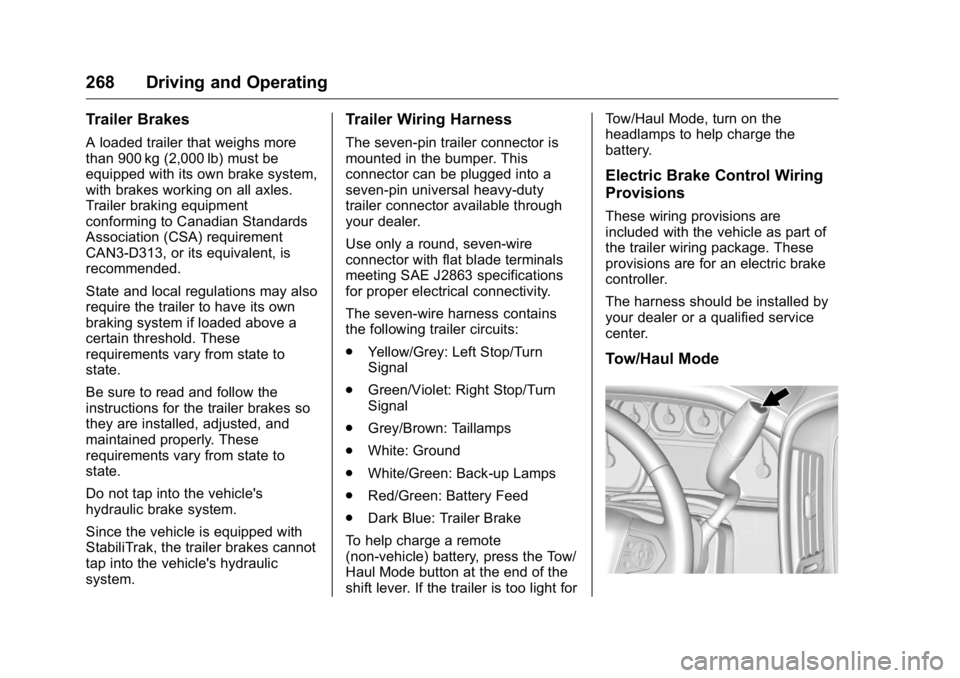
(non-vehicle) battery, press the Tow/
Haul Mode button at the end of the
shift lever. If the trailer is too light for Tow/Haul Mode, turn on the
headlamps to help charge the
battery.
Electric Brake Control Wiring
Provisions These wiring provisions are
included with the vehicle as part of
the trailer wiring package. These
provisions are for an electric brake
controller.
The harness should be installed by
your dealer or a qualified service
center.
Tow/Haul Mode
Page 270 of 425

GMC Yukon/Yukon XL/Denali Owner Manual (GMNA-Localizing-U.S./
Canada/Mexico-11349262) - 2018 - crc - 6/21/17
Driving and Operating 269Pressing this button at the end of
the shift lever turns on and off the
Tow/Haul Mode.
This indicator light on the instrument
cluster comes on when the Tow/
Haul Mode is on.
Tow/Haul is a feature that assists
when pulling a heavy trailer or a
large or heavy load. See Tow/Haul
Mode 0 222 .
Tow/Haul is designed to be most
effective when the vehicle and
trailer combined weight is at least
75 % of the vehicle's Gross
Combined Weight Rating (GCWR).
See “ Weight of the Trailer ” under
Trailer Towing 0 262 . Tow/Haul is
most useful under the following
driving conditions:
.
When pulling a heavy trailer or a
large or heavy load through
rolling terrain. .
When pulling a heavy trailer or a
large or heavy load in
stop-and-go traffic.
.
When pulling a heavy trailer or a
large or heavy load in busy
parking lots where improved low
speed control of the vehicle is
desired.
Operating the vehicle in Tow/Haul
when lightly loaded or with no trailer
at all will not cause damage.
However, there is no benefit to the
selection of Tow/Haul when the
vehicle is unloaded. Such a
selection when unloaded may result
in unpleasant engine and
transmission driving characteristics
and reduced fuel economy. Tow/
Haul is recommended only when
pulling a heavy trailer or a large or
heavy load. Integrated Trailer Brake
Control System
The vehicle may have an Integrated
Trailer Brake Control (ITBC) system
for use with electric trailer brakes or
most electric-over-hydraulic trailer
brakes.
This symbol is on the Trailer Brake
Control Panel on vehicles with an
ITBC system. The power output to
the trailer brakes is based on the
amount of brake pressure being
applied by the vehicle ’ s brake
system, and on the type of trailer
brakes detected. This available
power output to the trailer brakes
can be adjusted to a wide range of
trailering situations.
The ITBC system is integrated with
the vehicle ’ s brake, antilock brake,
and StabiliTrak systems. In trailering
conditions that cause the vehicle ’ s
Page 274 of 425

GMC Yukon/Yukon XL/Denali Owner Manual (GMNA-Localizing-U.S./
Canada/Mexico-11349262) - 2018 - crc - 6/21/17
Driving and Operating 2733. Wait 10 seconds, then turn the
ignition back to RUN.
4. If the CHECK TRAILER
WIRING message reappears,
the electrical fault is on the
vehicle side.
If the CHECK TRAILER
WIRING message only
reappears when connecting the
trailer wiring harness to the
vehicle, the electrical fault is on
the trailer side.
SERVICE TRAILER BRAKE
SYSTEM: This message will display
when there is a problem with the
ITBC system. If this message
continues over multiple ignition
cycles, there is a problem with the
ITBC system. Have the vehicle
serviced.
If either the CHECK TRAILER
WIRING or SERVICE TRAILER
BRAKE SYSTEM message displays
while driving, the ITBC system may
not be fully functional or may not
function at all. When traffic
conditions allow, carefully pull the
vehicle over to the side of the road
and turn the ignition off. Check the wiring connection to the trailer and
turn the ignition back on. If either of
these messages continues, either
the vehicle or trailer needs service.
A GM dealer may be able to
diagnose and repair problems with
the trailer. However, any diagnosis
and repair of the trailer is not
covered under the vehicle warranty.
Contact your trailer dealer for
assistance with trailer repairs and
trailer warranty information.
Trailer Sway
Control (TSC) The vehicle has a Trailer Sway
Control (TSC) feature as part of the
StabiliTrak system. If TSC detects
that the trailer is swaying, the
vehicle's brakes are automatically
applied. When TSC is applying the brakes,
the TCS/StabiliTrak indicator light
flashes to notify the driver to reduce
speed. If the trailer continues to
sway, StabiliTrak will reduce engine
torque to help slow the vehicle.
TSC will not function if StabiliTrak is
turned off. See Traction Control/
Electronic Stability Control 0 229 .
Electronic Trailer Sway Control
Devices Some trailers may come equipped
with an electronic device designed
to reduce or control trailer sway.
Aftermarket equipment
manufacturers also offer similar
devices that connect to the wiring
between the trailer and the vehicle.
These devices may interfere with
the vehicle ’ s trailer brake or other
systems, including integrated
anti-sway systems, if equipped.
Messages related to trailer
connections or trailer brakes could
appear on the Driver Information
Center (DIC). The effect that these
devices may have on vehicle
handling or trailer brake
performance is unknown.
Page 275 of 425

GMC Yukon/Yukon XL/Denali Owner Manual (GMNA-Localizing-U.S./
Canada/Mexico-11349262) - 2018 - crc - 6/21/17
274 Driving and Operating
{ WarningUse of electronic trailer sway
control devices could result in
reduced trailer brake
performance, loss of trailer
brakes, or other malfunctions, and
could cause a crash. You or
others could be injured or killed.
Before using one of these
devices:
.
Ask the device or trailer
manufacturer if the device
has been thoroughly tested
for compatibility with the
make, model, and year of
the vehicle as well as
optional equipment installed
on the vehicle.
.
Before driving on the open
roads, check that the trailer
brakes are working properly.
Drive the vehicle with the
trailer attached on a level
road surface that is free of
traffic at about 32-40 km/h
(20-25 mph) and fully apply
(Continued) Warning (Continued) the manual trailer brake
apply lever. Also check that
the trailer brake lamps and
other lamps are functioning
correctly.
.
If the trailer brakes are not
operating properly at any
time, or if a DIC message
indicates problems with the
trailer connections or trailer
brakes, carefully pull the
vehicle over to the side of
the road when traffic
conditions allow. Conversions and
Add-Ons Add-On Electrical
Equipment
{ WarningThe Data Link Connector (DLC) is
used for vehicle service and
Emission Inspection/
Maintenance testing. See
Malfunction Indicator Lamp
(Check Engine Light) 0 143 .
A device connected to the DLC —
such as an aftermarket fleet or
driver-behavior tracking device —
may interfere with vehicle
systems. This could affect vehicle
operation and cause a crash.
Such devices may also access
information stored in the vehicle ’ s
systems.
Page 277 of 425

GMC Yukon/Yukon XL/Denali Owner Manual (GMNA-Localizing-U.S./
Canada/Mexico-11349262) - 2018 - crc - 6/20/17
276 Vehicle Care
Vehicle Care General Information General Information . . . . . . . . . . 277
California Proposition
65 Warning . . . . . . . . . . . . . . . . . 277
California Perchlorate
Materials Requirements . . . . . 278
Accessories and
Modifications . . . . . . . . . . . . . . . . 278
Vehicle Checks Doing Your Own
Service Work . . . . . . . . . . . . . . . 278
Hood . . . . . . . . . . . . . . . . . . . . . . . . . 279
Engine Compartment
Overview . . . . . . . . . . . . . . . . . . . . 280
Engine Oil . . . . . . . . . . . . . . . . . . . . 283
Engine Oil Life System . . . . . . . 285
Automatic Transmission Fluid
(6 Speed Transmission) . . . . . 286
Automatic Transmission Fluid
(8 and 10 Speed
Transmission) . . . . . . . . . . . . . . . 289
Engine Air Cleaner/Filter . . . . . . 290
Cooling System . . . . . . . . . . . . . . 291
Engine Overheating . . . . . . . . . . 294
Engine Fan . . . . . . . . . . . . . . . . . . . 296
Washer Fluid . . . . . . . . . . . . . . . . . 296
Brakes . . . . . . . . . . . . . . . . . . . . . . . 297 Brake Fluid . . . . . . . . . . . . . . . . . . . 297
Battery - North America . . . . . . 298
Four-Wheel Drive . . . . . . . . . . . . . 299
Front Axle . . . . . . . . . . . . . . . . . . . . 300
Rear Axle . . . . . . . . . . . . . . . . . . . . 300
Noise Control System . . . . . . . . 301
Starter Switch Check . . . . . . . . . 302
Automatic Transmission Shift
Lock Control Function
Check . . . . . . . . . . . . . . . . . . . . . . . 302
Ignition Transmission Lock
Check . . . . . . . . . . . . . . . . . . . . . . . 303
Park Brake and P (Park)
Mechanism Check . . . . . . . . . . 303
Wiper Blade Replacement . . . . 303
Glass Replacement . . . . . . . . . . 304
Windshield Replacement . . . . . 304
Gas Strut(s) . . . . . . . . . . . . . . . . . . 305
Headlamp Aiming Headlamp Aiming . . . . . . . . . . . . 306
Bulb Replacement Bulb Replacement . . . . . . . . . . . . 306
High Intensity Discharge (HID)
Lighting . . . . . . . . . . . . . . . . . . . . . 306
LED Lighting . . . . . . . . . . . . . . . . . 307
Fog Lamps . . . . . . . . . . . . . . . . . . . 307
Back-Up Lamps . . . . . . . . . . . . . . 307
License Plate Lamp . . . . . . . . . . 308 Electrical System Electrical System Overload . . . 309
Fuses and Circuit Breakers . . . 309
Engine Compartment Fuse
Block . . . . . . . . . . . . . . . . . . . . . . . . 310
Instrument Panel Fuse
Block (Left) . . . . . . . . . . . . . . . . . 314
Instrument Panel Fuse Block
(Right) . . . . . . . . . . . . . . . . . . . . . . 317
Rear Compartment Fuse
Block . . . . . . . . . . . . . . . . . . . . . . . . 319
Wheels and Tires Tires . . . . . . . . . . . . . . . . . . . . . . . . . . 320
All-Season Tires . . . . . . . . . . . . . . 321
Winter Tires . . . . . . . . . . . . . . . . . . 321
Low-Profile Tires . . . . . . . . . . . . . 322
All-Terrain Tires . . . . . . . . . . . . . . . 322
Tire Sidewall Labeling . . . . . . . . 322
Tire Designations . . . . . . . . . . . . . 324
Tire Terminology and
Definitions . . . . . . . . . . . . . . . . . . 324
Tire Pressure . . . . . . . . . . . . . . . . . 327
Tire Pressure for High-Speed
Operation . . . . . . . . . . . . . . . . . . . 328
Tire Pressure Monitor
System . . . . . . . . . . . . . . . . . . . . . . 329
Tire Pressure Monitor
Operation . . . . . . . . . . . . . . . . . . . 330
Tire Inspection . . . . . . . . . . . . . . . . 333
Tire Rotation . . . . . . . . . . . . . . . . . 334