2018 GMC SIERRA DENALI engine coolant
[x] Cancel search: engine coolantPage 262 of 505
GMC Sierra/Sierra Denali Owner Manual (GMNA-Localizing-U.S./Canada/
Mexico-11349177) - 2018 - CRC - 10/17/17
Driving and Operating 261To Use the Engine Coolant
Heater 1. Turn off the engine.
2. Open the hood and unwrap the
electrical cord. The cord is
secured to the driver side
fender with a clip, next to the
engine compartment fuse
block. Carefully remove the
wire tie that bundles the
electrical plug. Do not cut the
electrical cord.
Check the heater cord for
damage. If it is damaged, do
not use it. See your dealer for
a replacement. Inspect the
cord for damage yearly.
3. Plug the cord into a normal,
grounded 110-volt AC outlet. { WarningImproper use of the heater cord
or an extension cord can damage
the cord and may result in
overheating and fire.
.
Plug the cord into a
three-prong electrical utility
receptacle that is protected
by a ground fault detection
function. An ungrounded
outlet could cause an
electric shock.
.
Use a weatherproof,
heavy-duty, 15 amp-rated
extension cord if needed.
Failure to use the
recommended extension
cord in good operating
condition, or using a
damaged heater or
extension cord, could make
(Continued) Warning (Continued) it overheat and cause a fire,
property damage, electric
shock, and injury.
.
Do not operate the vehicle
with the heater cord
permanently attached to the
vehicle. Possible heater
cord and thermostat
damage could occur.
.
While in use, do not let the
heater cord touch vehicle
parts or sharp edges. Never
close the hood on the
heater cord.
.
Before starting the vehicle,
unplug the cord, reattach
the cover to the plug, and
securely fasten the cord.
Keep the cord away from
any moving parts.
4. Before starting the engine, be
sure to unplug and store the
cord as it was before to keep it
Page 307 of 505
GMC Sierra/Sierra Denali Owner Manual (GMNA-Localizing-U.S./Canada/
Mexico-11349177) - 2018 - CRC - 10/17/17
306 Driving and Operating Driving on Grades Reduce speed and shift to a lower
gear before starting down a long or
steep downgrade. If the
transmission is not shifted down, the
brakes might get hot and no longer
work well.
Vehicles can tow in D (Drive). Shift
the transmission to a lower gear if
the transmission shifts too often
under heavy loads and/or hilly
conditions.
The Tow/Haul Mode may be used if
the transmission shifts too often.
See Tow/Haul Mode 0 271 .
When towing at high altitude on
steep uphill grades, consider the
following: Engine coolant will boil at
a lower temperature than at normal
altitudes. If the engine is turned off
immediately after towing at high
altitude on steep uphill grades, the
vehicle may show signs similar to
engine overheating. To avoid this,
let the engine run while parked,
preferably on level ground, with the
transmission in P (Park) for a few minutes before turning the engine
off. If the overheat warning comes
on, see Engine Overheating 0 363 .
Parking on Hills
{ WarningParking the vehicle on a hill with
the trailer attached can be
dangerous. If something goes
wrong, the rig could start to move.
People can be injured, and both
the vehicle and the trailer can be
damaged. When possible, always
park the rig on a flat surface.
If parking the rig on a hill:
1. Press the brake pedal, but do
not shift into P (Park) yet. Turn
the wheels into the curb if
facing downhill or into traffic if
facing uphill.
2. Have someone place chocks
under the trailer wheels. 3. When the wheel chocks are in
place, release the regular
brakes until the chocks absorb
the load.
4. Reapply the brake pedal. Then
apply the parking brake and
shift into P (Park).
5. Release the brake pedal.
Leaving After Parking on a Hill 1. Apply and hold the brake
pedal.
.
Start the engine.
.
Shift into a gear.
.
Release the parking brake.
2. Let up on the brake pedal.
3. Drive slowly until the trailer is
clear of the chocks.
4. Stop and have someone pick
up and store the chocks.
Page 338 of 505
GMC Sierra/Sierra Denali Owner Manual (GMNA-Localizing-U.S./Canada/
Mexico-11349177) - 2018 - CRC - 10/17/17
Driving and Operating 337
Adding a Snow Plow or
Similar Equipment CautionDo not exceed 72 km/h (45 mph)
with a snow plow mounted to the
vehicle. The vehicle could
overheat and be damaged.
Before installing a snow plow on the
vehicle, follow these guidelines:
CautionIf the vehicle does not have the
snow plow prep package, RPO
VYU, adding a plow can damage
the vehicle, and the repairs would
not be covered by the vehicle
warranty. Unless the vehicle was
built to carry a snow plow, do not
add one to the vehicle. If the
vehicle has RPO VYU, then the
payload the vehicle can carry will
be reduced when a snow plow is
(Continued) Caution (Continued) installed. The vehicle can be
damaged if either the front or rear
axle ratings or the Gross Vehicle
Weight Rating (GVWR) are
exceeded.
The plow the vehicle can carry
depends on many things, such as:
.
The options the vehicle came
with, and the weight of those
options.
.
The weight and number of
passengers to be carried.
.
The weight of items added to the
vehicle, like a tool box or
truck cap.
.
The total weight of any
additional cargo to be carried.
For example, if the snow plow
weighs 318 kg (700 lb), the total
weight of all occupants and cargo
inside the cab should not exceed
135 kg (300 lb). This means that you
may only be able to carry one
passenger. Even this may be too much if there is other equipment
already adding to the weight of the
vehicle.
To safely carry a snow plow on the
vehicle:
.
Follow all aftermarket snow plow
manufacturer ’ s instructions for
the operation and transportation
of the snow plow.
.
With a snow plow attached, the
engine coolant temperature
gauge may show a higher
temperature than while driving
without one. The snow plow
could block the airflow to the
radiator. This could be more
noticeable as vehicle speed
increases. At speeds above
72 km (45 mph), this may cause
the engine coolant to overheat.
.
To increase the airflow, move the
snow plow blade postion.
.
If driving more than 24 km
(15 mi), angle the plow blade
position.
Page 347 of 505

GMC Sierra/Sierra Denali Owner Manual (GMNA-Localizing-U.S./Canada/
Mexico-11349177) - 2018 - CRC - 10/17/17
346 Vehicle Care 1. Positive (+) Terminal. See
Jump Starting - North America
0 426 .
2. Battery - North America 0 369 .
3. Coolant Surge Tank and
Pressure Cap. See Cooling
System 0 359 .
4. Engine Air Cleaner/Filter 0 358 .
5. Automatic Transmission
Dipstick (If Equipped). See
“ How to Check Automatic
Transmission Fluid ” under
Automatic Transmission Fluid
(6-Speed Transmission) 0 354
or Automatic Transmission
Fluid (8-Speed Transmission)
0 357 . 6. Remote Negative ( – ) Location.
See Jump Starting - North
America 0 426 .
7. Engine Cooling Fans (Out of
View). See Cooling System
0 359 .
8. Engine Oil Fill Cap. See “ When
to Add Engine Oil ” under
Engine Oil 0 350 .
9. Engine Oil Dipstick. See
“ Checking Engine Oil ” under
Engine Oil 0 350 . 10. Brake Fluid Reservoir. See
Brake Fluid 0 368 .
11. Windshield Washer Fluid
Reservoir. See “ Adding Washer
Fluid ” under Washer Fluid
0 366 .
12. Engine Compartment Fuse
Block 0 381 .
Page 349 of 505

GMC Sierra/Sierra Denali Owner Manual (GMNA-Localizing-U.S./Canada/
Mexico-11349177) - 2018 - CRC - 10/17/17
348 Vehicle Care 1. Positive (+) Terminal. See
Jump Starting - North America
0 426 .
2. Battery - North America 0 369 .
3. Coolant Surge Tank and
Pressure Cap. See Cooling
System 0 359 .
4. Engine Air Cleaner/Filter 0 358 .
5. Automatic Transmission
Dipstick (If Equipped). See
“ How to Check Automatic
Transmission Fluid ” under
Automatic Transmission Fluid
(6-Speed Transmission) 0 354
or Automatic Transmission
Fluid (8-Speed Transmission)
0 357 . 6. Remote Negative ( – ) Location
(Out of View). See Jump
Starting - North America 0 426 .
7. Engine Cooling Fans (Out of
View). See Cooling System
0 359 .
8. Engine Oil Fill Cap. See “ When
to Add Engine Oil ” under
Engine Oil 0 350 .
9. Engine Oil Dipstick. See
“ Checking Engine Oil ” under
Engine Oil 0 350 . 10. Windshield Washer Fluid
Reservoir. See “ Adding Washer
Fluid ” under Washer Fluid
0 366 .
11. Brake Fluid Reservoir. See
Brake Fluid 0 368 .
12. Engine Compartment Fuse
Block 0 381 .
Page 351 of 505

GMC Sierra/Sierra Denali Owner Manual (GMNA-Localizing-U.S./Canada/
Mexico-11349177) - 2018 - CRC - 10/17/17
350 Vehicle Care 1. Positive (+) Terminal. See
Jump Starting - North America
0 426 .
2. Battery - North America 0 369 .
3. Coolant Surge Tank and
Pressure Cap. See Cooling
System 0 359 .
4. Engine Air Cleaner/Filter 0 358 .
5. Automatic Transmission
Dipstick (If Equipped). See
“ How to Check Automatic
Transmission Fluid ” under
Automatic Transmission Fluid
(6-Speed Transmission) 0 354
or Automatic Transmission
Fluid (8-Speed Transmission)
0 357 .
6. Engine Oil Dipstick. See
“ Checking Engine Oil ” under
Engine Oil 0 350 .
7. Engine Oil Fill Cap. See “ When
to Add Engine Oil ” under
Engine Oil 0 350 .
8. Engine Cooling Fan (Out of
View). See Cooling System
0 359 . 9. Remote Negative ( – ) Location.
See Jump Starting - North
America 0 426 .
10. Power Steering Fluid
Reservoir. See Power Steering
Fluid (1500 Series) 0 365 or
Power Steering Fluid (2500/
3500 Series) 0 365 .
11. Windshield Washer Fluid
Reservoir. See “ Adding Washer
Fluid ” under Washer Fluid
0 366 .
12. Brake Fluid Reservoir. See
Brake Fluid 0 368 .
13. Auxiliary Battery (If Equipped).
See Battery - North America
0 369 .
14. Engine Compartment Fuse
Block 0 381 .
If the vehicle has a diesel engine
and/or an Allison Transmission, see
the Duramax diesel supplement.
For an eAssist vehicle, see the
Silverado/Sierra supplement. Engine Oil For diesel engine vehicles, see
“ Engine Oil ” in the Duramax diesel
supplement.
To ensure proper engine
performance and long life, careful
attention must be paid to engine oil.
Following these simple, but
important steps will help protect
your investment:
.
Use engine oil approved to the
proper specification and of the
proper viscosity grade. See
“ Selecting the Right Engine Oil ”
in this section.
.
Check the engine oil level
regularly and maintain the
proper oil level. See “ Checking
Engine Oil ” and “ When to Add
Engine Oil ” in this section.
.
Change the engine oil at the
appropriate time. See Engine Oil
Life System 0 353 .
.
Always dispose of engine oil
properly. See “ What to Do with
Used Oil ” in this section.
Page 360 of 505

GMC Sierra/Sierra Denali Owner Manual (GMNA-Localizing-U.S./Canada/
Mexico-11349177) - 2018 - CRC - 10/17/17
Vehicle Care 3594. Remove the four screws (1) on
top of the cover of the housing
and lift up the cover.
5. Remove the engine air cleaner/
filter from the housing. Take
care to dislodge as little dirt as
possible.
6. Clean the engine air cleaner/
filter sealing surfaces and the
housing.
7. Inspect or replace the engine
air cleaner/filter.
8. Reverse Steps 2 – 4 to reinstall
the filter cover housing.
{ WarningOperating the engine with the air
cleaner/filter off can cause you or
others to be burned. The air
cleaner not only cleans the air; it
helps to stop flames if the engine
backfires. Use caution when
working on the engine and do not
drive with the air cleaner/filter off. CautionIf the air cleaner/filter is off, dirt
can easily get into the engine,
which could damage it. Always
have the air cleaner/filter in place
when driving.
Cooling System If the vehicle has the Duramax
diesel engine, see the Duramax
diesel supplement.
The cooling system allows the
engine to maintain the correct
working temperature. 5.3L V8 Engine Shown, 4.3L
V6 Engine and 6.2L V8 Engine
Similar
1. Coolant Surge Tank
2. Coolant Surge Tank
Pressure Cap
3. Engine Electric Cooling
Fans (Out of View)
Page 361 of 505
GMC Sierra/Sierra Denali Owner Manual (GMNA-Localizing-U.S./Canada/
Mexico-11349177) - 2018 - CRC - 10/17/17
360 Vehicle Care
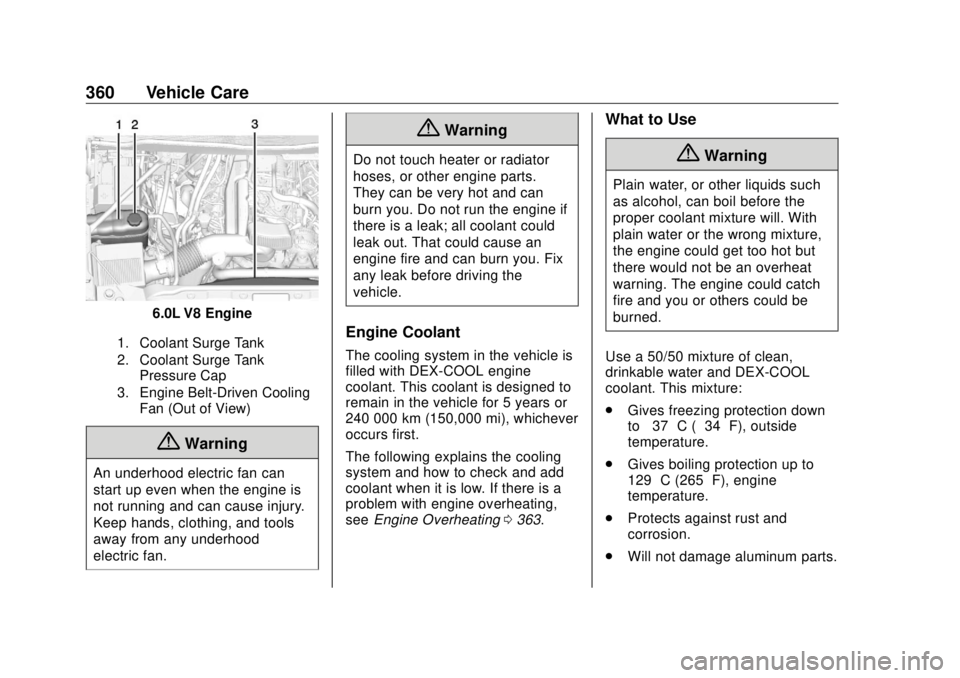
6.0L V8 Engine
1. Coolant Surge Tank
2. Coolant Surge Tank
Pressure Cap
3. Engine Belt-Driven Cooling
Fan (Out of View)
{ Warning
An underhood electric fan can
start up even when the engine is
not running and can cause injury.
Keep hands, clothing, and tools
away from any underhood
electric fan. { WarningDo not touch heater or radiator
hoses, or other engine parts.
They can be very hot and can
burn you. Do not run the engine if
there is a leak; all coolant could
leak out. That could cause an
engine fire and can burn you. Fix
any leak before driving the
vehicle.
Engine Coolant The cooling system in the vehicle is
filled with DEX-COOL engine
coolant. This coolant is designed to
remain in the vehicle for 5 years or
240 000 km (150,000 mi), whichever
occurs first.
The following explains the cooling
system and how to check and add
coolant when it is low. If there is a
problem with engine overheating,
see Engine Overheating 0 363 . What to Use
{ WarningPlain water, or other liquids such
as alcohol, can boil before the
proper coolant mixture will. With
plain water or the wrong mixture,
the engine could get too hot but
there would not be an overheat
warning. The engine could catch
fire and you or others could be
burned.
Use a 50/50 mixture of clean,
drinkable water and DEX-COOL
coolant. This mixture:
.
Gives freezing protection down
to − 37 °C ( − 34 °F), outside
temperature.
.
Gives boiling protection up to
129 °C (265 °F), engine
temperature.
.
Protects against rust and
corrosion.
.
Will not damage aluminum parts.