Page 410 of 516
7-9
7
Maintenance
At least twice a year:
(i.e., every Spring and Fall):
Check radiator, heater and air con-
ditioning hoses for leaks or dam-
age.
Check windshield washer spray
and wiper operation. Clean wiper
blades with clean cloth dampened
with washer fluid.
Check headlight alignment.
Check muffler, exhaust pipes,
shields and clamps.
Check the seat belts for wear and
function.
At least once a year:
Clean body and door drain holes.
Lubricate door hinges and hood
hinges.
Lubricate door and hood locks and
latches.
Lubricate door rubber weather
strips.
Check the air conditioning system.
Inspect and lubricate automatic
transmission linkage and controls.
Clean the battery and terminals.
Check the brake fluid level.
Page 430 of 516
7-29
7
Maintenance
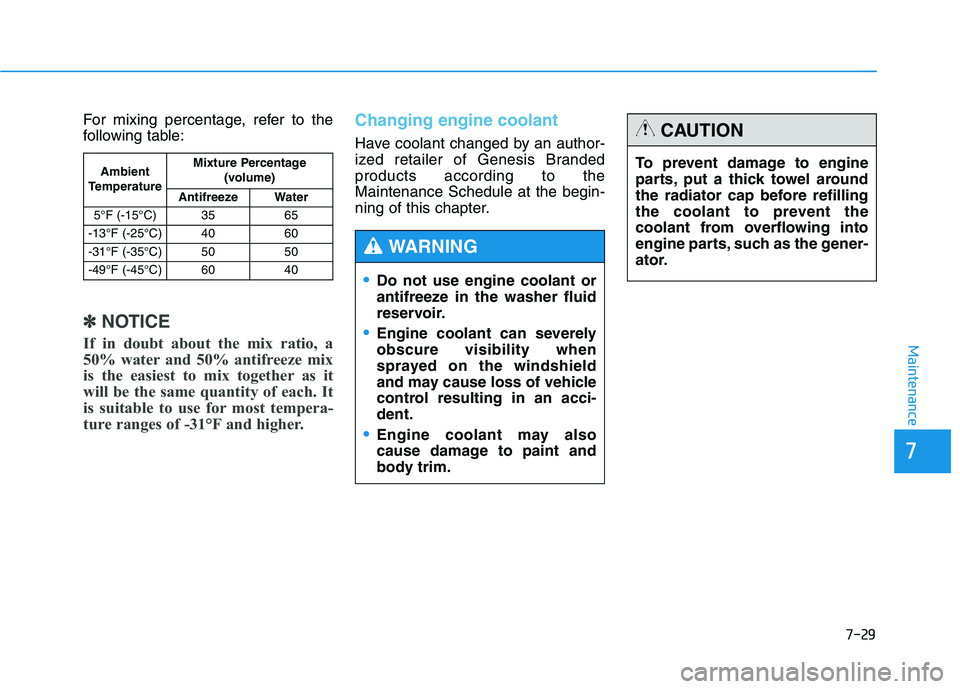
For mixing percentage, refer to the
following table:
✽ ✽
NOTICE
If in doubt about the mix ratio, a
50% water and 50% antifreeze mix
is the easiest to mix together as it
will be the same quantity of each. It
is suitable to use for most tempera-
ture ranges of -31°F and higher.
Changing engine coolant
Have coolant changed by an author-
ized retailer of Genesis Branded
products according to the
Maintenance Schedule at the begin-
ning of this chapter.
Ambient
TemperatureMixture Percentage
(volume)
Antifreeze Water
5°F (-15°C) 35 65
-13°F (-25°C) 40 60
-31°F (-35°C) 50 50
-49°F (-45°C) 60 40
Do not use engine coolant or
antifreeze in the washer fluid
reservoir.
Engine coolant can severely
obscure visibility when
sprayed on the windshield
and may cause loss of vehicle
control resulting in an acci-
dent.
Engine coolant may also
cause damage to paint and
body trim.
WARNING
To prevent damage to engine
parts, put a thick towel around
the radiator cap before refilling
the coolant to prevent the
coolant from overflowing into
engine parts, such as the gener-
ator.
CAUTION
Page 433 of 516

7-32
Maintenance
W WA
AS
SH
HE
ER
R
F
FL
LU
UI
ID
D
Checking the washer fluid
level
Check the fluid level in the washer
fluid reservoir and add fluid if neces-
sary. Plain water may be used if
washer fluid is not available.
However, use washer solvent with
antifreeze characteristics in cold cli-
mates to prevent freezing.
Checking the parking brake
Foot type
Check whether the stroke is within
specification when the parking brake
pedal is depressed with 44 lb (20 kg,
196 N) of force. Also, the parking
brake alone should securely hold the
vehicle on a fairly steep grade. If the
stroke is more or less than specified,
have the parking brake adjusted by
an authorized retailer of Genesis
Branded products.
Stroke : 3 notch To prevent serious injury or
death, take the following safety
precautions when using washer
fluid:
Do not use engine coolant or
antifreeze in the washer fluid
reservoir.
Engine coolant can severely
obscure visibility when
sprayed on the windshield
and may cause loss of vehicle
control resulting in an acci-
dent or damage to paint and
body trim.
Do not allow sparks or flame
to contact the washer fluid or
the washer fluid reservoir.
Washer fluid may contain
alcohol and can be flamma-
ble.
Do not drink washer fluid and
avoid contact with skin.
Washer fluid is poisonous to
humans and animals.
Keep washer fluid away from
children and animals.
CAUTION
ODH073007ODH053142
P PA
AR
RK
KI
IN
NG
G
B
BR
RA
AK
KE
E
Page 437 of 516

7-36
Maintenance
W WI
IP
PE
ER
R
B
BL
LA
AD
DE
ES
S
Blade inspection
Contamination of either the wind-
shield or the wiper blades with for-
eign matter can reduce the effective-
ness of the windshield wipers.
Common sources of contamination
are insects, tree sap, and hot wax
treatments used by some commer-
cial car washes. If the blades are not
wiping properly, clean both the win-
dow and the blades with a clean
cloth dampened with washer fluid.
✽ ✽
NOTICE
Commercial hot waxes applied by
automatic car washes have been
known to make the windshield diffi-
cult to clean.
Blade replacement
When the wipers no longer clean
adequately, the blades may be worn
or cracked, and require replacement.
OLMB073019
To prevent damage to the wiper
blades, arms or other compo-
nents, do not:
Use gasoline, kerosene, paint
thinner, or other solvents on
or near them.
Attempt to move the wipers
manually.
Use non-specified wiper
blades.
CAUTION
To prevent damage to the wiper
arms or other components, do
not attempt to move the wipers
manually.
CAUTION
The use of a non-specified
wiper blade could result in
wiper malfunction and failure.
CAUTION
Page 470 of 516

7-69
7
Maintenance
Engine compartment fuse panel
Fuse NameFuse ratingCircuit Protected
ALT200AAlternator, Multifuse (BATT) - B+2/ B+5/ MDPS 1,
Fuse - P/SEAT DRV 2/ P/SEAT RR/ SEAT LUMBAR/ ESC 1/ ESC 2
B+160A IGPM (Fuse - BRAKE SWITCH, E-SHIFTER 1 Leak Current Autocut Device (Fuse - INTERIOR LAMP/
MULTI MEDIA 1/ MEMORY 3), IPS 1)
B+360A IGPM (Fuse - SMART KEY 1/ SMART KEY 2/ MODULE 1/ B/A HORN, IPS 2/IPS 3/IPS 5/IPS 7)
B+460A IGPM (Fuse - DOOR LAMP/ MODULE 9/ MODULE 10, IPS 4/ IPS6/ IPS)
B+660A Metal Core Block (PCB #1 Fuse - ECU 3/ IG2/ MODULE 1)
B+780A Metal Core Block (PCB #2 Fuse - HORN/ ACC/ EPB 1/ EPB 2/ B/UP LAMP)
B+260A IGPM (Fuse - P/HANDLE/ P/WDW LH/ P/SEAT DRV 1/ P/SEAT PASS 1/ S/HEATER PASS/ POWER
OUTLET 3/ SUNROOF/ P/DOOR DRV/ P/DOOR PASS)
B+580A Metal Core Block (PCB #1 Fuse - BLOWER/ DEICER/ H/LAMP WASHER/ H/LAMP HI SOL)
MDPS 1125A MDPS Unit
C/FAN80A Cooling Fan Controller
P/SEAT
RR30A Not Used
ESC 240A ESC Module, Multipurpose Check Connector
ESC 140A ESC Module, Multipurpose Check Connector
P/SEAT DRV 225A Driver IMS Control Module, Driver Power Seat Switch, Driver Power Seat Relay Box
VACUUM
PUMP40A Vacuum Pump Relay
WIPER 130A Wiper Motor
Page 471 of 516

7-70
Maintenance
Fuse NameFuse ratingCircuit Protected
S/HEATER
DRV25A Driver CCS Module, Driver Seat Warmer Control Module
4WD30A 4WD ECM
PRESAFETY
SEAT BELT 130A Pre-Active Seat Belt Module
PRESAFETY
SEAT BELT 230A Pre-Active Seat Belt Module
IG230A IG2 Relay
ECU 330A Engine Control Relay
MODULE 110A 4WD ECM, Smart Cruise Control Radar, Active Air Flap
WIPER 210A Metal Core Block (PCB #2 - Wiper Relay)
WASHER20A Washer Relay
SENSOR 210A G6DN : Oxygen Sensor #1/#2/#3/#4, Variable Intake Solenoid Valve #1/#2
G8BE : Oxygen Sensor #1/#2/#3/#4, Electronic Thermostat
G6DP : Oxygen Sensor #1/#2/#3/#4, RCV Control Solenoid Valve
SENSOR 110A Oil Control Valve #1/#2/#3/#4, Canister Close Valve, Purge Control Solenoid Valve
SENSOR 310A Electronic Thermostat, Rear Junction Block (Fuel Pump Relay)
SENSOR 410A G8BE : Camshaft Position Sensor #1/#2/#3/#4
IGN COIL15A G6DN : Ignition Coil #1/#2/#3/#4/#5/#6
G8BE : Ignition Coil #1/#2/#3/#4/#5/#6/#7/#8
G6DP : Ignition Coil #1/#2/#3/#4/#5/#6
ECU 420A ECM
H/LAMP
HI SOL10A H/LAMP HI SOL Relay
Page 472 of 516
7-71
7
Maintenance
Fuse NameFuse ratingCircuit Protected
DEICER20A Metal Core Block (PCB #2 - Front Deicer Relay)
H/LAMP
WASHER25A Head Lamp Washer Relay
A/CON 210A A/C Control Module
BLOWER40A Blower Relay
IG140A IG1 Relay
START30A E/R Junction Block (RLY. 2 - Start Relay)
ECU 115A ECM
TCU 120A TCM
ESC 310A ESC Module
MODULE 310A Smart Cruise Control Radar, Active Air Flap, 4WD ECM
MDPS 210A MDPS Unit, Steering Angle Sensor
SENSOR 510A G6DP : Brake Boost Vacuum Pressure Sensor Switch
HORN20A Horn Relay
ECU 210A ECM
TCU 215A TCM, Transmission Range Switch, P/N Relay, B/UP Lamp Relay
EPB 215A Electronic Parking Brake Module
EPB 115A Electronic Parking Brake Module
B/UP LAMP10A B/UP Lamp Relay
ACC40A ACC Relay
Page 484 of 516

7-83
7
Maintenance
A AP
PP
PE
EA
AR
RA
AN
NC
CE
E
C
CA
AR
RE
E
Exterior care
Exterior general caution
It is very important to follow the label
directions when using any chemical
cleaner or polish. Read all warning
and caution statements that appear
on the label.
High-pressure washing
When using high-pressure wash-
ers, make sure to maintain suffi-
cient distance from the vehicle.
Insufficient clearance or excessive
pressure can lead to component
damage or water penetration.
Do not spray the camera, sensors
or its surrounding area directly with
a high pressure washer. Shock
applied from high pressure water
may cause the device to not oper-
ate normally.
Do not bring the nozzle tip close to
boots (rubber or plastic covers) or
connectors as they may be dam-
aged if they come into contact with
high pressure water.
Finish maintenance
Washing
To help protect your vehicle’s finish
from rust and deterioration, wash it
thoroughly and frequently at least
once a month with lukewarm or cold
water.
If you use your vehicle for off-road
driving, you should wash it after each
off-road trip. Pay special attention to
the removal of any accumulation of
salt, dirt, mud, and other foreign
materials. Make sure the drain holes
in the lower edges of the doors and
rocker panels are kept clear and
clean.
Insects, tar, tree sap, bird droppings,
industrial pollution and similar
deposits can damage your vehicle’s
finish if not removed immediately.
Even prompt washing with plain
water may not completely remove all
these deposits. A mild soap, safe for
use on painted surfaces, should be
used.After washing, rinse the vehicle thor-
oughly with lukewarm or cold water.
Do not allow soap to dry on the fin-
ish.
After washing the vehicle, test
the brakes while driving slowly
to see if they have been affected
by water before getting on the
road. If braking performance is
impaired, dry the brakes by
applying them lightly while
maintaining a slow forward
speed.
WARNING

