2018 FORD TRANSIT traction control
[x] Cancel search: traction controlPage 273 of 521
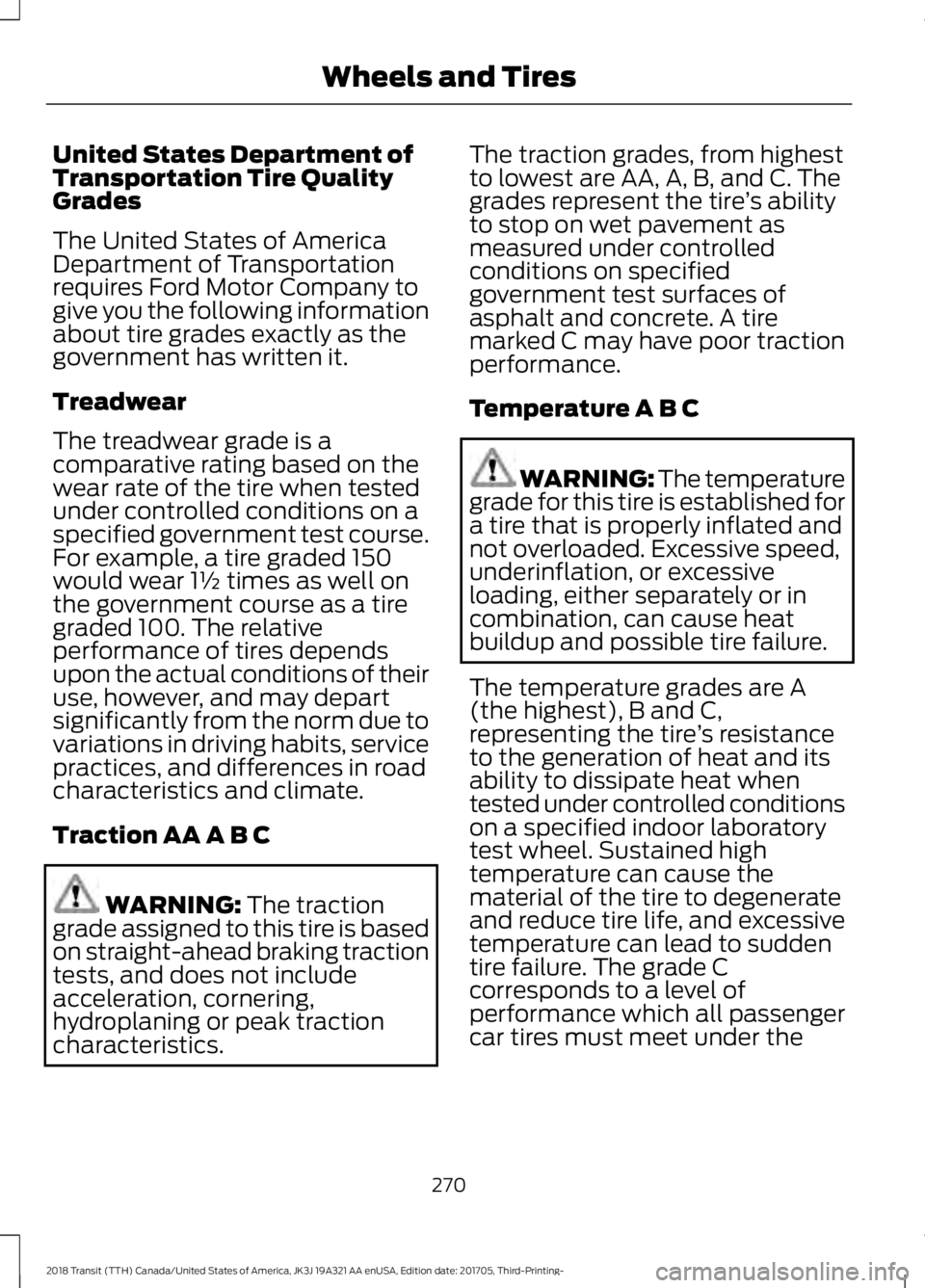
United States Department of
Transportation Tire Quality
Grades
The United States of America
Department of Transportation
requires Ford Motor Company to
give you the following information
about tire grades exactly as the
government has written it.
Treadwear
The treadwear grade is a
comparative rating based on the
wear rate of the tire when tested
under controlled conditions on a
specified government test course.
For example, a tire graded 150
would wear 1½ times as well on
the government course as a tire
graded 100. The relative
performance of tires depends
upon the actual conditions of their
use, however, and may depart
significantly from the norm due to
variations in driving habits, service
practices, and differences in road
characteristics and climate.
Traction AA A B C
WARNING: The traction
grade assigned to this tire is based
on straight-ahead braking traction
tests, and does not include
acceleration, cornering,
hydroplaning or peak traction
characteristics. The traction grades, from highest
to lowest are AA, A, B, and C. The
grades represent the tire
’s ability
to stop on wet pavement as
measured under controlled
conditions on specified
government test surfaces of
asphalt and concrete. A tire
marked C may have poor traction
performance.
Temperature A B C WARNING: The temperature
grade for this tire is established for
a tire that is properly inflated and
not overloaded. Excessive speed,
underinflation, or excessive
loading, either separately or in
combination, can cause heat
buildup and possible tire failure.
The temperature grades are A
(the highest), B and C,
representing the tire ’s resistance
to the generation of heat and its
ability to dissipate heat when
tested under controlled conditions
on a specified indoor laboratory
test wheel. Sustained high
temperature can cause the
material of the tire to degenerate
and reduce tire life, and excessive
temperature can lead to sudden
tire failure. The grade C
corresponds to a level of
performance which all passenger
car tires must meet under the
270
2018 Transit (TTH) Canada/United States of America, JK3J 19A321 AA enUSA, Edition date: 201705, Third-Printing- Wheels and Tires
Page 277 of 521
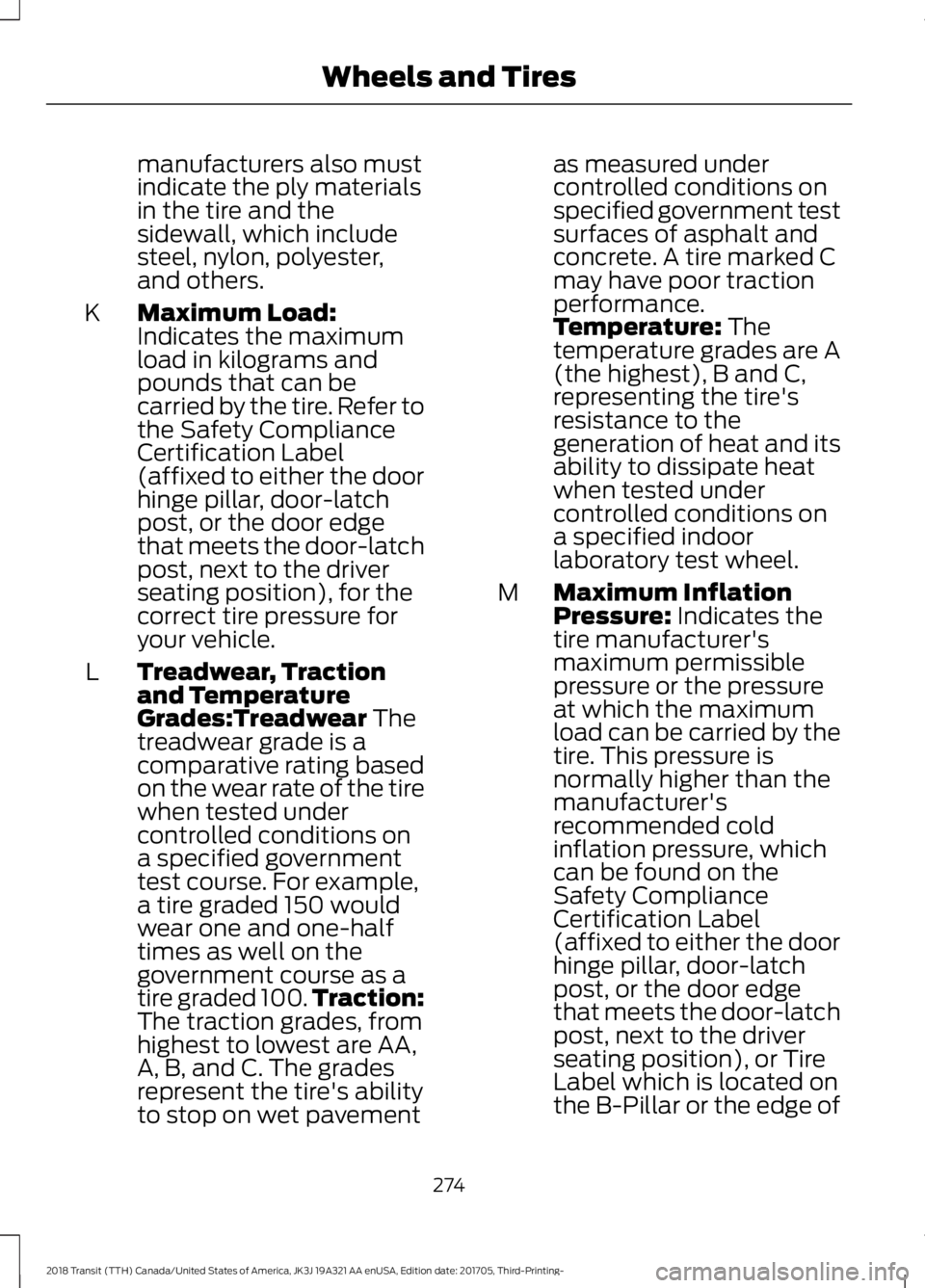
manufacturers also must
indicate the ply materials
in the tire and the
sidewall, which include
steel, nylon, polyester,
and others.
Maximum Load:
Indicates the maximum
load in kilograms and
pounds that can be
carried by the tire. Refer to
the Safety Compliance
K
Certification Label
(affixed to either the door
hinge pillar, door-latch
post, or the door edge
that meets the door-latch
post, next to the driver
seating position), for the
correct tire pressure for
your vehicle.
Treadwear, Traction
and Temperature
Grades:Treadwear The
treadwear grade is a
comparative rating based
on the wear rate of the tire
L
when tested under
controlled conditions on
a specified government
test course. For example,
a tire graded 150 would
wear one and one-half
times as well on the
government course as a
tire graded 100. Traction:
The traction grades, from
highest to lowest are AA,
A, B, and C. The grades
represent the tire's ability
to stop on wet pavement as measured under
controlled conditions on
specified government test
surfaces of asphalt and
concrete. A tire marked C
may have poor traction
performance.
Temperature:
The
temperature grades are A
(the highest), B and C,
representing the tire's
resistance to the
generation of heat and its
ability to dissipate heat
when tested under
controlled conditions on
a specified indoor
laboratory test wheel.
Maximum Inflation
Pressure:
Indicates the
tire manufacturer's
maximum permissible
pressure or the pressure
at which the maximum
M
load can be carried by the
tire. This pressure is
normally higher than the
manufacturer's
recommended cold
inflation pressure, which
can be found on the
Safety Compliance
Certification Label
(affixed to either the door
hinge pillar, door-latch
post, or the door edge
that meets the door-latch
post, next to the driver
seating position), or Tire
Label which is located on
the B-Pillar or the edge of
274
2018 Transit (TTH) Canada/United States of America, JK3J 19A321 AA enUSA, Edition date: 201705, Third-Printing- Wheels and Tires
Page 290 of 521

WARNING: If you choose to install
snow tires on your vehicle, they must be
the same size, construction, and load range
as the original tires listed on the tire
placard, and they must be installed on all
four wheels. Mixing tires of different size
or construction on your vehicle can
adversely affect your vehicle's handling
and braking, and may lead to loss of
vehicle control. WARNING:
Only fit snow chains to
specified tires.
The tires on your vehicle have all-weather
treads to provide traction in rain and snow.
However, in some climates, you may need
to use snow tires, snow chains or cables.
If you use snow chains or cables, we
recommended that steel wheels of the
same size and specifications are used,
snow chains or cables may damage alloy
wheels.
Follow these guidelines when using snow
chains or cables:
• Avoid fully loading your vehicle.
• Only certain snow chains or cables
have been approved by Ford as safe
for use on vehicles with either 235/65
R16C or 195/75 R16C tires.
• Snow chains or cables must be
mounted in pairs on the rear tires only.
• Do not use snow chains or cables on
dual rear alloy wheels.
• Install snow chains or cables securely,
make sure they do not touch any wiring,
brake lines or fuel lines.
• Use only SAE Class S snow chains,
snow cables or equivalent that
measure
0.4 in (10 mm) or less in
dimension as measured on the sidewall
of the tire. •
Do not exceed
30 mph (48 km/h) or
the maximum speed recommended by
the snow chains or cables
manufacturer, whichever is less.
• Purchase snow chains or cables from
a manufacturer that clearly labels the
body to tire dimension restrictions.
• Remove the snow chains or cables
when they are no longer needed.
• Do not use snow chains or cables on
dry roads.
• If you have any questions regarding
snow chains or cables, see an
authorized dealer.
TIRE PRESSURE MONITORING
SYSTEM
(If Equipped) WARNING:
The tire pressure
monitoring system is not a substitute for
manually checking tire pressures. You
should periodically check tire pressures
using a pressure gauge. Failure to correctly
maintain tire pressures could increase the
risk of tire failure, loss of control, vehicle
rollover and personal injury. WARNING:
Do not use tire sealants
as they may damage the tire pressure
monitoring system. WARNING:
If the tire pressure
monitor sensor becomes damaged it may
not function.
287
2018 Transit (TTH) Canada/United States of America, JK3J 19A321 AA enUSA, Edition date: 201705, Third-Printing- Wheels and Tires
Page 428 of 521
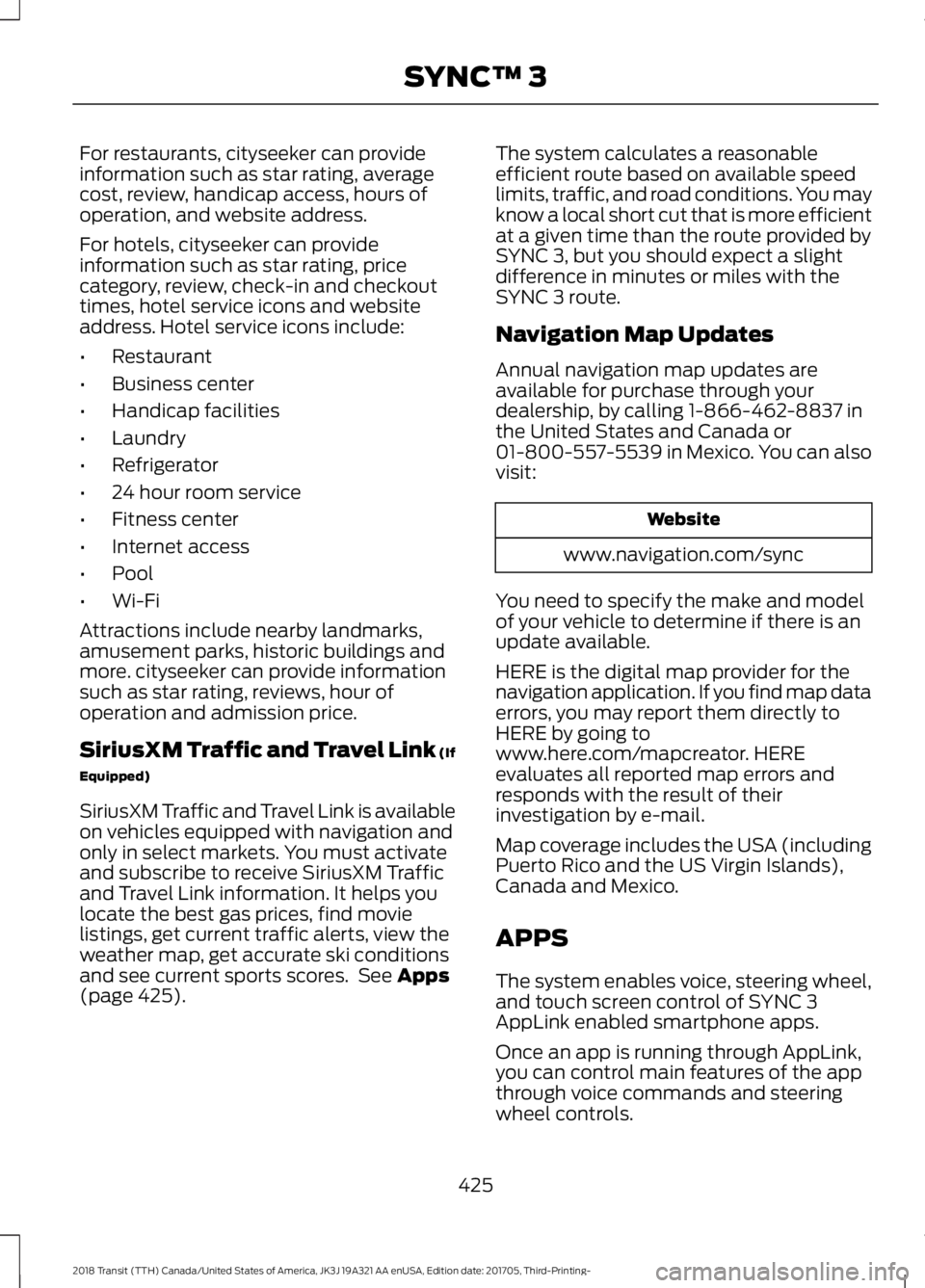
For restaurants, cityseeker can provide
information such as star rating, average
cost, review, handicap access, hours of
operation, and website address.
For hotels, cityseeker can provide
information such as star rating, price
category, review, check-in and checkout
times, hotel service icons and website
address. Hotel service icons include:
•
Restaurant
• Business center
• Handicap facilities
• Laundry
• Refrigerator
• 24 hour room service
• Fitness center
• Internet access
• Pool
• Wi-Fi
Attractions include nearby landmarks,
amusement parks, historic buildings and
more. cityseeker can provide information
such as star rating, reviews, hour of
operation and admission price.
SiriusXM Traffic and Travel Link (If
Equipped)
SiriusXM Traffic and Travel Link is available
on vehicles equipped with navigation and
only in select markets. You must activate
and subscribe to receive SiriusXM Traffic
and Travel Link information. It helps you
locate the best gas prices, find movie
listings, get current traffic alerts, view the
weather map, get accurate ski conditions
and see current sports scores. See Apps
(page 425). The system calculates a reasonable
efficient route based on available speed
limits, traffic, and road conditions. You may
know a local short cut that is more efficient
at a given time than the route provided by
SYNC 3, but you should expect a slight
difference in minutes or miles with the
SYNC 3 route.
Navigation Map Updates
Annual navigation map updates are
available for purchase through your
dealership, by calling 1-866-462-8837 in
the United States and Canada or
01-800-557-5539 in Mexico. You can also
visit:
Website
www.navigation.com/sync
You need to specify the make and model
of your vehicle to determine if there is an
update available.
HERE is the digital map provider for the
navigation application. If you find map data
errors, you may report them directly to
HERE by going to
www.here.com/mapcreator. HERE
evaluates all reported map errors and
responds with the result of their
investigation by e-mail.
Map coverage includes the USA (including
Puerto Rico and the US Virgin Islands),
Canada and Mexico.
APPS
The system enables voice, steering wheel,
and touch screen control of SYNC 3
AppLink enabled smartphone apps.
Once an app is running through AppLink,
you can control main features of the app
through voice commands and steering
wheel controls.
425
2018 Transit (TTH) Canada/United States of America, JK3J 19A321 AA enUSA, Edition date: 201705, Third-Printing- SYNC™ 3
Page 486 of 521

SYNC® Automotive Important Safety
Information Read and follow
instructions:
•
Before using your SYNC® system, read
and follow all instructions and safety
information provided in this end user
manual ("Owner Guide".) Not
following precautions found in the
Owner Guide can lead to an accident
or other serious injuries.
General Operation
• Voice Command Control: Certain
functions within the SYNC® system
may be accomplished using voice
commands. Using voice commands
while driving helps you to operate the
system without removing your hands
from the wheel or eyes from the road.
• Prolonged Views of Screen:
Do not
access any function requiring a
prolonged view of the screen while you
are driving. Pull over in a safe and legal
manner before attempting to access a
function of the system requiring
prolonged attention.
• Volume Setting:
Do not raise the
volume excessively. Keep the volume
at a level where you can still hear
outside traffic and emergency signals
while driving. Driving while unable to
hear these sounds could cause an
accident.
• Navigation Features:
Any navigation
features included in the system are
intended to provide turn by turn
instructions to get you to a desired
destination. Please make certain all
persons using this system carefully
read and follow instructions and safety
information fully. •
Distraction Hazard:
Any navigation
features may require manual
(non-verbal) setup. Attempting to
perform such set-up or insert data
while driving can distract your attention
and could cause an accident or other
serious injury. Stop the vehicle in a safe
and legal manner before attempting
these operations.
• Let Your Judgment Prevail:
Any
navigation features are provided only
as an aid. Make your driving decisions
based on your observations of local
conditions and existing traffic
regulations. Any such feature is not a
substitute for your personal judgment.
Any route suggestions made by this
system should never replace any local
traffic regulations or your personal
judgment or knowledge of safe driving
practices.
• Route Safety: Do not follow the route
suggestions if doing so would result in
an unsafe or illegal maneuver, if you
would be placed in an unsafe situation,
or if you would be directed into an area
that you consider unsafe. The driver is
ultimately responsible for the safe
operation of the vehicle and therefore,
must evaluate whether it is safe to
follow the suggested directions.
• Potential Map Inaccuracy:
Maps
used by this system may be inaccurate
because of changes in roads, traffic
controls or driving conditions. Always
use good judgment and common sense
when following the suggested routes.
• Emergency Services:
Do not rely on
any navigation features included in the
system to route you to emergency
services. Ask local authorities or an
emergency services operator for these
locations. Not all emergency services
such as police, fire stations, hospitals
and clinics are likely to be contained in
the map database for such navigation
features.
483
2018 Transit (TTH) Canada/United States of America, JK3J 19A321 AA enUSA, Edition date: 201705, Third-Printing- Appendices
Page 517 of 521

T
Technical Specifications
See: Capacities and Specifications............305
The Better Business Bureau (BBB) Auto Line Program (U.S. Only).......................203
Tire Care..........................................................269 Glossary of Tire Terminology.......................... 271
Inflating the Tires............................................... 278
Information About Uniform Tire Quality Grades.............................................................. 269
Information Contained on the Tire Sidewall............................................................ 272
Inspecting the Tires and Wheel Valve Stems................................................................. 281
Location of the Tire Label............................... 278
Tire Age.................................................................. 282
Tire and Wheel Alignment............................. 284
Tire Damage......................................................... 281
Tire Pressure Monitoring System.................283
Tire Replacement Requirements.................282
Tire Rotation........................................................ 285
Tire Safety Practices......................................... 283
Tire Wear................................................................ 281
United States Department of Transportation Tire Quality
Grades............................................................... 270
Tire Pressure Monitoring System...........287 Changing Tires With a Tire Pressure
Monitoring System....................................... 289
Tire Pressure Monitoring System Reset Procedure......................................................... 291
Understanding the Tire Pressure Monitoring System.............................................................. 289
Tires See: Wheels and Tires..................................... 268
Tow/Haul.........................................................154
Towing a Trailer.............................................180 Load Placement................................................. 180
Towing Points................................................199
Front Towing Point............................................. 199
Rear Towing Point.............................................. 199
Towing Eye Location........................................ 200
Towing the Vehicle on Four Wheels..........................................................189
Emergency Towing............................................ 189
Recreational Towing......................................... 190
Towing..............................................................180 Traction Control
............................................160
Principle of Operation...................................... 160
Trailer Sway Control.....................................181
Transmission Code Designation.............312
Transmission...................................................151
Transporting the Vehicle
...........................198
Trip Computer................................................102 All Values............................................................... 102
Average Fuel Consumption............................ 102
Digital Speedometer......................................... 102
Distance to Empty............................................. 102
Outside Air Temperature................................. 102
Resetting the Trip Computer.......................... 102
Trip Odometer..................................................... 102
Trip Timer.............................................................. 102
U
Under Hood Overview - 3.2L Power Stroke Diesel
..............................................230
Under Hood Overview - 3.5L Ecoboost™..................................................231
Under Hood Overview - 3.7L....................232
USB Port
..........................................................347
Using Cruise Control...................................168 Switching Cruise Control Off......................... 168
Switching Cruise Control On.......................... 168
Using MyKey With Remote Start Systems..........................................................68
Using Power Running Boards.....................77 Automatic Power Deploy................................... 77
Automatic Power Stow....................................... 77
Bounce-back.......................................................... 78
Enabling and Disabling...................................... 78
Manual Operation................................................ 78
Manual Power Deploy......................................... 77
Resetting the System.......................................... 79
Using Snow Chains
.....................................286
Using Stability Control................................162
Using SYNC™ With Your Media Player.............................................................370
Accessing Your USB Song Library................374
Bluetooth Devices and System Settings............................................................. 376
Connecting Your Digital Media Player to the USB Port........................................................... 370
Media Menu Features....................................... 373
Media Voice Commands.................................. 371
514
2018 Transit (TTH) Canada/United States of America, JK3J 19A321 AA enUSA, Edition date: 201705, Third-Printing- Index
Page 518 of 521

USB 2......................................................................
376
Voice Commands for Audio Sources..........377
Using SYNC™ With Your Phone............353
Accessing Features through the Phone
Menu.................................................................. 358
Accessing Your Phone Settings.................... 361
Bluetooth Devices............................................. 362
Making Calls......................................................... 357
Pairing a Phone for the First Time...............354
Pairing Subsequent Phones.......................... 355
Phone Options during an Active Call..........357
Phone Voice Commands................................ 355
Receiving Calls.................................................... 357
System Settings................................................. 363
Text Messaging................................................... 359
Using Traction Control
...............................160
Switching the System Off............................... 160
System Indicator Lights and Messages......................................................... 160
Using a Switch..................................................... 160
Using the Information Display Controls............................................................ 160
Using Voice Recognition
............................351
Apps........................................................................\
401
Automatic Blower Motor Speed Reduction........................................................ 402
Climate Control.................................................. 398
Entertainment..................................................... 397
General.................................................................. 396
Initiating a Voice Session................................. 351
Navigation........................................................... 400
Phone..................................................................... 399
System Interaction and Feedback..............352
Voice Settings...................................................... 401
Using Winter Tires
.......................................286
Utilizing the Mediation/Arbitration Program (Canada Only)........................204
V
Vehicle Care..................................................260
Vehicle Certification Label........................312
Vehicle Identification Number..................311
Vehicle Storage
............................................266
Battery.................................................................... 267
Body....................................................................... 266
Brakes..................................................................... 267
Cooling system................................................... 267Engine....................................................................
266
Fuel system.......................................................... 267
General.................................................................. 266
Miscellaneous...................................................... 267
Removing Vehicle From Storage.................. 267
Tires........................................................................\
. 267
Ventilation See: Climate Control......................................... 109
VIN See: Vehicle Identification Number..............311
Voice Control
....................................................81
W
Warning Lamps and Indicators
................95
Airbag Warning Lamp........................................ 95
Anti-Lock Brake System Warning Lamp
.................................................................... 95
Battery Charging Condition Warning Lamp
.................................................................... 95
Brake System Warning Lamp.......................... 95
Diesel Warning Lamps....................................... 95
Direction Indicator............................................... 96
Door Ajar................................................................. 96
Engine Coolant Temperature Warning Lamp.................................................................... 96
Engine Warning Lamps..................................... 96
Fasten Seatbelt Warning Lamp...................... 97
Headlamp High Beam Indicator..................... 97
Lamps on Indicator.............................................. 97
Lane Departure Warning Indicator................97
Low Fuel Level Warning Lamp........................ 97
Low Tire Pressure Warning Lamp.................. 97
Low Washer Fluid Level Warning Lamp.................................................................... 97
Message Center Indicator................................. 97
Oil Pressure Warning Lamp.............................. 97
Stability Control and Traction Control Indicator............................................................. 98
Stability Control and Traction Control Off Warning Lamp................................................. 98
Tow/Haul Warning Lamp................................. 98
Washer Fluid Check....................................242
Washers See: Cleaning the Exterior............................... 261
Waxing.............................................................262
Wheel Nuts See: Changing a Road Wheel........................ 292
515
2018 Transit (TTH) Canada/United States of America, JK3J 19A321 AA enUSA, Edition date: 201705, Third-Printing- Index