2018 FORD TRANSIT height
[x] Cancel search: heightPage 45 of 521
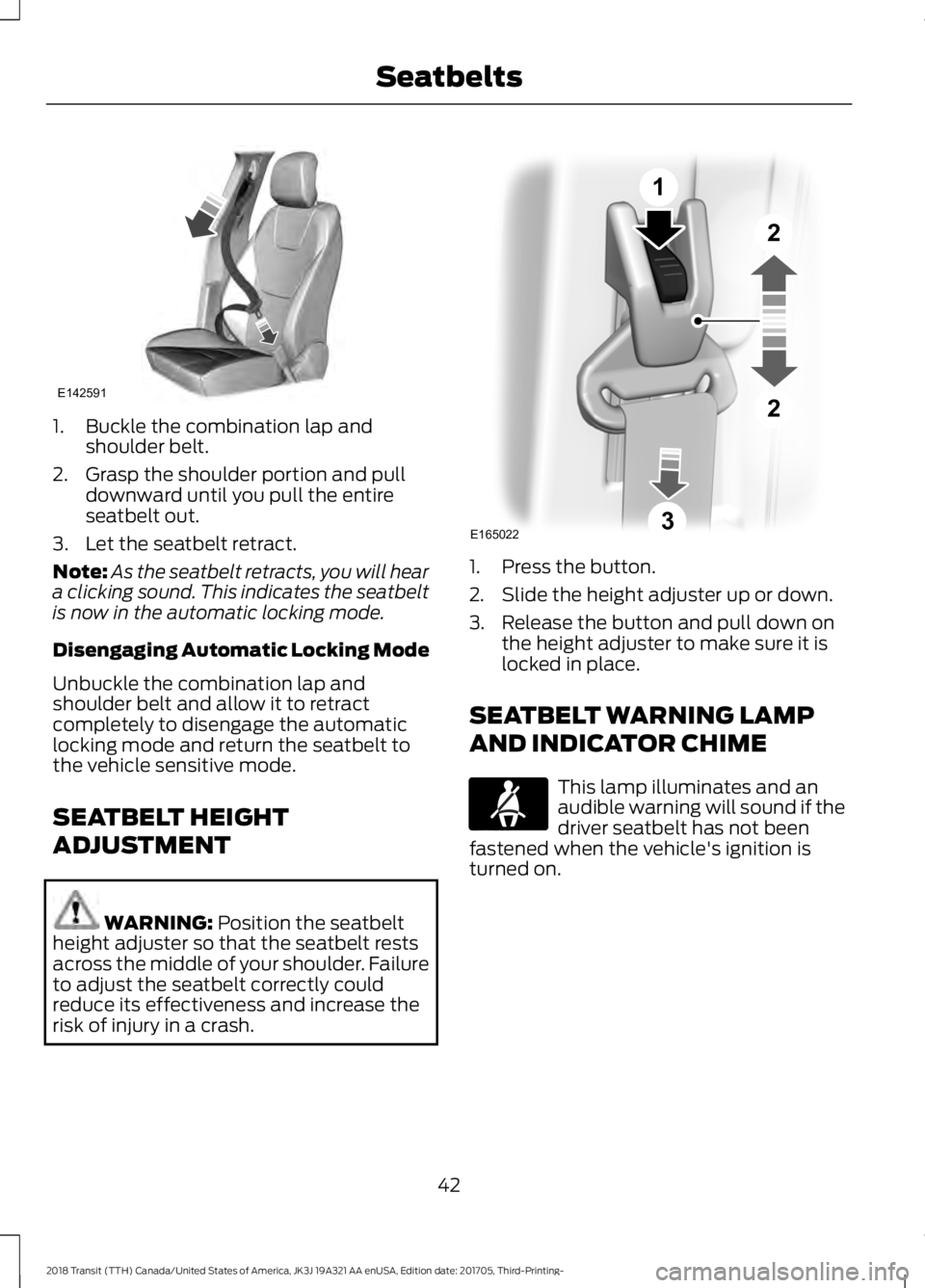
1. Buckle the combination lap and
shoulder belt.
2. Grasp the shoulder portion and pull downward until you pull the entire
seatbelt out.
3. Let the seatbelt retract.
Note: As the seatbelt retracts, you will hear
a clicking sound. This indicates the seatbelt
is now in the automatic locking mode.
Disengaging Automatic Locking Mode
Unbuckle the combination lap and
shoulder belt and allow it to retract
completely to disengage the automatic
locking mode and return the seatbelt to
the vehicle sensitive mode.
SEATBELT HEIGHT
ADJUSTMENT WARNING: Position the seatbelt
height adjuster so that the seatbelt rests
across the middle of your shoulder. Failure
to adjust the seatbelt correctly could
reduce its effectiveness and increase the
risk of injury in a crash. 1. Press the button.
2. Slide the height adjuster up or down.
3. Release the button and pull down on
the height adjuster to make sure it is
locked in place.
SEATBELT WARNING LAMP
AND INDICATOR CHIME This lamp illuminates and an
audible warning will sound if the
driver seatbelt has not been
fastened when the vehicle's ignition is
turned on.
42
2018 Transit (TTH) Canada/United States of America, JK3J 19A321 AA enUSA, Edition date: 201705, Third-Printing- SeatbeltsE142591 E165022
1
2
2
3 E71880
Page 47 of 521
Switching the Belt-Minder on and off
WARNING: While the system allows
you to switch it off, this system is designed
to improve your chances of being safely
belted and surviving a crash. We
recommend you leave the system
switched on. To reduce the risk of injury,
do not switch the system on or off while
driving your vehicle.
Read Steps 1 - 4 thoroughly before
proceeding with the programming
procedure.
The system can be switched on and off by
carrying out the following procedure:
Before following the procedure, make sure
that:
• The parking brake is set.
• The transmission selector lever is in
position park (
P).
• The ignition is switched off.
• The driver seatbelt is unbuckled.
1. Switch the ignition on. Do not start the
engine.
2. Wait until the seatbelt warning light turns off (about one minute). After
Step 2, wait an additional five seconds
before proceeding with Step 3. Once
Step 3 is started, the procedure must
be completed within 30 seconds.
3. Buckle then unbuckle the driver seatbelt three times at a moderate
speed, ending in the unbuckled state.
After Step 3, the seatbelt warning light
will illuminate.
4. While the seatbelt warning light is illuminated, buckle then unbuckle the
driver seatbelt. After Step 4, the
seatbelt warning light will flash for
confirmation. •
This will disable the feature if it is
currently enabled.
• This will enable the feature if it is
currently disabled.
CHILD RESTRAINT AND
SEATBELT MAINTENANCE
Inspect the vehicle seatbelts and child
safety seat systems periodically to make
sure they work properly and are not
damaged. Inspect the vehicle and child
restraint seatbelts to make sure there are
no nicks, tears or cuts. Replace if
necessary. All vehicle seatbelt assemblies,
including retractors, buckles, front seatbelt
buckle assemblies, buckle support
assemblies (slide bar-if equipped),
shoulder belt height adjusters (if
equipped), shoulder belt guide on seat
backrest (if equipped), child safety seat
LATCH and tether anchors, and attaching
hardware, should be inspected after a
crash. Read the child restraint
manufacturer's instructions for additional
inspection and maintenance information
specific to the child restraint.
We recommend that all seatbelt
assemblies in use in vehicles involved in a
crash be replaced. However, if the crash
was minor and an authorized dealer finds
that the belts do not show damage and
continue to operate properly, they do not
need to be replaced. Seatbelt assemblies
not in use during a crash should also be
inspected and replaced if either damage
or improper operation is noted.
Properly care for seatbelts. See
Vehicle
Care (page 260).
44
2018 Transit (TTH) Canada/United States of America, JK3J 19A321 AA enUSA, Edition date: 201705, Third-Printing- Seatbelts
Page 250 of 521

ADJUSTING THE HEADLAMPS
Vertical Aim Adjustment
If your vehicle has been involved in a crash,
have the aim of the headlamp beam
checked by an authorized dealer.
Headlamp Aiming Target
8 ft (2.4 m)
A
Ground to the center of the
headlamp low beam bulb
B
25 ft (7.6 m)
C
Horizontal reference line
D
Vertical Aim Adjustment Procedure
1. Park your vehicle on level ground approximately 25 ft (7.6 m) from a wall
or screen.
2. Measure the distance from the ground
to the center of the headlamp low
beam bulb and mark an
8 ft (2.4 m)
long horizontal reference line on the
wall or screen at this height. Note:
There may be an identifying mark on
the lens to help you locate the center of the
bulb.
Note: To see a clearer light pattern while
adjusting one headlamp, you may want to
block the light from the other headlamp.
3. Switch on the low beam headlamps and open the hood. 4. On the wall or screen you will observe
a flat zone of high intensity light
located at the top of the beam pattern.
If the top edge of the flat zone of high
intensity light is not on the horizontal
reference line, adjust the aim of the
headlamp beam.
247
2018 Transit (TTH) Canada/United States of America, JK3J 19A321 AA enUSA, Edition date: 201705, Third-Printing- MaintenanceE142592 E199411 E142465
Page 275 of 521

Information Contained on the
Tire Sidewall
United States of America, and
Canada Federal regulations
require tire manufacturers to place
standardized information on the
sidewall of all tires. This
information identifies and
describes the fundamental
characteristics of the tire and also
provides a United States of
America DOT Tire Identification
Number for safety standard
certification and in case of a recall.
P Type Tires
P215/65R15 95H is an example of
a tire size, load index and speed
rating. The definitions of these
items are listed below.
Note:
Tire size, load index and
speed rating for your vehicle may
be different from the following
example. P: Indicates a tire,
designated by the Tire
and Rim Association, that
may be used for service on
cars, sport utility vehicles,
minivans and light trucks.
A
215: Indicates the nominal
width of the tire in
millimeters from sidewall
edge to sidewall edge. In
general, the larger the
number, the wider the tire.
B
65:
Indicates the aspect
ratio which gives the tire's
ratio of height to width.
C
R:
Indicates a radial type
tire.
D
272
2018 Transit (TTH) Canada/United States of America, JK3J 19A321 AA enUSA, Edition date: 201705, Third-Printing- Wheels and TiresH
I
J
KL
M
A
B
CDEFG
E142543
Page 279 of 521

T: Indicates a type of tire,
designated by the Tire
and Rim Association, that
is intended for temporary
service on cars,
sport-utility vehicles,
minivans and light trucks.
A
145:
Indicates the
nominal width of the tire
in millimeters from
sidewall edge to sidewall
edge. In general, the larger
the number, the wider the
tire.
B 80:
Indicates the aspect
ratio which gives the tire's
ratio of height to width.
Numbers of 70 or lower
indicate a short sidewall.
C
D:
Indicates a diagonal
type tire. R: Indicates a
radial type tire.
D
16:
Indicates the wheel or
rim diameter in inches. If
you change the wheel
size, you will have to
purchase new tires to
match the new wheel
diameter.
E
Additional Information for LT
Type Tires
LT235/85 R16 is an example of a
tire size. LT type tires have some
additional information beyond
those of P type tires. The
definitions of these items are
listed below.
Note: Tire Quality Grades do not
apply to this type of tire.
276
2018 Transit (TTH) Canada/United States of America, JK3J 19A321 AA enUSA, Edition date: 201705, Third-Printing- Wheels and TiresA
BCDE
E142545
Page 284 of 521
Inspecting the Tires and Wheel
Valve Stems
Periodically inspect the tire treads
for uneven or excessive wear and
remove objects, for example
stones, nails or glass that may be
wedged in the tread grooves.
Check the tire and valve stems for
holes, cracks, or cuts that may
permit air leakage and repair or
replace the tire and replace the
valve stem. Inspect the tire
sidewalls for cracking, cuts,
bruises and other signs of damage
or excessive wear. If internal
damage to the tire is suspected,
have the tire removed and
inspected in case it needs to be
repaired or replaced. For your
safety, tires that are damaged or
show signs of excessive wear
should not be used because they
are more likely to blow out or fail.
Incorrect or inadequate vehicle
maintenance can cause tires to
wear abnormally. Inspect all the
tires, including the spare,
frequently, and replace them if
one or more of the following
conditions exist:
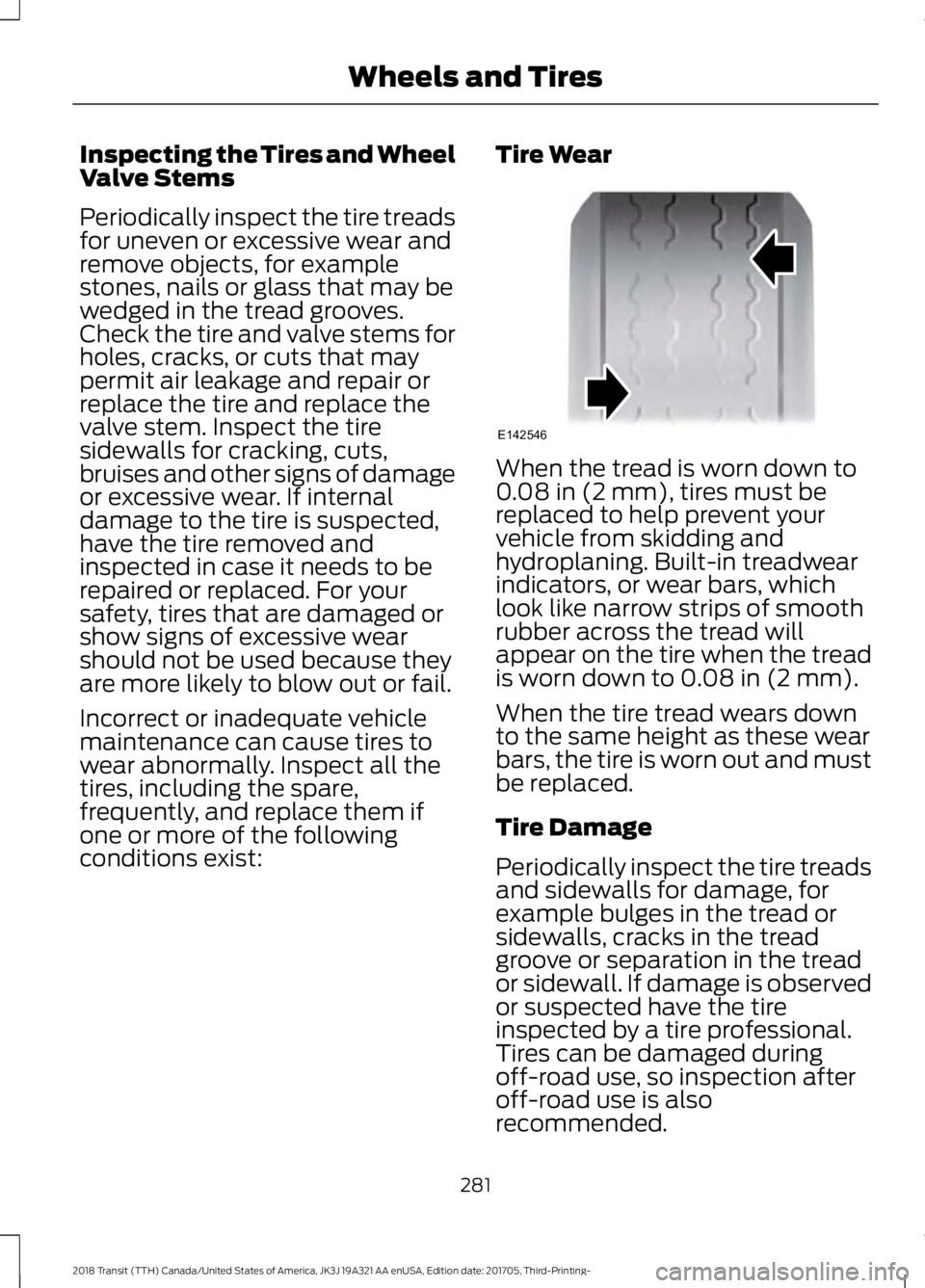
Tire Wear When the tread is worn down to
0.08 in (2 mm), tires must be
replaced to help prevent your
vehicle from skidding and
hydroplaning. Built-in treadwear
indicators, or wear bars, which
look like narrow strips of smooth
rubber across the tread will
appear on the tire when the tread
is worn down to
0.08 in (2 mm).
When the tire tread wears down
to the same height as these wear
bars, the tire is worn out and must
be replaced.
Tire Damage
Periodically inspect the tire treads
and sidewalls for damage, for
example bulges in the tread or
sidewalls, cracks in the tread
groove or separation in the tread
or sidewall. If damage is observed
or suspected have the tire
inspected by a tire professional.
Tires can be damaged during
off-road use, so inspection after
off-road use is also
recommended.
281
2018 Transit (TTH) Canada/United States of America, JK3J 19A321 AA enUSA, Edition date: 201705, Third-Printing- Wheels and TiresE142546
Page 516 of 521

S
Safety Canopy
™.............................................53
Safety Precautions........................................131
Satellite Radio..............................................344
Satellite Radio Electronic Serial Number
(ESN)................................................................ 345
Satellite Radio Reception Factors..............345
SiriusXM Satellite Radio Service.................345
Troubleshooting................................................. 346
Scheduled Maintenance Record...........466
Scheduled Maintenance
..........................459
Seatbelt Extension........................................45
Seatbelt Height Adjustment
......................42
Seatbelt Reminder........................................43
Belt-Minder®......................................................... 43
Seatbelts...........................................................39 Principle of Operation........................................ 39
Seatbelt Warning Lamp and Indicator Chime...............................................................42
Conditions of operation..................................... 43
Seats...................................................................113
Security...............................................................75
Selective Catalytic Reductant System - 3.2L Diesel
....................................................143
Diesel Exhaust Fluid (AdBlue)
Guidelines......................................................... 143
Diesel Exhaust Fluid (AdBlue) Level...........143
Warning Lamps and Messages..................... 143
Settings...........................................................428 911 Assist............................................................... 433
Ambient Lighting.............................................. 440
Bluetooth............................................................. 430
Clock...................................................................... 430
Display.................................................................... 441
General.................................................................. 438
Media Player........................................................ 429
Mobile Apps......................................................... 436
Navigation............................................................ 434
Phone.................................................................... 430
Radio...................................................................... 433
Sound..................................................................... 428
Valet Mode........................................................... 442
Vehicle................................................................... 440
Voice Control........................................................ 441
Wi-Fi & Hotspot................................................. 438
Side Airbags.....................................................52
Sitting in the Correct Position...................113 Snow Chains
See: Using Snow Chains................................. 286
Spare Wheel See: Changing a Road Wheel........................ 292
Special Notices
................................................13
New Vehicle Limited Warranty......................... 13
Special Operating Conditions Scheduled Maintenance..............................................464
Exceptions........................................................... 466
Speed Control See: Cruise Control............................................ 168
Speed Limiter................................................169 Engine Speed Limiter........................................ 169
Vehicle Speed Limiter - Fixed........................ 169
Stability Control.............................................161 Principle of Operation........................................ 161
Starter Switch See: Ignition Switch........................................... 126
Starting a Diesel Engine..............................127 Cold Weather Operation.................................. 128
Engine Glow Plugs.............................................. 128
Failure to Start..................................................... 128
Starting a Cold or Hot Engine........................ 128
Starting a Gasoline Engine
........................127
Cold or Hot Engine.............................................. 127
Engine Idle Speed after Starting................... 127
Flooded Engine.................................................... 127
Starting and Stopping the Engine..........126 General Information.......................................... 126
Steering.............................................................172
Steering Wheel
...............................................80
Storage Compartments.............................125
Supplementary Restraints System.........46 Principle of Operation........................................ 46
Switching Off the Engine...........................129 Vehicles With a Turbocharger........................ 129
Symbols Glossary
.............................................7
SYNC™ 3........................................................387 General Information......................................... 387
SYNC™ 3 Troubleshooting
......................442
SYNC™ Applications and Services........................................................365
911 Assist............................................................... 365
SYNC Mobile Apps............................................ 367
SYNC™...........................................................349 General Information......................................... 349
SYNC™ Troubleshooting
..........................379
513
2018 Transit (TTH) Canada/United States of America, JK3J 19A321 AA enUSA, Edition date: 201705, Third-Printing- Index