2018 FORD FUSION ENERGI airbag
[x] Cancel search: airbagPage 32 of 538
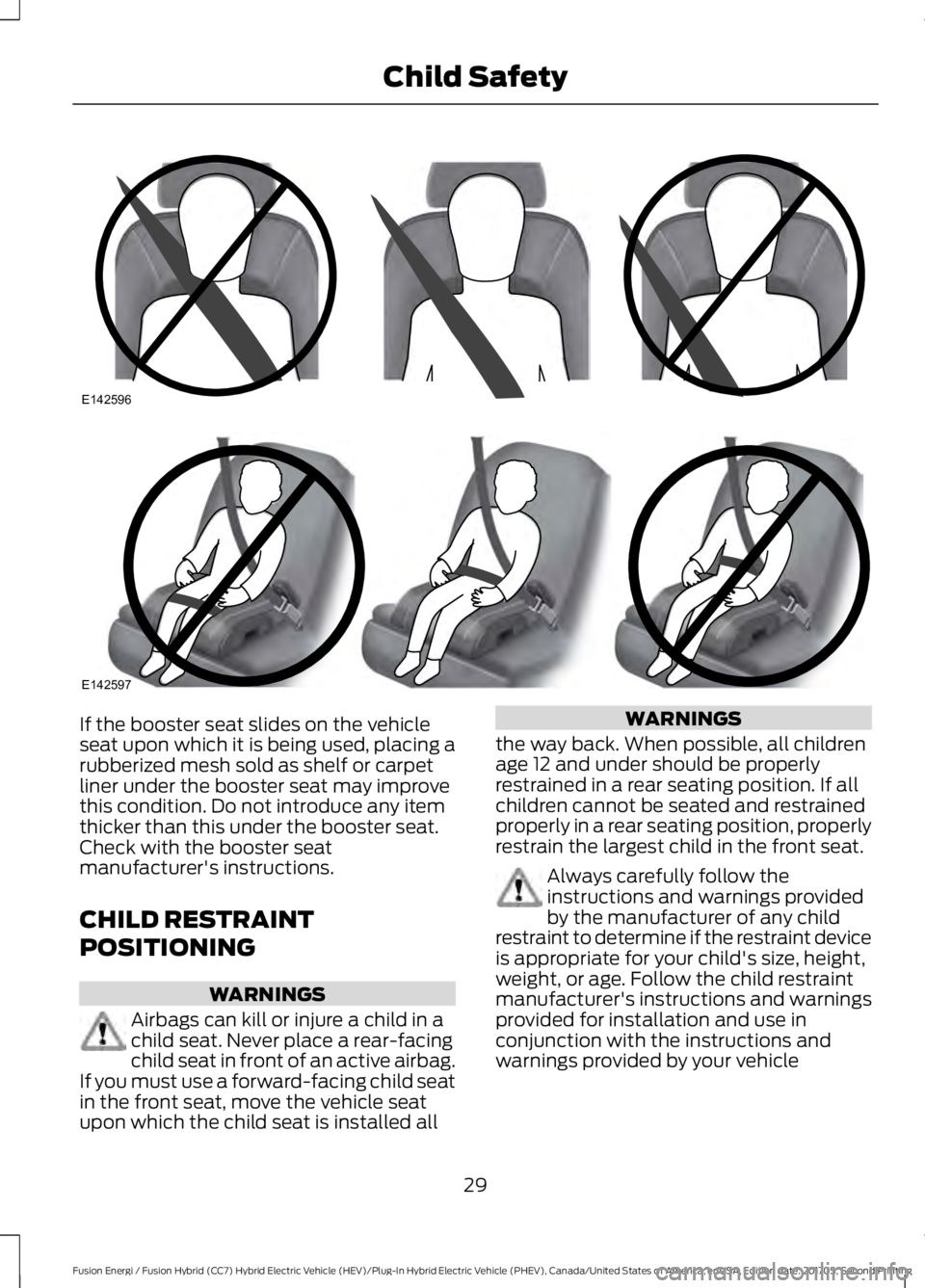
If the booster seat slides on the vehicleseat upon which it is being used, placing arubberized mesh sold as shelf or carpetliner under the booster seat may improvethis condition. Do not introduce any itemthicker than this under the booster seat.Check with the booster seatmanufacturer's instructions.
CHILD RESTRAINT
POSITIONING
WARNINGS
Airbags can kill or injure a child in achild seat. Never place a rear-facingchild seat in front of an active airbag.If you must use a forward-facing child seatin the front seat, move the vehicle seatupon which the child seat is installed all
WARNINGS
the way back. When possible, all childrenage 12 and under should be properlyrestrained in a rear seating position. If allchildren cannot be seated and restrainedproperly in a rear seating position, properlyrestrain the largest child in the front seat.
Always carefully follow theinstructions and warnings providedby the manufacturer of any childrestraint to determine if the restraint deviceis appropriate for your child's size, height,weight, or age. Follow the child restraintmanufacturer's instructions and warningsprovided for installation and use inconjunction with the instructions andwarnings provided by your vehicle
29
Fusion Energi / Fusion Hybrid (CC7) Hybrid Electric Vehicle (HEV)/Plug-In Hybrid Electric Vehicle (PHEV), Canada/United States of America, enUSA, Edition date: 201705, Second Printing
Child SafetyE142596 E142597
Page 35 of 538

PRINCIPLE OF OPERATION
WARNINGS
Always drive and ride with yourseatback upright and the lap beltsnug and low across the hips.
Children must always be properlyrestrained.
Never let a passenger hold a child onhis or her lap while the vehicle ismoving. The passenger cannotprotect the child from injury in a crash.
All occupants of your vehicle,including the driver, should alwaysproperly wear their seatbelts, evenwhen an airbag supplemental restraintsystem is provided. Failure to properly wearyour seatbelt could seriously increase therisk of injury or death.
It is extremely dangerous to ride in acargo area, inside or outside of avehicle. In a crash, people riding inthese areas are more likely to be seriouslyinjured or killed. Do not allow people to ridein any area of your vehicle that is notequipped with seats and seatbelts. Makesure everyone in your vehicle is in a seatand properly using a seatbelt. Failure tofollow this warning could result in seriouspersonal injury or death.
In a rollover crash, an unbeltedperson is significantly more likely todie than a person wearing a seatbelt.
Each seating position in your vehiclehas a specific seatbelt assemblymade up of one buckle and onetongue designed to be used as a pair. Usethe shoulder belt on the outside shoulderonly. Never wear the shoulder belt underthe arm. Never use a single seatbelt formore than one person.
WARNINGS
Airbags can kill or injure a child in achild restraint. Properly restrainchildren 12 and under in the rear seatwhenever possible.
Seatbelts and seats may be hot in avehicle that is in the sunshine. Thehot seatbelts or seats may burn asmall child. Check seat covers and bucklesbefore you place a child anywhere nearthem.
All seating positions in your vehicle havelap and shoulder seatbelts. All occupantsof the vehicle should always properly weartheir seatbelts, even when an airbagsupplemental restraint system is provided.
The seatbelt system consists of:
•Lap and shoulder seatbelts.
•Shoulder seatbelt with automaticlocking mode, (except driver seatbelt).
•Height adjuster at the front outboardseating positions.
•Seatbelt pretensioner at the frontoutboard seating positions.
•Belt tension sensor at the outboardpassenger seating position.
•Seatbelt warning light and chime.
•Crash sensors and monitoring systemwith readiness indicator.
32
Fusion Energi / Fusion Hybrid (CC7) Hybrid Electric Vehicle (HEV)/Plug-In Hybrid Electric Vehicle (PHEV), Canada/United States of America, enUSA, Edition date: 201705, Second Printing
SeatbeltsE71880 E67017
Page 36 of 538
The seatbelt pretensioners at the frontseating positions are designed to tightenthe seatbelts when activated. In frontaland near-frontal crashes, the seatbeltpretensioners may be activated alone or,if the crash is of sufficient severity, togetherwith the front airbags. The pretensionersmay also activate when the Safety Canopydeploys.
FASTENING THE SEATBELTS
Standard belts shown, inflatable beltssimilar
The front outboard and rear safetyrestraints in the vehicle are combinationlap and shoulder belts.
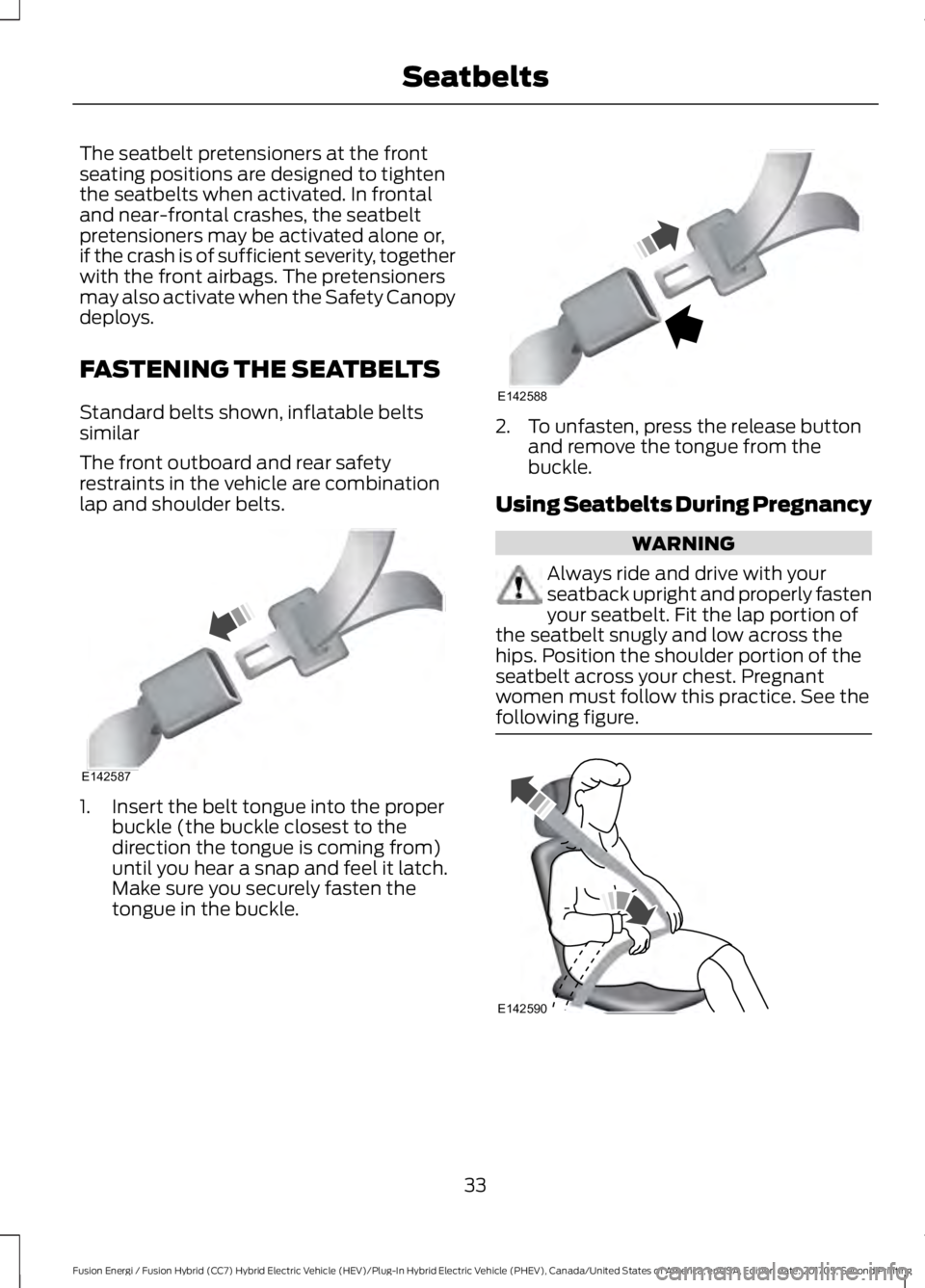
1. Insert the belt tongue into the properbuckle (the buckle closest to thedirection the tongue is coming from)until you hear a snap and feel it latch.Make sure you securely fasten thetongue in the buckle.
2. To unfasten, press the release buttonand remove the tongue from thebuckle.
Using Seatbelts During Pregnancy
WARNING
Always ride and drive with yourseatback upright and properly fastenyour seatbelt. Fit the lap portion ofthe seatbelt snugly and low across thehips. Position the shoulder portion of theseatbelt across your chest. Pregnantwomen must follow this practice. See thefollowing figure.
33
Fusion Energi / Fusion Hybrid (CC7) Hybrid Electric Vehicle (HEV)/Plug-In Hybrid Electric Vehicle (PHEV), Canada/United States of America, enUSA, Edition date: 201705, Second Printing
SeatbeltsE142587 E142588 E142590
Page 38 of 538
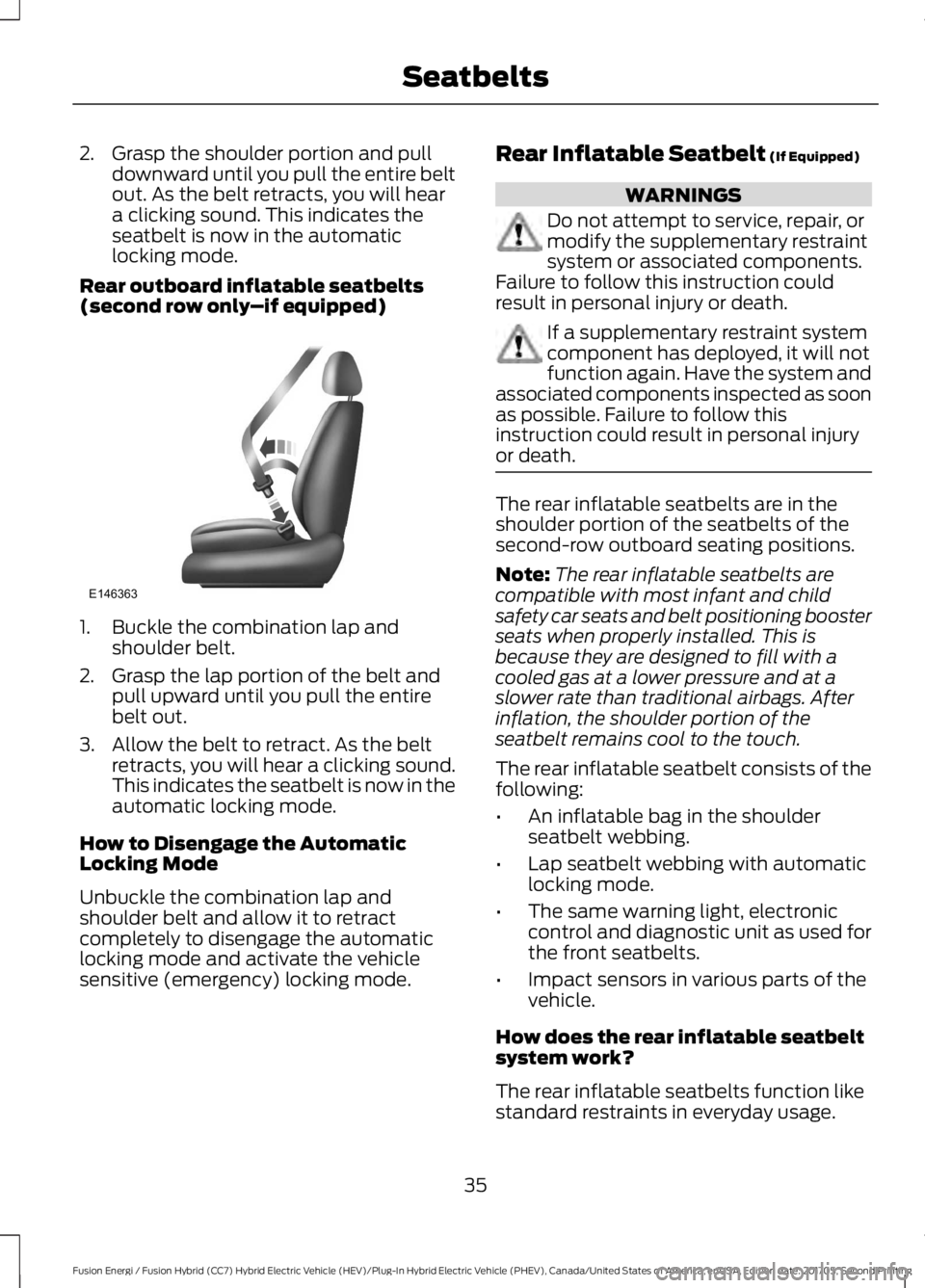
2. Grasp the shoulder portion and pulldownward until you pull the entire beltout. As the belt retracts, you will heara clicking sound. This indicates theseatbelt is now in the automaticlocking mode.
Rear outboard inflatable seatbelts(second row only–if equipped)
1. Buckle the combination lap andshoulder belt.
2. Grasp the lap portion of the belt andpull upward until you pull the entirebelt out.
3. Allow the belt to retract. As the beltretracts, you will hear a clicking sound.This indicates the seatbelt is now in theautomatic locking mode.
How to Disengage the AutomaticLocking Mode
Unbuckle the combination lap andshoulder belt and allow it to retractcompletely to disengage the automaticlocking mode and activate the vehiclesensitive (emergency) locking mode.
Rear Inflatable Seatbelt (If Equipped)
WARNINGS
Do not attempt to service, repair, ormodify the supplementary restraintsystem or associated components.Failure to follow this instruction couldresult in personal injury or death.
If a supplementary restraint systemcomponent has deployed, it will notfunction again. Have the system andassociated components inspected as soonas possible. Failure to follow thisinstruction could result in personal injuryor death.
The rear inflatable seatbelts are in theshoulder portion of the seatbelts of thesecond-row outboard seating positions.
Note:The rear inflatable seatbelts arecompatible with most infant and childsafety car seats and belt positioning boosterseats when properly installed. This isbecause they are designed to fill with acooled gas at a lower pressure and at aslower rate than traditional airbags. Afterinflation, the shoulder portion of theseatbelt remains cool to the touch.
The rear inflatable seatbelt consists of thefollowing:
•An inflatable bag in the shoulderseatbelt webbing.
•Lap seatbelt webbing with automaticlocking mode.
•The same warning light, electroniccontrol and diagnostic unit as used forthe front seatbelts.
•Impact sensors in various parts of thevehicle.
How does the rear inflatable seatbeltsystem work?
The rear inflatable seatbelts function likestandard restraints in everyday usage.
35
Fusion Energi / Fusion Hybrid (CC7) Hybrid Electric Vehicle (HEV)/Plug-In Hybrid Electric Vehicle (PHEV), Canada/United States of America, enUSA, Edition date: 201705, Second Printing
SeatbeltsE146363
Page 43 of 538
The Personal Safety System provides animproved overall level of frontal crashprotection to front seat occupants and isdesigned to help further reduce the risk ofairbag-related injuries. The system is ableto analyze different occupant conditionsand crash severity before activating theappropriate safety devices to help betterprotect a range of occupants in a varietyof frontal crash situations.
The Vehicle Personal Safety Systemconsists of:
•Driver and passenger dual-stage airbagsupplemental restraints.
•Front seat outboard seatbelts withpretensioners, energy managementretractors and seatbelt usage sensors.
•Driver seat position sensor.
•Passenger seat position sensor.
•Front passenger sensing system.
•Passenger airbag off and on indicatorlamp.
•Front crash severity sensors.
•Restraints control module with impactand safing sensors.
•Restraint system warning lamp andtone.
•The electrical wiring for the airbags,crash sensors, seatbelt pretensioners,front seatbelt usage sensors, driverseat position sensor, front passengersensing system and indicator lights.
How Does the Personal SafetySystem Work?
The Personal Safety System can adapt thedeployment strategy of the safety devicesaccording to crash severity and occupantconditions. A collection of crash andoccupant sensors provides information tothe restraints control module. During acrash, the restraints control module maydeploy the seatbelt pretensioners, one orboth stages of the dual-stage airbagsbased on crash severity and occupantconditions.
40
Fusion Energi / Fusion Hybrid (CC7) Hybrid Electric Vehicle (HEV)/Plug-In Hybrid Electric Vehicle (PHEV), Canada/United States of America, enUSA, Edition date: 201705, Second Printing
Personal Safety System™
Page 44 of 538
PRINCIPLE OF OPERATION
WARNINGS
Airbags do not inflate slowly orgently, and the risk of injury from adeploying airbag is the greatest closeto the trim covering the airbag module.
All occupants of your vehicle,including the driver, should alwaysproperly wear their seatbelts, evenwhen an airbag supplemental restraintsystem is provided. Failure to properly wearyour seatbelt could seriously increase therisk of injury or death.
Even with advanced restraintssystems, properly restrain children12 and under in a rear seatingposition. Failure to follow this couldseriously increase the risk of injury or death.
Do not place your arms on the airbagcover or through the steering wheel.Failure to follow this instructioncould result in personal injury.
Keep the areas in front of the airbagsfree from obstruction. Do not affixanything to or over the airbag covers.Objects could become projectiles duringairbag deployment or in a sudden stop.Failure to follow this instruction couldresult in personal injury or death.
Airbags can kill or injure a child in achild restraint. Never place arear-facing child restraint in front ofan active airbag. If you must use aforward-facing child restraint in the frontseat, move the seat upon which the childrestraint is installed all the way back.
Do not attempt to service, repair, ormodify the supplementary restraintsystem or associated components.Failure to follow this instruction couldresult in personal injury or death.
WARNINGS
Several airbag system componentsget hot after inflation. To reduce therisk of injury, do not touch them afterinflation.
If a supplementary restraint systemcomponent has deployed, it will notfunction again. Have the system andassociated components inspected as soonas possible. Failure to follow thisinstruction could result in personal injuryor death.
The airbags are a supplemental restraintsystem and are designed to work with theseatbelts to help protect the driver andright front passenger from certain upperbody injuries. Airbags do not inflate slowly;there is a risk of injury from a deployingairbag.
Note:You will hear a loud bang and see acloud of harmless powdery residue if anairbag deploys. This is normal.
The airbags inflate and deflate rapidlyupon activation. After airbag deployment,it is normal to notice a smoke-like, powderyresidue or smell the burnt propellant. Thismay consist of cornstarch, talcum powder(to lubricate the bag) or sodiumcompounds (for example, baking soda)that result from the combustion processthat inflates the airbag. Small amounts ofsodium hydroxide may be present whichmay irritate the skin and eyes, but none ofthe residue is toxic.
While the system is designed to helpreduce serious injuries, contact with adeploying airbag may also cause abrasionsor swelling. Temporary hearing loss is alsoa possibility as a result of the noiseassociated with a deploying airbag.Because airbags must inflate rapidly andwith considerable force, there is the risk ofdeath or serious injuries such as fractures,facial and eye injuries or internal injuries,
41
Fusion Energi / Fusion Hybrid (CC7) Hybrid Electric Vehicle (HEV)/Plug-In Hybrid Electric Vehicle (PHEV), Canada/United States of America, enUSA, Edition date: 201705, Second Printing
Supplementary Restraints System
Page 45 of 538
particularly to occupants who are notproperly restrained or are otherwise out ofposition at the time of airbag deployment.Thus, it is extremely important thatoccupants be properly restrained as faraway from the airbag module as possiblewhile maintaining vehicle control.
Routine maintenance of the airbags is notrequired.
DRIVER AND PASSENGER
AIRBAGS
WARNINGS
Do not place your arms on the airbagcover or through the steering wheel.Failure to follow this instructioncould result in personal injury.
Keep the areas in front of the airbagsfree from obstruction. Do not affixanything to or over the airbag covers.Objects could become projectiles duringairbag deployment or in a sudden stop.Failure to follow this instruction couldresult in personal injury or death.
Airbags can kill or injure a child in achild restraint. Never place arear-facing child restraint in front ofan active airbag. If you must use aforward-facing child restraint in the frontseat, move the seat upon which the childrestraint is installed all the way back.
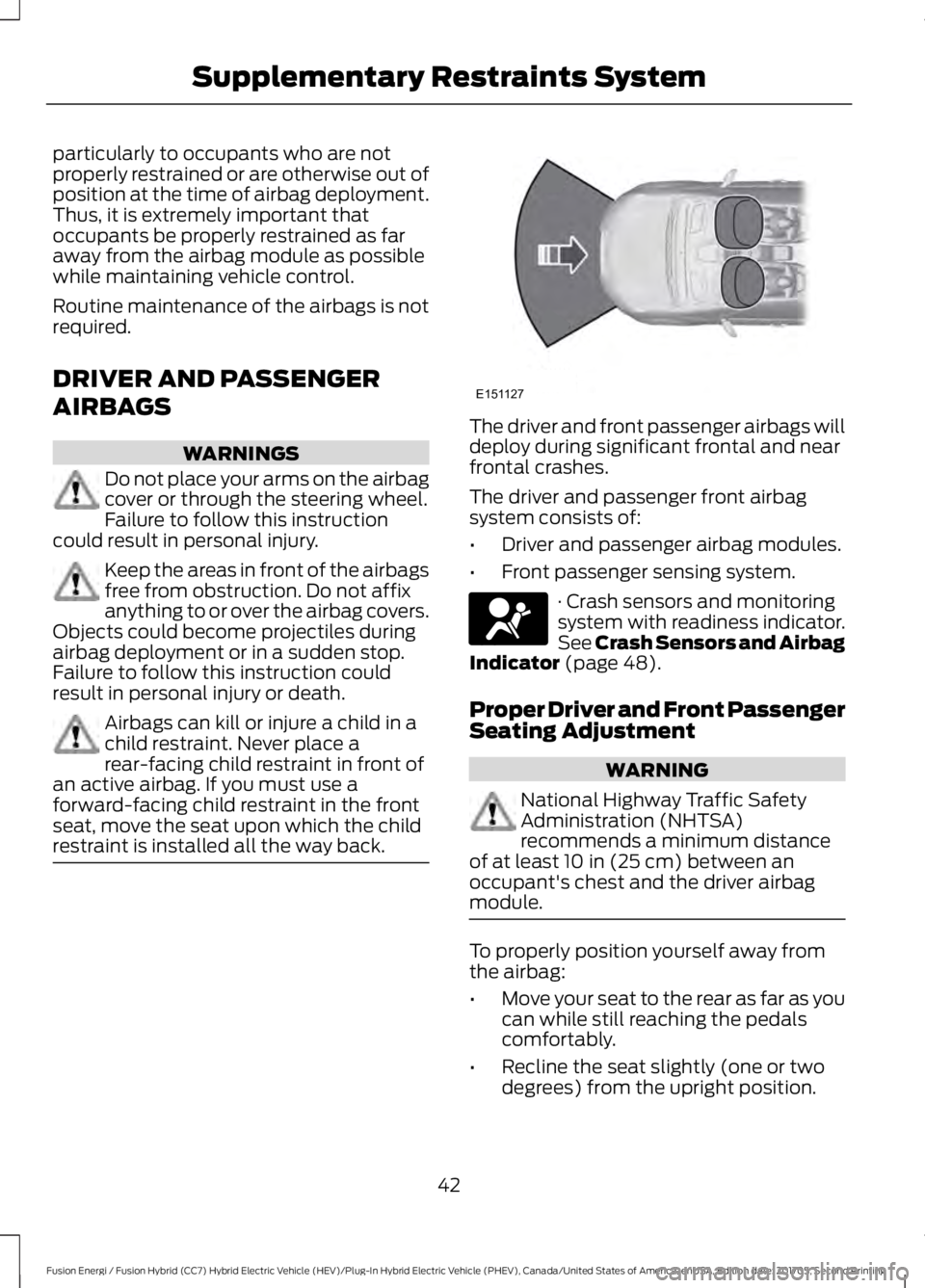
The driver and front passenger airbags willdeploy during significant frontal and nearfrontal crashes.
The driver and passenger front airbagsystem consists of:
•Driver and passenger airbag modules.
•Front passenger sensing system.
· Crash sensors and monitoringsystem with readiness indicator.See Crash Sensors and AirbagIndicator (page 48).
Proper Driver and Front PassengerSeating Adjustment
WARNING
National Highway Traffic SafetyAdministration (NHTSA)recommends a minimum distanceof at least 10 in (25 cm) between anoccupant's chest and the driver airbagmodule.
To properly position yourself away fromthe airbag:
•Move your seat to the rear as far as youcan while still reaching the pedalscomfortably.
•Recline the seat slightly (one or twodegrees) from the upright position.
42
Fusion Energi / Fusion Hybrid (CC7) Hybrid Electric Vehicle (HEV)/Plug-In Hybrid Electric Vehicle (PHEV), Canada/United States of America, enUSA, Edition date: 201705, Second Printing
Supplementary Restraints SystemE151127 E67017
Page 46 of 538
After all occupants have adjusted theirseats and put on seatbelts, it is veryimportant that they continue to sitproperly. A properly seated occupant sitsupright, leaning against the seatback, andcentered on the seat cushion, with theirfeet comfortably extended on the floor.Sitting improperly can increase the chanceof injury in a crash event. For example, ifan occupant slouches, lies down, turnssideways, sits forward, leans forward orsideways, or puts one or both feet up, thechance of injury during a crash is greatlyincreased.
Children and Airbags
WARNING
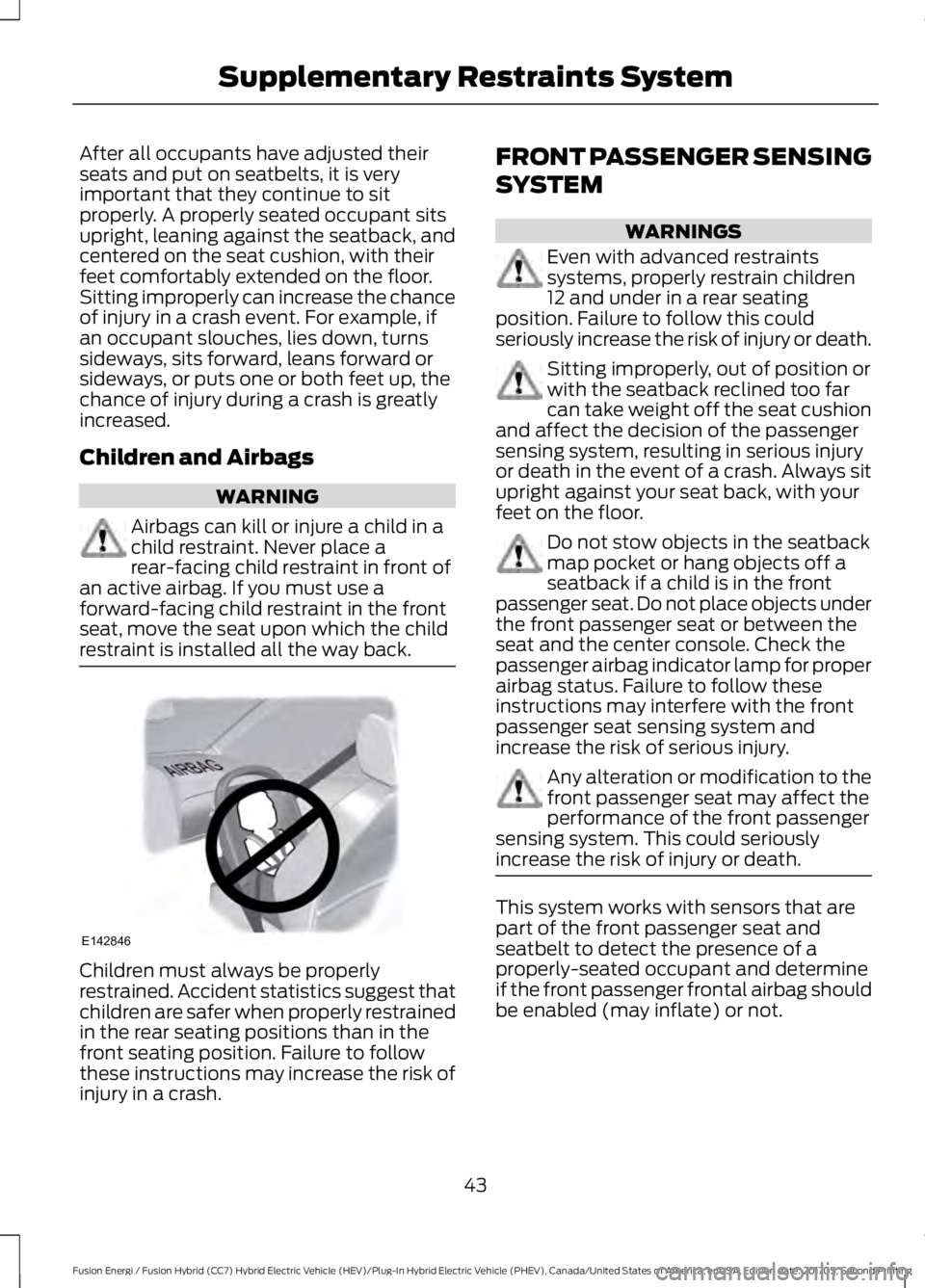
Airbags can kill or injure a child in achild restraint. Never place arear-facing child restraint in front ofan active airbag. If you must use aforward-facing child restraint in the frontseat, move the seat upon which the childrestraint is installed all the way back.
Children must always be properlyrestrained. Accident statistics suggest thatchildren are safer when properly restrainedin the rear seating positions than in thefront seating position. Failure to followthese instructions may increase the risk ofinjury in a crash.
FRONT PASSENGER SENSING
SYSTEM
WARNINGS
Even with advanced restraintssystems, properly restrain children12 and under in a rear seatingposition. Failure to follow this couldseriously increase the risk of injury or death.
Sitting improperly, out of position orwith the seatback reclined too farcan take weight off the seat cushionand affect the decision of the passengersensing system, resulting in serious injuryor death in the event of a crash. Always situpright against your seat back, with yourfeet on the floor.
Do not stow objects in the seatbackmap pocket or hang objects off aseatback if a child is in the frontpassenger seat. Do not place objects underthe front passenger seat or between theseat and the center console. Check thepassenger airbag indicator lamp for properairbag status. Failure to follow theseinstructions may interfere with the frontpassenger seat sensing system andincrease the risk of serious injury.
Any alteration or modification to thefront passenger seat may affect theperformance of the front passengersensing system. This could seriouslyincrease the risk of injury or death.
This system works with sensors that arepart of the front passenger seat andseatbelt to detect the presence of aproperly-seated occupant and determineif the front passenger frontal airbag shouldbe enabled (may inflate) or not.
43
Fusion Energi / Fusion Hybrid (CC7) Hybrid Electric Vehicle (HEV)/Plug-In Hybrid Electric Vehicle (PHEV), Canada/United States of America, enUSA, Edition date: 201705, Second Printing
Supplementary Restraints SystemE142846