2018 FORD F-59 light
[x] Cancel search: lightPage 78 of 168
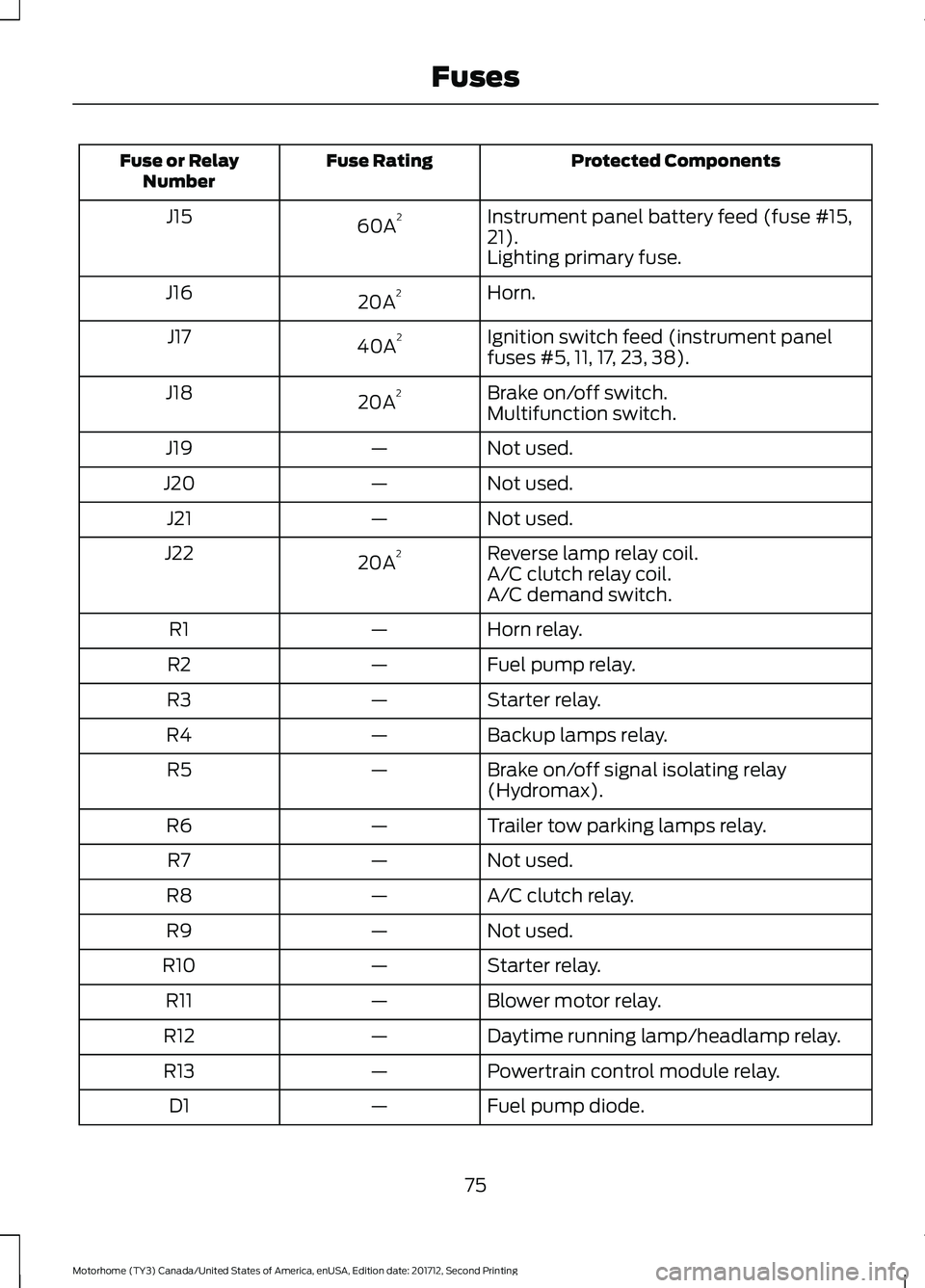
Protected Components
Fuse Rating
Fuse or Relay
Number
Instrument panel battery feed (fuse #15,
21).
60A 2
J15
Lighting primary fuse.
Horn.
20A 2
J16
Ignition switch feed (instrument panel
fuses #5, 11, 17, 23, 38).
40A 2
J17
Brake on/off switch.
20A 2
J18
Multifunction switch.
Not used.
—
J19
Not used.
—
J20
Not used.
—
J21
Reverse lamp relay coil.
20A 2
J22
A/C clutch relay coil.
A/C demand switch.
Horn relay.
—
R1
Fuel pump relay.
—
R2
Starter relay.
—
R3
Backup lamps relay.
—
R4
Brake on/off signal isolating relay
(Hydromax).
—
R5
Trailer tow parking lamps relay.
—
R6
Not used.
—
R7
A/C clutch relay.
—
R8
Not used.
—
R9
Starter relay.
—
R10
Blower motor relay.
—
R11
Daytime running lamp/headlamp relay.
—
R12
Powertrain control module relay.
—
R13
Fuel pump diode.
—
D1
75
Motorhome (TY3) Canada/United States of America, enUSA, Edition date: 201712, Second Printing Fuses
Page 81 of 168

Protected Components
Fuse Rating
Fuse or Relay
Number
Radio capacitors.
20A 1
M6
Ignition coils.
Backup lamp relay coil.
20A 1
M7
Air conditioning clutch coil.
Air conditioning demand switch.
Catalyst monitor sensor.
20A 1
M8
Engine heated exhaust gas oxygen sensor
#11 and #21.
Vapor management valve.
Powertrain control module power.
20A 1
M9
Brake shift Interlock
5A 1
M10
Powertrain control module relay keep alive
power.
5A 1
M11
Powertrain control module relay coil.
Parking lamps feed.
20A 1
M12
Not used.
Diode
D1
Fuel pump.
Diode
D2
Air conditioning clutch.
Diode
D3
Not used.
—
R2-1
Powertrain control module relay feed
(power distribution box fuse M6, M7, M8,
M9).
30A
2
J1
Fuel injectors.
20A 2
J2
Fuel pump motor.
Mass airflow sensor.
Powertrain control module.
Cigar lighter power point.
20A 2
J3
Diagnostic connector.
Blower motor.
40A 2
J4
Headlamps.
30A 2
J5
Daytime running lamps on/off relay coil.
78
Motorhome (TY3) Canada/United States of America, enUSA, Edition date: 201712, Second Printing Fuses
Page 82 of 168

Protected Components
Fuse Rating
Fuse or Relay
Number
Headlamp daytime running lamp relay
feed.
High beam headlamps flash to pass.
(Instrument panel fuses #25, 31).
Ignition switch feeds (instrument panel
fuses #F26).
40A 2
J6
Instrument panel fuses #F24, F22, F20,
F26, F21, F8, F6, F4, F2.
40A 2
J7
Power distribution box fuses M4, M1-4.
Instrument panel fuses F11, F13, F15, F17.
50A 2
J8
Starter relay feed.
30A 2
J9
Starter motor solenoid.
Power distribution box fuse M1-1.
60A 2
J10
Power brake assist motor (HydroMax).
Trailer tow electronic brake.
30A 2
J11
Lighting primary.
60A 2
J12
Power distribution box fuse M1-2.
Instrument panel fuses #F19, F5, F3.
Brake on/off.
20A 2
J13
Hazard.
Horn.
20A 2
J14
HydroMax anti-lock brake system module.
60A 2
J15
Trailer tow parking lamps.
20A 2
J16
1 Mini fuse.
2 J case fuse.
Diode and Relay Module
Locate the module box with the power
distribution box in from of the radiator.
79
Motorhome (TY3) Canada/United States of America, enUSA, Edition date: 201712, Second Printing Fuses
Page 86 of 168
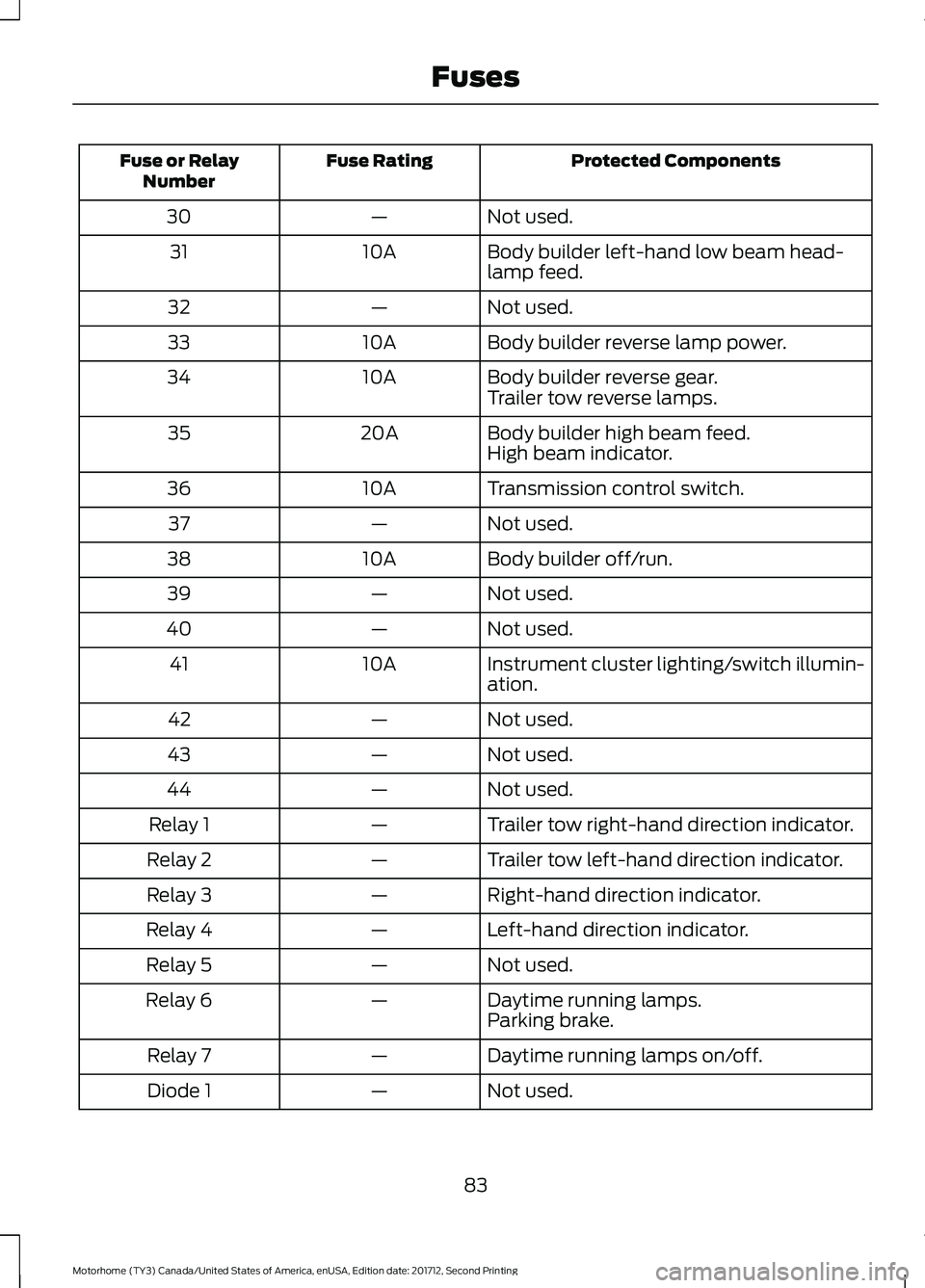
Protected Components
Fuse Rating
Fuse or Relay
Number
Not used.
—
30
Body builder left-hand low beam head-
lamp feed.
10A
31
Not used.
—
32
Body builder reverse lamp power.
10A
33
Body builder reverse gear.
10A
34
Trailer tow reverse lamps.
Body builder high beam feed.
20A
35
High beam indicator.
Transmission control switch.
10A
36
Not used.
—
37
Body builder off/run.
10A
38
Not used.
—
39
Not used.
—
40
Instrument cluster lighting/switch illumin-
ation.
10A
41
Not used.
—
42
Not used.
—
43
Not used.
—
44
Trailer tow right-hand direction indicator.
—
Relay 1
Trailer tow left-hand direction indicator.
—
Relay 2
Right-hand direction indicator.
—
Relay 3
Left-hand direction indicator.
—
Relay 4
Not used.
—
Relay 5
Daytime running lamps.
—
Relay 6
Parking brake.
Daytime running lamps on/off.
—
Relay 7
Not used.
—
Diode 1
83
Motorhome (TY3) Canada/United States of America, enUSA, Edition date: 201712, Second Printing Fuses
Page 89 of 168
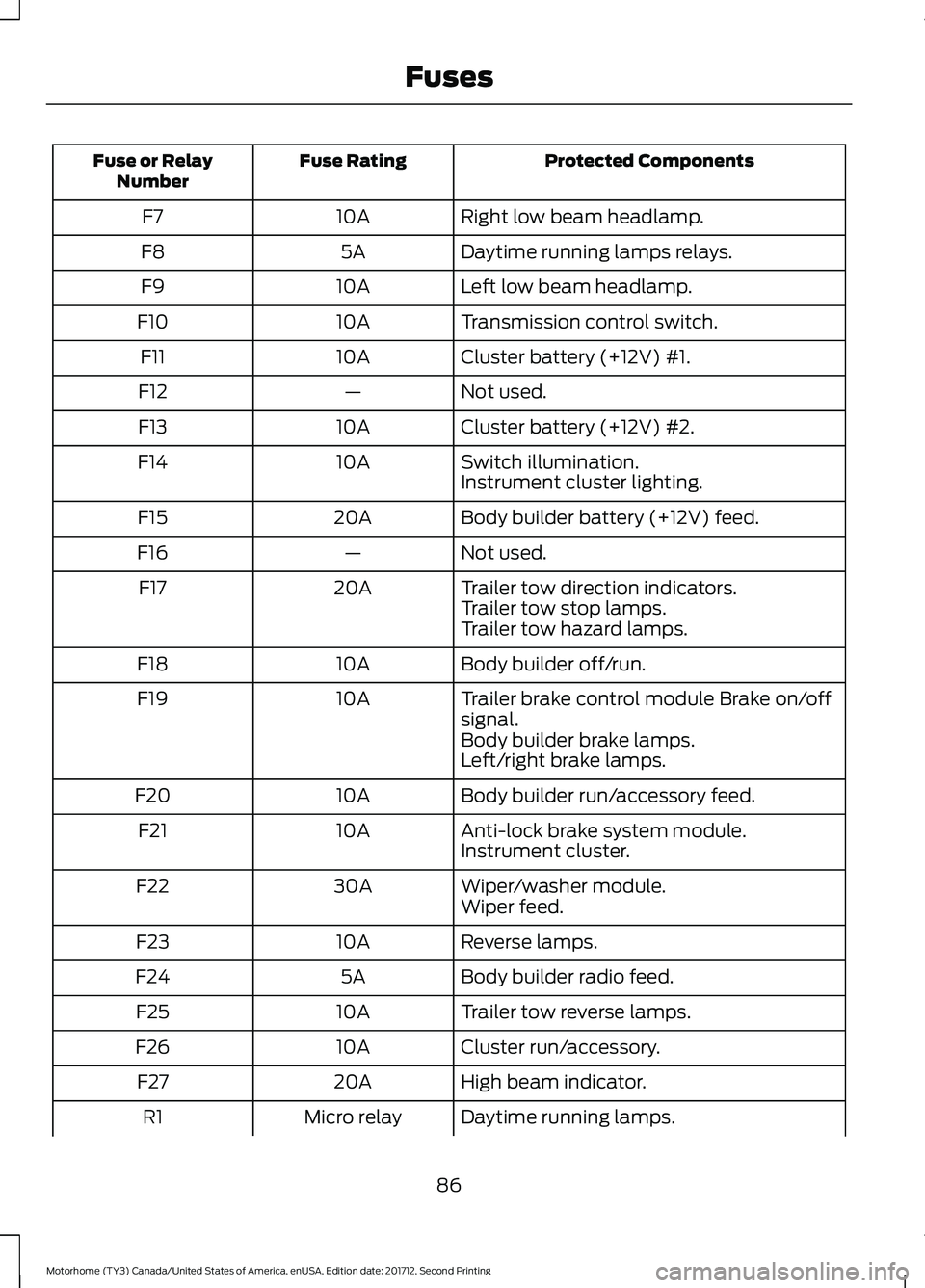
Protected Components
Fuse Rating
Fuse or Relay
Number
Right low beam headlamp.
10A
F7
Daytime running lamps relays.
5A
F8
Left low beam headlamp.
10A
F9
Transmission control switch.
10A
F10
Cluster battery (+12V) #1.
10A
F11
Not used.
—
F12
Cluster battery (+12V) #2.
10A
F13
Switch illumination.
10A
F14
Instrument cluster lighting.
Body builder battery (+12V) feed.
20A
F15
Not used.
—
F16
Trailer tow direction indicators.
20A
F17
Trailer tow stop lamps.
Trailer tow hazard lamps.
Body builder off/run.
10A
F18
Trailer brake control module Brake on/off
signal.
10A
F19
Body builder brake lamps.
Left/right brake lamps.
Body builder run/accessory feed.
10A
F20
Anti-lock brake system module.
10A
F21
Instrument cluster.
Wiper/washer module.
30A
F22
Wiper feed.
Reverse lamps.
10A
F23
Body builder radio feed.
5A
F24
Trailer tow reverse lamps.
10A
F25
Cluster run/accessory.
10A
F26
High beam indicator.
20A
F27
Daytime running lamps.
Micro relay
R1
86
Motorhome (TY3) Canada/United States of America, enUSA, Edition date: 201712, Second Printing Fuses
Page 96 of 168

Note:
Do not add oil further than the
maximum mark. Oil levels above the
maximum mark may cause engine damage.
Note: Make sure you install the oil filler cap
correctly.
Note: Soak up any spillage with an
absorbent cloth immediately.
OIL CHANGE INDICATOR
RESET
Resetting the Oil Life Monitoring
System
Only reset the oil life monitoring system
after changing the engine oil and oil filter.
To reset the oil life monitoring system do
the following:
1. Switch the ignition on. Do not start the
engine.
2. Fully press the accelerator and brake pedals at the same time.
3. Keep the accelerator and brake pedals
fully pressed.
4. After three seconds, a message displays confirming the reset procedure
is in progress.
5. After 25 seconds, a message displays confirming the reset procedure is
complete.
6. Release the accelerator and brake pedals.
7. Switch the ignition off. ENGINE COOLANT CHECK WARNINGS
Do not remove the coolant reservoir
cap when the cooling system is hot.
Wait 10 minutes for the cooling
system to cool down. Cover the coolant
reservoir cap with a thick cloth to prevent
the possibility of scalding and slowly
remove the cap. Failure to follow this
instruction could result in personal injury. Do not put coolant in the windshield
washer fluid reservoir. If sprayed on
the windshield, coolant could make
it difficult to see through the windshield. To reduce the risk of personal injury,
make sure the engine is cool before
unscrewing the coolant pressure
relief cap. The cooling system is under
pressure. Steam and hot liquid can come
out forcefully when you loosen the cap
slightly. Do not add coolant further than the
MAX mark.
When the engine is cold, check the
concentration and level of the coolant at
the intervals listed in the scheduled
maintenance information. See Scheduled
Maintenance
(page 140).
Note: Make sure that the coolant level is
between the
MIN and MAX marks on the
coolant reservoir.
Note: Coolant expands when it is hot. The
level may extend beyond the
MAX mark.
Maintain coolant concentration within
48% to 50%, which equates to a freeze
point between -30°F (-34°C) and -34°F
(-37°C). Coolant concentration should be
checked using a refractometer. We do not
recommend the use of hydrometers or
coolant test strips for measuring coolant
concentration.
93
Motorhome (TY3) Canada/United States of America, enUSA, Edition date: 201712, Second Printing Maintenance
Page 97 of 168

Adding Coolant
WARNING
Never remove the coolant reservoir
cap when the engine is running or
hot.
Note:
Automotive fluids are not
interchangeable. Take care not to put
engine coolant in the windshield washer
fluid reservoir or windshield washer fluid in
the engine coolant reservoir.
Note: Do not use stop leak pellets, cooling
system sealants, or non-specified additives
as they can cause damage to the engine
cooling or heating systems. Resulting
component damage may not be covered by
the vehicle Warranty.
It is very important to use prediluted
coolant approved to the correct
specification in order to avoid plugging the
small passageways in the engine cooling
system. See Capacities and
Specifications (page 129). Do not mix
different colors or types of coolant in your
vehicle. Mixing of engine coolants or using
an incorrect coolant may harm the engine
or cooling system components and may
not be covered by the vehicle Warranty.
Note: If prediluted coolant is not available,
use the approved concentrated coolant
diluting it to 50/50 with distilled water. See
Capacities and Specifications (page 129).
Using water that has not been deionised
may contribute to deposit formation,
corrosion and plugging of the small cooling
system passageways.
Note: Coolants marketed for all makes and
models may not be approved to Ford
specifications and may cause damage to
the cooling system. Resulting component
damage may not be covered by the vehicle
Warranty. If the coolant level is at or below the
minimum mark, add prediluted coolant
immediately.
To top up the coolant level do the
following:
1. Unscrew the cap slowly. Any pressure
escapes as you unscrew the cap.
2. Add prediluted coolant approved to the correct specification. See
Capacities and Specifications (page
129
).
3. Add enough prediluted coolant to reach the correct level.
4. Replace the coolant reservoir cap, turn
it clockwise until you feel a strong
resistance.
5. Check the coolant level in the coolant reservoir the next few times you drive
your vehicle. If necessary, add enough
prediluted engine coolant to bring the
coolant level to the correct level.
If you have to add more than
1.1 qt (1 L) of
engine coolant per month, have your
vehicle checked as soon as possible.
Operating an engine with a low level of
coolant can result in engine overheating
and possible engine damage.
Note: During normal vehicle operation, the
coolant may change color from orange to
pink or light red. As long as the coolant is
clear and uncontaminated, this color change
does not indicate the coolant has degraded
nor does it require the coolant to be drained,
the system to be flushed, or the coolant to
be replaced.
In case of emergency, you can add a large
amount of water without engine coolant
in order to reach a vehicle service location.
In this instance, qualified personnel:
1. Must drain the cooling system.
2. Chemically clean the coolant system with Motorcraft Premium Cooling
System Flush.
94
Motorhome (TY3) Canada/United States of America, enUSA, Edition date: 201712, Second Printing Maintenance
Page 104 of 168
4. Check the fluid level on the dipstick. It
should be between the arrows in the
FULL range on the side of the dipstick
with the words MAX. HOT at the top.
Do not add fluid if the level is within
this range.
5. If the fluid is low, add fluid in small amounts, continuously checking the level until it reaches the FULL range.
Be sure to put the dipstick back in the
reservoir.
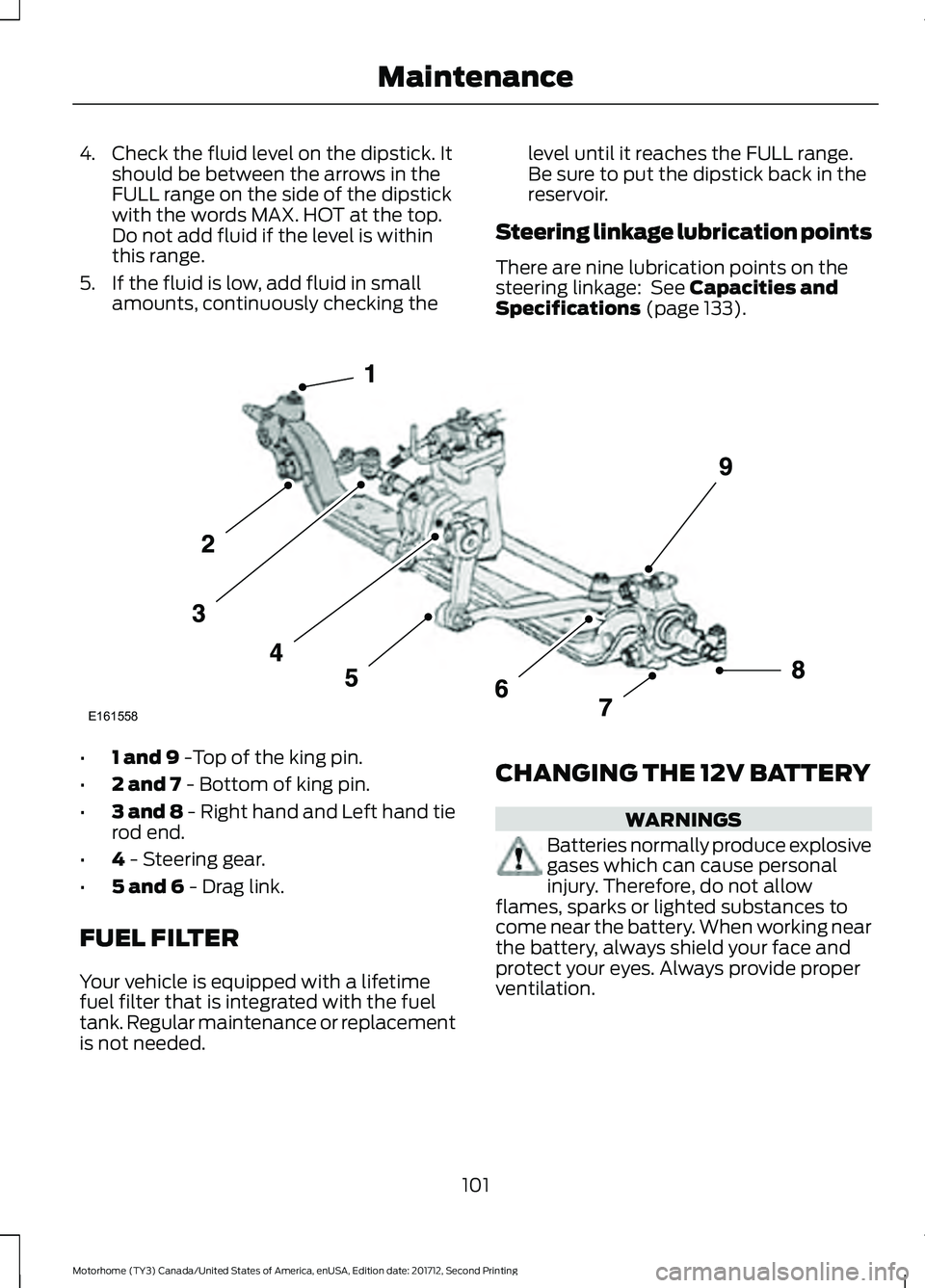
Steering linkage lubrication points
There are nine lubrication points on the
steering linkage: See Capacities and
Specifications (page 133). •
1 and 9
-Top of the king pin.
• 2 and 7
- Bottom of king pin.
• 3 and 8 - Right hand and Left hand tie
rod end.
• 4
- Steering gear.
• 5 and 6
- Drag link.
FUEL FILTER
Your vehicle is equipped with a lifetime
fuel filter that is integrated with the fuel
tank. Regular maintenance or replacement
is not needed. CHANGING THE 12V BATTERY WARNINGS
Batteries normally produce explosive
gases which can cause personal
injury. Therefore, do not allow
flames, sparks or lighted substances to
come near the battery. When working near
the battery, always shield your face and
protect your eyes. Always provide proper
ventilation.
101
Motorhome (TY3) Canada/United States of America, enUSA, Edition date: 201712, Second Printing MaintenanceE161558