2018 FORD F-59 engine oil
[x] Cancel search: engine oilPage 110 of 168

General
•
Store all vehicles in a dry, ventilated
place.
• Protect from sunlight, if possible.
• If vehicles are stored outside, they
require regular maintenance to protect
against rust and damage.
Body
• Wash your vehicle thoroughly to
remove dirt, grease, oil, tar or mud from
exterior surfaces, rear-wheel housing
and the underside of front fenders.
• Periodically wash your vehicle if it is
stored in exposed locations.
• Touch-up exposed or primed metal to
prevent rust.
• Cover chrome and stainless steel parts
with a thick coat of auto wax to prevent
discoloration. Re-wax as necessary
when you wash your vehicle.
• Lubricate all hood, door and luggage
compartment hinges and latches with
a light grade oil.
• Cover interior trim to prevent fading.
• Keep all rubber parts free from oil and
solvents.
Engine
• Change the engine oil and filter prior to
storage because used engine oil
contains contaminates which may
cause engine damage.
• Start the engine every 15 days for a
minimum of 15 minutes. Run at fast idle
with the climate controls set to defrost
until the engine reaches normal
operating temperature. •
With your foot on the brake, shift
through all the gears while the engine
is running.
• We recommend that you change the
engine oil before you use your vehicle
again.
Fuel system
• Fill the fuel tank with high-quality fuel
until the first automatic shutoff of the
fuel pump nozzle.
Cooling system
• Protect against freezing temperatures.
• When removing your vehicle from
storage, check coolant fluid level.
Confirm that there are no cooling
system leaks and that fluid is at the
recommended level.
Battery
• Check and recharge as necessary. Keep
connections clean.
• If storing your vehicle for more than 30
days without recharging the battery,
we recommend that you disconnect
the battery cables to maintain battery
charge for quick starting.
Note: It is necessary to reset memory
features if battery cables are disconnected.
Brakes
• Make sure the brakes and parking brake
release fully.
Tires
• Maintain recommended air pressure.
107
Motorhome (TY3) Canada/United States of America, enUSA, Edition date: 201712, Second Printing Vehicle Care
Page 132 of 168

ENGINE SPECIFICATIONS
6.8L Engine
Engine
415 in³ (6,800 cm³)
Displacement
1-6-5-10-2-7-3-8-4-9
Firing order
Coil on plug
Ignition system
0.039 in (1 mm) - 0.043 in (1.1 mm)
Spark plug gap
9.2:1
Compression ratio
Drivebelt Routing
Engines with Air Conditioning Engines without Air Conditioning
MOTORCRAFT PARTS
Motorcraft Part number
Component
FA-1782
Air filter element
BH-31-XT
Battery (F-53 stripped chassis and F-59
step van ramp prep package)
BH-31-XT
Battery (F-59 step van)
FL-820-S
Oil filter
129
Motorhome (TY3) Canada/United States of America, enUSA, Edition date: 201712, Second Printing Capacities and SpecificationsE270433 E270434
Page 133 of 168

Motorcraft Part number
Component
SP-509
Spark plugs
FT-187
Transmission fluid filter
We recommend Motorcraft replacement parts available at your Ford dealer or at
fordparts.com for scheduled maintenance. These parts meet or exceed Ford Motor
Company ’s specifications and are engineered for your vehicle. Use of other parts may
impact vehicle performance, emissions and durability. Your warranty may be void for any
damage related to use of other parts.
If a Motorcraft oil filter is not available, use an oil filter that meets industry performance
specification SAE/USCAR-36.
For spark plug replacement, contact an authorized dealer. Replace spark plugs at the
appropriate intervals. See Scheduled Maintenance (page 140).
130
Motorhome (TY3) Canada/United States of America, enUSA, Edition date: 201712, Second Printing Capacities and Specifications
Page 136 of 168
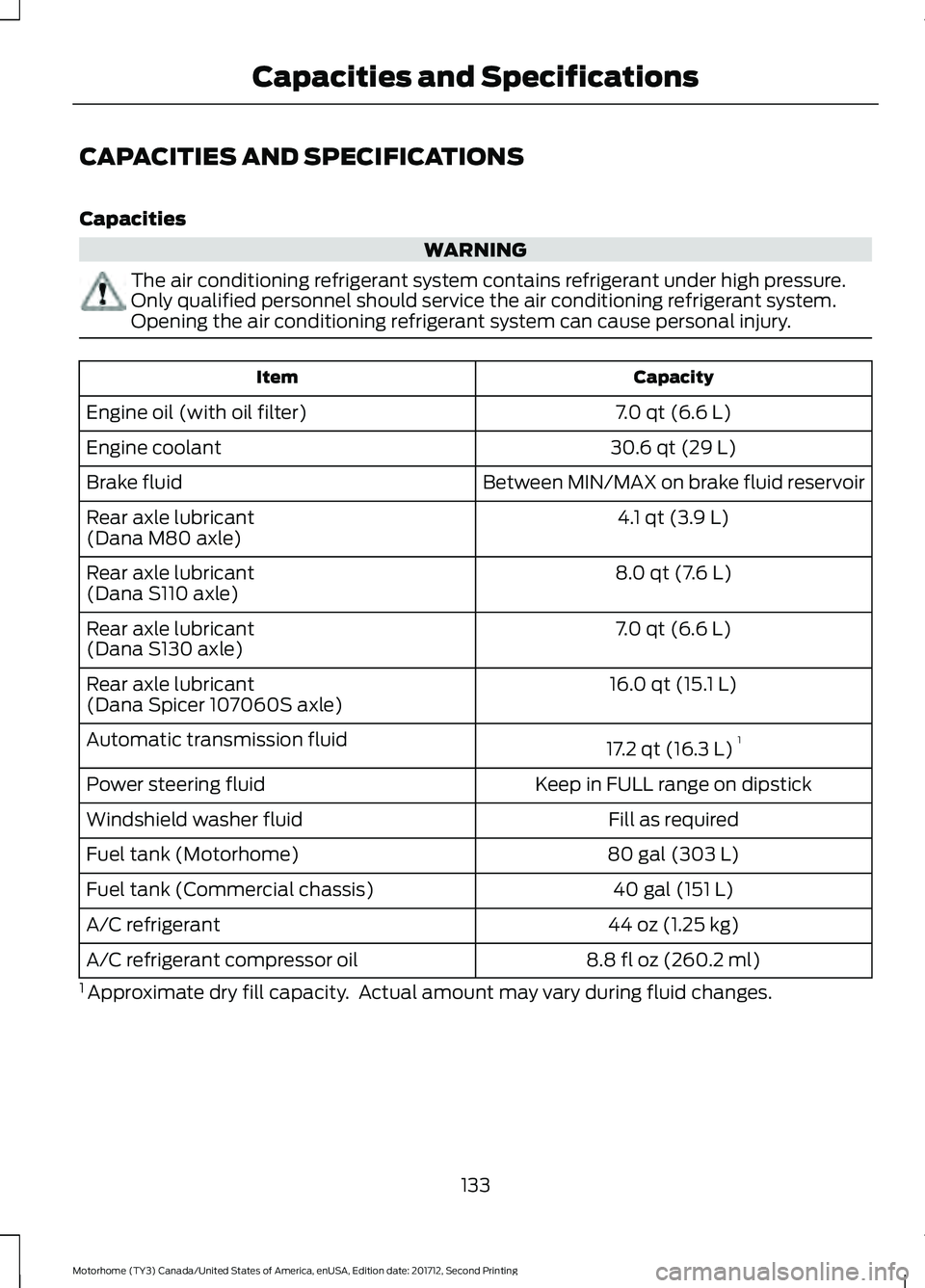
CAPACITIES AND SPECIFICATIONS
Capacities
WARNING
The air conditioning refrigerant system contains refrigerant under high pressure.
Only qualified personnel should service the air conditioning refrigerant system.
Opening the air conditioning refrigerant system can cause personal injury.
Capacity
Item
7.0 qt (6.6 L)
Engine oil (with oil filter)
30.6 qt (29 L)
Engine coolant
Between MIN/MAX on brake fluid reservoir
Brake fluid
4.1 qt (3.9 L)
Rear axle lubricant
(Dana M80 axle)
8.0 qt (7.6 L)
Rear axle lubricant
(Dana S110 axle)
7.0 qt (6.6 L)
Rear axle lubricant
(Dana S130 axle)
16.0 qt (15.1 L)
Rear axle lubricant
(Dana Spicer 107060S axle)
17.2 qt (16.3 L)1
Automatic transmission fluid
Keep in FULL range on dipstick
Power steering fluid
Fill as required
Windshield washer fluid
80 gal (303 L)
Fuel tank (Motorhome)
40 gal (151 L)
Fuel tank (Commercial chassis)
44 oz (1.25 kg)
A/C refrigerant
8.8 fl oz (260.2 ml)
A/C refrigerant compressor oil
1 Approximate dry fill capacity. Actual amount may vary during fluid changes.
133
Motorhome (TY3) Canada/United States of America, enUSA, Edition date: 201712, Second Printing Capacities and Specifications
Page 137 of 168
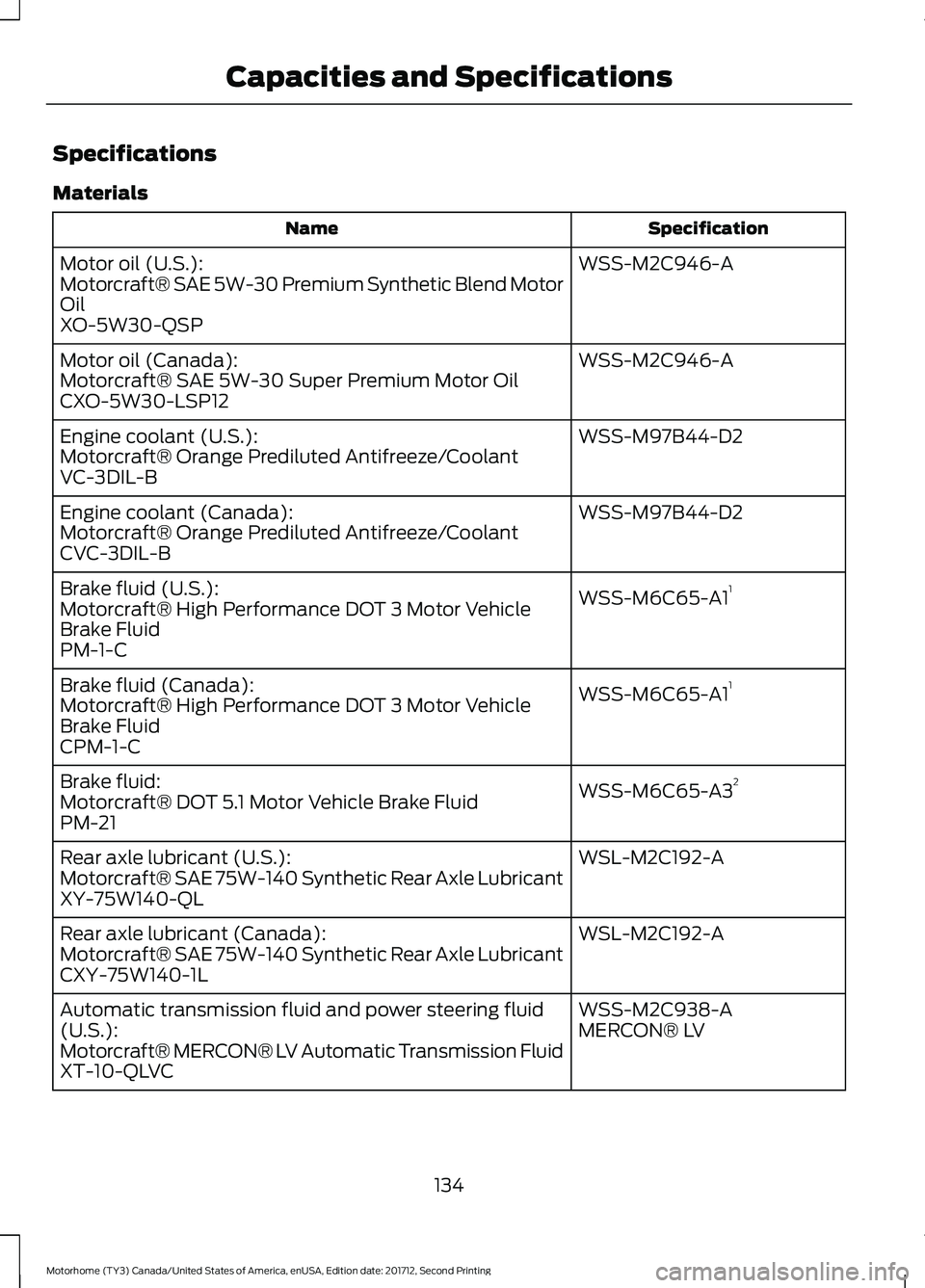
Specifications
Materials
Specification
Name
WSS-M2C946-A
Motor oil (U.S.):
Motorcraft® SAE 5W-30 Premium Synthetic Blend Motor
Oil
XO-5W30-QSP
WSS-M2C946-A
Motor oil (Canada):
Motorcraft® SAE 5W-30 Super Premium Motor Oil
CXO-5W30-LSP12
WSS-M97B44-D2
Engine coolant (U.S.):
Motorcraft® Orange Prediluted Antifreeze/Coolant
VC-3DIL-B
WSS-M97B44-D2
Engine coolant (Canada):
Motorcraft® Orange Prediluted Antifreeze/Coolant
CVC-3DIL-B
WSS-M6C65-A11
Brake fluid (U.S.):
Motorcraft® High Performance DOT 3 Motor Vehicle
Brake Fluid
PM-1-C
WSS-M6C65-A11
Brake fluid (Canada):
Motorcraft® High Performance DOT 3 Motor Vehicle
Brake Fluid
CPM-1-C
WSS-M6C65-A32
Brake fluid:
Motorcraft® DOT 5.1 Motor Vehicle Brake Fluid
PM-21
WSL-M2C192-A
Rear axle lubricant (U.S.):
Motorcraft® SAE 75W-140 Synthetic Rear Axle Lubricant
XY-75W140-QL
WSL-M2C192-A
Rear axle lubricant (Canada):
Motorcraft® SAE 75W-140 Synthetic Rear Axle Lubricant
CXY-75W140-1L
WSS-M2C938-A
Automatic transmission fluid and power steering fluid
(U.S.): MERCON® LV
Motorcraft® MERCON® LV Automatic Transmission Fluid
XT-10-QLVC
134
Motorhome (TY3) Canada/United States of America, enUSA, Edition date: 201712, Second Printing Capacities and Specifications
Page 139 of 168
If you use oil and fluids that do not meet
the defined specification and viscosity
grade, this may lead to:
•
Component damage which is not
covered by the vehicle warranty.
• Longer engine cranking periods.
• Increased emission levels.
• Reduced engine performance.
• Reduced fuel economy.
• Degraded brake performance.
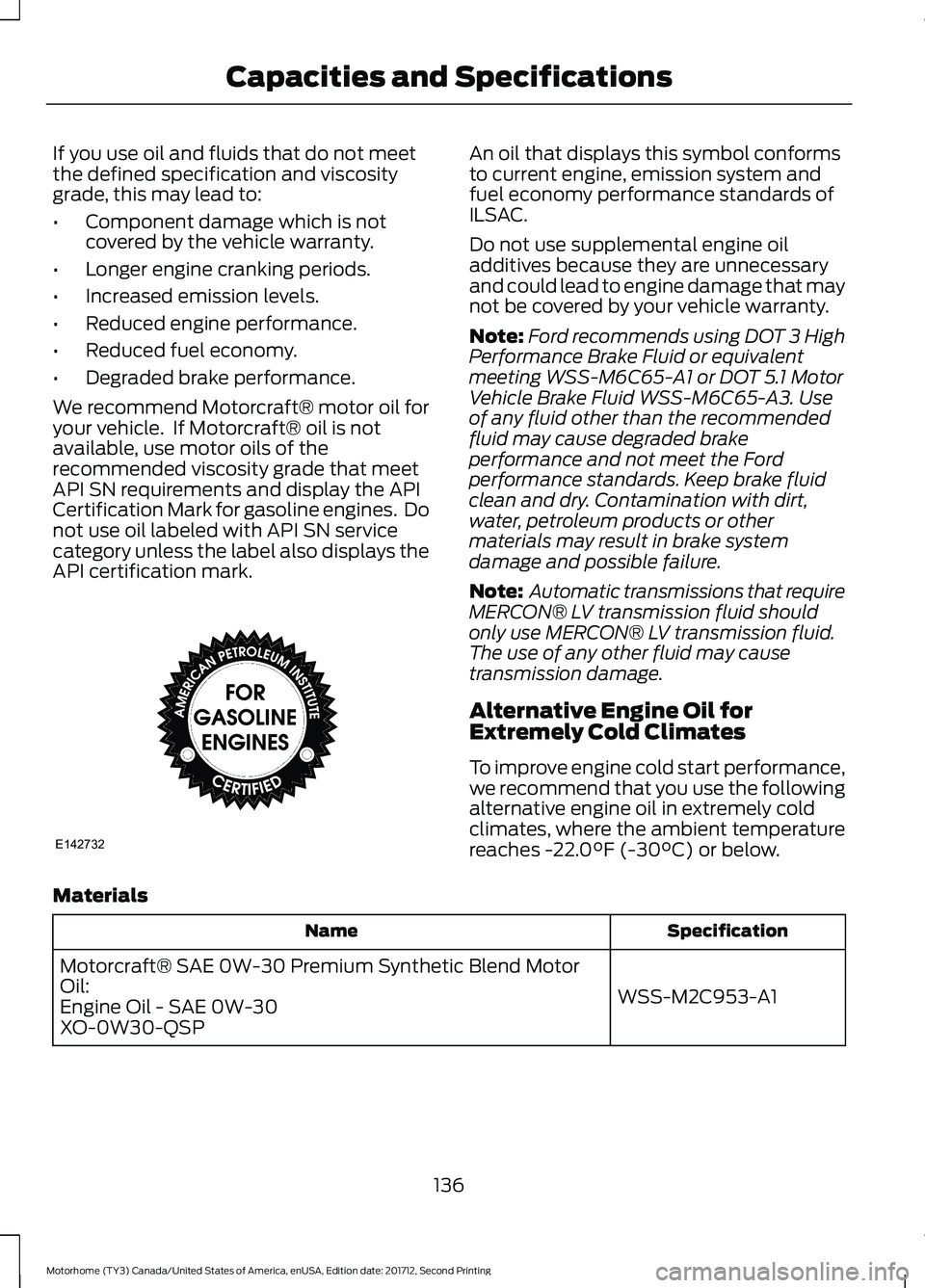
We recommend Motorcraft® motor oil for
your vehicle. If Motorcraft® oil is not
available, use motor oils of the
recommended viscosity grade that meet
API SN requirements and display the API
Certification Mark for gasoline engines. Do
not use oil labeled with API SN service
category unless the label also displays the
API certification mark. An oil that displays this symbol conforms
to current engine, emission system and
fuel economy performance standards of
ILSAC.
Do not use supplemental engine oil
additives because they are unnecessary
and could lead to engine damage that may
not be covered by your vehicle warranty.
Note:
Ford recommends using DOT 3 High
Performance Brake Fluid or equivalent
meeting WSS-M6C65-A1 or DOT 5.1 Motor
Vehicle Brake Fluid WSS-M6C65-A3. Use
of any fluid other than the recommended
fluid may cause degraded brake
performance and not meet the Ford
performance standards. Keep brake fluid
clean and dry. Contamination with dirt,
water, petroleum products or other
materials may result in brake system
damage and possible failure.
Note: Automatic transmissions that require
MERCON® LV transmission fluid should
only use MERCON® LV transmission fluid.
The use of any other fluid may cause
transmission damage.
Alternative Engine Oil for
Extremely Cold Climates
To improve engine cold start performance,
we recommend that you use the following
alternative engine oil in extremely cold
climates, where the ambient temperature
reaches -22.0°F (-30°C) or below.
Materials Specification
Name
WSS-M2C953-A1
Motorcraft® SAE 0W-30 Premium Synthetic Blend Motor
Oil:
Engine Oil - SAE 0W-30
XO-0W30-QSP
136
Motorhome (TY3) Canada/United States of America, enUSA, Edition date: 201712, Second Printing Capacities and SpecificationsE142732
Page 144 of 168
Ford Motor Company has recommended
maintenance intervals for various parts
and component systems based upon
engineering testing. Ford Motor Company
relies upon this testing to determine the
most appropriate mileage for replacement
of oils and fluids to protect your vehicle at
the lowest overall cost to you and
recommends against maintenance
schedules that deviate from the scheduled
maintenance information.
We strongly recommend the use of only
genuine Ford, Motorcraft or
Ford-authorized re-manufactured
replacement parts engineered for your
vehicle.
Additives and Chemicals
This owner's manual and the Ford
Workshop Manual list the recommended
additives and chemicals for your vehicle.
We do not recommend using chemicals or
additives not approved by us as part of
your vehicle
’s normal maintenance. Please
consult your warranty information. Oils, Fluids and Flushing
In many cases, fluid discoloration is a
normal operating characteristic and, by
itself, does not necessarily indicate a
concern or that the fluid needs to be
changed. However, a qualified expert, such
as the factory-trained technicians at your
dealership, should inspect discolored fluids
that also show signs of overheating or
foreign material contamination
immediately.
Make sure to change your vehicle
’s oils and
fluids at the specified intervals or in
conjunction with a repair. Flushing is a
viable way to change fluid for many vehicle
sub-systems during scheduled
maintenance. It is critical that systems are
flushed only with new fluid that is the same
as that required to fill and operate the
system or using a Ford-approved flushing
chemical.
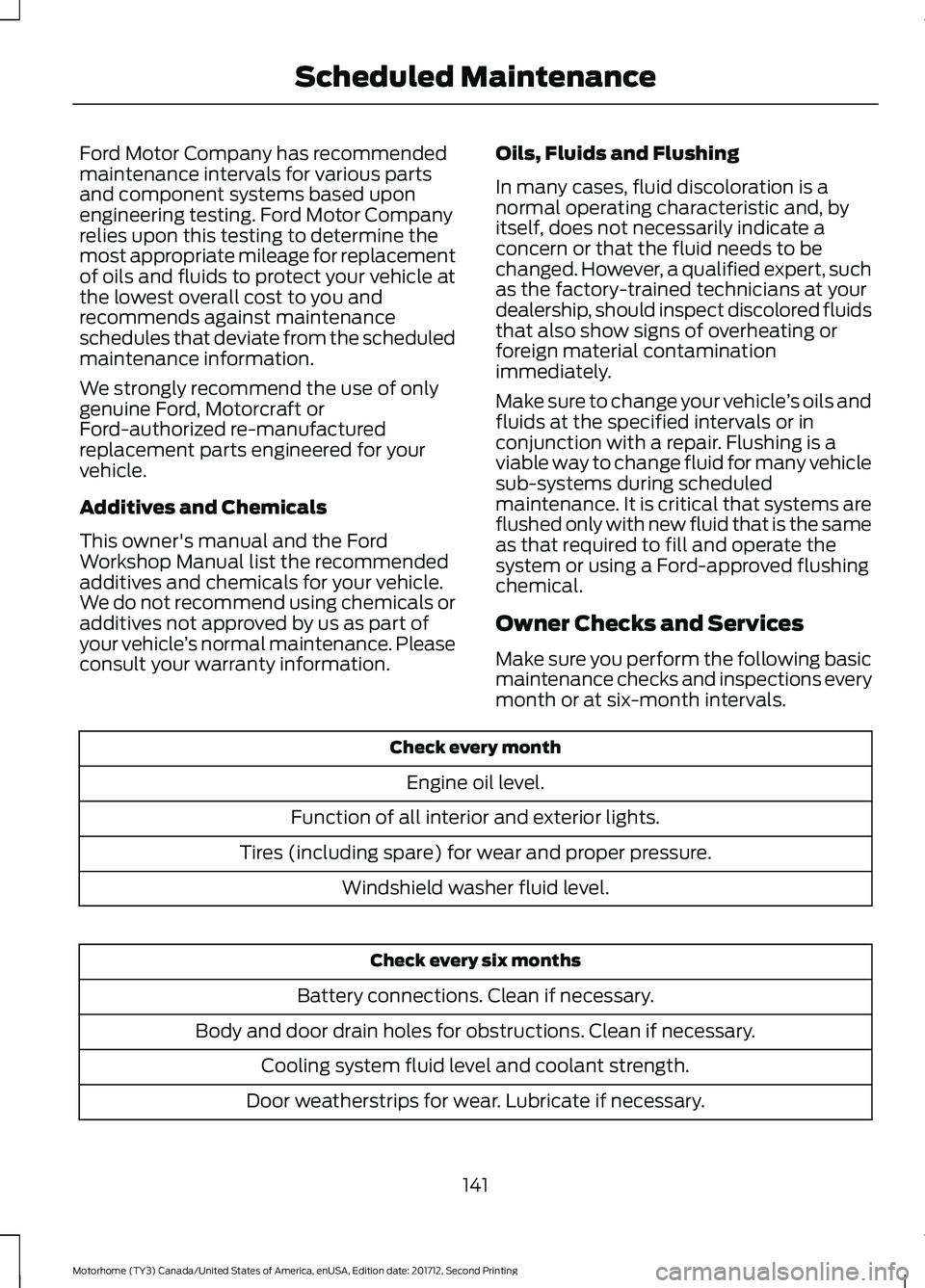
Owner Checks and Services
Make sure you perform the following basic
maintenance checks and inspections every
month or at six-month intervals. Check every month
Engine oil level.
Function of all interior and exterior lights.
Tires (including spare) for wear and proper pressure. Windshield washer fluid level. Check every six months
Battery connections. Clean if necessary.
Body and door drain holes for obstructions. Clean if necessary. Cooling system fluid level and coolant strength.
Door weatherstrips for wear. Lubricate if necessary.
141
Motorhome (TY3) Canada/United States of America, enUSA, Edition date: 201712, Second Printing Scheduled Maintenance
Page 145 of 168

Check every six months
Hinges, latches and outside locks for proper operation. Lubricate if necessary. Parking brake for proper operation.
Safety belts and seat latches for wear and function.
Safety warning lamps (brake, ABS, airbag and safety belt) for operation.
Washer spray and wiper operation. Clean or replace blades as necessary.
Multi-point Inspection
In order to keep your vehicle running right,
it is important to have the systems on your
vehicle checked regularly. This can help
identify potential issues and prevent major
problems. We recommend having the
following multi-point inspection performed
at every scheduled maintenance interval
to help make sure your vehicle keeps
running great. Multi-point inspection
Horn operation
Accessory drive belt(s)
Radiator, cooler, heater and A/C hoses
Battery performance
Suspension component for leaks ordamage
Engine air filter
Steering and linkage
Exhaust system
Tires (including spare) for wear and properpressure**
Exterior lamps and hazard warning system
operation
Windshield for cracks, chips or pits
Fluid levels *
; fill if necessary
Washer spray and wiper operation
For oil and fluid leaks
* Brake, coolant recovery reservoir, automatic transmission, power steering and window
washer.
** If your vehicle is equipped with a temporary mobility kit, check the tire sealant expiration
Use By date on the canister. Replace as needed.
142
Motorhome (TY3) Canada/United States of America, enUSA, Edition date: 201712, Second Printing Scheduled Maintenance