Page 219 of 517

BREAKING-IN
You need to break in new tires for
approximately 300 mi (480 km). During
this time, your vehicle may exhibit some
unusual driving characteristics.
Avoid driving too fast during the first
1,000 mi (1,600 km)
. Vary your speed
frequently and change up through the
gears early. Do not labor the engine.
Do not tow during the first
1,000 mi
(1,600 km).
ECONOMICAL DRIVING
Your fuel economy is affected by several
things, such as how you drive, the
conditions you drive under, and how you
maintain your vehicle.
You may improve your fuel economy by
keeping these things in mind:
• Accelerate and slow down in a smooth,
moderate fashion.
• Drive at steady speeds without
stopping.
• Anticipate stops; slowing down may
eliminate the need to stop.
• Combine errands and minimize
stop-and-go driving.
• Close the windows for high-speed
driving.
• Drive at reasonable speeds (traveling
at 55 mph [88 km/h] uses 15% less
fuel than traveling at 65 mph [105
km/h]).
• Keep the tires properly inflated and use
only the recommended size.
• Use the recommended engine oil.
• Perform all regularly scheduled
maintenance. Avoid these actions; they reduce your fuel
economy:
•
Sudden accelerations or hard
accelerations.
• Revving the engine before turning it off.
• Idle for periods longer than one minute.
• Warm up your vehicle on cold
mornings.
• Use the air conditioner or front
defroster.
• Use the speed control in hilly terrain.
• Rest your foot on the brake pedal while
driving.
• Drive a heavily loaded vehicle or tow a
trailer.
• Carry unnecessary weight
(approximately 1 mpg [0.4 km/L] is
lost for every 400 lb [180 kilogram] of
weight carried).
• Driving with the wheels out of
alignment.
Conditions
• Heavily loading a vehicle or towing a
trailer may reduce fuel economy at any
speed.
• Adding certain accessories to your
vehicle (for example bug deflectors,
rollbars, light bars, running boards, ski
racks or luggage racks) may reduce
fuel economy.
• To maximize the fuel economy, drive
with the tonneau cover installed (if
equipped).
• Using fuel blended with alcohol may
lower fuel economy.
• Fuel economy may decrease with lower
temperatures during the first
5–10 mi
(12 –16 km) of driving.
• Driving on flat terrain offers improved
fuel economy as compared to driving
on hilly terrain.
216
Escape (TM2) Canada/United States of America, JJ5J 19A321 AC enUSA, Edition date: 201706, Fourth-Printing Driving Hints
Page 236 of 517
Protected Component
Fuse Rating
Fuse or Relay
Number
Anti-lock brake system and electronic
stability program pump.
50A 1
F7
Electronic stability program valve.
30A 1
F8
Cooling fan (600 Watt)
40A 1
F9
Cooling fan (390 Watt and 750 Watt).
50A 1
Heater blower motor.
40A 1
F10
Body control module power feed.
30A 1
F11
Voltage quality module.
Powertrain control module relay.
30A 1
F12
Starter relay.
30A 1
F13
Cooling fan (600 Watt and 750 Watt).
25A 1
F14
Front cigar lighter or power outlet.
20A 1
F15
Front power window (without door control
unit).
25A 1
F16
Cooling fan (600 Watt).
40A 1
F17
Cooling fan (750 Watt).
50A 1
Center power outlet.
20A 1
F18
Anti-lock brake system and electronic
stability program 15 feed.
5A 2
F19
Horn.
15A 2
F20
Stop light switch.
5A 2
F21
Battery monitor system.
15A 2
F22
Relay coils.
5A 2
F23
233
Escape (TM2) Canada/United States of America, JJ5J 19A321 AC enUSA, Edition date: 201706, Fourth-Printing Fuses
Page 237 of 517
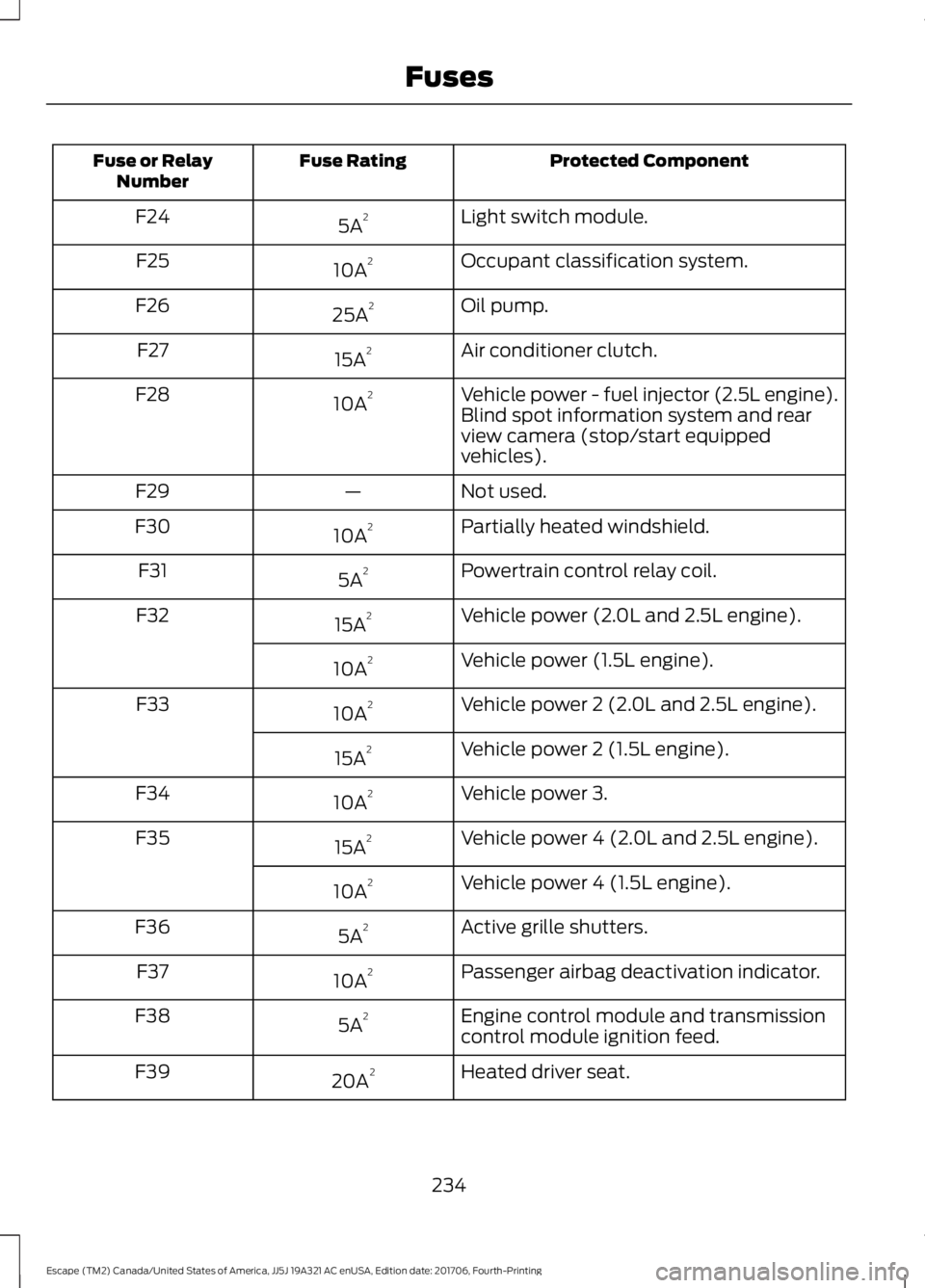
Protected Component
Fuse Rating
Fuse or Relay
Number
Light switch module.
5A 2
F24
Occupant classification system.
10A 2
F25
Oil pump.
25A 2
F26
Air conditioner clutch.
15A 2
F27
Vehicle power - fuel injector (2.5L engine).
10A 2
F28
Blind spot information system and rear
view camera (stop/start equipped
vehicles).
Not used.
—
F29
Partially heated windshield.
10A 2
F30
Powertrain control relay coil.
5A 2
F31
Vehicle power (2.0L and 2.5L engine).
15A 2
F32
Vehicle power (1.5L engine).
10A 2
Vehicle power 2 (2.0L and 2.5L engine).
10A 2
F33
Vehicle power 2 (1.5L engine).
15A 2
Vehicle power 3.
10A 2
F34
Vehicle power 4 (2.0L and 2.5L engine).
15A 2
F35
Vehicle power 4 (1.5L engine).
10A 2
Active grille shutters.
5A 2
F36
Passenger airbag deactivation indicator.
10A 2
F37
Engine control module and transmission
control module ignition feed.
5A 2
F38
Heated driver seat.
20A 2
F39
234
Escape (TM2) Canada/United States of America, JJ5J 19A321 AC enUSA, Edition date: 201706, Fourth-Printing Fuses
Page 242 of 517
Protected Component
Fuse Rating
Fuse or Relay
Number
Hands-free liftgate entry module.
5A
F1
Heated outside mirror (without door
control unit).
15A
F2
Heated wiper park.
Keyless vehicle door handles.
5A
F3
Door control unit front left.
25A
F4
Door control unit front right.
25A
F5
Door control unit rear left.
25A
F6
Door control unit rear right.
25A
F7
Passenger seat.
25A
F8
Driver seat.
25A
F9
Driver seat memory module logic feed.
5A
F10
Rear ignition coil feed.
5A
F11
Not used.
—
F12
Not used.
—
F13
High current power windows (front relay).
25A
F14
Not used (vehicles with one-touch up
power windows).
—
F15
239
Escape (TM2) Canada/United States of America, JJ5J 19A321 AC enUSA, Edition date: 201706, Fourth-Printing FusesE129927
Page 244 of 517
Protected Component
Fuse Rating
Fuse or Relay
Number
Not used.
—
F37
Not used.
—
F38
Not used.
—
F39
Not used.
—
F40
Not used.
—
F41
Not used.
—
F42
Not used.
—
F43
Not used.
—
F44
Not used.
—
F45
Heated outside mirror relay coil.
5A
F46
Delay accessory relay.
Power relay
R1
Rear 15 relay.
Mini relay
R2
Heated rear window relay.
Micro relay
R3
Not used.
—
R4
Not used.
—
R5
Heated outside mirror relay.
Micro relay
R6
CHANGING A FUSE
Fuses WARNING: Always replace a fuse
with one that has the specified amperage
rating. Using a fuse with a higher amperage
rating can cause severe wire damage and
could start a fire. If electrical components in the vehicle are
not working, a fuse may have blown. Blown
fuses are identified by a broken wire within
the fuse. Check the appropriate fuses
before replacing any electrical
components.
241
Escape (TM2) Canada/United States of America, JJ5J 19A321 AC enUSA, Edition date: 201706, Fourth-Printing FusesE217331
Page 248 of 517
Engine coolant reservoir. See
Engine Coolant Check (page
250).
A
Windshield washer fluid.
See
Washer Fluid Check (page 255).
B
Engine oil filler cap.
See Engine
Oil Check (page 248).
C
Engine oil dipstick.
See Engine
Oil Dipstick (page 248).
D Brake fluid reservoir.
See Brake
Fluid Check (page 254).
E
Battery.
See Changing the 12V
Battery (page 255).
F
Power distribution box.
See
Changing a Fuse (page 241).
G
Air filter.
See Changing the
Engine Air Filter (page 266).
H
UNDER HOOD OVERVIEW - 2.0L ECOBOOST™
245
Escape (TM2) Canada/United States of America, JJ5J 19A321 AC enUSA, Edition date: 201706, Fourth-Printing MaintenanceE280039
Page 249 of 517
Engine coolant reservoir: See
Engine Coolant Check (page
250).
A
Engine oil dipstick:
See Engine
Oil Dipstick (page 248).
B
Brake fluid reservoir:
See Brake
Fluid Check (page 254).
C
Battery:
See Changing the 12V
Battery (page 255).
D Power distribution box:
See
Fuses (page 232).
E
Air filter assembly:
See
Changing the Engine Air Filter
(page
266).
F
Engine oil filler cap:
See Engine
Oil Check (page 248).
G
Windshield washer fluid
reservoir:
See Washer Fluid
Check (page 255).
H
UNDER HOOD OVERVIEW - 2.5L
246
Escape (TM2) Canada/United States of America, JJ5J 19A321 AC enUSA, Edition date: 201706, Fourth-Printing MaintenanceE146022
Page 250 of 517
Windshield washer fluid
reservoir: See Washer Fluid
Check (page 255).
A
Engine coolant reservoir:
See
Engine Coolant Check (page
250).
B
Engine oil filler cap:
See Engine
Oil Check (page 248).
C
Engine oil dipstick:
See Engine
Oil Dipstick (page 248).
D
Brake fluid reservoir:
See Brake
Fluid Check (page 254).
E
Battery:
See Changing the 12V
Battery (page 255).
F Power distribution box:
See
Fuses (page 232).
G
Air filter assembly:
See
Changing the Engine Air Filter
(page
266).
H
247
Escape (TM2) Canada/United States of America, JJ5J 19A321 AC enUSA, Edition date: 201706, Fourth-Printing MaintenanceE260255


