2018 FORD E-450 stop start
[x] Cancel search: stop startPage 189 of 323

TIRE PRESSURE MONITORING
SYSTEM (If Equipped)
WARNING
The tire pressure monitoring system
is not a substitute for manually
checking tire pressures. You should
periodically check tire pressures using a
pressure gauge. Failure to correctly
maintain tire pressures could increase the
risk of tire failure, loss of control, vehicle
rollover and personal injury. Note:
You should only use tire sealants in
roadside emergencies as they may cause
damage to the tire pressure monitoring
system sensor.
Note: If the tire pressure monitoring system
sensor becomes damaged, it may not
function. Each tire, including the spare (if
provided), should be checked
monthly when cold and inflated
to the inflation pressure recommended by
the vehicle manufacturer on the vehicle
placard or tire inflation pressure label. (If
your vehicle has tires of a different size
than the size indicated on the vehicle
placard or tire inflation pressure label, you
should determine the proper tire inflation
pressure for those tires).
As an added safety feature, your vehicle
has been equipped with a Tire Pressure
Monitoring System (TPMS) that
illuminates a low tire pressure telltale
when one or more of your tires is
significantly under-inflated. Accordingly,
when the low tire pressure telltale
illuminates, you should stop and check
your tires as soon as possible, and inflate them to the proper pressure. Driving on a
significantly under-inflated tire causes the
tire to overheat and can lead to tire failure.
Under-inflation also reduces fuel efficiency
and tire tread life, and may affect the
vehicle
’s handling and stopping ability.
Please note that the TPMS is not a
substitute for proper tire maintenance, and
it is the driver ’s responsibility to maintain
correct tire pressure, even if under-inflation
has not reached the level to trigger
illumination of the TPMS low tire pressure
telltale.
Your vehicle has also been equipped with
a TPMS malfunction indicator to indicate
when the system is not operating properly.
The TPMS malfunction indicator is
combined with the low tire pressure
telltale. When the system detects a
malfunction, the telltale will flash for
approximately one minute and then remain
continuously illuminated. This sequence
will continue upon subsequent vehicle
start-ups as long as the malfunction exists.
When the malfunction indicator is
illuminated, the system may not be able
to detect or signal low tire pressure as
intended. TPMS malfunctions may occur
for a variety of reasons, including the
installation of replacement or alternate
tires or wheels on the vehicle that prevent
the TPMS from functioning properly.
Always check the TPMS malfunction
telltale after replacing one or more tires or
wheels on your vehicle to ensure that the
replacement or alternate tires and wheels
allow the TPMS to continue to function
properly.
This device complies with Part 15 of the
FCC Rules and with License exempt RSS
Standards of Industry Canada. Operation
is subject to the following two conditions:
1. This device may not cause harmful interference, and
186
E-Series (TE4) Canada/United States of America, enUSA, Edition date: 201712, Second Printing Wheels and Tires
Page 216 of 323

CLOCK: Press to display the
clock. To set the time, press and
hold until the hours start to flash.
Press the arrow buttons to
adjust the hours, then repeat to
set the minutes. Press again to
exit clock mode.
A
TUNE:
Press to search through
the radio frequency band.
B
AUDIO: Press to access settings
for Treble, Midrange, Bass, Fade
or Balance.
C
Seek:
Press to select a
frequency band. The system
stops at the first station it finds
in that direction.
D
Memory presets:
Store your
favorite radio stations. To store
a radio station, tune to the
station, then press and hold a
preset button until sound
returns.
E AM/FM:
Press to access
different audio modes, for
example AM, FM and auxiliary
input jack.
F
Vol and Power:
Turn to adjust
the volume. Press to switch the
system on and off.
G
DIGITAL RADIO
(If Equipped)
Note: HD Radio broadcasts are not
available in all markets.
HD Radio technology is the digital
evolution of analog AM/FM radio. Your
system has a special receiver that allows
it to receive digital broadcasts (where
available) in addition to the analog
broadcasts, it already receives. Digital
broadcasts provide a better sound quality
than analog broadcasts with free,
crystal-clear audio and no static or
distortion. For more information, and a
guide to available stations and
programming, please visit
www.hdradio.com.
213
E-Series (TE4) Canada/United States of America, enUSA, Edition date: 201712, Second Printing Audio SystemE163157
Page 265 of 323
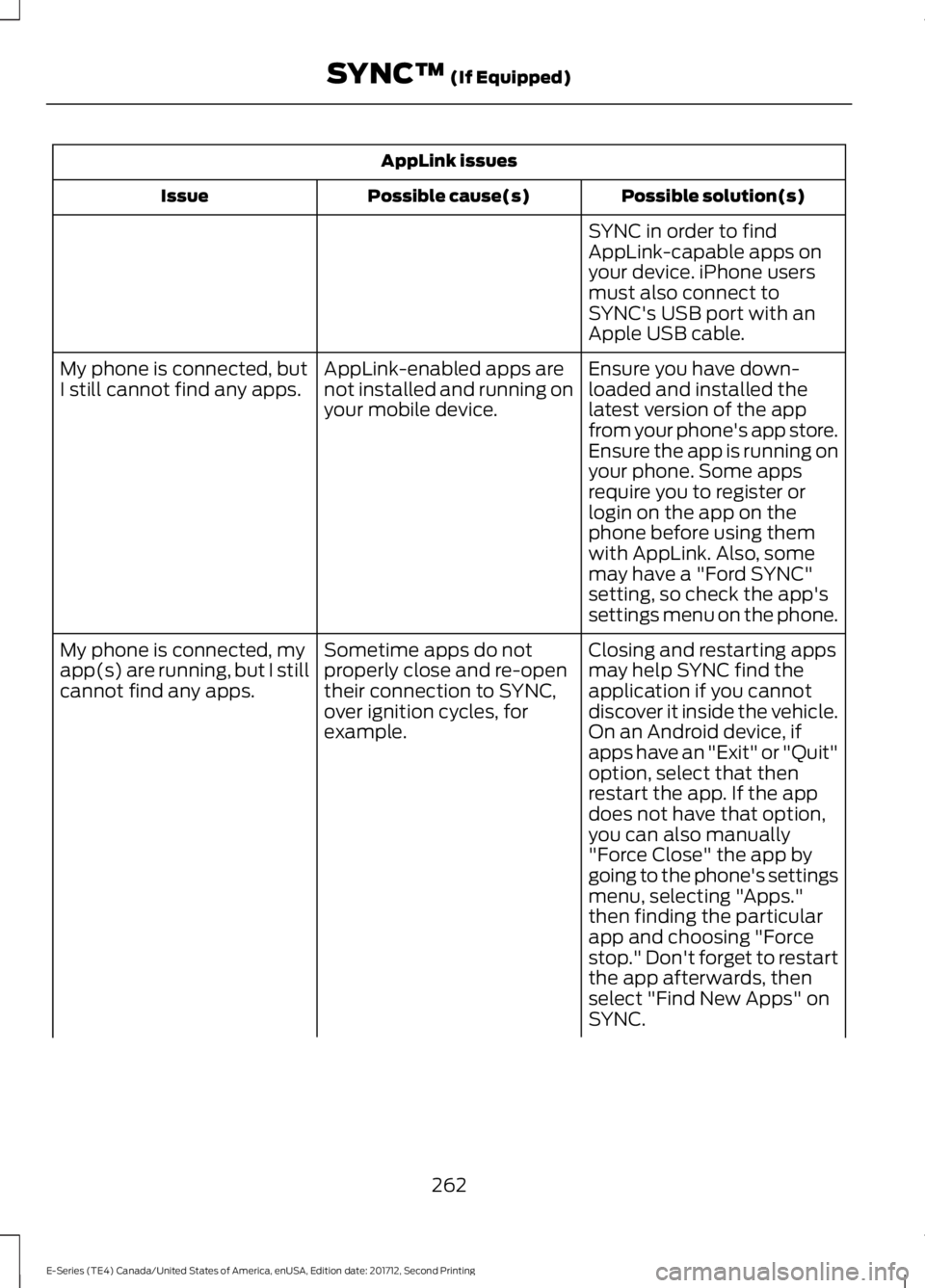
AppLink issues
Possible solution(s)
Possible cause(s)
Issue
SYNC in order to find
AppLink-capable apps on
your device. iPhone users
must also connect to
SYNC's USB port with an
Apple USB cable.
Ensure you have down-
loaded and installed the
latest version of the app
from your phone's app store.
Ensure the app is running on
your phone. Some apps
AppLink-enabled apps are
not installed and running on
your mobile device.
My phone is connected, but
I still cannot find any apps.
require you to register or
login on the app on the
phone before using them
with AppLink. Also, some
may have a "Ford SYNC"
setting, so check the app's
settings menu on the phone.
Closing and restarting apps
may help SYNC find the
application if you cannot
discover it inside the vehicle.
On an Android device, if
apps have an "Exit" or "Quit"
Sometime apps do not
properly close and re-open
their connection to SYNC,
over ignition cycles, for
example.
My phone is connected, my
app(s) are running, but I still
cannot find any apps.
option, select that then
restart the app. If the app
does not have that option,
you can also manually
"Force Close" the app by
going to the phone's settings
menu, selecting "Apps."
then finding the particular
app and choosing "Force
stop." Don't forget to restart
the app afterwards, then
select "Find New Apps" on
SYNC.
262
E-Series (TE4) Canada/United States of America, enUSA, Edition date: 201712, Second Printing SYNC™ (If Equipped)
Page 321 of 323

Scheduled Maintenance Record............277
Scheduled Maintenance...........................270
Seatbelt Extension........................................29
Seatbelt Height Adjustment......................27
Seatbelts...........................................................25 Principle of Operation......................................... 25
Seatbelt Warning Lamp and Indicator Chime..............................................................28
Conditions of operation..................................... 28
Seats...................................................................68
Security..............................................................43
Sitting in the Correct Position...................68
Snow Chains See: Using Snow Chains.................................. 185
Spare Wheel See: Changing a Road Wheel........................ 189
Special Notices
................................................10
New Vehicle Limited Warranty........................ 10
Notice to Owners of Pickup Trucks and Utility Type Vehicles......................................... 11
On Board Diagnostics Data Link Connector
............................................................. 11
Special Instructions............................................. 10
Using your Vehicle as an Ambulance..............11
Special Operating Conditions Scheduled Maintenance...............................................275
Exceptions............................................................. 277
Speed Control See: Cruise Control.............................................. 95
Starter Switch See: Ignition Switch............................................. 73
Starting a Gasoline Engine..........................73 Failure to Start....................................................... 74
Guarding Against Exhaust Fumes.................. 74
Important Ventilating Information.................74
Stopping the Engine When Your Vehicle is Moving.................................................................. 74
Stopping the Engine When Your Vehicle is Stationary........................................................... 74
Starting and Stopping the Engine............73 General Information............................................ 73
Steering.............................................................96
Steering Wheel
...............................................45
Sun Visors.........................................................50
Illuminated Vanity Mirror................................... 50
Supplementary Restraints System.........30 Principle of Operation........................................ 30
Symbols Glossary.............................................5 SYNC™ Applications and Services.......237
911 Assist................................................................ 237
SYNC Services: Traffic, Directions & Information (TDI) (If Equipped, United
States Only)..................................................... 241
Vehicle Health Report (If Equipped, United States Only).................................................... 239
SYNC™ AppLink ™
......................................245
SYNC Mobile Apps............................................ 245
SYNC™.............................................................219 General Information.......................................... 219
SYNC™ Troubleshooting.........................256
T
Technical Specifications See: Capacities and Specifications.............194
The Better Business Bureau (BBB) Auto Line Program (U.S. Only)........................124
Tire Care
...........................................................167
Glossary of Tire Terminology......................... 169
Information About Uniform Tire Quality Grading............................................................... 167
Information Contained on the Tire Sidewall............................................................. 170
Temperature A B C............................................. 168
Traction AA A B C............................................... 168
Treadwear............................................................. 168
Tire Pressure Monitoring System...........186 Changing Tires With a Tire Pressure
Monitoring System........................................ 187
Understanding Your Tire Pressure Monitoring System ....................................... 187
Tires See: Wheels and Tires...................................... 166
Towing a Trailer.............................................102 Load Placement................................................. 102
Towing the Vehicle on Four Wheels.......113 Emergency Towing.............................................. 113
Recreational Towing........................................... 113
Towing..............................................................102
Traction Control
..............................................92
Principle of Operation........................................ 92
Trailer Sway Control
....................................103
Transmission Code Designation.............198
Transmission...................................................86
Transporting the Vehicle.............................121
318
E-Series (TE4) Canada/United States of America, enUSA, Edition date: 201712, Second Printing Index