2018 FIAT FIORINO four wheel drive
[x] Cancel search: four wheel drivePage 70 of 196

ESC (Electronic
Stability Control)
SYSTEM
(for versions/markets, where provided)
This is an electronic system that
controls vehicle stability in the event of
tyre grip loss, helping to maintain
directional control. The system
is capable of recognising potentially
dangerous situations in terms of vehicle
stability and intervenes automatically
on the brakes in a differentiated manner
for the four wheels in order to provide
a stabilizing torque.
The ESC system switches on
automatically when the engine is
started and cannot be switched off.
The ESC system also includes the
following systems:
Hill Holder
ASR
MSR
HBA
SYSTEM INTERVENTION
This is signalled by the flashing of the
warning light in the instrument panel,
to inform the driver that the vehicle is
in critical stability and grip conditions.
Switching the system on
The ESC system is automatically
activated when the vehicle is started
and cannot be deactivated.Fault warnings
In the event of a failure, the ESC will be
automatically switched off and the
warning light
will come on constantly
in the instrument panel along with a
message in the multifunction display
(for versions/markets where provided)
(see “Warning lights and messages”
section in the "Knowing the instrument
panel" chapter). Contact a Fiat
Dealership as soon as possible.
44) 45) 46)
HILL HOLDER SYSTEM
(for versions/markets, where provided)
It is an integral part of the ESC system
and facilitates starting on an incline.
It is automatically activated in the
following conditions:
uphill: vehicle stationary on a road
with a gradient higher than 5%, engine
running, brake pedal pressed and
gearbox in neutral or gear other than
reverse;
downhill: vehicle stationary on a road
with a gradient higher than 5%, engine
running, brake pedal pressed and
reverse gear engaged.
When setting off, the ESC system
control unit maintains the braking
pressure on the wheels until the torque
necessary for starting is reached, or
in any case for a maximum of 2seconds, allowing your right foot to be
moved easily from the brake pedal to
the accelerator. When the 2 seconds
have elapsed, without starting, the
system is automatically deactivated,
gradually releasing the braking
pressure. During this release stage, the
typical brake disengagement noise
indicating that the vehicle is going to
move imminently will be heard.
Fault warnings
System failure is indicated by
instrument panel warning light
with
digital display and warning light
on
the instrument panel with multifunction
display (for versions/markets, where
provided) (see section “Warning lights
and messages” in the "Knowing the
instrument panel" chapter).
IMPORTANT The Hill Holder system is
not a parking brake, therefore do not
leave the vehicle without activating the
handbrake, switching off the engine
and engaging first gear.
47)
ASR SYSTEM (Antislip
Regulation)
(for versions/markets, where provided)
This is a traction control system that
cuts in automatically every time one or
both drive wheels slip.
68
SAFETY
Page 72 of 196
Maximum assistance of the HBA
system is obtained pressing the brake
pedal very quickly; in addition, the
brake pedal should be pressed
continuously during braking, avoiding
intermittent presses, to obtain benefits
from the system. Do not reduce
pressure on the brake pedal until
braking is no longer necessary. The
HBA system is deactivated when the
brake pedal is released.
52) 53) 54)
WARNING
44)The ESC system can’t overrule the
natural laws of physics, and can’t increase
the grip available according to the
condition of the road.
45)The ESC system cannot prevent
accidents, including those due to excessive
speed on corners, driving on low-grip
surfaces or aquaplaning.
46)The capability of the ESC system must
never be tested irresponsibly and
dangerously, in such a way as to
compromise personal safety and the safety
of others.
47)For the ESC and ASR systems to
function correctly, all four tyres must be the
same brand and type, must be in excellent
condition and, above all, must be of the
prescribed type and size.48)The ASR cannot overrule the natural
laws of physics, and cannot increase
the grip available according to the
condition of the road.
49)The ASR system cannot prevent
accidents, including those due to excessive
speed on corners, driving on low-grip
surfaces or aquaplaning.
50)The capability of the ASR must never
be tested irresponsibly and dangerously, in
such a way as to compromise personal
safety and the safety of others.
51)Do not take unnecessary risks, even if
your vehicle is fitted with this system.
Your driving style must always be suited to
the road conditions, visibility and traffic.
The driver is always responsible for road
safety.
52)The HBA system cannot overrule the
natural laws of physics, and cannot
increase the grip available according to the
condition of the road.
53)The HBA system cannot prevent
accidents, including those due to excessive
speed on corners, driving on low-grip
surfaces or aquaplaning.
54)The capability of the HBA must never
be tested irresponsibly and dangerously, in
such a way as to compromise personal
safety and the safety of others.
iTPMS System
(indirect Tyre
Pressure
Monitoring System)
(for versions/markets, where provided)
The indirect Tyre Pressure Monitoring
System iTPMS can monitor the tyre
inflation status through the wheel speed
sensors. The system warns the driver
if one or more tyres are flat by switching
on the
warning light on the
instrument panel and a warning
message on the display, along with an
acoustic signal.
It is advisable to check the pressure of
all four tyres. This indication is displayed
also when turning the engine off and
on until the “Reset” procedure is carried
out.
“Reset” procedure
The iTPMS needs an initial "self-
learning" phase (with length depending
on the driving style and road conditions:
optimal conditions being driving on a
straight road at 80 km/h for at least 20
minutes) which starts when the “Reset”
procedure is carried out.
The “Reset” procedure must be carried
out:
each time tyre pressure is modified;
when even only one tyre is changed;
when tyres are rotated/inverted;
70
SAFETY
Page 74 of 196
59)If the vehicle must be placed on a roller
bench (at a speed within 5 and 30 km/h)
for maintenance interventions or if it is
washed in an automatic roller washing
tunnel with an obstacle in the front part
(e.g. another vehicle, a wall or another
obstacle), the system may detect its
presence and activate. In this case the
system must be deactivated through the
display Setup Menu.
WARNING
12)The laser sensor may have limited or
absent operation due to weather
conditions such as: heavy rain, hail, thick
fog, heavy snow, formation of ice layers on
the windscreen.
13)Sensor operation may also be
compromised by the presence of dust,
condensation, dirt or ice on the
windscreen, by traffic conditions (e.g.
vehicles that are driving not aligned with
your vehicle, vehicle driving in a transverse
or opposite way on the same lane, bend
with a small radius of curvature), by road
surface conditions and by driving
conditions (e.g. off-road driving). Make sure
the windscreen is always clean. Use
specific detergents and clean cloths to
avoid scratching the windscreen. The
sensor operation may also be limited or
absent in some driving, traffic and road
surface conditions.14)Projecting loads on the roof of the
vehicle may interfere with the correct
operation of the sensor. Before starting
make sure the load is correctly positioned,
in order not to cover the sensor operating
range.
15)If the windscreen must be replaced
due to scratches, chipping or breakage,
contact exclusively a Fiat Dealership.
Do not replace the windscreen on your
own, risk of malfunction! It is advisable to
replace the windscreen if it is damaged
in the laser sensor area.
16)Do not tamper nor operate on the laser
sensor. Do not close the openings in the
aesthetic cover located under the interior
rear view mirror. In the event of a sensor
failure, contact a Fiat Dealership.
17)If you are driving on roads close to
trees with protruding branches it is
advisable to deactivate the system to
prevent the branches at the height of the
bonnet or the windscreen from interfering
with the system.
18)Do not cover the operating range of the
sensor with stickers or other objects. Also
pay attention to other objects on the
bonnet of the vehicle (e.g. a layer of snow)
and make sure they do not interfere with
the light emitted by the laser.
19)If a trailer or a vehicle is towed the
system must be deactivated with the
display Setup Menu.
20)If the system signals a loss of pressure
on a specific tyre, it is recommended to
check the pressure on all four tyres.
TRACTION PLUS
SYSTEM
(for versions/markets, where provided)
Traction Plus is a driving aid, useful
for setting off in poor grip conditions
(snow, ice, mud, etc.) which allows the
drive force to be distributed in the
best way over the front axle when one
wheel is slipping.
Traction Plus acts by braking the
wheels with poor grip (or those slipping
more than the others), thereby
transferring the drive force to those
which have greater grip on the ground.
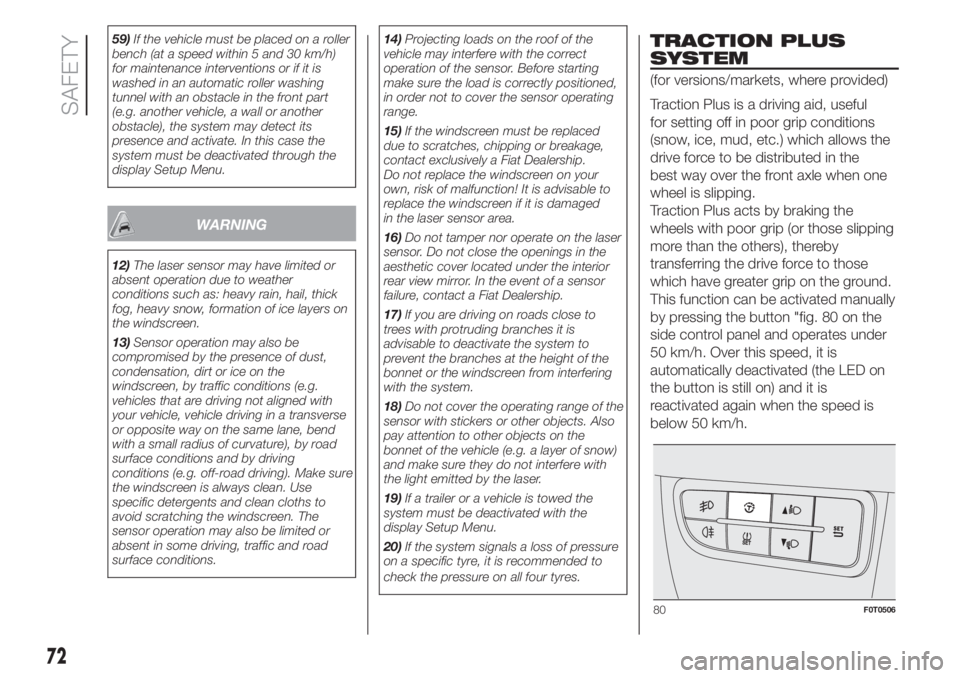
This function can be activated manually
by pressing the button "fig. 80 on the
side control panel and operates under
50 km/h. Over this speed, it is
automatically deactivated (the LED on
the button is still on) and it is
reactivated again when the speed is
below 50 km/h.
80F0T0506
72
SAFETY