2018 FIAT 124 SPIDER maintenance
[x] Cancel search: maintenancePage 66 of 220

Warning light What it means
TCS / DSC SYSTEM INDICATOR LIGHT
The warning light turns on when the in case of intervention of TCS/DSC systems. This means
that the vehicle is in critical stability and grip conditions.
DSC OFF INDICATOR LIGHT
The warning light turns on when the ESC system is deactivated.
REAR FOG LIGHT INDICATOR LIGHT
The warning light switches on when the rear fog light is turned on.
ADJUSTABLE SPEED LIMITER MAIN INDICATOR LIGHT
The warning light switches on when the MODE switch on steering wheel is pressed and the
adjustable speed limiter is activated (see “Speed limiter” paragraph in “Starting and driving”
chapter).
WRENCH INDICATOR LIGHT (where provided)
When the ignition is switched ON, the wrench indicator light is illuminated and then turns off
after a few seconds.
The wrench indicator light is illuminated when the preset maintenance period arrives. Verify the
content and perform maintenance. Refer to “Maintenance monitor” paragraph in this chapter.
64
KNOWING THE INSTRUMENT PANEL
Page 76 of 220

74)The capability of the DSC system must
never be tested irresponsibly and
dangerously, in such a way as to
compromise personal safety and the safety
of others.
75)If the active bonnet has activated,
always contact a Fiat Dealership. If the
bonnet release handle is pulled after the
active bonnet has activated, the bonnet will
rise even further. If the vehicle is driven with
the bonnet raised it will obstruct visibility
and could result in an accident. In addition,
do not attempt to push the bonnet back
down. Otherwise, it could deform the
bonnet or cause injury because the
activated bonnet cannot be lowered
manually. Before driving the vehicle contact
a Fiat Dealership after the active bonnet
has activated, make sure that the raised
bonnet does not obstruct vision and drive
the vehicle at a low speed.AUXILIARY DRIVING
SYSTEMS
TPMS (Tire Pressure
Monitoring System)
76) 77) 78)
The Tire Pressure Monitoring System
(TPMS) monitors the air pressure of all
four tires. If the air pressure of one or
more tires is too low, the system warns
the driver by indicating the tire pressure
monitoring system warning light
in
the instrument cluster and operating a
beep sound. The system monitors the
tire pressures indirectly using the data
sent from the ABS wheel speed
sensors.
To allow the system to operate
correctly, the system needs to be
initialized with the specified tire pressure
(value on the tire pressure label). Refer
to “Tire Pressure Monitoring System
Initialization” in this paragraph.
The warning light flashes when the
system has a malfunction. Refer to
“Warning lights and messages”
paragraph in “Knowing the instrument
panel” chapter.
IMPORTANT Each tire, including the
spare (where provided), should be
checked monthly when cold and
inflated to the inflation pressure
recommended by the vehiclemanufacturer on the vehicle placard or
tire inflation pressure label (if your
vehicle has tires of a different size than
the size indicated on the vehicle placard
or tire inflation pressure label, you
should determine the proper tire
inflation pressure for those tires).
IMPORTANT As an added safety
feature, your vehicle has been equipped
with a TPMS system that illuminates a
low tire pressure telltale when one or
more of your tires is significantly
under-inflated. Accordingly, when the
low tire pressure telltale illuminates, you
should stop and check your tires as
soon as possible, and inflate them to
the proper pressure. Driving on a
significantly under-inflated tire causes
the tire to overheat and can lead to tire
failure. Under-inflation also reduces fuel
efficiency and tire tread life, and may
affect the vehicle's handling and
stopping ability.
IMPORTANT Please note that the
TPMS is not a substitute for proper tire
maintenance, and it is the driver's
responsibility to maintain correct tire
pressure, even if under-inflation has not
reached the level to trigger illumination
of the TPMS low tire pressure telltale.
Your vehicle has also been equipped
with a TPMS malfunction indicator to
74
SAFETY
Page 80 of 220

applied, the vehicle has not stopped
completely, or the clutch pedal is
released.
IMPORTANT While Hill Launch Assist is
operating, the brake pedal may feel stiff
and vibrate, however, this does not
indicate a malfunction.
IMPORTANT Hill Launch Assist does
not operate while the TCS/DSC
indicator light is illuminated. Refer to
“Warning lights and messages”
paragraph in “Knowing the instrument
panel” chapter.
IMPORTANT Hill Launch Assist (HLA)
does not turn off even if the DSC OFF
switch is pressed to turn off the
TCS/DSC.
IMPORTANT For vehicles with an
automatic transmission although the Hill
Launch Assist does not operate during
idling stop, the vehicle roll prevention
function operates to prevent vehicle roll.
IMPORTANT Do not rely completely on
Hill Launch Assist. Hill Launch Assist is
an auxiliary device for accelerating from
a stop on a slope. The system only
operates for about two seconds and
therefore, relying only on the system,
when accelerating from a stop is
dangerous because the vehicle may
move (roll) unexpectedly and cause anaccident. The vehicle could roll
depending on the vehicle's load or if it
is towing something. In addition, for
vehicles with a manual transmission,
the vehicle could still roll depending on
how the clutch pedal or the accelerator
pedal is operated. Always confirm the
safety around the vehicle before starting
to drive the vehicle.
WARNING
76)The presence of the TPMS does not
permit the driver to neglect regular checks
of the tire pressure, including for the spare
wheel, and correct maintenance: the
system is not used to signal a possible fault
to a tire. Tire pressure must be checked
with tires rested and cold. Should it
become necessary for whatever reason to
check pressure with warm tires, do not
reduce pressure even though it is higher
than the prescribed value. Repeat the
check when the tires are cold.
77)Replacing the normal tires with winter
tires and vice versa requires an inspection
of the TPMS, which should be carried out
only by a Fiat Dealership.
78)Changes in outside temperature may
cause tire pressures to vary. The system
may temporarily indicate insufficient
pressure. In this case check the tire
inflation pressure with the tires cold and, if
necessary top up the inflation pressure.
OCCUPANT
PROTECTION
SYSTEMS
The most important safety equipment
of the vehicle comprise the following
protection systems:
seat belts;
SBA (Seat Belt Alert) system;
head restraints;
child restraint systems;
front air bags and side air bags.
Read the information given the following
pages with the utmost care.
It is of fundamental importance that the
protection systems are used in the
correct way to guarantee the maximum
possible safety level for the driver and
the passengers.
78
SAFETY
Page 154 of 220
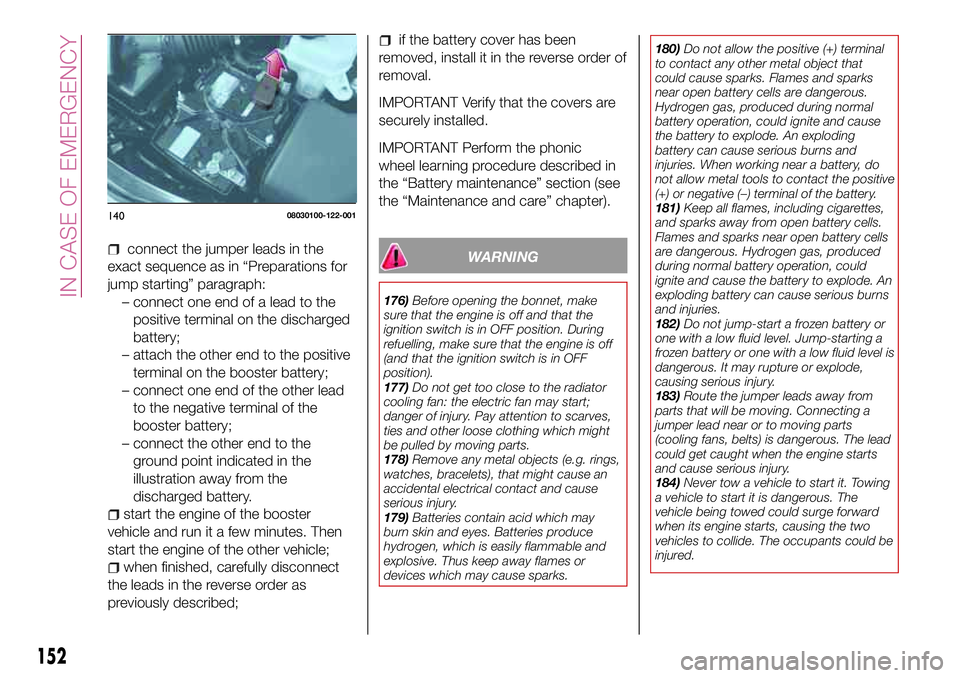
connect the jumper leads in the
exact sequence as in “Preparations for
jump starting” paragraph:
– connect one end of a lead to the
positive terminal on the discharged
battery;
– attach the other end to the positive
terminal on the booster battery;
– connect one end of the other lead
to the negative terminal of the
booster battery;
– connect the other end to the
ground point indicated in the
illustration away from the
discharged battery.
start the engine of the booster
vehicle and run it a few minutes. Then
start the engine of the other vehicle;
when finished, carefully disconnect
the leads in the reverse order as
previously described;
if the battery cover has been
removed, install it in the reverse order of
removal.
IMPORTANT Verify that the covers are
securely installed.
IMPORTANT Perform the phonic
wheel learning procedure described in
the “Battery maintenance” section (see
the “Maintenance and care” chapter).
WARNING
176)Before opening the bonnet, make
sure that the engine is off and that the
ignition switch is in OFF position. During
refuelling, make sure that the engine is off
(and that the ignition switch is in OFF
position).
177)Do not get too close to the radiator
cooling fan: the electric fan may start;
danger of injury. Pay attention to scarves,
ties and other loose clothing which might
be pulled by moving parts.
178)Remove any metal objects (e.g. rings,
watches, bracelets), that might cause an
accidental electrical contact and cause
serious injury.
179)Batteries contain acid which may
burn skin and eyes. Batteries produce
hydrogen, which is easily flammable and
explosive. Thus keep away flames or
devices which may cause sparks.180)Do not allow the positive (+) terminal
to contact any other metal object that
could cause sparks. Flames and sparks
near open battery cells are dangerous.
Hydrogen gas, produced during normal
battery operation, could ignite and cause
the battery to explode. An exploding
battery can cause serious burns and
injuries. When working near a battery, do
not allow metal tools to contact the positive
(+) or negative (–) terminal of the battery.
181)Keep all flames, including cigarettes,
and sparks away from open battery cells.
Flames and sparks near open battery cells
are dangerous. Hydrogen gas, produced
during normal battery operation, could
ignite and cause the battery to explode. An
exploding battery can cause serious burns
and injuries.
182)Do not jump-start a frozen battery or
one with a low fluid level. Jump-starting a
frozen battery or one with a low fluid level is
dangerous. It may rupture or explode,
causing serious injury.
183)Route the jumper leads away from
parts that will be moving. Connecting a
jumper lead near or to moving parts
(cooling fans, belts) is dangerous. The lead
could get caught when the engine starts
and cause serious injury.
184)Never tow a vehicle to start it. Towing
a vehicle to start it is dangerous. The
vehicle being towed could surge forward
when its engine starts, causing the two
vehicles to collide. The occupants could be
injured.
14008030100-122-001
152
IN CASE OF EMERGENCY
Page 158 of 220

MAINTENANCE AND CARE
Correct maintenance permits the
performance of the vehicle to be
maintained over time, as well as limited
running costs and safeguarding the
efficiency of the safety systems.SCHEDULED SERVICING.......157
ENGINE COMPARTMENT......163
BATTERY RECHARGING.......167
WHEELS AND TIRES..........168
BODYWORK...............170
INTERIORS................172
156
MAINTENANCE AND CARE
Page 159 of 220
SCHEDULED
SERVICING
INTRODUCTION
Be extremely careful and prevent injury
to yourself and others or damage to
your vehicle when using this manual for
inspection and maintenance.
If you are unsure about any procedure it
describes, we strongly urge you to have
a reliable and qualified service shop
perform the work, preferably at Fiat
Dealership.
Factory-trained FCA technicians and
genuine FCA parts are best for your
vehicle. Without this expertise and the
parts that have been designed and
made especially for your vehicle,
inadequate, incomplete, and insufficient
servicing may result in problems. This
could lead to vehicle damage or an
accident and injuries.
For expert advice and quality service,
contact a Fiat Dealership.
The owner should retain evidence that
proper maintenance has been
performed as prescribed.
A claim against a warranty will not
qualify if it results from lack of
maintenance and not from defective
material or authorised workmanship.
Claims against the warranty resulting
from lack of maintenance, as opposedto defective materials or authorized FCA
workmanship, will not be honored.
Scheduled maintenance
NOTE After the prescribed period,
continue to follow the described
maintenance at the recommended
intervals.
Emission control and related
systems
The ignition and fuel systems are highly
important to the emission control
system and to efficient engine
operation. Do not tamper with them.
All inspections and adjustments must
be made by an expert repairer, we
recommend a Fiat Dealership.
OWNER MAINTENANCE
PRECAUTIONS
186) 187) 188)
38)
Routine service
We highly recommend that these items
be inspected daily, or at least every
week:
Engine oil level
Engine coolant level
Brake and clutch fluid Level
Washer fluid level
Battery maintenance
Tire inflation pressure
Improper or incomplete service may
result in problems. This section gives
instructions only for items that are easy
to perform.
As explained in the “Introduction”
paragraph, several procedures can be
done only by a qualified service
technician with special tools.
Improper do-it yourself maintenance
during the warranty period may affect
warranty coverage. For details, read the
separate Warranty statement provided
with the vehicle. If you are unsure about
any servicing or maintenance
procedure, have it done by an expert
repairer, we recommend a Fiat
Dealership.
There are strict environmental laws
157
Page 160 of 220

regarding the disposal of waste oil and
fluids. Please dispose of your waste
properly and with due regard to the
environment.
We recommend that you entrust the oil
and fluid changes of your vehicle to a
Fiat Dealership.
PERIODIC CHECKS
Every1,000 kmor before long trips
check and, if necessary, top up:
engine coolant level;
brake fluid level;
windscreen washer fluid level;
tire inflation pressure and condition;
operation of lighting system
(headlights, direction indicators, hazard
warning lights, etc.);
operation of windscreen
washer/wiper system and
positioning/wear of windscreen window
wiper blades.
Every 3,000 km, check and top up if
required: engine oil level.
HEAVY-DUTY USE OF THE
VEHICLE
If the vehicle is used under one of the
following conditions:
dusty roads;
short, repeated journeys (less than
7-8 km) at sub-zero outside
temperatures;
engine often idling or driving long
distances at low speeds or long periods
of inactivity;
the following checks must be carried
out more often than indicated in the
Scheduled Servicing Plan:
check front disc brake pad condition
and wear;
check cleanliness of bonnet and
luggage compartment locks,
cleanliness and lubrication of linkage;
visually inspect conditions of: engine,
gearbox, transmission, pipes and hoses
(exhaust/fuel system/brakes) and
rubber elements (gaiters/sleeves/
bushes, etc.);
check battery charge and battery
fluid level (electrolyte);
visually inspect conditions of the
accessory drive belts;
check and, if necessary, change
engine oil and replace oil filter;
check and, if necessary, replace
pollen filter;
check and, if necessary, replace air
cleaner.
158
MAINTENANCE AND CARE
Page 162 of 220

160
MAINTENANCE AND CARE
Thousands of miles9 182736455463728190
Thousands of kilometers15 30 45 60 75 90 105 120 135 150
Years12345678910
Check endfloat of wheel bearings and front and
rear joints●●●●●
Check windscreen wiper blade position/wear●●●●●
Check operation of the wiper/washer system
and adjust jets, if necessary●●●●●
Check cleanliness of bonnet and boot locks, as
well as cleanliness and lubrication of linkages●●●●●
Check handbrake lever travel and adjust, if
necessary●●●●●●●●●●
Visually inspect conditions and wear of front/rear
disk brake pads and integrity of pad wear
indicator
●●●●●●●●●●
Visually inspect condition of evaporation control
system●●●
Visually inspect condition and tensioning of
accessory drive belt(s)●
Visually inspect conditions of toothed timing
drive belt●
Change transmission oil●
Change engine oil and replace oil filter●●●●●●●●●●