Page 418 of 568

Points To Remember
NOTE:When the vehicle is stopped after a few miles/
kilometers of operation, you may observe vapor coming
from the front of the engine compartment. This is normally
a result of moisture from rain, snow, or high humidity
accumulating on the radiator and being vaporized when
the thermostat opens, allowing hot engine coolant (anti-
freeze) to enter the radiator.
If an examination of your engine compartment shows no
evidence of radiator or hose leaks, the vehicle may be
safely driven. The vapor will soon dissipate.
• Do not overfill the coolant expansion bottle.
• Check the coolant freeze point in the radiator and in the
coolant expansion bottle. If engine coolant (antifreeze)
needs to be added, the contents of the coolant expansion
bottle must also be protected against freezing.
• If frequent engine coolant (antifreeze) additions are
required, the cooling system should be pressure tested
for leaks.
•
Maintain engine coolant (antifreeze) concentration at a
minimum of 50% OAT coolant (conforming to MS.90032)
and distilled water for proper corrosion protection of your
engine which contains aluminum components.
• Make sure that the coolant expansion bottle overflow
hoses are not kinked or obstructed.
• Keep the front of the radiator clean. If your vehicle is
equipped with air conditioning, keep the front of the
condenser clean.
• Do not change the thermostat for Summer or Winter
operation. If replacement is ever necessary, install ONLY
the correct type thermostat. Other designs may result in
unsatisfactory engine coolant (antifreeze) performance,
poor gas mileage, and increased emissions.
Brake System
In order to assure brake system performance, all brake
system components should be inspected periodically. Refer
to the “Maintenance Plan” in this section for the proper
maintenance intervals.
WARNING!
Riding the brakes can lead to brake failure and possi-
bly a collision. Driving with your foot resting or riding
on the brake pedal can result in abnormally high brake
temperatures, excessive lining wear, and possible
brake damage. You would not have your full braking
capacity in an emergency.
416 SERVICING AND MAINTENANCE
Page 459 of 568
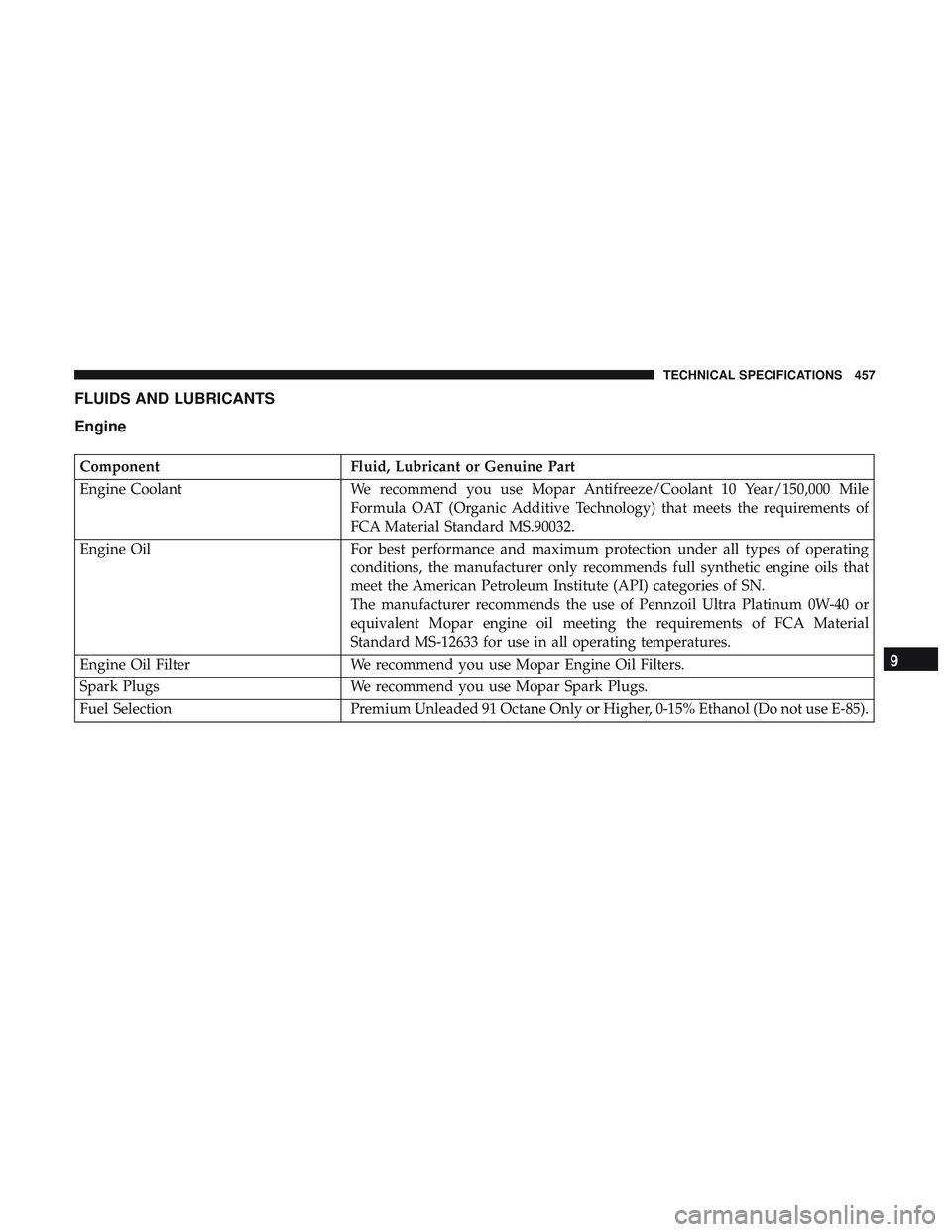
FLUIDS AND LUBRICANTS
Engine
ComponentFluid, Lubricant or Genuine Part
Engine Coolant We recommend you use Mopar Antifreeze/Coolant 10 Year/150,000 Mile
Formula OAT (Organic Additive Technology) that meets the requirements of
FCA Material Standard MS.90032.
Engine Oil For best performance and maximum protection under all types of operating
conditions, the manufacturer only recommends full synthetic engine oils that
meet the American Petroleum Institute (API) categories of SN.
The manufacturer recommends the use of Pennzoil Ultra Platinum 0W-40 or
equivalent Mopar engine oil meeting the requirements of FCA Material
Standard MS-12633 for use in all operating temperatures.
Engine Oil Filter We recommend you use Mopar Engine Oil Filters.
Spark Plugs We recommend you use Mopar Spark Plugs.
Fuel Selection Premium Unleaded 91 Octane Only or Higher, 0-15% Ethanol (Do not use E-85).
9
TECHNICAL SPECIFICATIONS 457
Page 492 of 568
•Coolant Temperature
Shows the actual coolant temperature.
• Battery Voltage
Shows the actual battery voltage.
• Trans Oil Temp
Shows the current transmission oil temperature.
• Intake Air Temperature
Shows the actual air intake temperature.
If a gauge is selected, the Gauge Detail View page will
appear on the screen. This page shows further information
on the selected gauge.
Pressing the left or right arrows will cycle through the
details for each gauge. Pressing the lower X button in the
top right corner will return to the gauge main menu.
Gauge Detail View Page
490 MULTIMEDIA
Page 553 of 568

Anti-Lock Warning Light.....................159
Apple CarPlay ............................539
Arming System Security Alarm ...........................30
Assist, Hill Start .......................... .170
Audio Systems (Radio) .......................462
Auto Down Power Windows ...................98
Automatic Headlights ........................70
Automatic High Beams .......................70
Automatic Temperature Control (ATC) ............94
Automatic Transmission ..................257, 268
Adding Fluid ........................419, 458
Autostick ............................. .274
Fluid And Filter Change ...................419
Fluid Change .......................... .419
Fluid Level Check ........................418
Fluid Type ..........................418, 458
Gear Ranges ............................269
Special Additives ........................ .418
Automatic Transmission Limp Home Mode ........273
Autostick ............................... .274
Auxiliary Electrical Outlet (Power Outlet) .........122
Auxiliary Power Outlet ..................... .122
Axle Lubrication .......................... .458Battery
...............................153, 397
Charging System Light ....................153
Keyless Key Fob Replacement ................19
Belts, Seat ............................... .249
Blind Spot Monitoring .......................179
Body Mechanism Lubrication ..................405
B-Pillar Location .......................... .426
Brake Assist System ........................ .170
Brake Control System, Electronic ................169
Brake Fluid .......................... .417, 458
Brake System ..........................416, 451
Anti-Lock (ABS) ........................ .451
Fluid Check ........................ .417,458
Master
Cylinder ........................ .417
Parking ...............................264
Warning Light .......................... .151
Brake/Transmission Interlock ..................267
Bulb Replacement .......................358, 359
Bulbs, Light ............................. .251
Camera, Rear ............................ .330
Capacities, Fluid .......................... .456
Caps, Filler Oil (Engine) ..................... .395, 398, 399
Radiator (Coolant Pressure) .................415
12
INDEX 551