Page 33 of 568

NOTE:
•The driver’s door key cylinder and the liftgate button on
the key fob cannot arm or disarm the vehicle security
alarm.
• The vehicle security alarm remains armed during power
liftgate entry. Pushing the liftgate button will not disarm
the vehicle security alarm. If someone enters the vehicle
through the liftgate and opens any door, the alarm will
sound.
• When the vehicle security alarm is armed, the interior
power door lock switches will not unlock the doors.
The vehicle security alarm is designed to protect your
vehicle. However, you can create conditions where the
system will give you a false alarm. If one of the previously
described arming sequences has occurred, the vehicle
security alarm will arm regardless of whether you are in
the vehicle or not. If you remain in the vehicle and open a
door, the alarm will sound. If this occurs, disarm the
vehicle security alarm. If the vehicle security alarm is armed and the battery
becomes disconnected, the vehicle security alarm will
remain armed when the battery is reconnected; the exterior
lights will flash, and the horn will sound. If this occurs,
disarm the vehicle security alarm.
Rearming Of The System
If something triggers the alarm, and no action is taken to
disarm it, the vehicle security alarm will turn the horn off
after 29 seconds, five seconds between cycles, up to eight
cycles if the trigger remains active and the vehicle security
alarm will rearm itself.
Tamper Alert
If something has triggered the vehicle security alarm in
your absence, the horn will sound three times and the
exterior lights will blink three times when you disarm the
vehicle security alarm. Check the vehicle for tampering.
3
GETTING TO KNOW YOUR VEHICLE 31
Page 34 of 568

DOORS
Manual Door Locks
The power door locks can be manually locked from inside the
vehicle by using the door lock knob. To lock each door, push the
door lock knob on each door trim panel downward. To unlock
the front doors, pull the inside door handle to the first detent. To
unlock the rear doors, pull the door lock knob on the door trim
panel upward. If the lock knob is down when the door is closed,
the door will lock. Therefore, make sure the key is not inside the
vehicle before closing the door.
WARNING!
•For personal security and safety in the event of an
collision, lock the vehicle doors as you drive as well
as when you park and leave the vehicle.
• Never leave children alone in a vehicle, or with
access to an unlocked vehicle.
• Allowing children to be in a vehicle unattended is
dangerous for a number of reasons. A child or others
could be seriously or fatally injured. Children
should be warned not to touch the parking brake,
brake pedal or the gear selector.
• Do not leave the key fob in or near the vehicle, or in
a location accessible to children, and do not leave the
ignition of a vehicle equipped with Keyless Enter-
N-Go in the ACC or ON/RUN mode. A child could
operate power windows, other controls, or move the
vehicle.
• When leaving the vehicle, always make sure the
keyless ignition node is in the �Off�mode, remove
the key fob from the vehicle and lock the vehicle.
Unsupervised use of the vehicle equipment may
cause severe person injuries and death.
Manual Door Lock Knob
32 GETTING TO KNOW YOUR VEHICLE
Page 36 of 568

NOTE:
•Passive Entry may be programmed ON/OFF. Refer to
“Uconnect Settings” in “Multimedia” for further infor-
mation.
• If wearing gloves on your hands, or if it has been
raining/snowing on the Passive Entry door handle, the
unlock sensitivity can be affected, resulting in a slower
response time.
• If the vehicle is unlocked by Passive Entry and no door
is opened within 60 seconds, the vehicle will re-lock and
if equipped will arm the security alarm.
• The key fob may not be able to be detected by the vehicle
passive entry system if it is located next to a mobile
phone, laptop or other electronic device; these devices
may block the key fob’s wireless signal and prevent the
passive entry handle from locking/unlocking the ve-
hicle.
• Passive Entry activates illuminated approach for the
time set by the customer (0, 30, 60, or 90 seconds), and
flashes the turn signal lights. Refer to “Uconnect Set-
tings” in “Multimedia” for further information To Unlock From The Driver’s Side:
With a valid Passive Entry key fob within 5 ft (1.5 m) of the
driver’s door handle, grab the driver’s front door handle to
unlock the driver’s door automatically. The interior door
panel lock knob will raise when the door is unlocked.
NOTE:
If “Unlock All Doors 1st Press” is programmed, all
doors will unlock when you grab hold of the driver ’s front
door handle. To select between “Unlock Driver Door 1st
Press” and “Unlock All Doors 1st Press”, refer to “Uconnect
Settings” in “Multimedia” for further information.
Grab The Door Handle To Unlock
34 GETTING TO KNOW YOUR VEHICLE
Page 55 of 568
To Raise Rear Seat
Fold the seat rearward to it’s original position, and lock it
into place.
WARNING!
Be certain that the seatback is securely locked into
position. If the seatback is not securely locked into
position the seat will not provide the proper stability
for child seats and/or passengers. An improperly
latched seat could cause serious injury.
Rear Captain’s Chairs — If Equipped
Second Row Captain Chair Fold Flat Seats
The second row seats can be folded flat to carry cargo.
Pull upward on the release lever located on the outboard
side of the seat.
Release Lever
3
GETTING TO KNOW YOUR VEHICLE 53
Page 58 of 568
To Raise Rear Seat
Fold the seat rearward to it’s original position, and lock it
into place.
WARNING!
Be certain that the seatback is securely locked into
position. If the seatback is not securely locked into
position the seat will not provide the proper stability
for child seats and/or passengers. An improperly
latched seat could cause serious injury.
Folding Third Row
Both third row seats can be folded forward to increase the
cargo area. To lower either seat, pull on the release handle
located on back of the seat and lower the seat using the pull
strap located next to the release handle.
Release Handles
56 GETTING TO KNOW YOUR VEHICLE
Page 59 of 568

NOTE:The second row seats must be in their full upright
position or tumbled when folding the third row seats.
To raise the seat, pull the seat toward you using the strap
located on the back of the seat.
NOTE: You may experience deformation in the seat cush-
ion from the seat belt buckles if the seats are left folded for
an extended period of time. This is normal and by simply
opening the seats to the open position, over time the seat
cushion will return to its normal shape.
WARNING!
Be certain that the seatback is securely locked into
position. If the seatback is not securely locked into
position the seat will not provide the proper stability
for child seats and/or passengers. An improperly
latched seat could cause serious injury.
HEAD RESTRAINTS
Head restraints are designed to reduce the risk of injury by
restricting head movement in the event of a rear impact.
Head restraints should be adjusted so that the top of the
head restraint is located above the top of your ear.
WARNING!
•All occupants, including the driver, should not operate
a vehicle or sit in a vehicle’s seat until the head
restraints are placed in their proper positions in order to
minimize the risk of neck injury in the event of a crash.
•Head restraints should never be adjusted while the
vehicle is in motion. Driving a vehicle with the head
restraints improperly adjusted or removed could cause
serious injury or death in the event of a collision.
Third Row Folded
3
GETTING TO KNOW YOUR VEHICLE 57
Page 62 of 568
WARNING!
•All occupants, including the driver, should not oper-
ate a vehicle or sit in a vehicle’s seat until the head
restraints are placed in their proper positions in
order to minimize the risk of neck injury in the event
of a collision.
• Do not place items over the top of the Active Head
Restraint, such as coats, seat covers or portable DVD
players. These items may interfere with the opera-
tion of the Active Head Restraint in the event of a
collision and could result in serious injury or death.
• Active Head Restraints may be deployed if they are
struck by an object such as a hand, foot or loose
cargo. To avoid accidental deployment of the Active
Head Restraint ensure that all cargo is secured, as
loose cargo could contact the Active Head Restraint
during sudden stops. Failure to follow this warning
could cause personal injury if the Active Head Re-
straint is deployed.
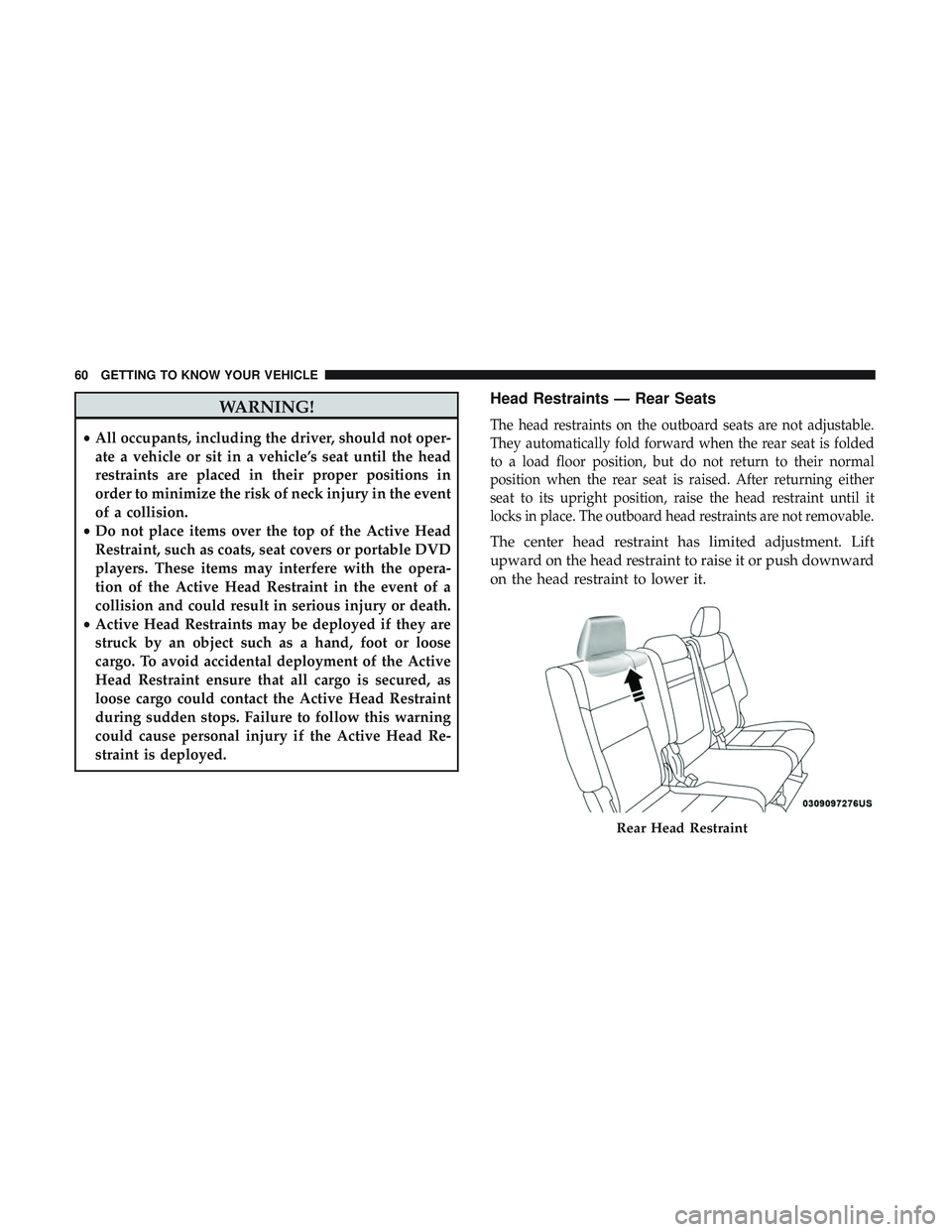
Head Restraints — Rear Seats
The head restraints on the outboard seats are not adjustable.
They automatically fold forward when the rear seat is folded
to a load floor position, but do not return to their normal
position when the rear seat is raised. After returning either
seat to its upright position, raise the head restraint until it
locks in place. The outboard head restraints are not removable.
The center head restraint has limited adjustment. Lift
upward on the head restraint to raise it or push downward
on the head restraint to lower it.
Rear Head Restraint
60 GETTING TO KNOW YOUR VEHICLE
Page 64 of 568

NOTE:For proper routing of a Child Seat Tether, refer to
“Occupant Restraints” in “Safety” for further information.
WARNING!
• A loose head restraint thrown forward in a collision
or hard stop could cause serious injury or death to
occupants of the vehicle. Always securely stow re-
moved head restraints in a location outside the
occupant compartment.
• ALL the head restraints MUST be reinstalled in the
vehicle to properly protect the occupants. Follow the
re-installation instructions above prior to operating
the vehicle or occupying a seat.
Power Folding Third Row Head Restraints
For improved visibility when in reverse, the third row head
restraints can be folded using the Uconnect System.
Press the “Controls” button located on the bottom of the
Uconnect display.
Press the Headrest Fold button
to power fold the third
row head restraints.
NOTE:
• The head restraints can only be folded downward using
the Headrest Fold button. The head restraints must be
raised manually when occupying the third row.
• Do not fold if there are passengers seated in the third
row seats.
62 GETTING TO KNOW YOUR VEHICLE

