2018 DACIA DUSTER Manual locking
[x] Cancel search: Manual lockingPage 16 of 244
\
ENG_NU_1079-3_H79Ph2_Dacia_1
O")
Downloaded from www.Manualslib.com manuals search engine JauneNoir Noir texte
1.10
ENG_UD33620_2
Ouverture et fermeture des portes (H79 - H79 Ph2 - H79 Nissan - Dacia)\
ENG_NU_1079-3_H79Ph2_Dacia_1
OPENING AND CLOSING THE DOORS (2/2)
Driver’s responsibility
when parking or stopping
the vehicle
Never leave an animal,
child or adult who is not self-suffi-
cient alone on your vehicle, even for
a short time.
They may pose a risk to themselves
or to others by starting the engine,
activating equipment such as the
electric windows or by locking the
doors.
Also, in hot and/or sunny weather,
please remember that the tempera-
ture inside the passenger compart-
ment increases very quickly.
RISK OF DEATH OR SERIOUS
INJURY.Lights-on reminder buzzer
If you have left the lights on after switch-
ing off the ignition, a warning buzzer will
sound when a front door is opened (to
prevent the battery from discharging,
etc.).
Door/tailgate open buzzer
Depending on the vehicle, this alarm is
fitted to the driver’s side door or on all
opening elements.
With the vehicle at a standstill, a warn-
ing light
2 will come on if a door or the
boot is open or not properly closed.
While driving, as soon as the vehicle
reaches 12 mph (20 km/h), a warning
light
2 comes on with an audio beep.
Special note
Depending on the vehicle, accessories
(e.g. radio) stop working either when
the engine is switched off or when the
driver’s door is opened or when the
doors are locked.
Page 22 of 244

Downloaded from www.Manualslib.com manuals search engine JauneNoir Noir texte
1.16
ENG_UD32114_1
Ceintures de sécurité (H79 - Dacia)
ENG_NU_1079-3_H79Ph2_Dacia_1
SEAT BELTS (2/5)
To fasten
Unwind the belt slowly and smoothly
and ensure that buckle 4 locks into
catch 6 (check that it is locked by pulling
on buckle 4). If it jams, allow it to return
before attempting to unwind it again. If
your seat belt is completely jammed,
pull slowly, but firmly so that just over
3 cm unwinds. Allow it to return slightly
before attempting to unwind it again.
If there is still a problem, contact an ap-
proved dealer.
Adjusting the front seat belt
height
(depending on the vehicle)
Move button 7 to select the position you
require so that chest strap 3 is worn as
described above.
Make sure that the seat belt is locked
in position correctly after you have ad-
justed it.
ßSeat belt reminder light
Depending on the vehicle, it
comes on when the engine is started
and if the driver’s and/or passenger’s
seat belt is not fastened. When the ve-
hicle is being driven, it comes on and a
beep sounds for approximately 2 min-
utes until the driver’s seat belt is fas-
tened.
Note: an object placed on the passen-
ger seat base may activate the warning
light in some cases.
Unlocking
Press button 5 on catch 6; the seat belt
is wound up by the inertia reel. Guide
the buckle to facilitate this manoeuvre.
3
45
6
6
7
Page 26 of 244
Downloaded from www.Manualslib.com manuals search engine JauneNoir Noir texte
1.20
ENG_UD32115_1
Dispositifs complémentaires aux ceintures avant (H79 - Dacia)
ENG_NU_1079-3_H79Ph2_Dacia_1
METHODS OF RESTRAINT IN ADDITION TO THE FRONT SEAT BELTS (1/3)
– Have the entire restraint
system checked following
an accident.
– No operation whatsoever
is permitted on any part of the
system (air bags, electronic con-
trol units, wiring) and the system
components must not be reused
on any other vehicle, even if iden-
tical.
– To avoid premature triggering of the system which may cause
injury, only qualified Network per-
sonnel are authorisedto work on
the methods of restraint in addi-
tion to the front seat belt.
– The electric trigger system may only be tested by a specially
trained technician using special
equipment.
– When the vehicle is scrapped, contact an approved dealer for
disposal of the pretensioner and
airbag gas generators.
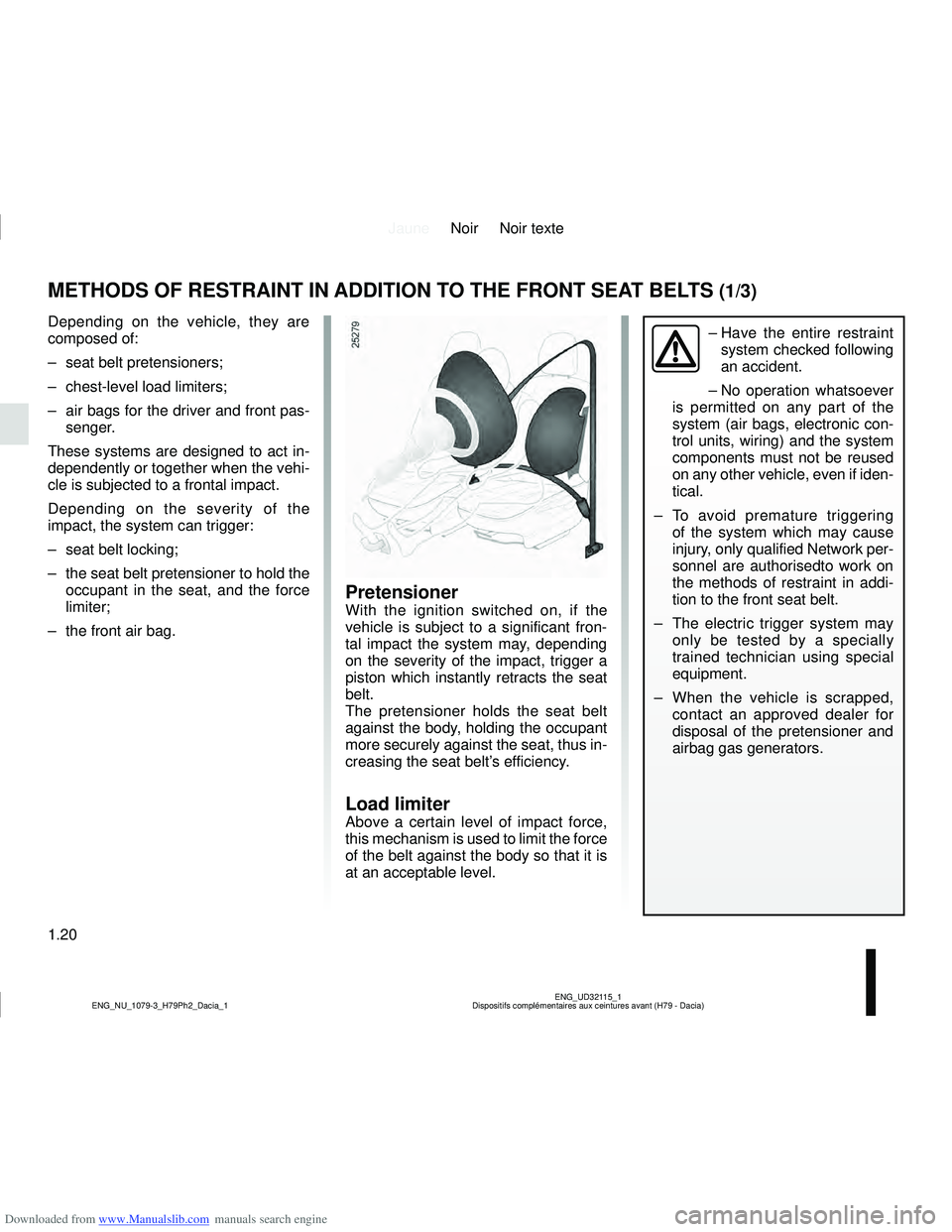
PretensionerWith the ignition switched on, if the
vehicle is subject to a significant fron-
tal impact the system may, depending
on the severity of the impact, trigger a
piston which instantly retracts the seat
belt.
The pretensioner holds the seat belt
against the body, holding the occupant
more securely against the seat, thus in-
creasing the seat belt’s efficiency.
Load limiterAbove a certain level of impact force,
this mechanism is used to limit the force
of the belt against the body so that it is
at an acceptable level.
Depending on the vehicle, they are
composed of:
– seat belt pretensioners;
– chest-level load limiters;
– air bags for the driver and front pas-
senger.
These systems are designed to act in-
dependently or together when the vehi-
cle is subjected to a frontal impact.
Depending on the severity of the
impact, the system can trigger:
– seat belt locking;
– the seat belt pretensioner to hold the occupant in the seat, and the force
limiter;
– the front air bag.
Page 31 of 244

E")
Downloaded from www.Manualslib.com manuals search engine JauneNoir Noir texte
1.25
ENG_UD34997_13
Sécurite enfants : généralités (B90 - F90 - U90 - R90 - F90\
Ph2 - R90 Ph2 - H79 - X52 - Dacia)
ENG_NU_1079-3_H79Ph2_Dacia_1
CHILD SAFETY: General information (1/2)
Carrying children
Children, and adults, must be correctly
seated and strapped in for all journeys.
The children being carried in your vehi-
cle are your responsibility.
A child is not a miniature adult. Children
are at risk of specific injuries as their
muscles and bones have not yet fin-
ished growing. The seat belt alone
would not provide suitable protection.
Use an approved child seat and ensure
you use it correctly.
A collision at 30 mph
(50 km/h) is the same
as falling a distance of
10 metres. Transporting a
child without a restraint is the equi-
valent of allowing him or her to play
on a fourthfloor balcony without rail-
ings.
Never travel with a child held in your
arms. In the event of an accident,
you will not be able to keep hold of
the child, even if you yourself are
wearing a seat belt.
If your vehicle has been involved in
a road accident, replace the child
seat and have the seat belts and
ISOFIX fittings checked.
Never leave a child unat-
tended in the vehicle.
Check that your child is
always strapped in and that
the belt or safety harness used is
correctly set and adjusted. Avoid
wearing bulky clothing which could
cause the belts to slacken.
Never let your child put their head or
arms out of the window.
Check that the child is in the correct
position for the entire journey, espe-
cially if asleep.
To prevent the doors being
opened, use the childproof
locks (refer to the informa-
tion on “Locking/unlocking
the doors” in Section 1).
Page 37 of 244

ENG_NU_1079-3")
Downloaded from www.Manualslib.com manuals search engine JauneNoir Noir texte
1.31
ENG_UD34961_5
Sécurité enfants : installation du siège enfant (H79 - H79 Ph2\
- H79 Nissan - Dacia)
ENG_NU_1079-3_H79Ph2_Dacia_1
Rear centre seat
A child seat may only be fitted in this
seat if it is equipped with an inertia-reel
belt. For any additional information,
contact an approved dealer.
CHILD SAFETY: fitting a child seat (2/6)
For the safety of the child in the
forward-facing seat, do not move the
seat in front back past the middle of the
runner, do not tilt the seatback too far
(maximum of 25°) and raise the seat as
much as possible.
Check that the forward-facing child seat
is resting against the back of the vehi-
cle seat and that the headrest of the
vehicle is not obstructing its use.In the rear side seat
A carrycot can be installed across the
vehicle and will take up at least two
seats. Position the child with his or her
feet nearest the door.
Before installing a child seat in the
ISOFIX anchoring points on a rear side
seat, check that the seat belt buckles
are not placed between the two ISOFIX
anchorage points in this seat. If ne-
cessary, move the buckle for the seat
concerned towards the centre of the
vehicle.
Move the front seat as far forward as
possible to install a rear-facing child
seat, then move back the seat in front
as far as it will go, although without al-
lowing it to come into contact with the
child seat.
Make sure that the child
seat or the child’s feet do
not prevent the front seat
from locking correctly.
Please refer to the information on
the “Front seat” in Section 1.
Page 47 of 244

Downloaded from www.Manualslib.com manuals search engine JauneNoir Noir texte
1.41
ENG_UD32123_1
Poste de conduite direction à gauche (H79 - Dacia)
ENG_NU_1079-3_H79Ph2_Dacia_1
DRIVING POSITION, LEFT-HAND DRIVE (2/2)
The fittings described DEPEND ON THE VEHICLE VERSION AND COUNTRY.
1 Side air vent.
2 Side demister outlet.
3 Stalk for:
– direction indicator lights,
– exterior lights,
– front fog lights,
– rear fog light,
– horn.
4 Instrument panel.
5 Location for driver’s airbag.
6 – Steering column stalk for wind-
screen and rear screen wash/
wiper.
– On-board computer information
readout control.
7 Ignition switch.
8 Hazard warning lights switch.
9 Centre air vents.
10 Electric central locking switch.
11 Central demister outlet. 12
Location for radio, navigation system
or storage compartments.
13 Location for passenger airbag.
14 Side demister outlet.
15 Side air vent.
16 Passenger airbag activation, deacti-
vation switch.
17 Glovebox.
18 Activation/deactivation control for
the parking distance control.
19 Rear screen and door mirror de-ic-
ing control
20 ECO mode switch.
21 ESC control (version 4x4 (4WD)).
22 Not used.
23 Mode selector 4x2 (2WD), 4x4
(4WD) or storage compartment.
24 Cigarette lighter or accessories
socket.
25 Handbrake.
26 Door mirror adjustment control. 27 Gear lever.
28 LPG control
29
Accessories socket.
30 Bottle holders.
31 Heating and ventilation controls.
32 Cruise control/speed limiter main
control.
33 Radio remote control.
34 Cruise control/speed limiter controls.
35 Beam height adjustment control.
36 Bonnet release control.
37 Fuse box.
Page 49 of 244

Downloaded from www.Manualslib.com manuals search engine JauneNoir Noir texte
1.43
ENG_UD32124_1
Poste de conduite direction à droite (H79 - Dacia)
ENG_NU_1079-3_H79Ph2_Dacia_1
DRIVING POSITION, RIGHT-HAND DRIVE (2/2)
The presence of the equipment DEPENDS ON THE VEHICLE VERSION AND COUNTRY.
1 Side air vent.
2 Side demister outlet.
3 Location for passenger airbag or
storage compartment.
4 Rear screen and door mirror de-icing control
5 Hazard warning lights switch.
6 Electric central locking switch.
7 Central demister outlet.
8 Centre air vents.
9 Location for radio, navigation system or storage compartments.
10 Stalk for: – direction indicator lights,
– exterior lights,
– front fog lights,
– rear fog light,
– horn. 11
Instrument panel.
12 Cruise control/speed limiter controls.
13 – Steering column stalk for wind-
screen and rear screen wash/
wiper.
– On-board computer information
readout control.
14 Side demister outlet.
15 Side air vent.
16 Ignition switch.
17 Bonnet release control.
18 Beam height adjustment control.
19 Radio remote control.
20 Cruise control/speed limiter main
control.
21 Heating and ventilation controls.
22 Gear lever.
23 Handbrake.
24 Door mirror adjustment control.
25 ECO mode switch.
26 ESC control (version 4x4 (4WD)).
27 Cigarette lighter or accessories
socket.
28 Mode selector 4x2 (2WD), 4x4
(4WD) or storage compartment.
29 Glovebox.
30 Fuse box.
31 Passenger airbag activation, deacti-
vation switch.
Page 85 of 244
Downloaded from www.Manualslib.com manuals search engine JauneNoir Noir texte
2.3
ENG_UD34520_2
Mise en route / Arrêt du moteur (H79 Ph2 - Dacia)
ENG_NU_1079-3_H79Ph2_Dacia_2
Stopping the engineWith the engine idling, turn the key
back to “Stop” position St.
Special note
Depending on the vehicle, accessories
(e.g. radio) stop working either when
the engine is switched off or when the
driver’s door is opened or when the
doors are locked.LPG versionsThe engine is always started using
petrol:
– activate the starter without accelerat- ing;
– release the key as soon as the engine starts.
The system will automatically deter-
mine the switchover from petrol to LPG.
When operating on LPG, the fuel gauge
may indicate a drop in the petrol level
and the on-board computer will not op-
erate.
Every 3,000 miles driven using LPG,
drivers are recommended to drive for
around 3 to 6 miles in petrol mode.
To enable the system to operate
smoothly and to prevent any wear to
the vehicle’s electric petrol pump, the
petrol tank should always be around
1/4 full.
vehicles with an automatic
gearbox
Before starting, move the lever to posi-
tion N or P.
Refer to the information on the
“Automatic gearbox” in Section 2.
Starting the engineIn very cold conditions (temperatures
below –20°C): so that it is easier to
start the engine, switch on the ignition
for several seconds before starting the
engine.
When starting the engine, if the outdoor
temperature is very low (below -10°C):
hold down the clutch pedal until the
engine starts.
Make sure the engine immobiliser is not
activated. Refer to the information on
the “Engine immobiliser” in Section 1.
Petrol injection
– Turn the key to the start position without depressing the accelera-
tor.
– Release the key as soon as the engine starts.
ÉDiesel injection
Turn the ignition key to ignition “On” po-
sition M, and hold this position until the
preheating warning light goes out.
Turn the key to starter position D with-
out depressing the accelerator
pedal.
Release the key as soon as the engine
starts.
STARTING/STOPPING THE ENGINE
Never leave your vehicle
with the key or remote con-
trol inside and never leave
a child (or a pet) unsuper-
vised, even for a short while.
The reason for this is that the child
may endanger himself or others by
starting the engine, activating equip-
ment such as the window winders
for example, or locking the doors.
Risk of serious injury.
Never switch off the ignition
before the vehicle has stopped
completely . Once the engine has
stopped, the brake servo, power as-
sisted steering and passive safety
equipment such as air bags will no
longer operate.
The steering is locked when the key
is removed.