2018 CHEVROLET COLORADO capacities
[x] Cancel search: capacitiesPage 283 of 421
Chevrolet Colorado Owner Manual (GMNA-Localizing-U.S./Canada/Mexico-
11349743) - 2018 - crc - 10/12/17
282 Vehicle Care
checking a cold engine prior to
starting. Remove the dipstick
and check the level.
. If unable to wait two hours, the
engine must be off for at least
15 minutes if the engine is
warm, or at least 30 minutes if
the engine is not warm. Pull out
the dipstick, wipe it with a clean
paper towel or cloth, then push it
back in all the way. Remove it
again, keeping the tip down, and
check the level.
When to Add Engine Oil
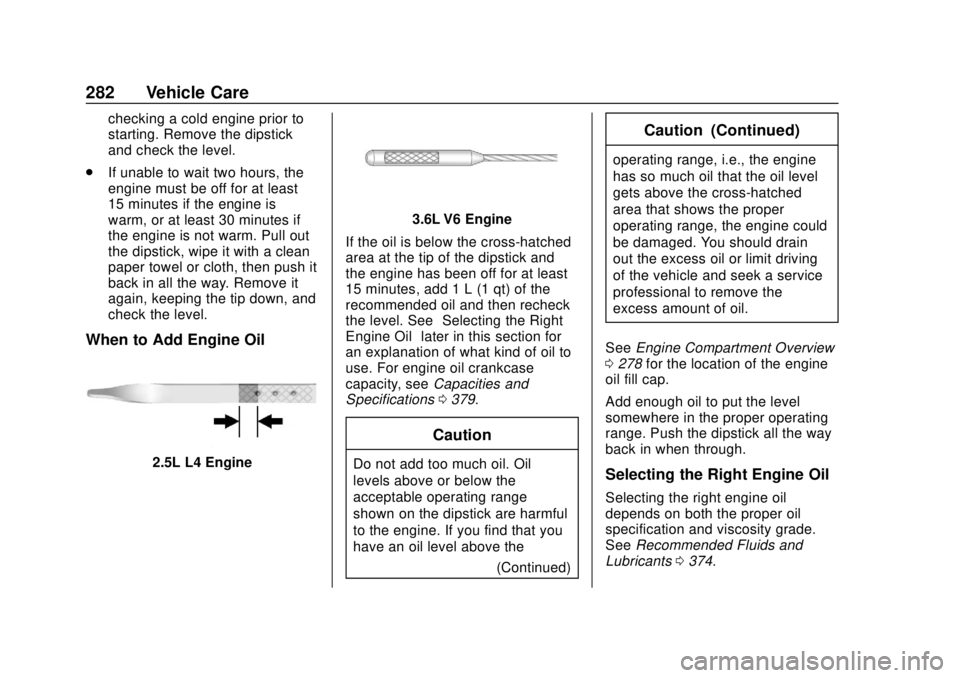
2.5L L4 Engine
3.6L V6 Engine
If the oil is below the cross-hatched
area at the tip of the dipstick and
the engine has been off for at least
15 minutes, add 1 L (1 qt) of the
recommended oil and then recheck
the level. See “Selecting the Right
Engine Oil” later in this section for
an explanation of what kind of oil to
use. For engine oil crankcase
capacity, see Capacities and
Specifications 0379.
Caution
Do not add too much oil. Oil
levels above or below the
acceptable operating range
shown on the dipstick are harmful
to the engine. If you find that you
have an oil level above the
(Continued)
Caution (Continued)
operating range, i.e., the engine
has so much oil that the oil level
gets above the cross-hatched
area that shows the proper
operating range, the engine could
be damaged. You should drain
out the excess oil or limit driving
of the vehicle and seek a service
professional to remove the
excess amount of oil.
See Engine Compartment Overview
0 278 for the location of the engine
oil fill cap.
Add enough oil to put the level
somewhere in the proper operating
range. Push the dipstick all the way
back in when through.
Selecting the Right Engine Oil
Selecting the right engine oil
depends on both the proper oil
specification and viscosity grade.
See Recommended Fluids and
Lubricants 0374.
Page 295 of 421
Chevrolet Colorado Owner Manual (GMNA-Localizing-U.S./Canada/Mexico-
11349743) - 2018 - crc - 10/12/17
294 Vehicle Care
heard all the time the vehicle is
moving, except when applying the
brake pedal firmly.
{Warning
The brake wear warning sound
means that soon the brakes will
not work well. That could lead to
a crash. When the brake wear
warning sound is heard, have the
vehicle serviced.
Caution
Continuing to drive with worn-out
brake pads could result in costly
brake repair.
Some driving conditions or climates
can cause a brake squeal when the
brakes are first applied or lightly
applied. This does not mean
something is wrong with the brakes.
Properly torqued wheel nuts are
necessary to help prevent brake
pulsation. When tires are rotated, inspect brake pads for wear and
evenly tighten wheel nuts in the
proper sequence to torque
specifications in
Capacities and
Specifications 0379.
Brake linings should always be
replaced as complete axle sets.
Brake Pedal Travel
See your dealer if the brake pedal
does not return to normal height,
or if there is a rapid increase in
pedal travel. This could be a sign
that brake service may be required.
Replacing Brake System Parts
Always replace brake system parts
with new, approved replacement
parts. If this is not done, the brakes
may not work properly. The braking
performance expected can change
in many other ways if the wrong
replacement brake parts are
installed or parts are improperly
installed.
Brake Fluid
The brake/clutch master cylinder
reservoir is filled with GM approved
DOT 3 brake fluid as indicated on
the reservoir cap. See Engine
Compartment Overview 0278 for
the location of the reservoir.
Checking Brake Fluid
Place the vehicle in P (Park) or
Neutral with the parking brake
applied if equipped with a manual
transmission. On a level surface,
the brake fluid level should be
between the minimum and
maximum marks on the brake fluid
reservoir.
Page 327 of 421
Chevrolet Colorado Owner Manual (GMNA-Localizing-U.S./Canada/Mexico-
11349743) - 2018 - crc - 10/12/17
326 Vehicle Care
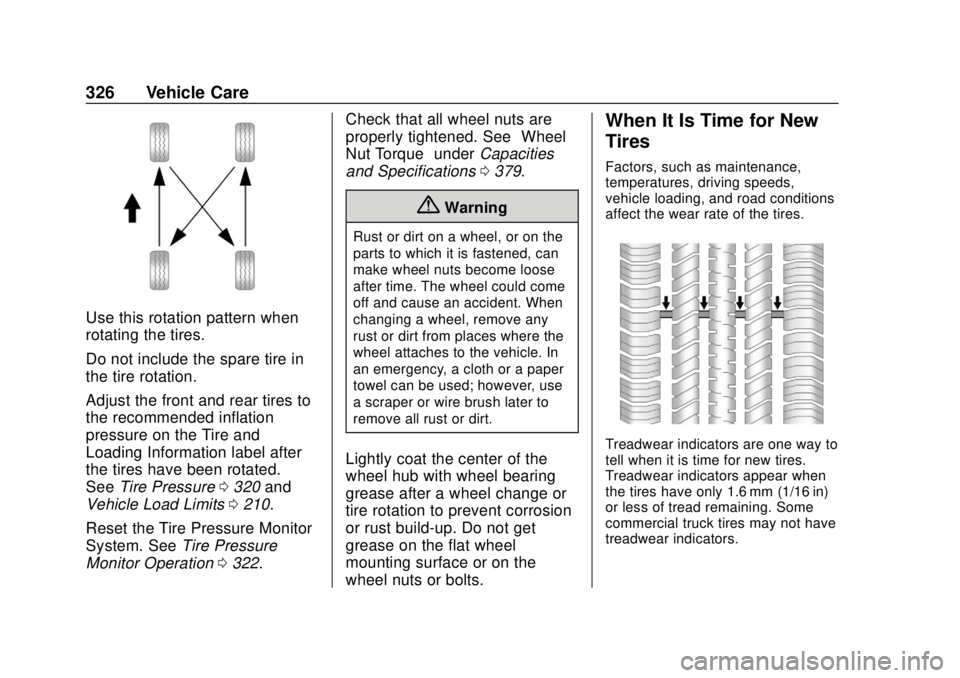
Use this rotation pattern when
rotating the tires.
Do not include the spare tire in
the tire rotation.
Adjust the front and rear tires to
the recommended inflation
pressure on the Tire and
Loading Information label after
the tires have been rotated.
SeeTire Pressure 0320 and
Vehicle Load Limits 0210.
Reset the Tire Pressure Monitor
System. See Tire Pressure
Monitor Operation 0322. Check that all wheel nuts are
properly tightened. See
“Wheel
Nut Torque” underCapacities
and Specifications 0379.
{Warning
Rust or dirt on a wheel, or on the
parts to which it is fastened, can
make wheel nuts become loose
after time. The wheel could come
off and cause an accident. When
changing a wheel, remove any
rust or dirt from places where the
wheel attaches to the vehicle. In
an emergency, a cloth or a paper
towel can be used; however, use
a scraper or wire brush later to
remove all rust or dirt.
Lightly coat the center of the
wheel hub with wheel bearing
grease after a wheel change or
tire rotation to prevent corrosion
or rust build-up. Do not get
grease on the flat wheel
mounting surface or on the
wheel nuts or bolts.
When It Is Time for New
Tires
Factors, such as maintenance,
temperatures, driving speeds,
vehicle loading, and road conditions
affect the wear rate of the tires.
Treadwear indicators are one way to
tell when it is time for new tires.
Treadwear indicators appear when
the tires have only 1.6 mm (1/16 in)
or less of tread remaining. Some
commercial truck tires may not have
treadwear indicators.
Page 341 of 421
Chevrolet Colorado Owner Manual (GMNA-Localizing-U.S./Canada/Mexico-
11349743) - 2018 - crc - 10/12/17
340 Vehicle Care
Warning (Continued)
If any stud is damaged because
of a loose-running wheel, it could
be that all of the studs are
damaged. To be sure, replace all
studs on the wheel. If the stud
holes in a wheel have become
larger, the wheel could collapse in
operation. Replace any wheel if
its stud holes have become larger
or distorted in any way. Inspect
hubs and hub‐piloted wheels for
damage. Because of loose
running wheels, piloting pad
damage may occur and require
replacement of the entire hub, for
proper centering of the wheels.
When replacing studs, hubs,
wheel nuts or wheels, be sure to
use GM original equipment parts.
{Warning
Wheel nuts that are improperly or
incorrectly tightened can cause
the wheels to become loose or
come off. The wheel nuts should
be tightened with a torque wrench
to the proper torque specification
after replacing. Follow the torque
specification supplied by the
aftermarket manufacturer when
using accessory locking wheel
nuts. SeeCapacities and
Specifications 0379 for original
equipment wheel nut torque
specifications.
Caution
Improperly tightened wheel nuts
can lead to brake pulsation and
rotor damage. To avoid expensive
brake repairs, evenly tighten the
wheel nuts in the proper
sequence and to the proper
(Continued)
Caution (Continued)
torque specification. See
Capacities and Specifications
0379 for the wheel nut torque
specification.
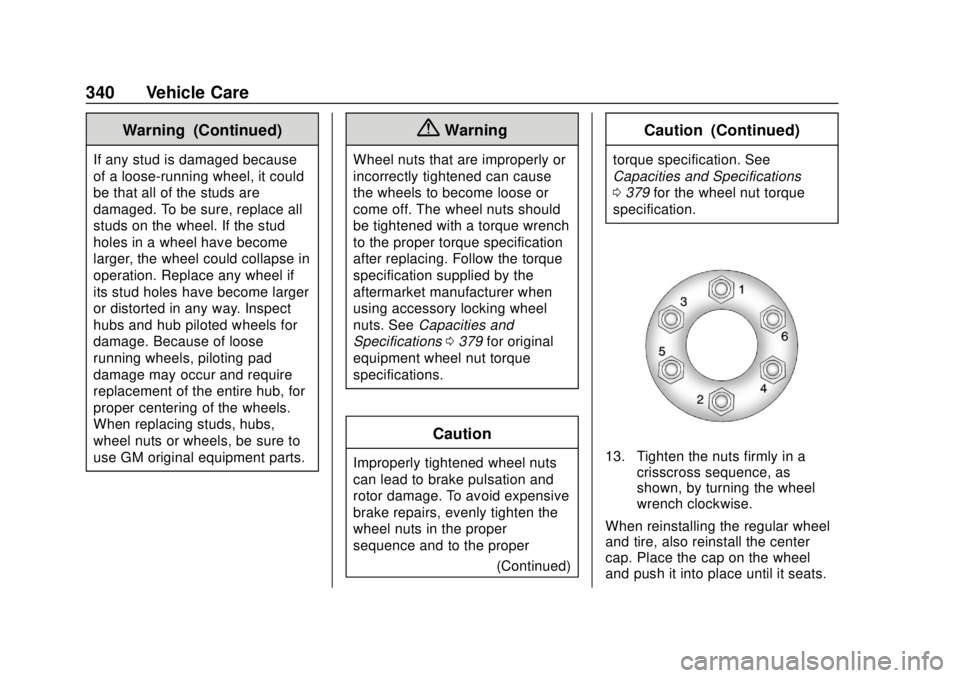
13. Tighten the nuts firmly in a crisscross sequence, as
shown, by turning the wheel
wrench clockwise.
When reinstalling the regular wheel
and tire, also reinstall the center
cap. Place the cap on the wheel
and push it into place until it seats.
Page 379 of 421

Chevrolet Colorado Owner Manual (GMNA-Localizing-U.S./Canada/Mexico-
11349743) - 2018 - crc - 10/12/17
378 Technical Data
Technical Data
Vehicle Identification
Vehicle IdentificationNumber (VIN) . . . . . . . . . . . . . . . 378
Service Parts Identification Label . . . . . . . . . . . . . . . . . . . . . . . . 378
Vehicle Data
Capacities andSpecifications . . . . . . . . . . . . . . . 379
Engine Drive Belt Routing . . . . 381
Vehicle Identification
Vehicle Identification
Number (VIN)
This legal identifier is in the front
corner of the instrument panel, on
the driver side of the vehicle. It can
be seen through the windshield from
outside. The Vehicle Identification
Number (VIN) also appears on the
Vehicle Certification and Service
Parts labels and certificates of title
and registration.
Engine Identification
The eighth character in the VIN is
the engine code. This code
identifies the vehicle's engine,
specifications, and replacement parts. See
“Engine Specifications”
under Capacities and Specifications
0 379 for the vehicle's engine code.
Service Parts
Identification Label
There may be a label on the inside
of the glove box that contains the
following information:
.
Vehicle Identification
Number (VIN)
. Model designation
. Paint information
. Production options and special
equipment
If there is no label, there is a
barcode on the certification label on
the center (B) pillar to scan for this
same information.
Page 380 of 421
Chevrolet Colorado Owner Manual (GMNA-Localizing-U.S./Canada/Mexico-
11349743) - 2018 - crc - 10/12/17
Technical Data 379
Vehicle Data
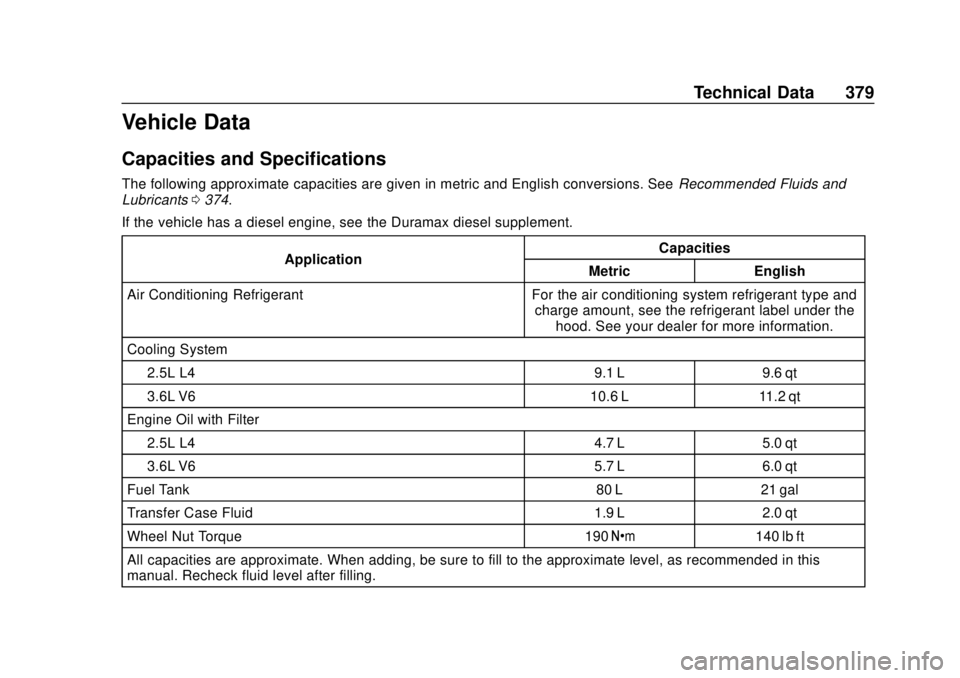
Capacities and Specifications
The following approximate capacities are given in metric and English conversions. SeeRecommended Fluids and
Lubricants 0374.
If the vehicle has a diesel engine, see the Duramax diesel supplement.
Application Capacities
Metric English
Air Conditioning Refrigerant For the air conditioning system refrigerant type and charge amount, see the refrigerant label under thehood. See your dealer for more information.
Cooling System
2.5L L4 9.1 L 9.6 qt
3.6L V6 10.6 L 11.2 qt
Engine Oil with Filter
2.5L L4 4.7 L 5.0 qt
3.6L V6 5.7 L 6.0 qt
Fuel Tank 80 L 21 gal
Transfer Case Fluid 1.9 L 2.0 qt
Wheel Nut Torque 190 Y140 lb ft
All capacities are approximate. When adding, be sure to fill to the approximate level, as recommended in this
manual. Recheck fluid level after filling.
Page 410 of 421

Chevrolet Colorado Owner Manual (GMNA-Localizing-U.S./Canada/Mexico-
11349743) - 2018 - crc - 10/12/17
Index 409
AudioBluetooth . . . . . . . . . . . . . . . . . . . . . 165
Theft-Deterrent Feature . . . . . . . 151
Automatic Climate Control System . . . . . . . 193
Door Locks . . . . . . . . . . . . . . . . . . . . . 34
Headlamp System . . . . . . . . . . . . 144
Transmission . . . . . . . . . . . . . . . . . 224
Transmission Fluid . . . . . . . . . . . 285
Automatic Transmission Manual Mode . . . . . . . . . . . . . . . . . 227
Shift Lock Control Function
Check . . . . . . . . . . . . . . . . . . . . . . . 299
Auxiliary Jack . . . . . . . . . . . . . . . . . . . 165
Avoiding Untrusted Media Devices . . . . . . . . . . . . . . . . . . . . . . . 159
Axle Locking Front . . . . . . . . . . . . . . . . . 246
Axle, Front . . . . . . . . . . . . . . . . . . . . . . 297
Axle, Rear . . . . . . . . . . . . . . . . . . . . . . 298
B
Battery Exterior Lighting BatterySaver . . . . . . . . . . . . . . . . . . . . . . . 149
Load Management . . . . . . . . . . . . 148 Battery (cont'd)
Power Protection . . . . . . . . . . . . . 149
Battery - North America . . . . 295, 345
Blade Replacement, Wiper . . . . . 300
Blind Spot Mirrors . . . . . . . . . . . . . . . 39
Bluetooth Overview . . . . . . . . . . . 172, 174, 178
Bluetooth Audio . . . . . . . . . . . . . . . . 165
Brake System Warning Light . . . . . . . . 122
Brakes . . . . . . . . . . . . . . . . . . . . . . . . . . 293 Antilock . . . . . . . . . . . . . . . . . . . . . . . 238
Assist . . . . . . . . . . . . . . . . . . . . . . . . . 239
Fluid . . . . . . . . . . . . . . . . . . . . . . . . . . 294
Parking . . . . . . . . . . . . . . . . . . . . . . . 239
Braking . . . . . . . . . . . . . . . . . . . . . . . . . 199
Break-In, New Vehicle . . . . . . . . . . 216
Bulb Replacement Center High-MountedStoplamp (CHMSL) and
Cargo Lamp . . . . . . . . . . . . . . . . . 304
Halogen Bulbs . . . . . . . . . . . . . . . . 302
Headlamp Aiming . . . . . . . . . . . . . 302
Headlamps . . . . . . . . . . . . . . . . . . . 302
Headlamps, Front Turn Signal, Sidemarker, and
Parking Lamps . . . . . . . . . . . . . . 303 Bulb Replacement (cont'd)
Taillamps, Turn Signal,
Stoplamps, and Back-up
Lamps . . . . . . . . . . . . . . . . . . . . . . 303
Buying New Tires . . . . . . . . . . . . . . . 327
C
Calibration . . . . . . . . . . . . . . . . . . . . . . 108
California Fuel Requirements . . . . . . . . . . . 256
Perchlorate Materials
Requirements . . . . . . . . . . . . . . . 276
California Proposition
65 Warning . . . . . . . . . .275, 295, 345,
Back Cover
Camera Rear Vision (RVC) . . . . . . . . . . . . 250
Canadian Vehicle Owners . . . . . . . . 2
Capacities and
Specifications . . . . . . . . . . . . . . . . . 379
Carbon Monoxide Engine Exhaust . . . . . . . . . . . . . . . 223
Tailgate . . . . . . . . . . . . . . . . . . . . . . . . . 36
Winter Driving . . . . . . . . . . . . . . . . 207
Cargo Lamp . . . . . . . . . . . . . . . . . . . . 147
Caution, Danger, and Warning . . . . 2
Center Console Storage . . . . . . . . 104
Page 418 of 421

Chevrolet Colorado Owner Manual (GMNA-Localizing-U.S./Canada/Mexico-
11349743) - 2018 - crc - 10/12/17
Index 417
Spare TireCompact . . . . . . . . . . . . . . . . . . . . . . 343
Special Application Services . . . . 370
Specifications and Capacities . . . . . . . . . . . . . . . . . . . . . 379
Speedometer . . . . . . . . . . . . . . . . . . . 116
StabiliTrak OFF Light . . . . . . . . . . . . . . . . . . . . . 125
Start Assist, Hill . . . . . . . . . . . . . . . . . 240
Start Vehicle, Remote . . . . . . . . . . . 32
Starter Switch Check . . . . . . . . . . . 298
Starting the Engine . . . . . . . . . . . . . 218
Steering . . . . . . . . . . . . . . . . . . . . . . . . 200 Wheel Adjustment . . . . . . . . . . . . 106
Wheel Controls . . . . . . . . . . . . . . . 106
Stoplamps and Back-up Lamps
Bulb Replacement . . . . . . . . . . . . 303
Storage Areas Center Console . . . . . . . . . . . . . . . 104
Glove Box . . . . . . . . . . . . . . . . . . . . 103
Sunglasses . . . . . . . . . . . . . . . . . . . 104
Underseat . . . . . . . . . . . . . . . . . . . . 104
Storage Compartments . . . . . . . . . 103
Struts Gas . . . . . . . . . . . . . . . . . . . . . . . . . . . 301
Stuck Vehicle . . . . . . . . . . . . . . . . . . . 209
Sun Visors . . . . . . . . . . . . . . . . . . . . . . . 44
Sunglass Storage . . . . . . . . . . . . . . . 104 Symbols . . . . . . . . . . . . . . . . . . . . . . . . . . 3
System
Forward CollisionAlert (FCA) . . . . . . . . . . . . . . . . . . 251
Infotainment . . . . . . . . . . . . . 150, 395
T
Tachometer . . . . . . . . . . . . . . . . . . . . . 116
Tailgate . . . . . . . . . . . . . . . . . . . . . . . . . . 36
Taillamps Bulb Replacement . . . . . . . . . . . . 303
Text Messaging . . . . . . . . . . . . . . . . . 183
Text Telephone (TTY) Users . . . . 385
Theft-Deterrent Systems . . . . . . . . . 38
Immobilizer . . . . . . . . . . . . . . . . . . . . . 37
Time . . . . . . . . . . . . . . . . . . . . . . . . . . . . 108
Tires . . . . . . . . . . . . . . . . . . . . . . . . . . . . 312 All-Season . . . . . . . . . . . . . . . . . . . . 313
All-Terrain . . . . . . . . . . . . . . . . . . . . 314
Buying New Tires . . . . . . . . . . . . . 327
Chains . . . . . . . . . . . . . . . . . . . . . . . . 332
Changing . . . . . . . . . . . . . . . . . . . . . 334
Compact Spare . . . . . . . . . . . . . . . 343
Designations . . . . . . . . . . . . . . . . . 316
Different Size . . . . . . . . . . . . . . . . . 329
Full-Size Spare . . . . . . . . . . . . . . . 344
If a Tire Goes Flat . . . . . . . . . . . . 332
Inspection . . . . . . . . . . . . . . . . . . . . 325 Tires (cont'd)
Pressure . . . . . . . . . . . . . . . . . . . . . . 320
Pressure Light . . . . . . . . . . . . . . . . 126
Pressure Monitor Operation . . 322
Pressure Monitor System . . . . . 321
Rotation . . . . . . . . . . . . . . . . . . . . . . 325
Sidewall Labeling . . . . . . . . . . . . . 314
Terminology and Definitions . . 317
Uniform Tire Quality
Grading . . . . . . . . . . . . . . . . . . . . . 329
Wheel Alignment and Tire Balance . . . . . . . . . . . . . . . . . . . . . 331
Wheel Replacement . . . . . . . . . . 331
When It Is Time for New Tires . . . . . . . . . . . . . . . . . . . . . . . . 326
Winter . . . . . . . . . . . . . . . . . . . . . . . . 313
Tow/Haul Mode . . . . . . . . . . . . . . . . . 229
Tow/Haul Mode Light . . . . . . . . . . . 124
Towing Driving Characteristics . . . . . . . . 259
Equipment . . . . . . . . . . . . . . . . . . . . 264
General Information . . . . . . . . . . 259
Recreational Vehicle . . . . . . . . . . 348
Trailer . . . . . . . . . . . . . . . . . . . . . . . . 261
Trailer Sway Control (TSC) . . . 271
Vehicle . . . . . . . . . . . . . . . . . . . . . . . 348