2018 CHEVROLET BOLT EV tire size
[x] Cancel search: tire sizePage 288 of 370

Chevrolet BOLT EV Owner Manual (GMNA-Localizing-U.S./Canada/Mexico-
11434431) - 2018 - crc - 2/14/18
Vehicle Care 287
sensors monitor the air pressure in
the tires and transmits the tire
pressure readings to a receiver
located in the vehicle.
When a low tire pressure condition
is detected, the TPMS illuminates
the low tire pressure warning light
located on the instrument cluster.
If the warning light comes on, stop
as soon as possible and inflate the
tires to the recommended pressure
shown on the Tire and Loading
Information label. SeeVehicle Load
Limits 0200.
A message to check the pressure in
a specific tire displays in the Driver
Information Center (DIC). The low
tire pressure warning light and the
DIC warning message come on at
each ignition cycle using POWER
O
until the tires are inflated to the
correct inflation pressure. Using the DIC, tire pressure levels can be
viewed. For additional information
and details about the DIC operation
and displays see
Driver Information
Center (DIC) 0141.
The low tire pressure warning light
may come on in cool weather when
the vehicle is first started, and then
turn off as the vehicle is driven. This
could be an early indicator that the
air pressure is getting low and
needs to be inflated to the proper
pressure.
A Tire and Loading Information
label, attached to your vehicle,
shows the size of the original
equipment tires and the correct
inflation pressure for the tires when
they are cold. See Vehicle Load
Limits 0200, for an example of the
Tire and Loading Information label
and its location. Also see Tire
Pressure 0284.
The TPMS can warn about a low
tire pressure condition but it does
not replace normal tire
maintenance. See Tire Inspection
0 289, Tire Rotation 0290 andTires
0 278.
Caution
Tire sealant materials are not all
the same. A non-approved tire
sealant could damage the TPMS
sensors. TPMS sensor damage
caused by using an incorrect tire
sealant is not covered by the
vehicle warranty. Always use only
the GM approved tire sealant
available through your dealer or
included in the vehicle.
Factory-installed Tire Inflator Kits
use a GM-approved liquid tire
sealant. Using non-approved tire
sealants could damage the TPMS
sensors. See Tire Sealant and
Compressor Kit 0297 for
information regarding the inflator kit
materials and instructions.
TPMS Malfunction Light and
Message
The TPMS will not function properly
if one or more of the TPMS sensors
are missing or inoperable. When the
system detects a malfunction, the
Page 291 of 370
Chevrolet BOLT EV Owner Manual (GMNA-Localizing-U.S./Canada/Mexico-
11434431) - 2018 - crc - 2/14/18
290 Vehicle Care
.The tread or sidewall is
cracked, cut, or snagged
deep enough to show cord or
fabric.
.The tire has a bump, bulge,
or split.
.The tire has a puncture, cut,
or other damage that cannot
be repaired well because of
the size or location of the
damage.
Tire Rotation
Tires should be rotated every
12 000 km (7,500 mi). See
Maintenance Schedule0322.
Tires are rotated to achieve a
uniform wear for all tires. The
first rotation is the most
important.
Anytime unusual wear is
noticed, rotate the tires as soon
as possible, check for proper tire
inflation pressure, and check for
damaged tires or wheels. If the unusual wear continues after the
rotation, check the wheel
alignment.
See
When It Is Time for New
Tires 0291 andWheel
Replacement 0295.
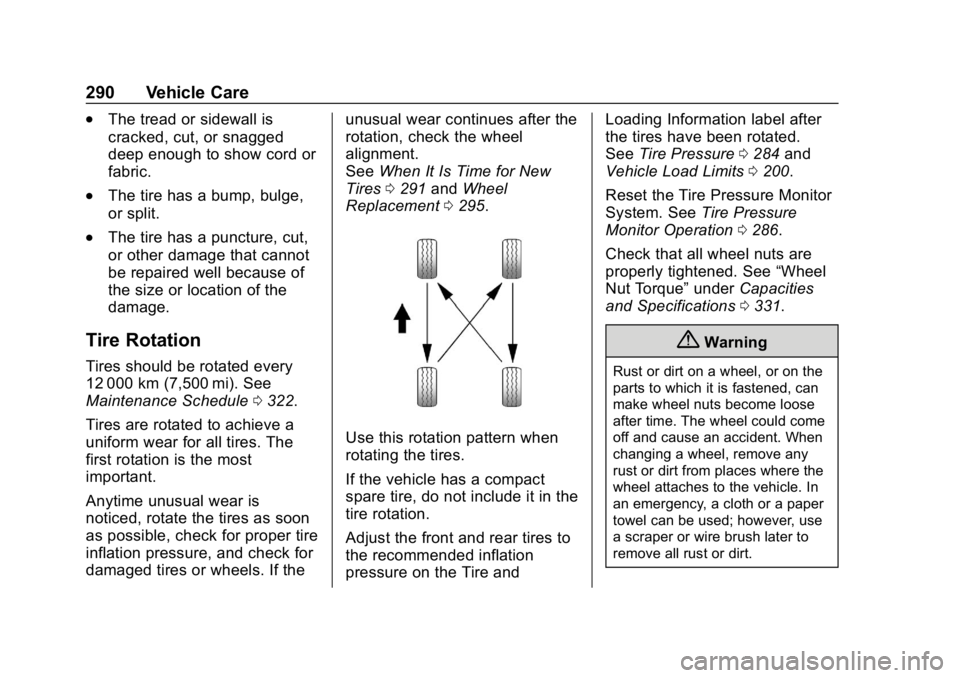
Use this rotation pattern when
rotating the tires.
If the vehicle has a compact
spare tire, do not include it in the
tire rotation.
Adjust the front and rear tires to
the recommended inflation
pressure on the Tire and Loading Information label after
the tires have been rotated.
See
Tire Pressure 0284 and
Vehicle Load Limits 0200.
Reset the Tire Pressure Monitor
System. See Tire Pressure
Monitor Operation 0286.
Check that all wheel nuts are
properly tightened. See “Wheel
Nut Torque” underCapacities
and Specifications 0331.
{Warning
Rust or dirt on a wheel, or on the
parts to which it is fastened, can
make wheel nuts become loose
after time. The wheel could come
off and cause an accident. When
changing a wheel, remove any
rust or dirt from places where the
wheel attaches to the vehicle. In
an emergency, a cloth or a paper
towel can be used; however, use
a scraper or wire brush later to
remove all rust or dirt.
Page 293 of 370
Chevrolet BOLT EV Owner Manual (GMNA-Localizing-U.S./Canada/Mexico-
11434431) - 2018 - crc - 2/14/18
292 Vehicle Care
GM strongly recommends
buying tires with the same TPC
Spec rating.
GM's exclusive TPC Spec
system considers over a dozen
critical specifications that impact
the overall performance of the
vehicle, including brake system
performance, ride and handling,
traction control, and tire
pressure monitoring
performance. GM's TPC Spec
number is molded onto the tire's
sidewall near the tire size. If the
tires have an all-season tread
design, the TPC Spec number
will be followed by MS for mud
and snow. SeeTire Sidewall
Labeling 0280, for additional
information.
GM recommends replacing worn
tires in complete sets of four.
Uniform tread depth on all tires
will help to maintain the
performance of the vehicle.
Braking and handling performance may be adversely
affected if all the tires are not
replaced at the same time.
If proper rotation and
maintenance have been done,
all four tires should wear out at
about the same time. See
Tire
Rotation 0290 for information
on proper tire rotation. However,
if it is necessary to replace only
one axle set of worn tires, place
the new tires on the rear axle.
Winter tires with the same speed
rating as the original equipment
tires may not be available for H,
V, W, and ZR speed rated tires.
Never exceed the winter tire's
maximum speed capability when
using winter tires with a lower
speed rating.
{Warning
Tires could explode during
improper service. Attempting
to mount or dismount a tire
(Continued)
Warning (Continued)
could cause injury or death.
Only your dealer or authorized
tire service center should
mount or dismount the tires.
{Warning
Mixing tires of different sizes
(other than those originally
installed on the vehicle), brands,
or types may cause loss of
control of the vehicle, resulting in
a crash or other vehicle damage.
Use the correct size, brand, and
type of tire on all four wheels.
{Warning
Using bias-ply tires on the
vehicle may cause the wheel
rim flanges to develop cracks
(Continued)
Page 294 of 370
Chevrolet BOLT EV Owner Manual (GMNA-Localizing-U.S./Canada/Mexico-
11434431) - 2018 - crc - 2/14/18
Vehicle Care 293
Warning (Continued)
after many miles of driving.
A tire and/or wheel could fail
suddenly and cause a crash.
Use only radial-ply tires with
the wheels on the vehicle.
If the vehicle tires must be
replaced with a tire that does not
have a TPC Spec number, make
sure they are the same size,
load range, speed rating, and
construction (radial) as the
original tires.
Vehicles that have a tire
pressure monitoring system
could give an inaccurate
low-pressure warning if non-TPC
Spec rated tires are installed.
See Tire Pressure Monitor
Operation 0286. The Tire and Loading
Information label indicates the
original equipment tires on the
vehicle. See
Vehicle Load Limits
0 200.
Different Size Tires and
Wheels
If wheels or tires are installed that
are a different size than the original
equipment wheels and tires, vehicle
performance, including its braking,
ride and handling characteristics,
stability, and resistance to rollover
may be affected. If the vehicle has
electronic systems such as antilock
brakes, rollover airbags, traction
control, electronic stability control,
or All-Wheel Drive, the performance
of these systems can also be
affected.
{Warning
If different sized wheels are used,
there may not be an acceptable
level of performance and safety if
(Continued)
Warning (Continued)
tires not recommended for those
wheels are selected. This
increases the chance of a crash
and serious injury. Only use GM
specific wheel and tire systems
developed for the vehicle, and
have them properly installed by a
GM certified technician.
See Buying New Tires 0291 and
Accessories and Modifications
0 256.
Uniform Tire Quality
Grading
The following information relates
to the system developed by the
United States National Highway
Traffic Safety Administration
(NHTSA), which grades tires by
treadwear, traction, and
temperature performance. This
applies only to vehicles sold in
the United States. The grades
are molded on the sidewalls of
Page 297 of 370
Chevrolet BOLT EV Owner Manual (GMNA-Localizing-U.S./Canada/Mexico-
11434431) - 2018 - crc - 2/14/18
296 Vehicle Care
Caution
The wrong wheel can also cause
problems with bearing life, brake
cooling, speedometer or
odometer calibration, headlamp
aim, bumper height, vehicle
ground clearance, and tire or tire
chain clearance to the body and
chassis.
Used Replacement Wheels
{Warning
Replacing a wheel with a used
one is dangerous. How it has
been used or how far it has been
driven may be unknown. It could
fail suddenly and cause a crash.
When replacing wheels, use a
new GM original equipment
wheel.
Tire Chains
{Warning
Do not use tire chains. There is
not enough clearance. Tire chains
used on a vehicle without the
proper amount of clearance can
cause damage to the brakes,
suspension, or other vehicle
parts. The area damaged by the
tire chains could cause loss of
control and a crash.
Use another type of traction
device only if its manufacturer
recommends it for the vehicle's
tire size combination and road
conditions. Follow that
manufacturer's instructions. To
avoid vehicle damage, drive slow
and readjust or remove the
traction device if it contacts the
vehicle. Do not spin the wheels.
If traction devices are used, install
them on the front tires.
If a Tire Goes Flat
This vehicle has self-sealing tires.
SeeSelf-Sealing Tires 0279. Tread
punctures typically will not cause
tires to lose air. However, if the
vehicle does get a flat tire, there is
no spare tire, tire changing
equipment, or place to store a tire.
Contact Roadside Assistance
for help.
It is unusual for a tire to blow out,
especially if the tires are maintained
properly. If air goes out of a tire, it is
much more likely to leak out slowly.
See Tires 0278. But if there is ever
a blowout, here are a few tips about
what to expect and what to do.
If a front tire fails, the flat tire will
create a drag that pulls the vehicle
toward that side. Take your foot off
the accelerator pedal and grip the
steering wheel firmly. Steer to
maintain lane position, and then
gently brake to a stop, well off the
road, if possible.
A rear blowout, particularly on a
curve, acts much like a skid and
may require the same correction as
Page 367 of 370

Chevrolet BOLT EV Owner Manual (GMNA-Localizing-U.S./Canada/Mexico-
11434431) - 2018 - crc - 2/14/18
366 Index
Security (cont'd)OnStar . . . . . . . . . . . . . . . . . . . . . . . 348
Vehicle . . . . . . . . . . . . . . . . . . . . . . . . . 48
Vehicle Alarm . . . . . . . . . . . . . . . . . . . 48
Self-Sealing Tires . . . . . . . . . . . . . . . 279
Service . . . . . . . . . . . . . . . . . . . . . . . . . 192 Accessories andModifications . . . . . . . . . . . . . . . . 256
Doing Your Own Work . . . . . . . . 256
Maintenance Records . . . . . . . . 329
Maintenance, General
Information . . . . . . . . . . . . . . . . . . 321
Parts Identification Label . . . . . 330
Publications Ordering Information . . . . . . . . . . . . . . . . . . 341
Scheduling Appointments . . . . . 338
Vehicle Soon Light . . . . . . . . . . . . 126
Service Electric Parking
Brake Light . . . . . . . . . . . . . . . . . . . . 127
Servicing the Airbag . . . . . . . . . . . . . 81
Settings . . . . . . . . . . . . . . . . . . . . . . . . 180 Energy . . . . . . . . . . . . . . . . . . . . . . . 140
Shifting
Into Park . . . . . . . . . . . . . . . . . . . . . . 206
Out of Park . . . . . . . . . . . . . . . . . . . 207
Side Blind Zone Alert (SBZA) . . . 231
Signals, Turn and Lane-Change . . . . . . . . . . . . . . . . . 154 Software Updates . . . . . . . . . . . . . . 161
Specifications and
Capacities . . . . . . . . . . . . . . . . . . . . . 331
Speedometer . . . . . . . . . . . . . . . . . . . 121
Sport Mode Light . . . . . . . . . . . . . . . 127
StabiliTrak OFF Light . . . . . . . . . . . . . . . . . . . . . 128
Start Remote . . . . . . . . . . . . . . . . . . . . . . . . . 39
Start Assist, Hill . . . . . . . . . . . . . . . . . 215
Starting and Stopping the Vehicle . . . . . . . . . . . . . . . . . . . . . . . . 205
Status Screens Charging . . . . . . . . . . . . . . . . . . . . . 240
Steering . . . . . . . . . . . . . . . . . . . . . . . . 195 Heated Wheel . . . . . . . . . . . . . . . . .110
Wheel Adjustment . . . . . . . . . . . . 109
Wheel Controls . . . . . . . . . . . . . . . 109
Stoplamps and Back-up Lamps Bulb Replacement . . . . . . . . . . . . 270
Storage Areas
Cargo Cover . . . . . . . . . . . . . . . . . . 106
Cargo ManagementSystem . . . . . . . . . . . . . . . . . . . . . . 107
Center Console . . . . . . . . . . . . . . . 106
Instrument Panel . . . . . . . . . . . . . 105
Storage Compartments . . . . . . . . . 105 Storing the Tire Sealant and
Compressor Kit . . . . . . . . . . . . . . . 303
Struts Gas . . . . . . . . . . . . . . . . . . . . . . . . . . . 267
Stuck Vehicle . . . . . . . . . . . . . . . . . . . 199
Sun Visors . . . . . . . . . . . . . . . . . . . . . . . 55
Symbols . . . . . . . . . . . . . . . . . . . . . . . . . . 3
System Forward CollisionAlert (FCA) . . . . . . . . . . . . . . . . . . 225
Systems
Driver Assistance . . . . . . . . . . . . . 221
T
TaillampsBulb Replacement . . . . . . . . . . . . 270
Teen Driver . . . . . . . . . . . . . . . . . . . . . 181
Text Telephone (TTY) Users . . . . 335
Theft-Deterrent Systems . . . . . . . . . 49
Immobilizer . . . . . . . . . . . . . . . . . . . . . 48
Time . . . . . . . . . . . . . . . . . . . . . . . . . . . . 114
Tires . . . . . . . . . . . . . . . . . . . . . . . . . . . . 278
All-Season . . . . . . . . . . . . . . . . . . . . 279
Buying New Tires . . . . . . . . . . . . . 291
Chains . . . . . . . . . . . . . . . . . . . . . . . . 296
Designations . . . . . . . . . . . . . . . . . 281
Different Size . . . . . . . . . . . . . . . . . 293
If a Tire Goes Flat . . . . . . . . . . . . 296
Page 369 of 370

Chevrolet BOLT EV Owner Manual (GMNA-Localizing-U.S./Canada/Mexico-
11434431) - 2018 - crc - 2/14/18
368 Index
W
WarningBrake System Light . . . . . . . . . . . 126
Caution and Danger . . . . . . . . . . . . . 2
Lane Departure (LDW) . . . . . . . 233
Warning Lights, Gauges, and Indicators . . . . . . . . . . . . . . . . . . . . . 118
Warnings Hazard Flashers . . . . . . . . . . . . . . 153
Washer Fluid . . . . . . . . . . . . . . . . . . . 261
Wheels
Alignment and Tire Balance . . 295
Different Size . . . . . . . . . . . . . . . . . 293
Replacement . . . . . . . . . . . . . . . . . 295
When It Is Time for New Tires . . . . . . . . . . . . . . . . . . . . . . . . . . 291
When to Charge . . . . . . . . . . . . . . . . 235
Where to Put the Restraint . . . . . . 89
Wi-Fi . . . . . . . . . . . . . . . . . . . . . . . . . . . 349
Windows . . . . . . . . . . . . . . . . . . . . . . . . 53 Power . . . . . . . . . . . . . . . . . . . . . . . . . . 53
Windshield Replacement . . . . . . . . . . . . . . . . . 267
Wiper/Washer . . . . . . . . . . . . . . . . . 111
Winter Driving . . . . . . . . . . . . . . . . . . . . . . . . 198
Winter Tires . . . . . . . . . . . . . . . . . . . . 279
Wiper Blade Replacement . . . . . . 266 Wipers
Rear Washer . . . . . . . . . . . . . . . . . .112
Wireless Charging . . . . . . . . . . . . . . 115
Wiring, High Voltage Devices . . . 271